
What if the “quiet quitting” echoing through your digital workspaces is actually a mathematical error in your leadership strategy? You’ve likely felt the subtle erosion of team momentum or watched with concern as rising turnover costs threaten to destabilize your organizational growth. It is a frustrating reality that many executives face when managing complex, global teams in an increasingly volatile market. Recognizing the early signs of a disengaged workforce isn’t just about maintaining morale; it is a critical diagnostic skill for any leader aiming to protect their strategic objectives in 2026.
I understand the pressure to maintain peak performance when traditional management tactics seem to be losing their efficacy. This article provides the executive roadmap you need to move beyond guesswork and into precision leadership. You’ll learn to identify the silent killers of productivity and use the Motivation Equation to systematically reignite team passion. We will walk through a clear diagnostic checklist and a strategic framework that turns re-engagement into a disciplined science, ensuring you improve retention and maximize your organizational ROI.
Key Takeaways
- Learn how disengagement acts as a silent tax on your organization, eroding productivity and stalling global growth.
- Master the executive checklist to identify the 12 behavioral signs of a disengaged workforce before they lead to costly turnover.
- Apply the Motivation Equation as a disciplined science to diagnose and resolve the root causes of team stagnation.
- Implement strategic stay interviews to move from reactive management toward a high-impact mentorship model.
- Recalibrate your leadership framework to transform a culture of quiet quitting into a high-performance engine for 2026.
Understanding the High Cost of a Disengaged Workforce
Stop viewing low morale as a simple HR inconvenience. It is a silent tax on your organizational growth, a friction that slows down every strategic move you make. In the high-stakes corporate environment of 2026, the distinction between “Quiet Quitting” and “Active Disengagement” is critical for your survival. While quiet quitters do the bare minimum to stay on the payroll, the actively disengaged can become a toxic force that works against your goals. Both are symptoms of a deeper structural failure.
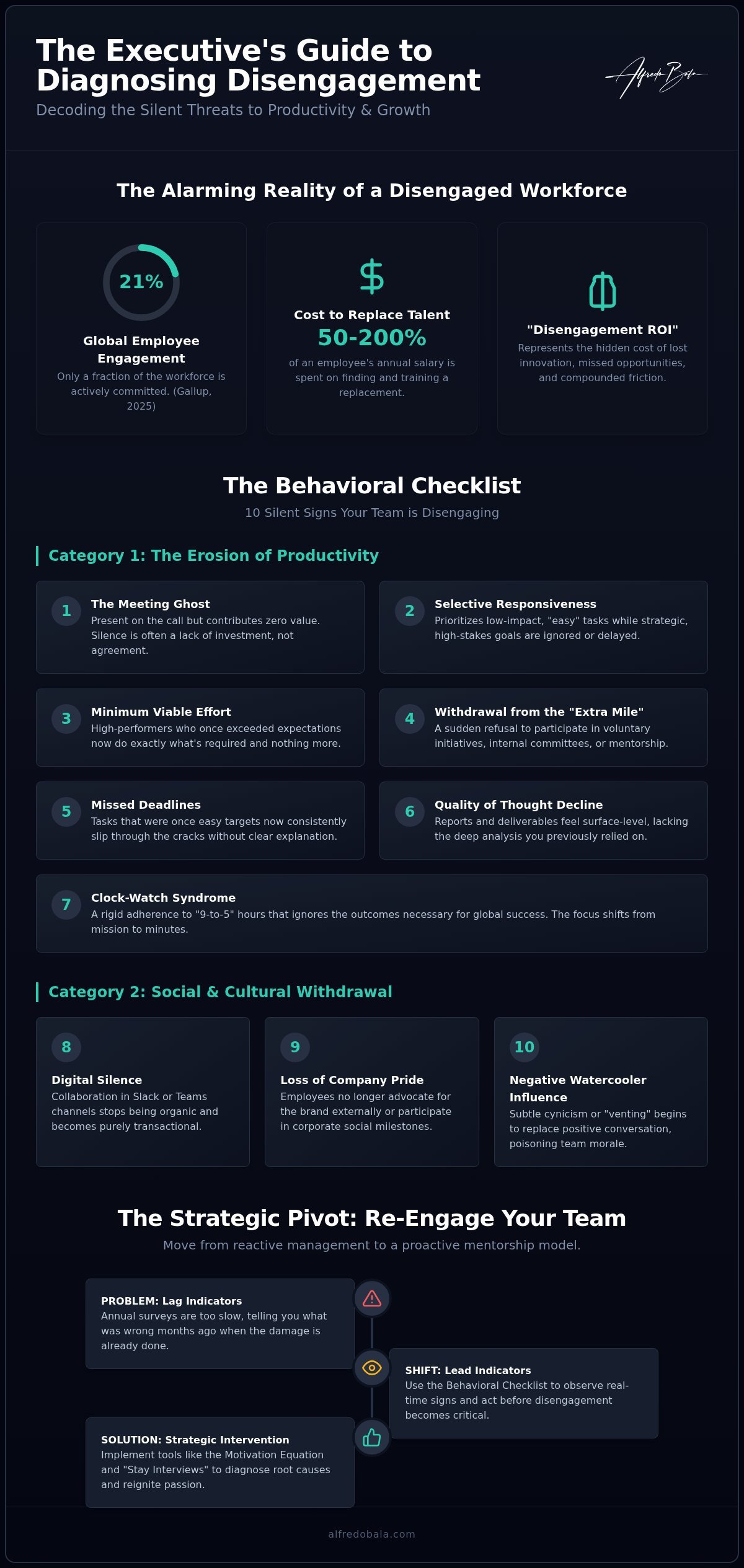
Retention is your most profitable strategy. With global employee engagement at just 21% according to Gallup’s 2025 report, the cost of replacing talent is staggering. Research indicates that replacing an employee costs between 50% and 200% of their annual salary. Ultimately, recognizing the signs of a disengaged workforce is a leadership responsibility. Disengagement is a signal that your current leadership framework needs recalibration, not a character flaw in your staff.
The Financial Impact: Beyond the Bottom Line
A single disengaged leader creates a ripple effect that can paralyze a global team. When executives lose their spark, the “Innovation Gap” widens. Employees stop offering new ideas and retreat into safe, mediocre routines because they no longer feel invested in the outcome. This lack of commitment results in a negative Disengagement ROI. Disengagement ROI is the hidden cost of lost opportunity and the compounded friction of missed potential.
Why Traditional Engagement Surveys Fail Executives
Most annual surveys are useless lag indicators. They tell you what was wrong six months ago, not what is happening today. Executives often fall victim to “Social Desirability Bias,” where HR reports look better than reality because employees are afraid to speak up. You must pivot toward lead indicators and direct behavioral observation. By identifying the real-time signs of a disengaged workforce, you can apply the Motivation Equation before the damage becomes irreversible and your best talent walks out the door.
The Behavioral Checklist: 12 Silent Signs of Disengagement
Identify the subtle patterns before they become permanent failures. Disengagement doesn’t always announce itself with a resignation letter; it often whispers through a slow erosion of standards. Recognizing the signs of a disengaged workforce requires you to look past surface-level metrics and observe the behavioral shifts that signal a loss of alignment. While Forbes highlights several signs of disengagement, executives must look deeper into the strategic impact of these behaviors. Use the following diagnostic checklist to evaluate your team’s current state.
Category 1: The Erosion of Productivity
Productivity is the first casualty of a fading spark. Watch for these seven indicators that suggest your high-performers are drifting into mediocrity:
- Sign 1: The Meeting Ghost. They are present on the call but contribute zero value. Silence isn’t always agreement; it’s often a lack of investment.
- Sign 2: Selective Responsiveness. You’ll notice them prioritizing low-impact, “easy” tasks while strategic, high-stakes goals are ignored.
- Sign 3: Minimum Viable Effort. High-performers who once exceeded expectations now do exactly what’s required and nothing more.
- Sign 4: Withdrawal from the “Extra Mile.” A sudden refusal to participate in voluntary initiatives or internal committees.
- Sign 5: Missed Deadlines. Tasks that were once easy targets now slip through the cracks without a clear explanation.
- Sign 6: Quality of Thought Decline. Reports and deliverables feel surface-level, lacking the deep analysis you previously relied on.
- Sign 7: Clock-Watch Syndrome. A rigid adherence to “9-to-5” hours that ignores the outcomes necessary for global success.
Category 2: Social and Cultural Withdrawal
When the emotional connection to the brand breaks, the social fabric of the team unravels. Observe these three cultural red flags:
- Sign 8: Digital Silence. Your Slack or Teams channels go cold. Collaboration stops being organic and becomes purely transactional.
- Sign 9: Loss of Company Pride. They no longer advocate for the brand externally or participate in corporate social milestones.
- Sign 10: Negative Watercooler Influence. Subtle cynicism or “venting” sessions that drain the energy of those around them.
Category 3: Professional Development Stagnation
A team that stops growing is a team that has already checked out. If you see these final two patterns, it’s time to refine your executive leadership development strategies:
- Sign 11: Interest Stagnation. A total lack of curiosity regarding mentorship, new certifications, or upward mobility opportunities.
- Sign 12: Unexplained Absenteeism. A spike in “personal time” or frequent, vague absences that disrupt the team’s rhythm.
Don’t wait for these behaviors to become your new cultural norm. To truly turn the tide and restore peak performance, you might need a fresh perspective from a seasoned leadership mentor who understands the mechanics of influence.
The Motivation Equation: Why Good Teams Lose Their Spark
Most leaders react to the signs of a disengaged workforce with surface-level fixes like office perks or generic recognition programs. These methods fail because they treat the symptom rather than the underlying psychological mechanics. To truly reignite a team, you must understand motivation as a disciplined science. Alfredo Bala’s “Motivation Equation” provides the strategic antidote to organizational drift. It moves beyond Transactional Engagement, where people work just for a paycheck, and builds Transformational Motivation, where individual ambition aligns with corporate vision.
If your team has lost its spark, you’re likely facing a mathematical failure in one of three areas. Gallup’s research on employee disengagement suggests that 70% of team engagement is attributable to the manager. This means your ability to balance the variables of the Motivation Equation is the single most important factor in your team’s success. You aren’t just managing people; you are managing the energy and belief systems that drive performance across your organization.
Breaking Down the Variables
Success requires a precise balance of three core factors. When one of these variables drops, you’ll see the immediate signs of a disengaged workforce emerge through lower productivity and stalled innovation. Use these benchmarks to diagnose where the connection has broken down:
- Value: This is the “Global Why.” If an employee cannot see how their daily grind contributes to a larger, meaningful mission, their effort will inevitably diminish. You must bridge the gap between their personal goals and the organization’s scale.
- Expectancy: This is the belief in success. When friction, bureaucracy, or lack of resources makes employees feel they “can’t win,” they stop trying. You must remove the obstacles that lower their confidence in reaching the finish line.
- Impulse and Delay: Long-term strategic goals are necessary, but they can lead to burnout if there are no short-term wins. Addressing the impulse for immediate gratification by celebrating incremental milestones prevents the exhaustion that occurs when the reward feels too distant.
The Leader’s Role as the Multiplier
Your energy as an executive is not neutral; it’s a force that either amplifies or negates the entire equation. If you lack conviction, even a high-value project will fail to inspire. The Motivation Multiplier is the executive’s ability to project certainty and purpose that increases the output of every team member. It’s about becoming the catalyst for a cultural turnaround. For a deeper dive into these mechanics, I recommend studying The Motivation Equation book, which serves as a masterclass in human performance and leadership strategy.
Strategic Re-engagement: Moving from Management to Mentorship
Transitioning from a manager to a mentor is the definitive shift required to reverse the signs of a disengaged workforce. Management is about oversight; mentorship is about elevation. When you stop policing activity and start fostering potential, you change the internal chemistry of your organization. This requires a disciplined, five-step framework designed to recalibrate the human element of your business strategy. Move beyond the transactional and start investing in the transformational.
- Step 1: Conduct Stay Interviews. Stop waiting for exit interviews to learn why your best talent is leaving. Ask your high-performers today what keeps them at the company and what could be improved to make their work more meaningful.
- Step 2: Recalibrate the Motivation Equation. Apply the framework of Value, Expectancy, and Impulse to individual team members. Diagnose whether a specific person lacks a sense of purpose or simply feels the path to success is blocked by friction.
- Step 3: Align Individual Growth with Corporate Scale. Show your team how their personal mastery directly fuels the organization’s global success.
- Step 4: Prioritize Autonomy. Micromanagement is the quickest way to extinguish a high-performer’s spark. Trust your people with the “how” once you have clearly defined the “what.”
- Step 5: Foster a Culture of Mastery. Invest in continuous leadership training. A team that isn’t learning is a team that is already checking out.
The Power of the Executive One-on-One
Your one-on-one meetings must evolve into high-impact strategic sessions. Replace the generic “How are you?” with precision-targeted questions like, “What is stopping you from doing your best work right now?” This shift forces a focus on systemic roadblocks rather than personal grievances. Active listening is your most potent tool here. In a global environment, your ability to hear what isn’t being said across a digital connection can be the difference between retention and resignation. It’s about spotting the signs of a disengaged workforce before they manifest as a drop in revenue.
Building High-Retention Global Teams
Managing across time zones and cultures demands a nuanced approach to connection. Use digital tools to facilitate collaboration, but remain vigilant against the exhaustion of “Zoom fatigue.” Engagement isn’t built through more meetings; it’s built through higher-quality interactions. If your organization needs a catalyst to reset this culture, consider booking a keynote speaker organizational growth expert to inspire your leadership tier. To begin this transformation today, you can schedule a consultation for executive team development and start applying these principles at scale.
Building a Culture of Peak Performance with Alfredo Bala
Peak performance isn’t a happy accident; it’s the result of a disciplined, scientific approach to human potential. Alfredo Bala understands that the signs of a disengaged workforce are more than just HR metrics; they are indicators of a broken leadership equation. Leveraging decades of global executive experience, Alfredo serves as the catalyst that helps organizations move from stagnation to scale. By applying The Motivation Equation, he transforms teams from passive participants into high-performance engines driven by purpose and clarity.
The journey from identifying the signs of a disengaged workforce to building a culture of mastery requires more than just internal policy changes. It demands a fundamental shift in how your leadership tier perceives influence. When the variables of Value, Expectancy, and Impulse are correctly balanced, the result is an environment where innovation is organic and retention is a natural byproduct of a shared vision. This is the hallmark of a legacy-minded organization.
Ignite Your Next Corporate Event
A high-impact keynote does more than just fill a slot in your schedule. It acts as a cultural reset for your entire company. Alfredo’s speaking engagements distill complex leadership strategies into actionable wisdom that resonates with everyone from front-line managers to C-suite executives. The ROI of professional leadership training is felt in the renewed energy and focused output of your team long after the event ends. You can book Alfredo Bala for your next leadership summit to start this transformation at your next gathering.
Strategic Advisory for the Modern Boardroom
In the boardroom, the stakes are higher and the complexity is greater. Alfredo offers strategic advisory and board-level insights that draw on his history of navigating multi-billion dollar global landscapes. A seasoned board advisor ensures that the organization maintains its focus on peak performance, even during periods of rapid transition or economic volatility. This high-level mentorship provides the clarity needed to align corporate strategy with individual entrepreneurial ambition.
Engagement is a choice leaders make every day. It’s a commitment to seeing the potential in your people and providing the framework they need to succeed. Whether through a transformative keynote or long-term advisory, the goal is always the same: to turn the “silent tax” of disengagement into a dividend of growth and personal mastery. The path to a high-performance future starts with a single, strategic decision to lead differently.
Lead with Legacy: Turning Disengagement into Peak Performance
Your ability to identify the signs of a disengaged workforce is the first step toward reclaiming your organization’s competitive edge. We’ve explored how disengagement acts as a silent tax on growth and how the Motivation Equation provides a scientific framework to restore alignment. By shifting your focus from oversight to mentorship, you empower your team to achieve personal mastery while driving global ROI. Success is never a matter of chance; it’s a matter of disciplined execution.
Drawing on 40 years of international leadership experience and my tenure as a former CEO of a global entity, I’ve seen how transformative a focused leadership reset can be. You don’t have to navigate this turnaround alone. It’s time to apply a proven methodology to your team development strategy and eliminate the friction stalling your progress.
Take the next step in your leadership journey and Master Team Motivation: Get “The Motivation Equation” Today. You have the tools to build a culture of peak performance. Now, you simply need to execute the plan. I’m here to help you turn your vision into a measurable success story.
Frequently Asked Questions
What are the most common signs of a disengaged workforce?
The primary signs of a disengaged workforce manifest as a shift toward transactional behavior. You’ll notice the “Meeting Ghost” who stays silent on calls or a sudden drop in the “quality of thought” in strategic reports. These aren’t just personality changes; they’re indicators that the emotional contract with your organization has been severed. When high-performers stop volunteering for the “extra mile,” it’s a clear signal that your leadership framework needs immediate recalibration.
How does employee disengagement impact company ROI in 2026?
Disengagement acts as a direct drain on your bottom line, costing U.S. employers approximately $1.9 trillion annually. For every disengaged employee, you lose roughly 34% of their salary in reduced productivity. In the high-stakes environment of 2026, these losses are compounded by the high cost of turnover, which can range from 50% to 200% of an annual salary. Engagement isn’t a “soft” metric; it’s a hard driver of your organization’s profitability.
Can a disengaged employee be re-engaged, or is it too late?
Re-engagement is absolutely possible, provided you address the root cause rather than the symptoms. It’s never too late to apply the Motivation Equation to diagnose why a team member has lost their spark. By recalibrating the Value they find in their work and removing the friction that lowers their Expectancy of success, you can reignite their passion. It requires moving from a management mindset to a mentorship model that honors their individual growth.
What is the difference between burnout and disengagement?
Burnout is a state of physical and mental exhaustion often caused by prolonged stress or over-commitment. Disengagement is a lack of emotional and strategic alignment with the company’s mission. While a burned-out employee might still care deeply but lack the energy to perform, a disengaged worker has simply stopped caring. Recognizing these distinct signs of a disengaged workforce allows you to apply the correct remedy, whether it’s rest or a mission-driven reset.
How do you measure employee engagement without using surveys?
You can measure engagement by observing lead indicators and behavioral patterns in your digital and physical workspaces. Monitor the frequency of organic collaboration in Slack or Teams and the level of participation in non-mandatory skill-building sessions. Analyze the “innovation gap” by tracking how many new ideas are coming from the team versus just fulfilling basic requirements. These real-time observations provide a more accurate picture than lag-heavy annual surveys ever could.
What role does leadership play in preventing a disengaged workforce?
Leadership is the primary architect of engagement, accounting for 70% of the variance in team scores. Your role is to serve as a “Motivation Multiplier” by clearly communicating the “Global Why” and removing systemic obstacles. If a workforce feels disconnected, it’s usually a signal that the leadership has failed to balance the variables of the Motivation Equation. Preventing disengagement requires consistent, active listening and a commitment to fostering a culture of mastery.
How can the Motivation Equation help fix team performance issues?
The Motivation Equation acts as a disciplined science for diagnosing and fixing performance gaps. It breaks down motivation into three measurable variables: Value, Expectancy, and Impulse. If a team is underperforming, you can systematically check if they don’t see the reward’s value, don’t believe they can successfully reach the goal, or are suffering from a delay in short-term wins. This mathematical approach removes the guesswork from executive leadership and provides a clear roadmap.
What should I do if my entire team seems disengaged?
If disengagement has become systemic across your entire team, you must initiate a cultural reset. Start by conducting “stay interviews” to understand the collective roadblocks. It’s often beneficial to bring in an external catalyst, such as a leadership keynote speaker, to provide a fresh perspective and reignite the team’s shared purpose. A total team reset requires you to be transparent about the challenges and decisive in your commitment to a new, high-performance standard.
 ES
ES  EN
EN
Comentarios recientes