
Gallup research indicates that managers account for at least 70% of the variance in team engagement scores. That makes leadership development too important to leave at the level of theory. The best leadership workshop ideas for managers turn real workplace challenges into practice, so participants can test their judgment, communication, and responses before they need those skills on the job.
If past workshops have felt generic or difficult to apply, the answer isn’t necessarily more content. Managers need relevant situations to work through, time to learn from one another, and a clear bridge from the session to everyday habits. A workshop should be a practice arena, not just a presentation.
In this guide, you’ll find 12 adaptable ideas to help managers strengthen feedback, coaching, trust, decision-making, and leadership through change. Each uses participation to explore common team challenges and turn learning into observable action. Choose activities that address the needs your managers face now, then build in follow-through so they can apply and refine what they practise.
Key Takeaways
- Choose workshop activities around a real leadership challenge, not a generic topic, to make practice relevant to managers’ daily work.
- Use psychologically safe role-play and reflection to build communication, feedback, and self-awareness without turning practice into public judgment.
- Match leadership workshop ideas for managers to the capability they need to strengthen, from team decision-making to coaching and delegation.
- Work with realistic, anonymized cases so managers can explore trade-offs and identify observable behaviors they can use on the job.
- Make learning stick with one behavior commitment per manager, a peer check-in, and a scheduled review after the workshop.
How to choose leadership workshop ideas that solve managers’ real challenges
A workshop can feel lively in the room and still leave managers leading exactly as they did before. What matters isn’t the number of activities or the energy in the session. It’s whether the practice addresses a real leadership challenge and gives participants a clear way to apply what they learn.
This roundup brings together 12 adaptable leadership workshop ideas for managers, grouped by the capability each one exercises: communication and self-awareness, judgment and problem-solving, coaching and delegation, and turning learning into everyday habits. Use the ideas as a menu, not a fixed program. The right choice depends on your managers’ needs, experience, team context, and how safely they can practise together.
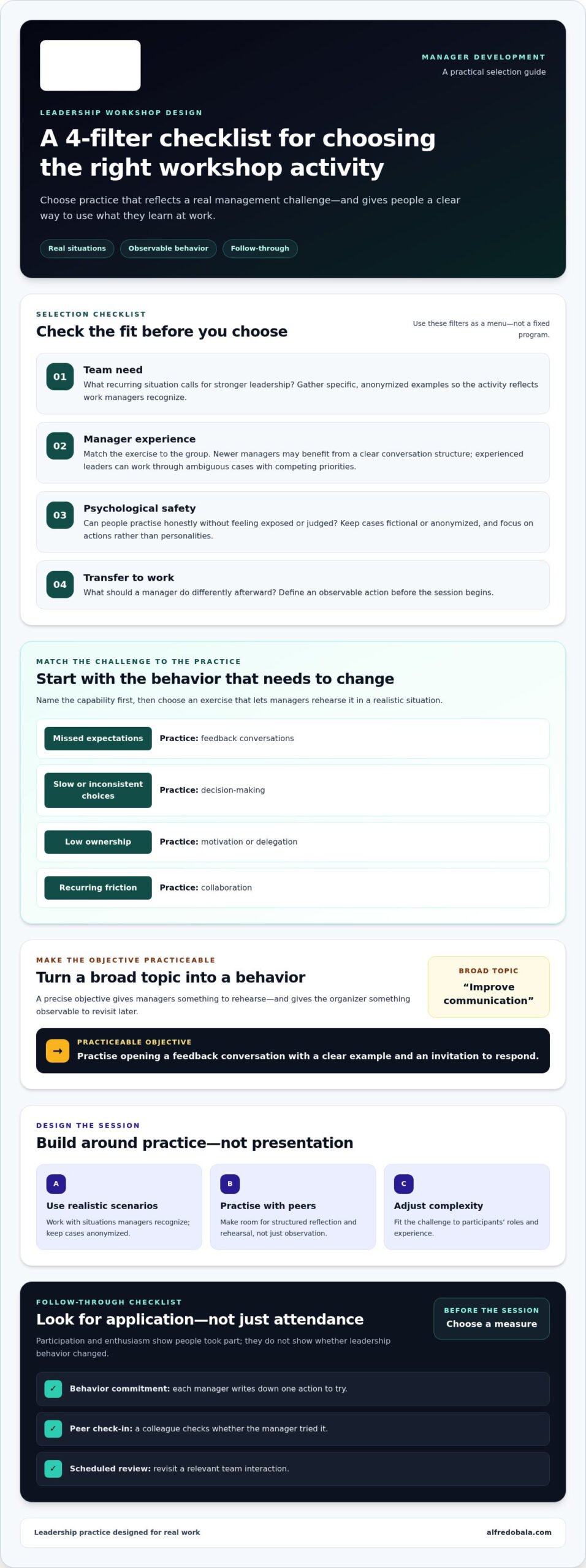
Leadership development can involve both individual growth and collective learning, as the broader process of leadership development reflects. To choose an activity that fits your team, apply four filters:
- Team need: What recurring situation calls for stronger leadership?
- Manager experience: Is the exercise suitable for new managers, experienced leaders, or a mixed group?
- Psychological safety: Can participants practise honestly without feeling exposed or judged?
- Transfer to work: What action should a manager take differently afterward?
Start with the leadership behavior the team needs to change
Name the capability before choosing the exercise. A team struggling with missed expectations may need feedback practice. Slow or inconsistent choices may point to decision-making. Low ownership may call for work on motivation or delegation, while recurring friction may require stronger collaboration. Gather a few specific, anonymized examples from managers so the workshop reflects situations they recognize, not hypothetical problems disconnected from their work.
Then turn the need into a practiceable objective. Instead of “improve communication,” try “practise opening a feedback conversation with a clear example and an invitation to respond.” A precise objective gives participants a behavior to rehearse and gives the organizer something observable to revisit later.
Design for participation, relevance, and follow-through
Build the session around realistic scenarios, structured reflection, and peer practice rather than long presentation blocks. Keep cases anonymized, and let managers rehearse choices without turning a colleague’s experience into a public example. Adjust the complexity to participants’ roles and experience. Newer managers may benefit from a clear conversation structure, while experienced leaders can work through ambiguous cases with competing priorities.
Decide how you’ll recognize progress before the session begins. Attendance and enthusiasm may show that people participated, but they don’t show whether leadership behavior changed. Choose a simple application measure, such as a written behavior commitment, a peer check-in on whether the manager tried it, or a scheduled review of a relevant team interaction. That follow-through connects workshop participation to action at work.
Leadership workshop ideas for communication, feedback, and self-awareness
Interpersonal skills improve through deliberate practice, not observation alone. These leadership workshop ideas for managers use familiar workplace situations to help participants try a behavior, reflect on its impact, and decide how to use it on the job. Keep scenarios fictional or anonymized, and focus discussion on actions rather than judging personalities. For broader context, explore these executive leadership development strategies.
Workshop idea 1: The listening and perspective-taking lab
Goal: Strengthen managers’ ability to understand a concern before responding. Pair participants and give them a realistic scenario, such as a team member raising a workload issue. One person speaks while the other listens without interrupting, then summarizes the concern and checks whether they understood it correctly. Partners switch roles and repeat the practice.
Adapt the scenario for a conversation with a direct report, a peer, or a cross-functional colleague. Keep the focus on listening behaviors, not on whether someone is a “good” communicator. Debrief: What did it feel like to be accurately heard, and which listening behavior will you use in your next team conversation?
Workshop idea 2: Feedback that moves work forward
Goal: Make feedback clearer, more respectful, and easier to act on. In small groups, turn vague statements such as “You need to communicate better” into a specific observation and a practical request. Managers then practise delivering the revised feedback and receiving it without immediately defending their intent.
Use fictional examples or let participants choose low-stakes scenarios, so no one is put on the spot about a real performance issue. The exercise works for feedback to direct reports and for raising concerns with peers. Debrief: Was the message clear and respectful, and what next action did both people agree on?
Workshop idea 3: Leadership blind spots through stakeholder perspectives
Goal: Help managers notice how one decision can affect people differently. Present a scenario, then ask participants to consider it from an employee’s, peer’s, and customer’s perspective. Have them separate observable actions, such as a decision being announced without consultation, from assumptions about someone’s motives or personality.
Invite groups to compare how each perspective changes the questions they’d ask before acting. Considering diverse input can strengthen the team decision-making process. Debrief: What perspective might you be missing, and what question could help you include it in a future decision?
Close by asking each manager to select one behavior to practise, rather than make a public pledge about personal shortcomings. For more practical leadership insights to support development conversations, explore leadership insights from Alfredo Bala.
Workshop activities that strengthen manager judgment and team problem-solving
Good judgment isn’t about getting every group to choose the same answer. It’s about making a decision people can explain: what they know, what they’re assuming, whose input matters, and how they’ll communicate the next step. These three leadership workshop ideas for managers let participants practise that process using fictional or anonymized cases, without putting real colleagues or sensitive situations on display.
| Workshop | Best-fit challenge | Group format | Observable learning outcome |
|---|---|---|---|
| Decision-room simulation | Competing priorities or incomplete information | Small teams | States a decision, assumptions, risks, and communication plan |
| Conflict mapping | Recurring disagreement or strained collaboration | Pairs or small groups | Opens a blame-free conversation and identifies a workable agreement |
| Change scenario planning | Uncertainty about a team or process change | Small teams, then full-group debrief | Plans clear communication and identifies what to listen for |
Workshop idea 4: The decision-room simulation
Best for: Managers who need to weigh urgency against incomplete evidence or competing team priorities. Give small teams a time-bound fictional scenario, such as a deadline conflict affecting two projects, and provide only part of the information at first. Ask each group to state its decision, key assumptions, risks, and plan for communicating with affected people. Then introduce a new piece of information and invite teams to revisit their choice.
Debrief: How did you balance speed, evidence, and input from the people affected? The learning isn’t which group made the “right” call. It’s whether managers can make their reasoning visible and adapt when circumstances change.
Workshop idea 5: Conflict mapping and resolution practice
Best for: Managers handling tension between colleagues or teams. Use a fictional disagreement, then map each party’s interests, the impact of the conflict, and any points of common ground. In pairs, practise opening a constructive conversation with neutral language, such as, “Can we compare what each team needs from this handoff?” Avoid assigning blame or treating assumptions as facts.
Debrief: What realistic agreement could both sides try, and when will they revisit it? Look for a specific next step rather than a promise that all tension will disappear.
Workshop idea 6: Leading through change scenario planning
Best for: Managers guiding teams through uncertainty. Give small teams a plausible change scenario and ask them to identify stakeholder concerns, what’s known, and what remains unknown. Have each group plan a sequence of manager communications that acknowledges uncertainty without promising outcomes beyond its control. Ask participants to name what they’ll listen for as the change unfolds, such as recurring questions, confusion about responsibilities, or emerging obstacles.
Debrief: Does the communication plan make space for honest questions, and how will the manager respond as new information comes in? Across all three activities, assess the decision process and next steps, not whether participants reached identical conclusions.
Practical leadership workshop ideas for coaching, motivation, and delegation
Managers strengthen ownership when they help people think, decide, and act, rather than stepping in with every answer. These three activities turn coaching, delegation, and motivation into skills participants can practise. Choose a scenario that reflects the team’s circumstances, then focus the debrief on the manager’s behavior and the employee’s opportunity to take responsibility.
- Select: Identify the capability to practise. Is the challenge that managers are solving too quickly, handing off work without clear decision boundaries, or relying on generic assumptions about motivation?
- Practise: Use a fictional workplace scenario and give participants clear roles. Ask observers to note specific actions, such as an open question or a clear outcome, rather than judge personalities.
- Follow up: Have each manager choose one behavior to apply in a real conversation, then set a peer check-in or review to reflect on what happened.
Workshop idea 7: Coaching conversations in rotating pairs
Goal: Practise guiding someone toward a useful next step without taking over. Give each manager a fictional performance challenge, such as a missed handoff or a stalled project. In groups of three, rotate the roles of manager, employee, and observer. The manager practises open questions and reflective listening, then works with the employee to agree on a next step.
Ask observers to describe what they heard or saw, such as whether the manager left space for the employee to consider options. Avoid rating anyone’s personality. Debrief: Which question helped the employee take greater ownership?
Workshop idea 8: Delegation by outcomes and decision rights
Goal: Make delegation clear enough to support autonomy. Present a scenario in which an employee owns a project but needs guidance on priorities or approval boundaries. Ask managers to define the intended outcome, relevant constraints, decisions the employee can make, and where support is available. Then role-play a progress check that invites updates without reclaiming the work.
Debrief: How can a manager stay informed while leaving responsibility with the employee? Look for clarity about decision rights and a check-in focused on progress, not control.
Workshop idea 9: Motivation mapping for managers
Goal: Explore what may support or hinder commitment in a specific team context. Give small groups a shared fictional scenario, such as a team facing shifting priorities, and ask them to identify relevant circumstances, possible concerns, and questions a manager could ask before acting. Don’t assume one incentive or slogan will motivate everyone.
Use ideas from The Motivation Equation as a starting point for discussion, without reducing motivation to a one-size-fits-all formula. Debrief: What would you ask team members to understand their perspective?
To build on these exercises, explore leadership insights from Alfredo Bala and choose one practical behavior to bring into your next manager conversation.
Turn leadership workshop ideas into manager habits that last
A workshop creates an opportunity to practise; what managers do afterward shows whether they’re applying the learning. Make the next step concrete: each person chooses one behavior, gets a peer check-in, and returns to review what happened. These final leadership workshop ideas for managers build a bridge from session insight to day-to-day action without promising that one activity will transform a team overnight.
Workshop idea 10: Cross-functional leadership challenge
Goal: Practise collaboration across team boundaries. Give mixed-role groups a fictional challenge that requires shared input, such as coordinating a project handoff with competing priorities. Rotate roles such as facilitator, questioner, and summarizer so managers practise coordination, listening, and shared accountability from different positions. Close by asking each participant to name one collaboration behavior they can test in current work, such as clarifying ownership before a handoff.
Workshop idea 11: The manager commitment and peer-coaching circle
Goal: Make individual practice visible and easier to sustain. Ask each manager to name one specific behavior to practise over the next month, such as asking a team member to suggest a solution before offering advice. Pair participants for a brief, structured check-in: What did you try? What happened? What will you adjust? Invite them to share evidence and reflection, not just whether they completed the commitment.
Workshop idea 12: From insight to a 30-day team experiment
Goal: Test a workshop insight on a small, low-risk scale. Each manager identifies one behavior to try with their team, a simple way to observe what happens, and a review date. For example, a manager might test a different format for gathering input in team discussions, then reflect on who contributed and what they learned. Treat the review as an opportunity to adjust, not a verdict on the manager.
Keep the follow-through sequence simple: record the behavior commitment before participants leave, schedule the peer check-in, and set a review date to discuss examples and lessons. Organizations can assess application through managers’ reflections, specific examples of what they tried, and observations of relevant workplace behavior. These signals show what’s being put into practice; they don’t guarantee a particular business outcome.
Alfredo Bala brings executive leadership experience as a former CEO and COO, alongside his work as an author and leadership expert. For broader perspective on applying leadership ideas to organizational growth, explore keynote speaker insights for organizational growth. To learn more about Alfredo Bala’s leadership work, explore his leadership insights and speaking.
Put one leadership behavior into practice
The strongest leadership workshop ideas for managers begin with a real team need and give participants a chance to practise the behavior that can address it. Choose activities that build communication, sound judgment, coaching, or collaboration, then make follow-through part of the design. One clear behavior commitment, a peer check-in, and a scheduled review can help managers reflect on what they tried and what they’ll adjust.
Keep the measure practical. Look for examples of workplace application and thoughtful reflection, not just attendance or enthusiasm in the room. Development takes sustained attention, but each intentional step gives managers an opportunity to lead with greater clarity and purpose.
Alfredo Bala brings leadership, team development, and executive advisory experience to his work. A former CEO of Mannatech Inc. and COO of Britt World Wide, he is also the author of The Motivation Equation. Explore Alfredo Bala’s leadership insights and speaking for perspective to support your organization’s development conversations. Choose one idea, adapt it to your managers’ needs, and invite Alfredo Bala to bring leadership insights to your organization through a speaking engagement.
Frequently Asked Questions
What are effective leadership workshop ideas for managers?
Effective leadership workshop ideas for managers give participants a chance to practise a real leadership behavior, reflect on what happened, and decide how to use it at work. Options include feedback role-play, decision simulations, coaching conversations, delegation exercises, and change scenarios. Start with a specific team need, such as unclear handoffs or difficult feedback conversations. Then end the activity with one practical follow-up action managers can try in their daily work.
How do you make a leadership workshop practical?
Build the session around a workplace challenge managers recognize, and give them time to practise rather than relying on extended presentations. Use realistic scenarios, rotating roles, peer observation, and focused debrief questions. For example, managers can practise giving feedback, then reflect on whether their message was specific and respectful. Before participants leave, ask each person to name one behavior to apply. A later check-in can help them discuss what they tried and what they learned.
How long should a leadership workshop for managers last?
The right duration depends on the objective, participants’ experience, and how much practice the session requires. A focused exercise on one skill may take less time than a session combining several scenarios, role-play, and reflection. Plan backward from the intended outcomes, leaving room to introduce the challenge, practise, debrief, and set an application commitment. Avoid packing the schedule with presentations if doing so leaves managers without enough time to rehearse the skills they need.
Can leadership workshops improve manager performance?
Leadership workshops can give managers structured practice and a chance to examine their decisions, but attendance alone doesn’t demonstrate lasting improvement. Application also depends on whether the activity fits the work and managers have support to use what they learned. Set an observable goal, invite each manager to try a behavior in a real situation, and schedule a review. Discuss examples of what they tried, what response they noticed, and what they might adjust next.
How do you choose the right leadership workshop for your team?
Choose an activity by identifying the leadership behavior or recurring workplace challenge that needs attention first. Consider participants’ roles, experience, and comfort practising together. Then compare ideas by relevance, participation, and the workplace action each one can support. For example, feedback practice may fit a communication need, while a decision simulation can help managers explore trade-offs. Use a realistic, anonymized scenario so participants can practise without exposing a colleague’s private situation.
What activities can managers use to practise leadership skills?
Managers can use role-play to practise feedback and coaching, case simulations to examine decisions, and stakeholder mapping to consider how change affects different people. Delegation exercises can clarify outcomes and decision-making boundaries, while peer-coaching circles can help managers reflect on applying a new behavior. Keep scenarios recognizable but anonymized. After each activity, ask participants what they noticed, what they would change, and which specific behavior they plan to carry into their work.
How can managers keep workshop learning from fading afterward?
Have each manager choose one behavior to practise in an upcoming work situation, then set a peer check-in and a review date. During the check-in, discuss what the manager tried, what got in the way, and what they learned from the response. A small team experiment can also help turn an insight into a practical test. Treat the review as a chance to reflect and adjust, not as proof that one workshop guarantees lasting change.
 ES
ES  EN
EN
Comentarios recientes