
Leadership development program ROI is measured by comparing the program’s tangible business benefits with its total costs. Subtract total cost from total benefits, divide the result by total cost, then multiply by 100 to express ROI as a percentage. The calculation matters because a positive learning experience alone doesn’t show whether the investment improved business performance.
That’s the challenge many organizations face: leadership development can feel valuable, but its contribution to retention, engagement, productivity, or other business outcomes can be hard to isolate. A credible leadership development program ROI evaluation connects learning to changes leaders can apply at work and outcomes the organization can track.
This article explains why measuring ROI matters, which business outcomes to assess, and how evaluation models distinguish participant reactions from workplace impact and financial return. It also outlines the costs and benefits to include, helping you build a fuller picture of what leadership development delivers and where its value comes from.
Key Takeaways
- Connect leadership learning to specific business goals, then track outcomes such as retention, engagement, safety, and productivity.
- Separate the program’s contribution from other factors by using clear baselines, consistent measurement, and realistic evaluation timelines.
- Use the Kirkpatrick and Phillips models to assess the journey from participant experience to learning transfer and financial return.
- Weigh direct and indirect program costs against tangible benefits, including changes in performance and employee retention.
- Build a more credible ROI calculation by defining what counts as a benefit and using a consistent method to compare benefits with total costs.
What business outcomes are influenced by leadership development?
Leadership development can influence employee engagement, retention, safety, productivity, and financial performance. To assess its business value, connect each learning objective to a priority the organization already tracks.
Connecting Learning to Business Goals
Connecting learning to business goals means turning a leadership skill into a workplace behavior linked to a measurable organizational priority. If retention is the priority, for example, participants might practice listening to and addressing team concerns while the organization tracks retention and engagement. This connection gives leaders a clear reason to apply what they learn and helps decision-makers assess whether the program meets a genuine business need.
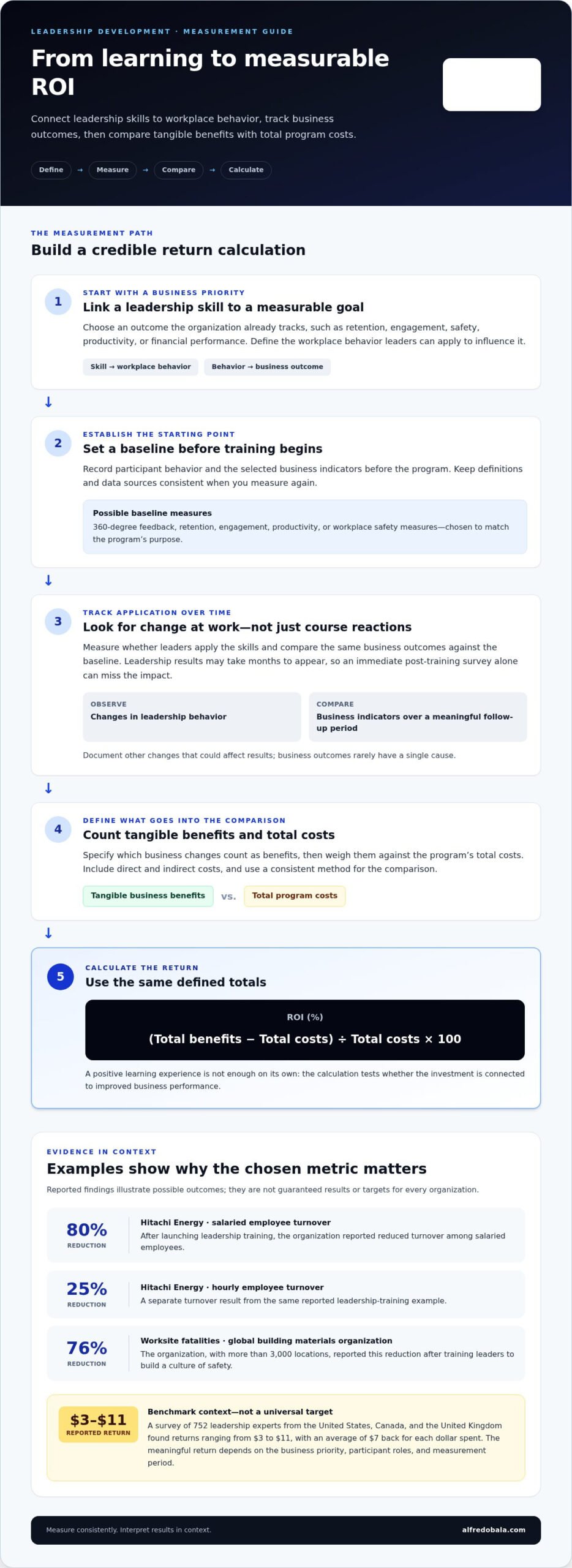
Typical benchmarks vary: a survey of 752 leadership experts from the United States, Canada, and the United Kingdom found returns ranging from $3 to $11, with an average of $7 back for each dollar spent. Treat that average as context, not a target for every organization. The business priority, participant roles, and measurement period shape what a meaningful return looks like.
Business Metrics and Performance Outcomes
Business metrics are observable measures that show whether leadership development aligns with changes in organizational performance. Choose indicators that match the program’s purpose, such as retention rates, engagement scores, productivity metrics, workplace safety, or financial performance. The right measures make learning outcomes visible in day-to-day work, rather than relying only on participants’ impressions of a course.
The potential links span both people and operations. Managers determine 70% of the variance in employee engagement, while organizations with top-tier leadership have nearly double the EBITDA of other organizations. After launching leadership training, Hitachi Energy reduced salaried employee turnover by 80% and hourly employee turnover by 25%. These examples show why metric selection should reflect the outcome the organization intends to influence.
Measuring Results Before and After Training
Before-and-after measurement compares participant behavior and business indicators against a baseline established before training. Companies can collect 360-degree feedback before and after a program, then examine retention, engagement, and productivity metrics alongside it. This combination helps distinguish changes in leadership behavior from changes in wider organizational outcomes.
Leadership-focused results may take months to appear, so an immediate post-training survey cannot capture the full effect. Compare the same measures over a meaningful follow-up period and consider relevant operational changes occurring at the same time. Employees were 3.5 times more likely to leave within a year when they perceived poor interpersonal skills in company leadership, making retention a useful outcome to monitor over time.
Reporting Business Results
Reporting business results means presenting the baseline, the measures tracked, the observed changes, and their relevance to organizational priorities. A concise report can pair participant feedback with 360-degree results and business indicators, then explain how each measure relates to the program’s intended outcome. That structure helps executives see what changed and where further attention may be useful.
Use concrete cases to make the connection clear. A global building materials organization with more than 3,000 locations reduced worksite fatalities by 76% after training leaders to build a culture of safety. In a survey, 87% of respondents reported higher employee satisfaction rates associated with leadership development, and 88% reported higher employee performance scores. Report such findings with their context, and separate association from proof of direct causation.
Challenges in measuring leadership development ROI
Leadership skills shape decisions across teams, but business results rarely have a single cause. A manager may communicate more clearly after training while sales, staffing, and customer demand also change. The challenge is to show a measurable connection without crediting the program for every improvement or overlooking the value of stronger leadership.
Attribution is difficult because workplace outcomes reflect several forces at once. For example, lower employee turnover could follow better manager conversations, revised compensation, or changing local hiring conditions. Compare outcomes across relevant periods and teams, then document major changes that could affect the results. This won’t isolate every cause, but it makes the reasoning more transparent.
Weak baselines create another barrier. If an organization starts collecting engagement or productivity metrics only after training, it has no reliable picture of the starting point. Set a baseline before participants begin, using the same definitions and data sources planned for follow-up. If “productivity” means completed work for one team but sales volume for another, the comparison won’t support a consistent conclusion.
Timing can distort findings, too. Leadership results may take months to appear, while employee surveys or quarterly business reports capture only a moment. An early skills assessment can show learning, but it can’t prove participants use those skills at work. Track application over time, interpreting short-term fluctuations alongside longer-term patterns rather than treating one result as the whole story.
Measurement also depends on what the organization asks participants and their teams. Self-reported confidence can reveal whether a person feels more prepared, but confidence alone doesn’t demonstrate improved ability. Pair feedback with observable examples, such as whether a manager gives clearer direction during team meetings or holds more consistent performance conversations. A structured 360-degree assessment can add perspectives from colleagues and direct reports.
Finally, inconsistent follow-through can break the link between learning and results. Participants need opportunities to practice new skills, and their managers can reinforce concepts, coach application, set expectations, and recognize improvement. Without that support, a program may build knowledge without changing daily behavior. Record participation, follow-up activities, and relevant business conditions so leaders can explain what happened and why.
For a sharper view of the people and leadership factors behind measurement, explore leadership development perspectives alongside your organization’s evaluation plan.
Kirkpatrick and Phillips evaluation models
Kirkpatrick and Phillips provide a structure for evaluating learning beyond participant satisfaction. Together, their levels trace a program from the training experience to workplace application, business outcomes, and financial return. The distinction matters: a positive reaction may signal relevance, but it doesn’t show that a manager changed behavior or improved results.
The four levels of the Kirkpatrick Model
The Kirkpatrick Model separates evidence into four levels, each answering a different evaluation question. Assess them as connected stages, not interchangeable proof: participant feedback can guide program improvements, while business measures show whether learning translates into organizational impact.
- Level 1, reaction: Evaluate participant experience and satisfaction. Feedback can show whether people found a session relevant, clear, and engaging, but favorable responses alone don’t demonstrate new skills.
- Level 2, learning: Assess participants’ gained knowledge or skill. A scenario-based exercise, for example, can test whether a manager can apply a newly taught coaching approach.
- Level 3, behavior: Evaluate how participants apply learning on the job. Observe whether managers use that coaching approach during real employee conversations.
- Level 4, results: Evaluate the training’s impact on performance or business outcomes. Connect workplace behavior to a relevant measure, such as engagement, retention, or productivity.
Each level answers a distinct question, so avoid using one result as a substitute for another. A participant may enjoy a workshop at Level 1 without retaining its content at Level 2. A knowledge check can demonstrate learning, but Level 3 requires evidence of application at work. Level 4 then tests whether those changes align with business performance. This progression helps an organization identify where the chain from learning to results strengthens or breaks.
Phillips adds a financial return level
The Phillips ROI Model adds Level 5, which evaluates financial return by comparing training benefits with total cost. This step translates business outcomes into financial terms, making it possible to judge whether measured benefits exceed the investment. For a leadership initiative, the calculation depends on identifying relevant benefits and accounting for the program’s total costs.
Keep the evidence sequence intact. If a manager attends training but doesn’t implement the skills, a projected financial benefit cannot be credited to workplace change. If behavior improves but the organization’s chosen business outcome doesn’t, Level 4 has not established that result. The models make those gaps visible before a final return is presented.
Timing matters, too. Evaluate whether participants apply what they learned at least nine months after training. This gives managers and participants time to establish new practices and provides a stronger basis for assessing workplace behavior. Use all five levels when the decision calls for a complete view, from participant response to financial return.
Leadership development program costs and benefits
Assess the full investment, not just the training fee. A balanced view weighs direct and indirect costs against measurable gains, such as retention, performance, and productivity.
Methods and Their ROI
Leadership development methods deliver stronger returns when participants practice relevant skills and apply them in their daily work. Coaching can help managers use what they’ve learned to address real team challenges, while follow-up and feedback reinforce action beyond a single session.
There’s no universal method that guarantees the best ROI. A single workshop or training session isn’t enough to fundamentally change how managers lead; ongoing application and manager support matter. Quality coaching also relates to retention: leaders who receive it are 1.5 times less likely to feel they need to change companies to advance.
Development experiences can support employee retention, too. High-potential employees are 2.4 times more likely to stay at companies that offer development experiences. Use this finding to weigh retention as a potential benefit, not as a promised result for every program or participant.
Organizations invest substantial resources in leadership development programs. In a survey of 752 leadership experts from the United States, Canada, and the United Kingdom, reported ROI ranged from $3 to $11, averaging $7 back for every $1 spent. These figures offer context, not a guaranteed return for an individual organization.
Factors Affecting Program ROI
Program ROI depends on design, delivery, and workplace conditions, all of which influence costs and benefits. Identifying these factors helps decision-makers understand why similar investments can produce different outcomes and where practical changes may improve value.
Include direct costs such as program design, facilitation, materials, and participant time. Also account for indirect costs, including time away from regular responsibilities and the manager effort required to reinforce learning.
Benefits may include improved performance, stronger productivity, reduced turnover, and better employee engagement. Convert outcomes into financial terms only when the organization can reasonably connect them to measurable value. Retention, for example, may reduce the costs of replacing employees, while improved team execution may contribute to productivity.
Manager follow-through is a decisive influence. Managers can reinforce concepts in daily work, provide coaching, set expectations for application, and recognize improvement. Without those actions, participants may learn useful skills but have limited opportunity to implement them. A study covering 20 organizations also underscores the relevance of examining program outcomes across organizational settings, rather than assuming one design fits every team.
Investing in leadership is most defensible when a program targets a business priority, its full costs are counted, and the organization tracks benefits over time. In mission-driven sectors, for example, building leadership capacity is often the foundation for shifting from nonprofit survival to sustainability. These conditions make comparisons more useful and clarify which elements merit continued investment.
How is leadership development program ROI calculated?
Calculate return by comparing a program’s tangible financial benefits with its total cost. The formula is: ROI = (total tangible benefits − total program cost) ÷ total program cost × 100. The result is a percentage, showing the net return relative to the investment, not simply the amount of benefit generated.
Start by defining the business outcomes the program aims to influence. If the goal is improved retention, for example, identify the measurable change and its financial value to the organization. Use a consistent period and compare results with a suitable baseline. This discipline helps prevent unrelated business changes from being counted as training benefits.
Next, calculate the benefits the organization can reasonably express in financial terms. Examples might include reduced employee turnover costs or measurable productivity gains. Connect each benefit to the relevant outcome and explain how you calculated its value. If an outcome can’t be translated into a defensible financial figure, track it as a business result, but leave it out of the tangible-benefit total.
Then include the complete program cost. Count direct expenses, such as program design and delivery, as well as indirect costs, such as participant time away from regular duties and manager support. Training ROI compares financial benefits with total costs, so omitting indirect costs can overstate the return. Apply the same cost boundaries across programs to make comparisons meaningful.
For a simple calculation, call total tangible benefits B and total program cost C. Subtract C from B, divide that difference by C, then multiply by 100. A result above zero indicates benefits exceeded costs in the period measured; a result below zero indicates costs were higher. Always report the underlying benefit and cost figures alongside the percentage.
Interpret the result with the evaluation evidence. The Phillips ROI Model adds Level 5 to assess financial return, while earlier Kirkpatrick levels examine reaction, learning, workplace behavior, and business results. This sequence helps test whether participants applied their skills before financial benefits are attributed to training. Leadership development outcomes may take months to appear, so timing and consistent measurement matter.
Make your next evaluation more strategic by connecting leadership priorities to practical business decisions. Explore leadership development insights to strengthen how you frame leadership and team outcomes.
Alfredo Bala (The Motivation Guy): The Motivation Equation
The Motivation Equation by Alfredo Bala (The Motivation Guy) offers a practical framework for thinking about motivation and leadership. For organizations connecting leadership development to business outcomes, its perspective can help clarify what leaders need to understand and apply with their teams.
Explore Alfredo Bala’s Leadership and Team Development Insights when shaping priorities around leadership, motivation, and organizational growth. His Speaking can also bring these themes into a broader leadership conversation. The value of development depends on how learning connects with the challenges leaders face and the actions they take at work.
To explore how these insights align with your leadership priorities, contact Alfredo Bala or visit alfredobala.com.
Turn Leadership Evidence Into Your Next Move
Treat leadership development program ROI as a decision tool, not the final measure of leadership’s worth. Use what your evaluation reveals to sharpen an organizational priority: where leaders need support, which behaviors deserve reinforcement, and what evidence should guide the next investment. That keeps development connected to the work people must lead, not simply to a report.
Build this discipline into regular leadership conversations. Examine a finding, identify what it means for managers and teams, and agree on a practical response. You might reinforce a useful practice, adjust the learning focus, or create more opportunities to apply new skills. Progress comes from acting on evidence and learning from the next measurement cycle.
Alfredo Bala’s The Motivation Equation, Leadership and Team Development Insights, and Speaking can inform conversations about motivation and leadership growth. If you’re ready to connect these perspectives with your organization’s priorities, contact Alfredo Bala. Take the next step with clarity, purpose, and a focus on lasting leadership impact.
Frequently Asked Questions
Why is it important to measure the ROI of leadership development?
Measuring ROI helps leaders decide whether to continue, adapt, or redirect an investment. It also creates accountability by linking development goals to decisions about people and business priorities. If a program aims to strengthen succession readiness, for example, assess whether participants are better prepared for expanded responsibilities. That evidence can help executives distinguish a useful development pathway from one that needs a different focus.
What metrics measure leadership development effectiveness?
Use a mix of learning, behavior, and organizational indicators. Alongside engagement or retention, consider whether managers hold more effective performance conversations, delegate decisions appropriately, or prepare employees for expanded roles. Track the same indicators across comparable groups or review periods, and record how each measure relates to the program’s purpose. A dashboard pairing behavior evidence with business outcomes gives leaders more context than a satisfaction score alone, and platforms such as westnetlearning.com can help organizations track corporate training activity and learner progress in one place.
What is the average cost of a leadership development program per employee?
A single per-employee average can obscure what an organization actually pays, because program design and delivery vary. To estimate a comparable figure, divide the full program cost by the number of participating employees. Include facilitator fees, learning materials, participant time, travel where applicable, and manager coaching time. Then compare that figure with programs serving similar roles and using similar delivery formats, rather than treating dissimilar programs as equivalent.
What are the risks and limitations of leadership training ROI calculations?
ROI calculations can overstate value when they assign every favorable business change to training. A stronger sales quarter, for example, may also reflect pricing changes, new products, or market demand. Financial estimates can also undercount benefits that are difficult to monetize, such as improved judgment or team trust. Document assumptions, separate observed outcomes from attributed benefits, and show decision-makers which estimates depend on interpretation.
How can organizations build a business case for leadership development?
Build the case around a specific organizational challenge, such as preparing successors for critical roles or improving coordination between teams. Describe the capability gap, identify the business consequence, and name an executive accountable for observing progress. Present expected program costs and the evidence that will inform a continuation decision. A clear business case also explains what leaders will do differently after training, not just what participants will learn.
 ES
 EN
Comentarios recientes