
Two-thirds of enterprises currently rank a lack of strategic alignment as their primary barrier to successful execution. You’ve likely felt this friction in your own boardroom, where brilliant minds retreat into departmental silos and competing agendas quietly derail the corporate vision. It’s a frustrating reality that turns high-level goals into a series of delayed decisions and missed milestones. Mastering effective team alignment strategies for executives isn’t just about scheduling more off-sites or quarterly reviews; it’s about shifting the internal culture from a collection of individual experts to a single, synchronized force.
I’ve spent over forty years navigating these exact complexities as a global CEO and COO, and I’ve learned that true synergy is a disciplined science, not a happy accident. This article will show you how to transform fragmented leadership into a unified powerhouse using the principles of the Motivation Equation and veteran executive advisory techniques. We’ll explore the shift toward real-time goal alignment, the critical role of human connection in 2026, and how to eliminate the strategic drift that stalls global growth. You’re about to discover a roadmap for faster execution and a leadership team that finally acts as a motivated, singular unit.
Key Takeaways
- Identify the “Hidden Tax” of leadership friction, including talent attrition and the delayed pivots that cripple global organizations.
- Apply the Motivation Equation to transition your C-suite from a collection of departmental experts into a unified, high-performance force.
- Implement proven team alignment strategies for executives that replace meeting-heavy tactics with a “motivation-first” approach to ensure genuine buy-in.
- Master the art of co-creating a “North Star” vision that fosters emotional ownership and eliminates the tactical silos that stall execution.
- Discover how board-level advisory acts as a strategic anchor to maintain leadership continuity and long-term synchronization across international markets.
The High Cost of Executive Misalignment in Global Organizations
Executive alignment is the rhythmic synchronization of vision, motivation, and execution at the C-suite level. It’s the difference between a high-performance engine and a collection of grinding gears. When your top-tier leaders aren’t in sync, you pay a “Hidden Tax” that bleeds the organization dry. This tax manifests as delayed pivots in a volatile market, the attrition of high-potential talent who tire of conflicting directives, and a brand identity that feels fractured to the global audience. Mastering team alignment strategies for executives is no longer a luxury; it’s a survival mechanism for the modern enterprise.
Most organizations attempt to fix these cracks with annual “alignment retreats.” These sessions often fail because they treat alignment as a temporary event rather than a continuous state of being. They focus on tactical checklists while ignoring the underlying motivation of each individual leader. True alignment doesn’t start with a shared spreadsheet; it begins when every executive’s personal ambition is harmonized with the corporate mission. Without that individual buy-in, any strategy you draft is destined to stall at the first sign of pressure.
The Velocity of Sync: Why Alignment Equals Speed
Stop settling for the slow, grinding process of consensus. Aligned teams bypass the friction of endless debate because they share a foundational clarity. They move with the “Speed of Trust,” while misaligned teams are weighed down by the “Drag of Bureaucracy,” where every decision requires a dozen meetings and a mountain of justifications. Executive sync is the ultimate competitive advantage for any organization aiming to dominate in 2026.
Signs Your Leadership Team is Drifting into Silos
Watch for the red flags before they become catastrophic failures. You might notice department-first thinking, where a VP prioritizes their own metrics over the company’s collective health. Look for “shadow strategies” or inconsistent messaging that leaves stakeholders confused. The psychological toll on middle management is immense; they feel the tremors of executive discord long before the C-suite acknowledges them. Beware of “polite misalignment,” where conflict is avoided to maintain a veneer of professionalism, but genuine buy-in is completely absent. Implementing robust team alignment strategies for executives is the only way to dismantle these silos and restore operational integrity.
- Department-first thinking: Leaders protect their own turf rather than the company’s “North Star.”
- Shadow strategies: Unofficial initiatives that drain resources and distract from the core vision.
- Inconsistent messaging: Different leaders telling different stories to the board and employees.
The Motivation Equation: The Foundation of Executive Alignment
Strategic sync is often treated as a logistical challenge, but it’s actually a psychological one. You can’t force a room full of high-achieving executives to march in the same direction simply by presenting a compelling slide deck. Real team alignment strategies for executives must address the internal engine of every leader. This is where the Motivation Equation becomes your most powerful tool. It’s a proprietary framework I’ve refined over decades to quantify why people do what they do, and more importantly, why they sometimes don’t.
The equation is a precise formula: (Expectancy x Value) divided by (Impulsiveness x Delay). When applied to a 2026 strategic plan, it reveals exactly where your alignment is leaking. If your CFO doesn’t have the Expectancy that the plan will succeed, or if your CMO doesn’t see the personal or professional Value in the outcome, their commitment will falter. A motivated executive is naturally an aligned one because their internal drive is finally pointed at the same target as the organization’s mission.
Deconstructing the Equation for Leadership Teams
Alignment fails when individual executive goals are at odds with corporate milestones. To fix this, you must analyze the denominator of the equation: Impulsiveness and Delay. In a world of constant digital distraction, “Impulsiveness” represents the shiny new projects that pull leaders away from the core strategy. “Delay” is the perceived time it takes to see results. If the payoff for your 2026 vision feels too distant, motivation drops and alignment dissolves into tactical silos. To dive deeper into these mechanics, explore The Motivation Equation: A Masterclass in Leadership and Human Performance.
Moving Beyond Compliance to Commitment
There’s a dangerous difference between executives who “agree” and those who are truly “aligned.” Compliance is a surface-level nod in a boardroom; commitment is a shared fire that survives the pressure of a crisis. When you use the Motivation Equation as a foundational framework, you create a self-correcting alignment culture. Leaders begin to monitor their own “Value” and “Expectancy” levels, catching misalignments before they manifest as operational friction. Shared motivation reduces the need for constant oversight because the team is driven by internal conviction rather than external pressure. For those ready to elevate their C-suite, seeking seasoned leadership and team development insights is the next logical step toward total strategic sync.
- Expectancy: The confidence that the team can actually deliver the 2026 goals.
- Value: The rewards, both corporate and personal, of achieving the vision.
- Impulsiveness: The tendency to get distracted by short-term wins or departmental “pet projects.”
- Delay: The time horizon for seeing the fruits of the strategic labor.
Strategic Sync vs. Tactical Silos: Why Meetings Aren’t Enough
Stop confusing activity with achievement. Many leadership teams fall into the trap of believing that a packed calendar equals a synchronized strategy. This “Meeting-Heavy” approach is a relic of 20th-century management that fails to account for the speed of the 2026 business environment. When you rely solely on meetings to create unity, you’re building a facade of alignment while deep-seated tactical silos continue to operate in the shadows. True team alignment strategies for executives prioritize a “Motivation-First” mindset, ensuring every leader is internally driven by the vision before they ever step into the boardroom.
Top-tier executives often check out during traditional alignment sessions because those meetings focus on granular status updates rather than high-level strategic pivots. They feel their time is being mortgaged for low-value information sharing. To fix this, you must implement radical transparency. When information flows freely through automated dashboards and shared narratives, the need for “update meetings” vanishes. This creates space for High-Impact Sync sessions that focus on solving complex bottlenecks and reinforcing the shared purpose that drives global success.
The Meeting Paradox: When Collaboration Kills Execution
There is a “Law of Diminishing Returns” in executive committees. The more people you involve in every minor decision, the slower your organization moves. If your C-suite spends more than 20% of their week in alignment-focused meetings, you aren’t collaborating; you’re drowning in bureaucracy. Use this checklist to determine if a meeting is necessary: Does it require real-time debate? Is there a clear decision-maker present? Does it directly impact the 2026 North Star? If the answer is no, move the conversation to asynchronous tools like shared strategic memos or real-time project tracking. This respects executive energy and keeps the focus on execution.
Building a Culture of Radical Strategic Clarity
Alignment requires a “Single Version of the Truth.” In global leadership, silos often form because different departments are looking at different data sets or interpreting the corporate vision through their own narrow lens. You must force cross-functional alignment by implementing shared KPIs that link departmental success to collective milestones. For example, if the CMO’s bonus is tied to the Sales team’s conversion efficiency, the silo between marketing and sales evaporates instantly. Sustaining this level of clarity requires robust executive leadership development strategies that teach leaders how to manage by influence rather than micro-management. When transparency is the default, alignment becomes the natural state of the team.
- Eliminate Status Meetings: Move updates to asynchronous dashboards to save boardroom hours for high-stakes decision-making.
- Force Cross-Functional KPIs: Tie executive incentives to shared outcomes to break down departmental walls.
- Adopt Radical Transparency: Ensure every leader has access to the same strategic data in real-time to prevent “information hoarding.”
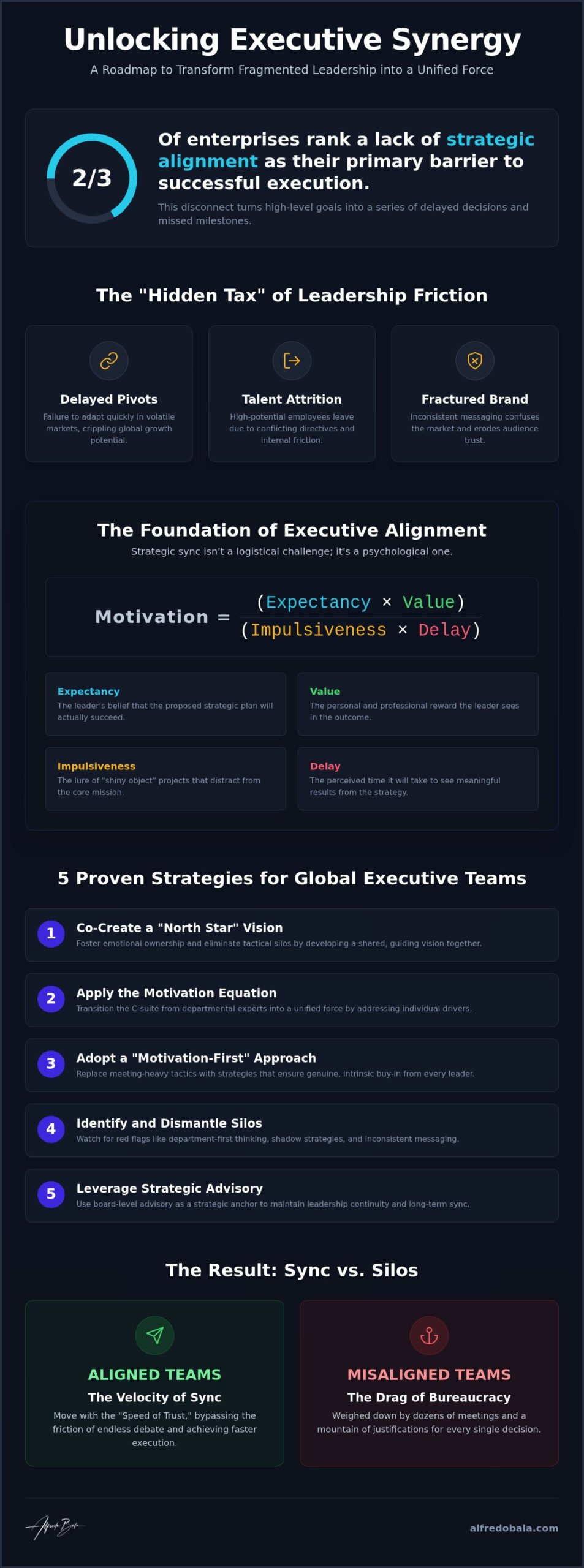
5 Proven Alignment Strategies for Global Executive Teams
Generic goal-setting is a recipe for mediocrity at the C-suite level. To achieve true strategic sync in 2026, you need a methodology that accounts for the complexity of global operations and the nuances of human motivation. These five team alignment strategies for executives are designed to move beyond checklists and into the realm of high-performance synergy.
- Strategy 1: Co-Creating the “North Star” Vision. Don’t just announce a destination; invite your leadership team to help map the route. This ensures emotional ownership, turning the corporate vision into a shared personal mission for every executive.
- Strategy 2: Implementing “Cascading Alignment.” Research shows that only 26% of employees currently understand how their work impacts company goals. You must bridge this gap by ensuring every directive flows seamlessly from the Board of Directors down to the front-line staff without losing its strategic intent.
- Strategy 3: The “Pre-Mortem” Alignment Session. Before launching a major initiative, gather your team to imagine the project has failed. Identifying potential friction points and departmental roadblocks early allows you to build a more resilient, unified plan.
- Strategy 4: Cross-Functional Rotations. Break down silos by moving high-potential executives into different departments. A CFO who has spent time in Operations develops a profound understanding of the trade-offs required for global success.
- Strategy 5: Leveraging External Advisory. Sometimes, internal politics make it impossible to see the path forward. A neutral third party can mediate divergent perspectives and provide the objective clarity needed to realign a drifting team.
Aligning Global Sales and Operations
Managing the friction between disparate regions, such as the US and Asia, requires more than just a shared spreadsheet. You have to maintain a unified brand voice while respecting diverse cultural leadership styles. I’ve launched dozens of global markets, and the blueprint for success always involves localized execution supported by a centralized strategic core. This balance ensures that your team alignment strategies for executives don’t get lost in translation as they cross borders. It’s about building a bridge between high-level strategy and regional reality.
The Role of the “Alignment Advocate”
Every executive team needs a neutral party to flag drift before it becomes a disaster. Whether it’s a Chief of Staff or an external consultant, this “Alignment Advocate” must be empowered to speak truth to power. They act as the guardian of the collective vision, ensuring that departmental interests never overshadow the corporate mission. For organizations looking to spark this transformation at scale, booking a Keynote Speaker for Organizational Growth provides the necessary catalyst for change. If you’re ready to solidify your leadership’s commitment, explore my leadership and team development insights to build a team that acts as a single, motivated unit.
Elevating Your Board and Leadership Through Strategic Advisory
Strategic sync is not a project with a start and end date; it’s a state of being that requires constant vigilance at the highest level. Board-level advisory acts as the “Alignment Anchor” for the C-suite, providing the weight and stability needed to keep the leadership team on course. Implementing team alignment strategies for executives at the board level provides the necessary gravity to prevent strategic drift. While the CEO manages the daily execution, a strategic advisor ensures that the long-term vision remains the primary driver of every decision. This oversight is what separates organizations that merely survive from those that dominate their industries.
Bringing a veteran perspective into a board seat offers more than just governance; it provides a blueprint for strategic continuity. My experience as a CEO and COO across global markets has taught me that boards often miss the subtle signs of executive drift until they manifest as poor quarterly results. Transitioning from a “Management Board” that focuses on historical data to a “Strategic Alignment Board” that focuses on future synergy is the most significant leap a leadership team can take. It shifts the focus from what happened to what is possible when every leader is perfectly synchronized.
Why Boards Must Prioritize Team Sync
The board’s role extends beyond financial oversight; it must actively prevent the formation of CEO-VP silos that stifle innovation. Board-level advisory can identify misalignment that a CEO, who is often too close to the operational fire, might overlook. By maintaining a high-level view of the organization’s health, the board ensures that team alignment strategies for executives are being practiced, not just discussed. For a deeper look at how this level of governance drives global impact, explore the Strategic Corporate Board Advisor pillar. It’s about creating a culture where alignment is valued as much as revenue.
Next Steps: Securing Your Leadership Alignment
Start your transformation by conducting a thorough alignment audit of your executive team. Ask the hard questions. Do we have a single version of the truth? Is every leader’s personal motivation tied to our 2026 milestones? Integrate the Motivation Equation into your next quarterly review to measure the “Value” and “Expectancy” levels of your C-suite. This isn’t a one-time fix; it’s a journey of continuous motivation. If you’re ready to transform your fragmented leadership into a unified force, book Alfredo Bala for an executive alignment session or board advisory today. Let’s build a team that acts as a single, motivated unit, ready to conquer the complexities of the global market.
Lead with Unrivaled Strategic Unity
Strategic synchronization is the lifeblood of a high-performing organization. It requires moving beyond the surface-level compliance of traditional meetings and into the deep emotional ownership defined by the Motivation Equation. By integrating these team alignment strategies for executives, you eliminate the “Hidden Tax” of departmental silos and replace it with a culture of radical clarity and rapid execution. The speed of your business in 2026 depends entirely on the speed of your leadership’s sync.
True alignment is a continuous journey that demands a global perspective and the wisdom of hard-won experience. Whether you’re refining your long-term strategic plan or seeking to stabilize your board’s governance, the path to unity begins with a commitment to human performance. As a veteran CEO and COO, and the author of The Motivation Equation, I’ve spent over 40 years transforming fragmented leadership into unified powerhouses across international markets.
Now is the time to bridge the gap between vision and reality. Elevate your leadership team with Alfredo Bala’s executive advisory and keynote speaking to secure your organization’s future. The potential for your team to act as a single, motivated unit is within reach; let’s unlock it together.
Frequently Asked Questions
What is the difference between team building and executive team alignment?
Team building focuses on social cohesion and interpersonal trust, while executive team alignment is the strategic synchronization of vision, motivation, and execution. One builds the relationship; the other builds the results. Alignment ensures that every C-suite leader is driving toward the same 2026 milestones with emotional ownership. It’s about moving from simply getting along to getting ahead as a single, motivated unit.
How often should an executive team meet to maintain strategic alignment?
Frequency depends on the pace of your market, but a monthly high-impact sync is the minimum standard for 2026. These shouldn’t be status update meetings. Instead, use them to address strategic bottlenecks and realign using the Motivation Equation. Supplement these with quarterly deep dives to review the North Star vision. Asynchronous tools should handle the daily data flow, leaving the boardroom for high-stakes decision-making.
Can The Motivation Equation be applied to remote or hybrid leadership teams?
Yes, the Motivation Equation is especially critical for remote and hybrid environments where physical presence is absent. You must actively manage Expectancy and Value to bridge the distance. Remote leaders are more prone to Delay and Impulsiveness due to digital silos. Applying these team alignment strategies for executives ensures that every leader feels connected to the corporate mission, regardless of their physical time zone or location.
What is the number one cause of misalignment among C-suite executives?
The primary cause is the Hidden Tax of departmental silos where leaders prioritize their own metrics over the company’s collective vision. This often stems from a lack of shared motivation. When executives don’t see how the global strategy aligns with their personal professional goals, they retreat into shadow strategies. This creates a fragmented leadership team that makes conflicting decisions, ultimately stalling the organization’s growth and execution speed.
How do you align an executive team that has conflicting personal agendas?
You must find the intersection between their personal ambitions and the corporate vision using the Motivation Equation. When an executive sees that the company’s success is the fastest vehicle for their own Value and growth, the conflict dissolves. It’s about shifting from a zero-sum departmental mindset to a collaborative one. If agendas remain fundamentally opposed, a neutral board advisor or external consultant can help mediate and realign the team.
How can a board of directors influence executive team alignment?
A board of directors acts as the ultimate alignment anchor by providing high-level oversight and strategic continuity. They can identify executive drift that the CEO might miss by focusing on long-term governance rather than daily operations. By holding a board seat, a veteran advisor ensures that the C-suite remains synchronized with the North Star vision. This prevents silos from forming between the CEO and the rest of the leadership team.
What role does a keynote speaker play in long-term organizational alignment?
A keynote speaker acts as a catalyst for change, providing the infectious energy and frameworks needed to spark a transformation. It isn’t just about a one-day event; it’s about establishing a shared language, like the Motivation Equation, that the team can use for years. High-impact speaking engagements create a moment of collective clarity that breaks through the noise of daily operations and resets the team’s strategic focus.
How do you measure the ROI of team alignment strategies?
Measure ROI through the velocity of strategy execution and the reduction of internal friction. Look for tangible markers like faster decision-making cycles, lower talent attrition at the leadership level, and consistent brand messaging across global regions. When you implement effective team alignment strategies for executives, you’ll see a direct correlation between leadership sync and the achievement of your 2026 corporate milestones. Reduced bureaucracy always leads to increased profitability.
 EN
EN  ES
ES
Recent Comments