
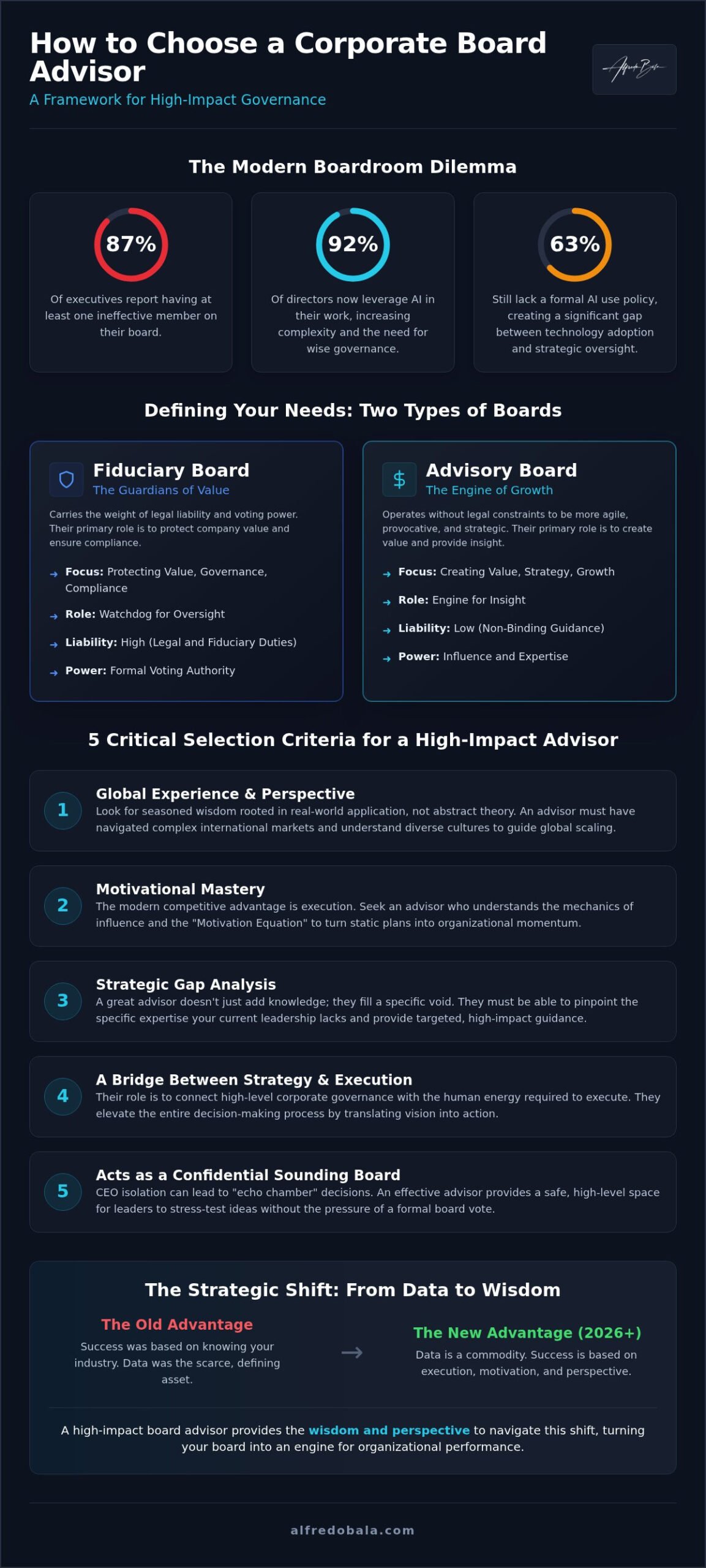
Did you know that 87% of executives report having at least one ineffective member on their board? In a high-stakes environment where 92% of directors now leverage AI yet 63% still lack a formal use policy, the gap between holding a seat and driving real value has never been wider. You’ve likely felt the stagnation of an echo-chamber boardroom while wondering how to choose a corporate board advisor who actually moves the needle. It’s a common struggle for leaders who find themselves caught between rigid legal compliance and the actual human mechanics of getting a company to move.
This guide will master the art of selecting a partner who does more than just monitor spreadsheets. You’ll learn to identify an advisor who understands that organizational success is both a disciplined science and a nuanced art of motivation. We’ll explore a clear framework for vetting candidates, clarify the vital distinctions between legal duties and strategic guidance, and show you how to build a board that bridges the gap between high-level governance and the human energy required to execute it.
Key Takeaways
- Distinguish between fiduciary liability and advisory agility to ensure your board remains both compliant and strategically nimble.
- Master the essential criteria for how to choose a corporate board advisor who possesses the rare blend of global experience and motivational mastery.
- Conduct a surgical gap analysis to pinpoint the specific expertise your current leadership lacks before initiating a targeted executive search.
- Leverage a proven framework to bridge the divide between high-level corporate strategy and the human energy required for global execution.
- Learn to integrate the Motivation Equation into your governance model to transform stagnant boardrooms into engines of organizational performance.
The Strategic Necessity of a Corporate Board Advisor in 2026
Strategic leadership in 2026 isn’t about having the most data; it’s about having the best perspective. A corporate board advisor acts as a strategic partner who provides non-binding but high-impact guidance. Unlike fiduciary directors, they aren’t bogged down by legal liabilities or voting protocols. Instead, they offer the clarity required to navigate a global market defined by trade fragmentation and rapid AI shifts. When you evaluate how to choose a corporate board advisor, you’re looking for a visionary guide who can see over the horizon.
There is a fundamental difference between the tactical nature of a consultant and the gravitas of a seasoned executive. A consultant brings a toolkit; a board advisor brings seasoned wisdom and a global perspective. They don’t just solve a single problem. They elevate the entire decision-making process by acting as a bridge between high-level strategy and individual entrepreneurial ambition. With 92% of board directors now utilizing AI for their work, the challenge isn’t accessing technology; it’s governing it with wisdom. This is why 2026’s global market volatility requires visionary guides rather than just technical experts.
Why Domain Expertise is No Longer Enough
Success used to be about knowing your industry better than anyone else. Today, data is a commodity that anyone can buy; the true competitive advantage lies in execution. What remains rare is an understanding of the mechanics of influence and the ability to motivate teams across disparate cultures. We’ve seen a massive shift from purely financial oversight toward a sophisticated human capital strategy. An Advisory board provides the specialized insight needed to manage these “soft” variables that produce hard results. The modern advisor serves as a bridge between high-level corporate strategy and individual entrepreneurial ambition.
The ROI of Strategic Advisory
CEO isolation is a silent killer of corporate momentum. It’s lonely at the top, and the pressure to perform for shareholders can lead to “echo chamber” decision making. An advisor provides a safe, high-level sounding board where leaders can stress-test ideas without the pressure of a formal board vote. This relationship is a cornerstone of effective executive leadership development strategies within the modern boardroom. Beyond the internal benefits, a high-impact advisor brings a network that opens doors for global scaling and fundraising. They provide the proprietary “Motivation Equation” necessary to turn a static plan into organizational momentum. Understanding how to choose a corporate board advisor means looking for someone who has lived the strategy they now advise on, ensuring their guidance is rooted in real-world application rather than abstract theory.
Defining Your Needs: Advisory Board vs. Fiduciary Board
Success requires knowing which tool to use for the job. A fiduciary board carries the weight of voting power and legal liability; they are the essential guardians of compliance and shareholder interests. In contrast, an advisory board operates without these legal constraints. This freedom allows them to be more agile, provocative, and strategic. When you evaluate how to choose a corporate board advisor, you must first determine if your organization needs a watchdog for oversight or an engine for insight.
Don’t fall into the trap of viewing an advisory board as a “lesser” body. It is often the most potent strategic asset a CEO possesses. While the fiduciary board manages the science of governance, the advisory board masters the art of growth. The relationship is complementary; a well-structured advisory board feeds the fiduciary board’s strategy with high-level guidance that hasn’t been filtered through a lens of personal liability. For a deeper dive into these distinctions, explore the strategic corporate board advisor and their role in driving global governance.
The Fiduciary Guardrails vs. The Advisory Engine
A fiduciary board focuses on protecting value, whereas an advisory board focuses on creating it. This distinction is vital for understanding the role of an advisory board in a complex 2026 market. You should move beyond a loose network of informal mentors and establish a formal advisory board when your company faces specific inflection points:
- Launching operations in complex international markets like China.
- Navigating a high-stakes leadership or CEO transition.
- Bridging the “AI governance gap” that currently affects 63% of boards.
- Scaling revenue and operations beyond the current team’s lived experience.
Structuring Your Advisory Board for Success
Structure dictates performance. When deciding how to choose a corporate board advisor, you must establish clear term limits, typically 12 to 24 months, to ensure the board remains fresh and relevant. Maintain a disciplined meeting cadence, usually quarterly, to prevent the group from becoming a social club. Compensation varies by stage; while startups often offer 0.1% to 1% equity, established firms may use cash retainers ranging from €500 to €3,000 monthly.
Decide whether you need a “Certified Chair” to facilitate rigid processes or a “Visionary Advisor” to spark strategic breakthroughs. Avoid governance bloat by keeping the group lean and focused on the specific gaps identified in your strategy. If you’re ready to transform your board from a compliance center into a growth engine, seeking a veteran who understands The Motivation Equation can provide the momentum your leadership team currently lacks.
5 Critical Selection Criteria for a High-Impact Board Advisor
Prestige is a poor substitute for performance. When you are evaluating how to choose a corporate board advisor, you must look beyond impressive resumes and focus on five specific pillars of impact. A high-value advisor doesn’t just fill a seat; they fill a strategic void. They bring the hard-won wisdom of someone who has already navigated the complexities you are currently facing.
- Proven Global Scale Experience: Have they actually been where you are going? An advisor who has scaled a company from $10 million to $500 million in domestic markets is different from one who has launched in 40 countries.
- Cognitive Diversity: Hire for what your current board lacks, not what it already has. If your board is heavy on finance, look for a specialist in the mechanics of global influence or human performance.
- High EQ and Gravitas: They must possess the emotional intelligence to challenge a CEO’s assumptions without creating destructive friction. This “gravitas” allows them to speak truth to power while maintaining trust.
- Alignment of Values: Reputation is a company’s most fragile asset. Ensure their personal brand and ethical framework enhance your own organizational culture.
- The Motivation Factor: They must understand how to move the people who move the numbers.
Mastering the Motivation Factor
Strategy is merely a document until people decide to execute it. This is why a top-tier advisor must understand the Motivation Equation to guide your team’s development. They act as a vital safeguard against executive burnout, providing frameworks that keep leadership teams energized through long-term scaling efforts. By applying these principles, an advisor uses The Motivation Equation to turn abstract strategy into tangible team momentum. They don’t just tell you what to do; they help you build the organizational culture that wants to do it.
Vetting for Global Cultural Intelligence
Generic “international business” experience is no longer sufficient in 2026. You need an advisor with deep cultural fluency, someone who understands that a strategy that works in Dallas will likely fail in Shanghai or Mexico City. This is particularly critical when navigating complex global markets like China or Latin America, where regulatory nuances and social dynamics dictate success. When considering how to choose a corporate board advisor for a global enterprise, prioritize those who have mastered the unique leadership dynamics of Direct Sales and Network Marketing. These industries require a sophisticated understanding of how to lead through influence rather than just authority, a skill set that is invaluable for any board operating in a fragmented, globalized economy.
The Executive Search: How to Vet and Onboard Your Advisor
Precision in selection is the difference between a decorative board and a functional one. When you are refining your process for how to choose a corporate board advisor, you must treat the search with the same rigor as a C-suite hire. It begins with a surgical Gap Analysis. You aren’t looking for a “good person”; you are looking for the specific missing piece in your board’s current lexicon. If your current directors are masters of risk management but struggle with human performance, your search must pivot toward a specialist in the mechanics of motivation.
Targeted outreach should bypass generic job boards entirely. In 2026, high-impact advisors are found through deep professional networks and executive circles. Once you identify potential candidates, move quickly to a “Pressure Test” interview. This is where you separate those who have read about leadership from those who have lived it. Assessing cultural alignment is the final hurdle. The energy of the advisor must match the momentum of the company; a mismatch here will lead to friction rather than acceleration.
The ‘Pressure Test’ Interview Questions
Move beyond the resume by presenting real-world problem-solving scenarios. Resumes are static; strategy is dynamic. Ask these high-impact questions to gauge their depth:
- “Tell me about a time you had to pivot a global strategy under extreme pressure while maintaining team morale.”
- “How would you address a board that has become an echo chamber for the CEO?”
- “Give me an example of how you used the Motivation Equation to solve a productivity crisis in a cross-cultural environment.”
Pay close attention to their “Listening to Speaking” ratio. A consultant often talks to prove their value, but a true advisor listens to understand the nuance before offering a guide. You want someone who guides the leadership team toward their own breakthroughs rather than someone who attempts to do the work for them.
Integration and Early Wins
Success in the first 90 days requires clear KPIs. Establish what an “early win” looks like, whether it’s a refined AI governance policy or a successful entry strategy for a new market. To avoid territorial friction, the CEO must introduce the new advisor to the C-suite as a strategic partner rather than an auditor. Formalize this relationship with a Board Charter that outlines expectations and meeting rhythms. If you are ready to stop guessing and start scaling, partner with an advisor who understands the science of business and the art of motivation.
Elevating Your Board with Alfredo Bala’s Strategic Vision
Transform your leadership from a functional role into a visionary powerhouse. When you finalize your criteria for how to choose a corporate board advisor, the search often leads to a rare archetype: the executive who has scaled mountains before teaching others the path. Alfredo Bala (The Motivation Guy) provides the essential link between high-level governance and the human mechanics of achievement. Having served as a former CEO who successfully navigated complex international markets, he offers a level of seasoned wisdom that abstract theory simply cannot replicate.
The true competitive advantage of securing a board seat for Alfredo Bala (The Motivation Guy) is the integration of The Motivation Equation into your strategic oversight. While traditional advisors focus on the “what” of a business plan, Alfredo addresses the “how” by aligning corporate objectives with the psychological drivers of the global workforce. This methodology turns static board directives into active momentum, ensuring that the strategies discussed in the boardroom actually resonate on the front lines of global execution.
A Visionary Guide for Global Growth
Scaling a multi-national entity requires more than just technical expertise; it requires a deep understanding of influence. Alfredo Bala (The Motivation Guy) leverages over 40 years of experience in global networking to help companies bridge the gap between their current state and their international ambitions. As a keynote speaker for organizational growth, he brings a unique energy to the boardroom, translating his lexicon of leadership into practical steps for the C-suite. He specializes in identifying the specific motivational blocks that prevent even the best strategies from taking root in diverse cultural landscapes.
Securing Your Board’s Future
Strategic drift is the greatest threat to long-term organizational health. By partnering with an advisor who is personally invested in your elevation, you create a safeguard against the “echo chamber” decision making that often plagues mature companies. Move beyond the science of business and embrace the art of human performance. We invite you to explore how the unique perspective of Alfredo Bala (The Motivation Guy) can invigorate your leadership team and secure your board’s future. Success in 2026 is a duality of disciplined science and nuanced art; ensure your board is equipped with both by booking a consultation to discuss an executive advisory role today.
Master the Art of Global Governance and Growth
The corporate landscape of 2026 demands a shift from passive oversight to proactive, strategic guidance. You now possess a clear roadmap for identifying the gaps in your current leadership and understanding how to choose a corporate board advisor who brings more than just a resume. By prioritizing cultural intelligence, emotional gravitas, and a proven framework for human performance, you position your organization to thrive amidst global volatility. The right advisor doesn’t just watch the numbers; they energize the people who make those numbers possible.
Alfredo Bala (The Motivation Guy) stands ready to serve as that transformative bridge for your boardroom. With over 40 years of global leadership and a history of scaling multi-billion dollar enterprises, he brings the proprietary insights of The Motivation Equation to every engagement. Whether you need an international keynote speaker to ignite your teams or a dedicated board seat occupied by a veteran executive, his expertise ensures your strategy is rooted in both science and art.
Secure a Strategic Visionary for Your Board: Contact Alfredo Bala (The Motivation Guy) to begin your organizational elevation. It’s time to move beyond the status quo and lead with the clarity and energy that your global mission deserves.
Frequently Asked Questions
What is the typical compensation for a corporate board advisor in 2026?
Compensation varies based on the company’s stage and the advisor’s experience level. For early-stage startups in 2026, advisors typically receive between 0.1% and 1% of equity, which usually vests over one to two years. More established firms often provide monthly cash retainers ranging from €500 to €3,000. Some models also include a revenue share of 5% to 15% on closed deals if the advisor’s role includes direct business development or networking.
How many advisors should a mid-sized company have on its board?
A mid-sized company should aim for a lean group of three to five advisors. This range provides a diverse set of perspectives without creating governance bloat or slowing down critical decision-making processes. When you’re determining how to choose a corporate board advisor, focus on filling specific knowledge gaps rather than just adding names. Quality always outweighs quantity when building a high-impact advisory engine for your leadership team and global strategy.
Is there a legal risk to having an advisory board alongside a fiduciary board?
The primary legal risk is the “shadow director” trap, where an advisory board begins making binding decisions that should belong to the fiduciary board. To avoid this, ensure your advisory board remains strictly non-binding and consultative. A formal Board Charter should clearly define their role as strategic guides rather than legal governors. This distinction protects the company from liability while allowing the advisory group to provide the provocative insights they were hired for.
Can a board advisor also serve as a leadership keynote speaker for the company?
Yes, many high-level advisors also serve as leadership keynote speakers to help align organizational culture with new strategies. Alfredo Bala frequently bridges this gap by providing board-level guidance and then delivering high-impact presentations to the broader team. This dual role ensures that the vision established in the boardroom is effectively communicated and motivated at the execution level. It’s a powerful way to turn abstract strategy into tangible organizational momentum.
How do I fire a board advisor who is no longer providing value?
Terminating an advisory relationship should be a professional, contract-driven process. Most effective advisory agreements include clear notice periods and specific term limits, typically 12 to 24 months. If an advisor is no longer providing value, reference the established Board Charter or engagement letter to initiate a clean break. It’s better to refresh the board with new expertise than to let a stagnant relationship drain your executive resources and distract from your primary growth goals.
What is the difference between a board advisor and an executive coach?
While both roles aim for improvement, their focus differs significantly. An executive coach works one-on-one with a leader to enhance personal performance and leadership skills. A corporate board advisor focuses on the organization’s strategic direction, market scaling, and global governance. When learning how to choose a corporate board advisor, look for someone with deep industry experience who can guide the company’s trajectory, rather than just an individual’s personal or professional growth.
How does ‘The Motivation Equation’ apply to board-level decision making?
The Motivation Equation acts as a proprietary tool for vetting the feasibility of strategic plans. Boards often fail because they ignore the human mechanics of execution. By applying this framework, directors can assess whether a proposed strategy includes the necessary incentives and clarity to drive team performance. It moves the conversation beyond just what the company should do and into the how of making the global workforce actually want to achieve those specific organizational milestones.
Should I choose a board advisor based on their social media following?
You shouldn’t choose an advisor based solely on social media metrics like follower counts. While a large following might suggest brand authority, it doesn’t guarantee the gravitas or lived experience needed for complex global governance. Prioritize candidates who have successfully navigated CEO roles or scaled international teams. True value comes from seasoned wisdom and the ability to apply frameworks like The Motivation Equation, not from the ability to generate viral content or digital engagement.
 EN
EN  ES
ES
Recent Comments