
Success in this industry often comes with a hidden tax: your time. If you’ve reached the upper echelons of your company only to find yourself trapped in a cycle of answering basic questions and micromanaging mid-level attrition, you aren’t leading a global empire; you’re running a high-stakes call center. True direct sales leadership training isn’t about teaching people how to sell. It’s about architecting a self-multiplying culture that thrives whether you’re in the room or on a flight to a new market launch.
You already know that what got you here won’t get you to the next level of global scale. The transition from a top earner to a visionary executive requires a fundamental shift in how you deploy influence and delegate authority. This blueprint promises to hand you the strategic frameworks and the exact Motivation Equation needed to break the management trap for good. You’ll learn how to translate local momentum into international growth while significantly reducing your personal workload. We’ll examine the specific leadership mechanics that turn high-potential distributors into autonomous global commanders, ensuring your business becomes a legacy that grows without your constant intervention.
Key Takeaways
- Identify and escape the “Management Trap” by shifting your focus from daily operational bottlenecks to mentoring a self-sufficient, high-performance volunteer army.
- Implement a structured framework for peak performance using The Motivation Equation to replace fleeting emotional hype with sustainable, measurable results.
- Transition from a top earner to a visionary executive through specialized direct sales leadership training that prioritizes strategic influence over individual sales instincts.
- Apply the “1% Rule” to international expansion to understand why smaller, focused markets often provide the most effective blueprint for global growth.
- Bridge the gap between field ambition and corporate excellence by leveraging high-level executive advisory and keynote speaking to solidify a legacy of leadership.
The Management Trap: Why Traditional Direct Sales Training Fails
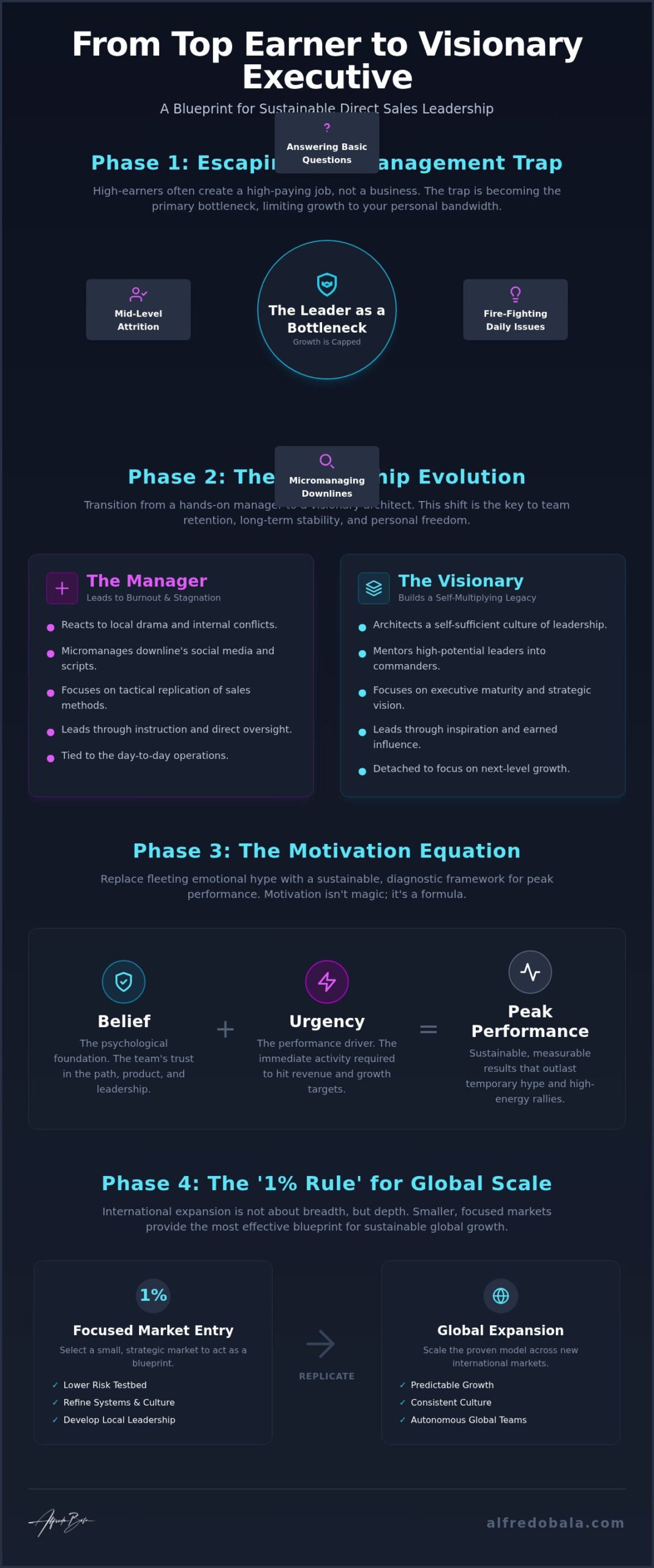
Many high earners believe they’ve built a business, only to realize they’ve actually created a high-paying job that consumes every waking hour. This is the Management Trap. It occurs when a leader becomes the primary bottleneck, spending their days fire-fighting instead of architecting growth. Traditional direct sales leadership training often misses the mark because it focuses on tactical replication rather than executive maturity. As we move into 2026, the industry is shifting away from fleeting hype and toward strategic autonomy and emotional intelligence.
Managing a volunteer army is fundamentally different from corporate oversight. You don’t have the leverage of a paycheck; you only have the power of your vision and the strength of your relationships. Visionary leadership acts as the antidote to high attrition by giving mid-level leaders a reason to stay that transcends the next commission check. Without this shift, your business will always be limited by your personal bandwidth.
Manager vs. Visionary: Identifying Your Current State
Are you a manager or a visionary? Managers often find themselves trapped in a cycle of answering basic scripts, micromanaging social media posts for their downline, and reacting to local drama. This constant state of reaction prevents you from seeing the bigger picture. It’s a recipe for burnout and stagnation.
Contrast this with visionary traits. Visionaries focus on culture building and mastering executive leadership development strategies. This shift isn’t just about personal sanity; it’s about team retention and long-term stability. When you provide a framework for growth, your leaders stop looking for the exit and start looking for the next market to conquer. You move from being a supervisor to becoming a catalyst for their success.
The Science of Influence in a Decentralized Organization
In a decentralized world, authority is an illusion. Success requires understanding the direct sales model as a system of voluntary cooperation rather than a top-down hierarchy. Building trust across geographic and cultural boundaries requires more than just a good product. It requires a deep commitment to the growth of others. You must lead through inspiration, not instruction.
Earned influence is the primary currency of modern networking success; it is the respect you garner by consistently delivering value and demonstrating character before demanding results. By focusing on this influence, you create a self-multiplying culture that doesn’t need your permission to thrive. This is the core of effective direct sales leadership training for the next generation of global executives who want to build a legacy that lasts.
The Motivation Equation: A Framework for Peak Leadership Performance
Motivation is often treated as a mysterious, fleeting spark that leaders must desperately try to keep alive. This is a fundamental misunderstanding of human performance. In my experience across four decades of global expansion, I’ve found that peak performance is the result of a precise, repeatable formula. This is what I call The Motivation Equation. While traditional direct sales leadership training often leans on emotional hype and high-energy rallies, true executive leadership requires a structured framework that survives long after the music stops.
Hype is a depreciating asset. It has a short half-life and requires constant re-injection from the top. A structured system, however, focuses on two critical drivers: Belief and Urgency. Belief provides the psychological floor, ensuring the team trusts the path and the products. Urgency provides the ceiling, driving the immediate activity required to hit revenue targets. When you understand these variables, you can stop guessing why a team is stalling and start diagnosing the specific missing component with surgical precision.
Breaking Down the Variables of Motivation
The first variable in the equation is the “Why.” This is not just a generic mission statement; it’s the alignment of an individual’s deep-seated goals with the organization’s broader vision. If a leader cannot articulate this connection, the team will eventually drift toward apathy. The second variable is the “How.” Strategy must make success feel attainable. Without a clear map, belief withers into frustration. My work in The Motivation Equation book provides a roadmap for this process, showing leaders how to balance these elements to create a self-sustaining engine of growth.
Implementing the Equation in Daily Leadership
To scale globally, you must move from delivering motivational speeches to building motivational systems. A system ensures that your team members can motivate themselves through the framework, even when you aren’t there to guide them. For example, during high-pressure sales cycles or complex new market entries, a leader using the equation doesn’t just yell louder. They identify if the team lacks the belief that the target is possible or the urgency to act now.
In a high-stakes environment like a global launch, the equation allows you to pivot your direct sales leadership training in real time. If urgency is high but belief is low, you provide more proof points and tactical support. If belief is high but urgency is low, you focus on the “Why” and the cost of inaction. This level of precision is what separates field managers from true global visionaries. If you’re ready to elevate your team’s output, mastering these mechanics of human performance is the first step toward long-term stability and international success.
Tactical Training vs. Strategic Leadership: A Comparison
Tactical training is a sprint; strategic leadership is the marathon. In the high-velocity world of networking, many organizations mistake activity for achievement. They focus on the latest social media algorithm or the perfect closing script, forgetting that tactics have a remarkably short shelf life. High-level direct sales leadership training must transcend these temporary tools to focus on the evergreen principles of influence and organizational design. If your growth depends on the latest viral trend, your foundation is built on sand. True scale requires a shift from teaching people what to do to teaching them how to lead.
Many top earners hit a glass ceiling because they lead by instinct. They possess a natural “gut feeling” for the business that served them well during their personal production phase, but instinct is notoriously difficult to replicate. When these leaders try to teach their teams, they often fail because they cannot codify their intuition into a repeatable system. To build a global empire, you must transition from being the “Hero” who saves every deal to the “Hero-Maker” who builds the systems that allow others to thrive without your direct intervention. This is the hallmark of a visionary executive. To facilitate this transformation, many organizations explore Business Thought Leader Speakers who can inspire and guide their leadership teams through the complexities of scaling.
Over-reliance on scripts and social media templates often results in “clone” organizations. These teams might see short-term gains, but they eventually lack the soul and authentic connection required for long-term loyalty. Furthermore, large-scale teams often suffer from “Tactical Fatigue,” where the constant pressure to master new digital tools leads to burnout and high attrition. Success in 2026 requires a sophisticated balance. You must integrate modern digital enablement with timeless leadership lessons from top executives. This creates a culture that is technologically advanced yet anchored in proven human psychology.
Building Strategic Autonomy in Your Downline
Strategic autonomy is the ultimate goal of direct sales leadership training. It means your leaders have the mental framework to make high-level decisions in your absence. Instead of giving them a map, you give them a compass. By teaching your downline how to think critically about market dynamics and team culture, you empower them to adapt your core strategies to local nuances. This is especially critical for international expansion, where a “one-size-fits-all” approach often fails. Through executive advisory and a robust feedback loop, you can shape a generation of leaders who don’t just follow orders, but actively contribute to the global growth of the enterprise.
Scaling Globally: The 1% Rule and International Expansion
Expanding into international territories in 2026 requires more than a translated website and a shipping partner. It demands a sophisticated understanding of regional dynamics and shifting regulatory landscapes. With the Asia-Pacific region holding 45.9% of the market share as of 2025, the opportunity for growth is immense, but so is the complexity. High-level direct sales leadership training must prepare you for the 1% Rule. This principle reveals why tiny, high-density nations often generate more sustainable volume than massive, sprawling countries. Success is found in the rapid transfer of belief within a focused demographic, not just geographic size.
Launching in markets like China requires a surgical approach to compliance and cultural alignment. You cannot simply export a Western model and expect it to thrive in a different social ecosystem. It’s about maintaining your core organizational identity while allowing local leaders the autonomy to adapt. This balance is the hallmark of a veteran global executive. Your direct sales leadership training must evolve to account for these nuances, ensuring that your message remains potent even when translated across diverse cultural boundaries.
The Blueprint for International Market Entry
Identifying high-growth triggers is the first step in geographic expansion. You look for regions with rising digital adoption and stable regulatory frameworks. Once identified, your priority is the selection and training of the “Foundational Five.” These are the local pioneers who will carry your culture into the new market. You must equip them with robust team retention strategies for network marketing that account for local labor trends and social norms. If your foundation is weak, the entire region will eventually collapse under its own weight.
Global Governance and Strategic Advisory
Maintaining brand consistency across dozens of countries is a monumental task. This is where the role of a corporate board advisor becomes indispensable. An advisor provides the high-level perspective needed to ensure local flexibility doesn’t turn into brand dilution. They guide the governance structures that protect your legacy while allowing for entrepreneurial innovation in the field.
The 1% Rule demonstrates that achieving deep market penetration in a focused demographic creates more sustainable global growth than a superficial presence across an entire continent. If you’re ready to take your organization to the world stage, securing executive-level advisory is the most critical investment you can make this year to navigate these complexities with confidence.
The Path Forward: Keynote Speaking and Executive Advisory
The journey from a top earner to a global visionary is a path few navigate alone. It requires a guide who has seen the view from both the field and the C-suite. Alfredo Bala serves as this bridge, distilling over 40 years of industry experience into actionable direct sales leadership training. Whether you’re a corporate executive looking to stabilize a volatile market or a field leader aiming for the next rank, the transition depends on your ability to apply high-level strategy to human performance. You don’t just need more information; you need the wisdom to deploy it effectively.
A high-level leadership speaker for corporate events does more than just energize a room for an afternoon. They provide the mental blueprints that your leaders will use for the next decade. This is about creating a lasting shift in the organizational DNA, moving from a culture of mere activity to a culture of strategic impact. When you bring this level of experience to your stage, you’re investing in the long-term stability of your entire network.
Bringing Global Wisdom to Your Next Event
There’s a profound difference between a typical motivational speaker and a strategic keynote. While hype fades by the time the attendees reach the parking lot, a strategic keynote provides the frameworks that drive measurable ROI. Professional keynote speaker organizational growth focuses on the mechanics of scale, teaching your team how to navigate the 2026 regulatory environment while maintaining explosive momentum. It’s about giving them the tools to solve complex problems without your constant intervention.
Customizing this training is essential for maximum impact. Field leaders need the tactical confidence to build global teams, while the C-suite requires the strategic foresight to support that growth through governance and infrastructure. By tailoring the message to the specific audience, you ensure that every level of the organization is aligned with the same vision of excellence. This alignment is what turns a group of talented individuals into a unified global force.
Securing Your Seat at the Table
For companies aiming for long-term dominance, a single event isn’t enough. Executive advisory and board-level consulting provide the ongoing guidance needed to navigate complex international expansions and shifting market sentiments. Engaging Alfredo for a board seat or a strategic advisory role brings a veteran perspective to your most critical decisions, ensuring your company’s trajectory remains upward even in uncertain times. This is how you build a legacy that survives market cycles.
The path forward is clear. To transition from managing a business to leading a movement, you must master the mechanics of human performance. Elevate your organization by embracing the Motivation Equation and integrating professional direct sales leadership training into your core growth strategy. The global stage is waiting; it’s time to lead with the clarity and authority your vision deserves.
Architecting Your Global Legacy
The global marketplace of 2026 doesn’t reward those who simply work harder; it rewards those who think strategically. To escape the management trap, you must pivot from being a tactical supervisor to a visionary architect of growth. By mastering the variables of Belief and Urgency within The Motivation Equation, you create a culture where leadership is decentralized and success is repeatable across every border.
Advanced direct sales leadership training is the catalyst that transforms a high-earning distributor into a legacy-building executive. As the author of The Motivation Equation and a former CEO with 40 years of network marketing leadership, I’ve seen that the difference between stagnation and scale is the quality of the systems you leave behind. It’s time to stop fire-fighting and start building a self-sustaining engine of international influence.
Take the first step toward executive mastery and book Alfredo Bala for your next global leadership event to bring this roadmap to your team. You have the ambition and the drive. Now, equip yourself with the strategic framework to lead at the highest level. Your global empire is ready for its visionary.
Frequently Asked Questions
What is the difference between direct sales management and leadership?
Direct sales management focuses on tracking activities and enforcing quotas, but leadership is about expanding influence and casting a vision. In a decentralized environment, you don’t have the leverage of a salary to compel action. You must lead through earned respect. Effective direct sales leadership training shifts the focus from managing tasks to mentoring people, ensuring your team stays committed because they want to, not because they have to.
How can the Motivation Equation improve my team’s retention rates?
Retention rates stabilize when the Motivation Equation is applied correctly. High attrition often happens because a distributor’s “Why” is no longer aligned with their daily “How.” By using this framework, you can diagnose whether a team member lacks a clear purpose or a viable strategy for success. Addressing these gaps ensures that your leaders feel both capable and inspired, which is the foundation of long-term organizational loyalty.
Can direct sales leadership training be applied to traditional corporate teams?
Absolutely. The principles of leading a “volunteer army” are the ultimate test of leadership. Corporate managers often rely on the authority of a paycheck, but direct sales leaders must rely on the power of influence. Traditional corporate teams that adopt these strategies find they can drive higher engagement and performance by treating employees with the same respect and motivational focus required in the networking profession.
What are the most common mistakes leaders make when scaling globally?
The most frequent error is trying to force a “one-size-fits-all” model onto diverse international markets. Leaders often ignore local cultural values or fail to account for specific regulatory changes, such as the 2026 commission caps. Successful global scaling requires a balance of brand consistency and local flexibility, where you empower foundational leaders in each country to adapt the core strategy to their specific geographic reality.
Is it possible to automate direct sales leadership training?
You can automate the delivery of information, but you cannot automate the transfer of belief. While AI tools and searchable micro-videos are excellent for tactical enablement, the strategic mentoring required for high-level growth still demands a human premium. Use digital platforms to handle the “what to do” while reserving your personal energy for the “how to lead” and the cultivation of organizational culture.
How much does it cost to hire a professional leadership keynote speaker?
Fees for professional speakers vary significantly based on their industry experience, global reach, and the specific requirements of the event. Rather than focusing solely on the price tag, savvy organizations look at the potential ROI of the engagement. A speaker who has served as a global CEO and authored foundational texts like The Motivation Equation brings a level of strategic depth that can transform a company’s entire trajectory.
What happens if my top leaders are resistant to new training frameworks?
Resistance is usually a sign that the “Belief” variable in the Motivation Equation is low. If your top leaders don’t see how the new framework solves their personal pains, like the Management Trap, they’ll stick to what they know. To overcome this, demonstrate how the new direct sales leadership training reduces their personal workload and creates a self-multiplying culture. When they see the path to greater freedom, resistance vanishes.
How do I choose between a tactical coach and an executive advisor?
Your choice depends on your current business stage. A tactical coach is ideal if you need immediate, short-term results on specific activities like social media scripts or closing techniques. An executive advisor, however, is essential if you want to build a sustainable global engine. Advisors focus on long-term governance, board-level strategy, and the mechanics of influence that allow you to step back from the daily operations.
 EN
EN  ES
ES
Recent Comments