
Did you know that 56% of people at work feel they have absolutely no influence over the decisions that affect them? When over half of your workforce feels sidelined during a transition, resistance isn’t just a hurdle; it’s a mathematical certainty. Most executives treat a pivot as a logistical puzzle, yet the most effective leadership strategies for organizational change recognize that the real battle is won in the human psyche. You’ve likely felt the frustration of a brilliant strategy stalling because the team simply didn’t buy in. It’s a costly experience that drains productivity and erodes the cultural foundation you’ve worked so hard to build.
You understand that leading through uncertainty requires more than just a boardroom memo. This guide provides the executive precision you need to master the motivational science of high-impact transitions. We’ll explore a repeatable framework, rooted in The Motivation Equation, to align your organizational goals with individual drive. You’re about to discover how to transform resistance into momentum and secure the long-term retention your organization deserves in 2026.
Key Takeaways
- Learn to distinguish between tactical change management and strategic leadership to provide the executive gravitas required for high-stakes transitions.
- Master leadership strategies for organizational change by applying The Motivation Equation to unlock team performance and individual drive.
- Identify and eliminate cultural blind spots by aligning your board of directors with executive-level advisory insights.
- Deploy the five pillars of high-impact leadership to replace organizational uncertainty with a clear vision and radical transparency.
- Shift from a one-time pivot mindset to building a permanently agile organization by institutionalizing proven motivational frameworks into your corporate DNA.
Why Leadership Strategies for Organizational Change Fail Without Executive Gravitas
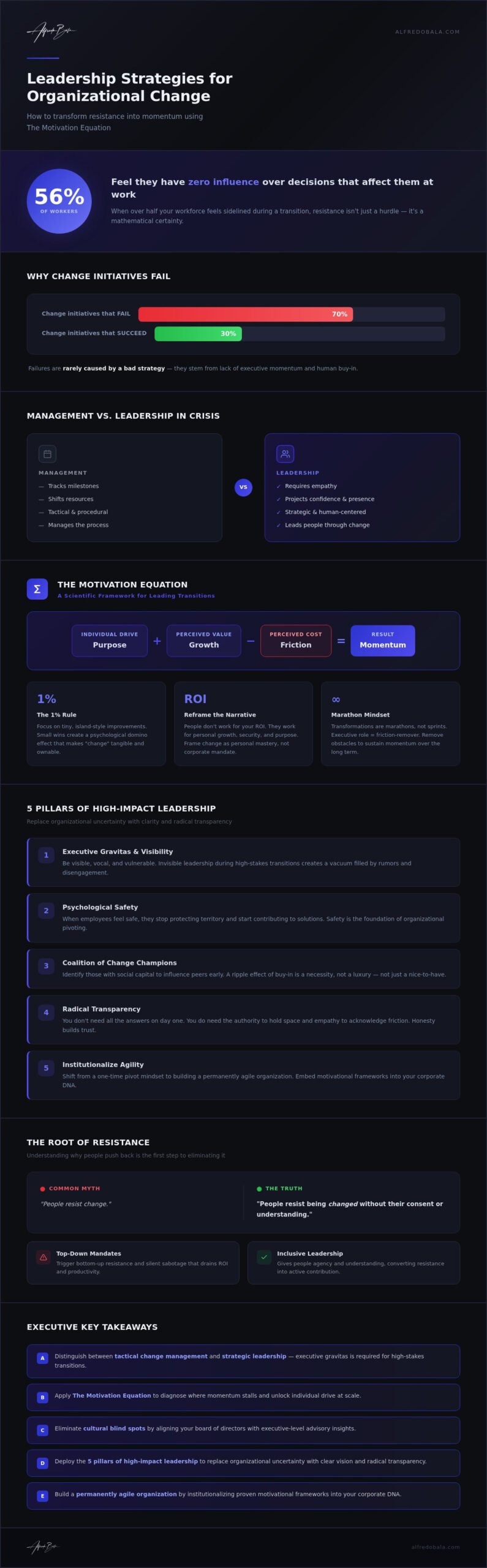
Stop treating organizational pivots like software updates. Most executives delegate the logistics of organizational change management to mid-level managers and wonder why the needle doesn’t move. The uncomfortable truth is that while change management is tactical and procedural, change leadership is strategic and human. You can’t manage your way out of a crisis; you have to lead people through it. When 70% of change initiatives fail, it’s rarely because the Gantt chart was wrong. It’s because the executive team lacked the momentum to sustain the shift. Without executive gravitas, even the most brilliant strategy feels like another “flavor of the month” initiative to your staff.
Leadership gravitas is the weight you carry into a room. It’s the silent assurance that the path forward, though difficult, is certain. This presence creates the psychological safety necessary for organizational pivoting. When employees feel safe, they stop protecting their territory and start contributing to the solution. Conversely, “invisible” leadership during a high-stakes transition is fatal. If you aren’t visible, vocal, and vulnerable, the vacuum will be filled with rumors, anxiety, and eventual disengagement. You must be the face of the future you’re trying to build.
Management vs. Leadership in Times of Crisis
Managing a process involves tracking milestones and shifting resources. Leading people requires empathy and a command of presence that stabilizes a shifting culture. During a transition, your team doesn’t just need a new workflow. They need to see a leader who projects absolute confidence, even when the final roadmap is still being drafted. This is the core of effective leadership strategies for organizational change. You don’t need all the answers on day one. You do need to show up with the authority to hold the space and the empathy to acknowledge the friction your team is feeling.
The Cost of Cultural Resistance
Disengaged teams don’t just slow down; they actively drain your ROI. When you rely solely on top-down mandates, you often trigger bottom-up sabotage. People don’t resist change; they resist being changed without their consent or understanding. Building a coalition of change champions early is a necessity, not a luxury. By identifying those who have the social capital to influence their peers, you create a ripple effect of buy-in. This is where The Motivation Equation begins to play a role, ensuring that individual drivers are aligned with the broader corporate mission to prevent the friction that grinds transitions to a halt.
The Motivation Equation: A Scientific Approach to Leading Transitions
Motivation isn’t something you hope for on a Tuesday morning; it’s a predictable outcome of specific variables. For an executive, relying on a team’s fleeting emotions to drive a pivot is a recipe for disaster. This is where The Motivation Equation becomes the definitive framework for high-level leadership. By treating human drive as a disciplined science rather than a vague feeling, you can quantify and replicate success across global teams. It moves the conversation from abstract “culture” to concrete “mechanics.”
One of the most powerful aspects of this scientific approach is the “1% Rule.” Instead of demanding a total overhaul overnight, focus on tiny, island-style improvements. These small, concentrated wins create a psychological domino effect. When a team sees a 1% gain in efficiency or alignment, the abstract concept of “change” becomes a tangible reality they can own. These small victories are the building blocks of global organizational wins, proving that the roadmap is working one step at a time.
Mastering the Mechanics of Influence
To succeed, your leadership strategies for organizational change must bridge the gap between individual entrepreneurial ambition and corporate strategy. People don’t work for your ROI; they work for their own growth, security, and sense of purpose. Use The Motivation Equation to diagnose exactly where momentum is stalling. Is it a lack of perceived value? Is the perceived “cost” of the change too high? When you craft a narrative that frames the transition as an opportunity for personal mastery rather than a threat to the status quo, resistance dissolves and is replaced by active contribution.
Driving Peak Performance Under Pressure
Transformations are marathons, not sprints. Your role as an executive is to act as a friction-remover for your team. If energy levels are dipping, it’s often because the “cost” variable in their internal equation has outweighed the “reward.” You can maintain peak performance by consistently highlighting the progress made through those 1% wins and ensuring the vision remains clear. For a deeper dive into these mechanics, explore The Motivation Equation: A Masterclass in Leadership and Human Performance. By mastering these variables, you move from pushing your team to pulling them toward a shared vision. If you’re looking to elevate your team’s output, a focused session on team development insights can provide the breakthrough you need.
Overcoming Cultural Resistance: The Executive Board Advisor’s Perspective
Cultural resistance is often the silent killer of even the best-laid plans. Most executives view it as an immovable object. It’s not. From the perspective of a seasoned executive who has sat in both the CEO and COO chairs, I’ve seen that cultural friction is usually a symptom of a disconnect between the vision at the top and the reality on the ground. Effective leadership strategies for organizational change require a bird’s-eye view that only the boardroom can provide. Board advisory services offer an essential external perspective, identifying the cultural blind spots that the C-suite is often too close to see.
One of the biggest objections I hear is that a company’s culture is “too rigid” for a major pivot. This is a fundamental misunderstanding of what culture actually is. Culture isn’t a static monument; it’s a strategic asset. When you align the Board of Directors with the executive team, you can reframe that “rigidity” as disciplined execution. You aren’t breaking the culture; you’re evolving it to meet a new market reality. This alignment ensures that the entire organization moves as one cohesive unit rather than a collection of fractured departments.
Strategic Governance and Growth
High-level oversight ensures that change initiatives don’t become expensive vanity projects. Every shift must be tied directly to long-term revenue drivers. A corporate board advisor plays a critical role here, acting as a neutral mediator during executive conflicts. When the C-suite is divided on the “how,” the board focuses on the “why.” This governance builds a culture of constant evolution. We want organizations that are perpetually agile, not just those that react to periodic crises. It’s about moving from a state of “fixing” to a state of “flourishing.”
Navigating Global Complexity
Leading change isn’t a one-size-fits-all endeavor, especially when you’re managing diverse international teams. What works in a North American headquarters might fail spectacularly in an emerging market due to different regulatory or cultural landscapes. I’ve spent over 40 years scaling global sales teams, and the lesson is clear: a global perspective is your best hedge against local resistance. By understanding the nuances of how different regions perceive authority and motivation, you can tailor your leadership strategies for organizational change to resonate across borders. This isn’t just about compliance; it’s about respect and strategic alignment on a global scale.
Executing Large-Scale Change with Precision
Equip the next tier of leaders to carry the torch. You cannot be everywhere at once, which is why you must leverage executive leadership development strategies to prepare your directors for the front lines. These individuals are the primary drivers of your leadership strategies for organizational change at the ground level. Training them to hunt for “quick wins” is essential for organizational morale. For instance, a 1% reduction in operational friction in a single department can serve as a powerful case study for the entire enterprise. This transition requires a fundamental shift from a fixed mindset to a growth mindset. You must be willing to learn in public, showing your team that evolution is a permanent state of excellence, not a temporary inconvenience.
Communication as a Keynote Event
Command the narrative at every opportunity. Treat every internal communication with the gravitas of a global keynote speech. Your team is bombarded with data, yet they are often starving for meaning. Use storytelling to bridge the gap between the status quo and the future state. When you speak with the authority of a veteran, you inspire the trust necessary for your people to follow you into the unknown. Strategic communication is the heartbeat of change. It provides the rhythm that keeps the organization alive during the most stressful transitions. By connecting daily tasks to a broader mission, you foster a sense of impact that transcends the spreadsheet. Bringing a seasoned perspective to your next event through professional speaking can ignite the momentum your organization needs to finalize this pivot.
Scaling Success: Integrating Change into the Organizational DNA
Abandon the outdated notion that a change initiative has a definitive end date. In the high-velocity environment of 2026, the goal isn’t to “finish” a transition; it’s to build a permanently agile organization. Many traditional models suggest a “refreezing” stage, but this creates a dangerous rigidity. Instead, you must integrate your leadership strategies for organizational change into the very fabric of your corporate culture. This means moving beyond the project roadmap and establishing a new standard for how your team operates, thinks, and evolves together. Change shouldn’t be an event; it should be your competitive advantage.
To institutionalize these gains, embed The Motivation Equation into your core corporate training programs. When every manager speaks the language of motivational science, you create a unified front that can diagnose and solve friction in real time. Reinforcing this new vision requires consistent, high-level engagement. Engaging a leadership speaker for corporate events serves as a powerful catalyst in this process. A veteran voice doesn’t just share information; it provides the infectious energy and hard-won wisdom that transforms a corporate mandate into a shared mission. Measuring the long-term ROI of these efforts goes beyond simple productivity metrics; it’s about the speed at which your organization can now pivot without losing its soul.
Building High-Retention, Motivated Teams
Retention is the ultimate metric of a successful change initiative. If you lose your best talent during a pivot, the “success” of the transition is an illusion. High-retention teams are built on the foundation of personal mastery. When you show your people that the organizational shift is a vehicle for their own professional elevation, you secure a level of loyalty that top-down mandates can’t buy. This is where the link between executive advisory and long-term health becomes undeniable. By prioritizing the growth of the individual, you ensure the resilience of the collective. A motivated team doesn’t just survive a change; they drive it.
The Future of Leadership in 2026
The next wave of challenges is already at the door. From the rapid integration of AI to shifting global trade dynamics, the variables of business are in constant flux. However, while the “what” of business changes, the “how” of human drive remains constant. The Motivation Equation is your anchor in this storm. It provides a repeatable framework that works regardless of the specific technology or market shift you face. As you look toward your next horizon, remember that leadership is an art of influence backed by a science of drive. To secure your organization’s future, engage Alfredo Bala for your next strategic transition and lead with the precision of a veteran executive.
Mastering the Art of Perpetual Agility
True leadership in 2026 requires a shift from managing static processes to mastering the fluid mechanics of human drive. You’ve seen that the most effective leadership strategies for organizational change aren’t found in a spreadsheet; they’re forged in the alignment of individual ambition and corporate vision. By applying the scientific precision of The Motivation Equation, you move beyond the “70% failure rate” and into a realm where pivots are executed with surgical accuracy. You’ve learned that cultural resistance is merely a signal of misaligned variables. With the right executive gravitas, you can transform that friction into unstoppable momentum.
The roadmap to a permanently agile organization is now in your hands. It’s time to move from theory to high-impact application. As the author of The Motivation Equation and a veteran who has spent 40+ years redefining leadership as a global executive and board advisor, I’m here to help you navigate your next high-stakes transition. Elevate your leadership with Alfredo Bala’s executive advisory and speaking services. Your organization’s highest potential is waiting for you to lead the way. Let’s build the future together.
Frequently Asked Questions
What is the most effective leadership style for organizational change?
The most effective style blends the gravitas of executive authority with the empathy of a mentor. It’s a strategic approach that prioritizes human performance over mere process management. By focusing on change leadership rather than change management, you create an environment where employees feel seen and valued. This style ensures that leadership strategies for organizational change are rooted in the science of drive, allowing for a transformation that is both sustainable and culturally aligned.
How do leaders overcome employee resistance to change?
Overcoming resistance begins with radical transparency and the creation of psychological safety. You must reframe the change as a personal opportunity for growth rather than a threat to the status quo. By using The Motivation Equation, you can identify specific points of friction where the perceived cost of change exceeds the reward. When you align individual entrepreneurial ambition with corporate strategy, resistance naturally dissolves as team members become active participants in the evolution.
What are the 5 key strategies for managing change in an organization?
High-impact transitions rely on five fundamental pillars to maintain momentum:
- Establishing a compelling vision
- Deploying radical transparency
- Empowering local leaders
- Incentivizing the right behaviors
- Maintaining a constant feedback loop
These pillars ensure that the strategy remains agile. Effective leadership strategies for organizational change focus on building a culture of constant evolution where the organization is perpetually ready to pivot without losing its strategic momentum or core identity.
How does the Motivation Equation help in corporate transitions?
The Motivation Equation serves as a diagnostic framework to pinpoint why momentum is stalling during a transition. It breaks down human drive into a disciplined science, allowing executives to quantify and replicate success. By analyzing variables like value, expectancy, and impulsiveness, you can adjust your leadership approach to remove friction. This scientific precision ensures that motivation remains a constant force, pulling the team toward a shared future state rather than pushing them through a process.
Why do most organizational change initiatives fail?
Research consistently shows that nearly 70% of change initiatives fail, primarily due to a lack of executive momentum and cultural misalignment. Most leaders focus on the tactical “how” while ignoring the motivational “why.” When the C-suite is invisible or delegates leadership to mid-management, the initiative loses its gravitas. Failure occurs when the human element is treated as an afterthought rather than the primary driver of the organizational transformation and long-term ROI.
Can a keynote speaker help with organizational change?
A seasoned keynote speaker acts as a powerful catalyst for organizational momentum. They provide the infectious energy and hard-won wisdom necessary to move a team from skepticism to active buy-in. By treating internal communications as high-stakes events, a speaker can bridge the gap between current reality and future potential. This professional engagement reinforces the executive vision, providing the global perspective needed to ignite the spirit of innovation across a diverse, international workforce.
What is the role of a corporate board advisor during a merger?
During a merger, a corporate board advisor provides an essential external perspective to identify cultural blind spots that the internal team might overlook. They act as a neutral mediator, ensuring that the Board of Directors and the executive team remain aligned on long-term revenue drivers. This advisory role is critical for navigating global business strategies and regulatory complexities, turning potential friction between merging entities into a cohesive, strategic asset for the new organization.
How do you maintain team performance during a digital transformation?
Maintaining performance during digital shifts requires protecting your team’s focus and prioritizing continuous upskilling. You must ensure that the reward of adopting new technology is clearly defined and outweighs the cost of the learning curve. By utilizing leadership insights to remove operational friction, you can foster a growth mindset. This approach prevents productivity loss by treating the transformation as an opportunity for personal mastery, keeping the team motivated despite the inherent uncertainty of technical change.
 EN
EN  ES
ES
Recent Comments