
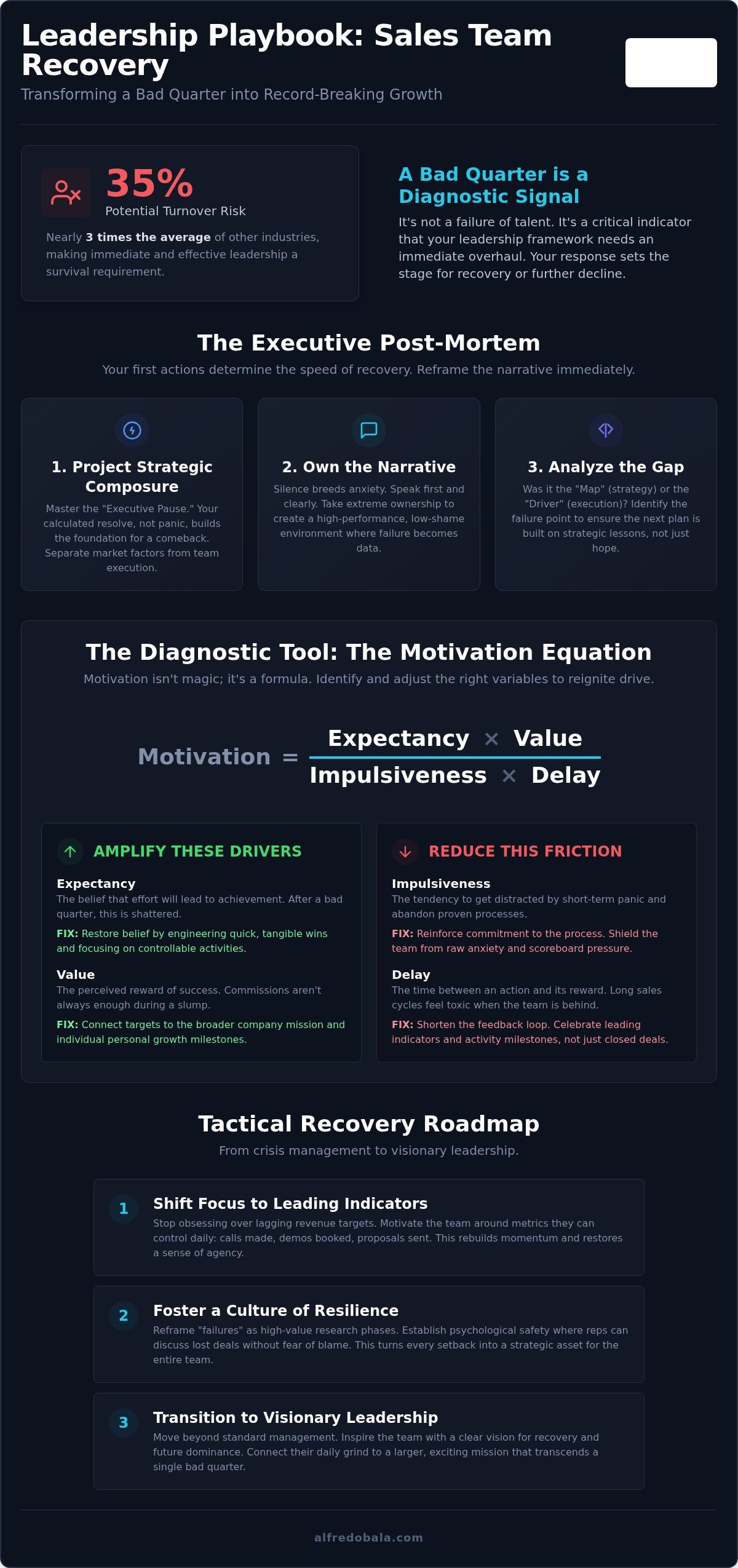
A disastrous quarter isn’t a failure of talent. It’s a diagnostic signal that your leadership framework needs an immediate executive overhaul. You’re likely feeling the weight of board expectations and the looming risk of a 35% turnover rate, which is nearly three times the average of other industries. Understanding how to motivate a sales team after a bad quarter is no longer just a soft skill. It’s a survival requirement when your personal credibility is on the line and the pressure to deliver immediate results is mounting.
You know that a simple pep talk won’t fix a systemic slump. This guide reveals the high-level psychological frameworks and tactical shifts needed to transform a disastrous quarter into a catalyst for record-breaking growth. We’ll use the Motivation Equation as our diagnostic tool to identify exactly where the momentum stalled and how to fix it. You’ll gain a clear roadmap to restore team confidence and the practical steps to hit next quarter’s targets with certainty. It’s time to lead your team from the foundational levels of recovery to the highest echelons of professional performance.
Key Takeaways
- Learn why your immediate reaction as a leader determines the speed of your team’s recovery and how to separate market factors from internal performance.
- Discover how to use The Motivation Equation as a diagnostic tool to identify exactly where organizational drive has stalled and which variables to adjust first.
- Master the tactical roadmap for how to motivate a sales team after a bad quarter by engineering quick wins and shifting focus to leading activity indicators.
- Foster a culture of resilience by reframing failures as high-value research phases and establishing psychological safety in high-pressure environments.
- Transition from standard management to visionary leadership to inspire global scale and maintain long-term momentum through the next growth cycle.
The Executive Post-Mortem: Reframing the ‘Bad Quarter’ as a Strategic Catalyst
Your immediate reaction as a leader acts as a signal flare for the entire organization. When results fall short, master the “Executive Pause.” This is not about inaction; it is about deliberate, strategic composure. Your team is watching for signs of panic or frustration. If you project calculated resolve, you establish the foundation for a comeback. A critical part of this process involves separating market volatility from team execution in your internal post-mortem. Did the macro environment shift, or did the internal process break? Understanding how to motivate a sales team after a bad quarter starts with this diagnostic precision. You must also navigate the “Transparency Paradox.” Share enough of the board’s pressure to create a sense of urgency, but shield your reps from the raw anxiety that paralyzes performance.
Owning the Narrative Before the Rumor Mill Does
Silence is the primary enemy of morale. When targets are missed, the rumor mill fills the gap with anxiety and speculation. Speak first and speak most clearly. You must take extreme ownership of the results without demoralizing yourself or the team. This means acknowledging that the current system did not produce the desired outcome while reinforcing that the team possesses the talent to pivot. By leading with accountability, you create a high-performance, low-shame environment. Your team needs to know that while the results were unacceptable, their professional value remains intact. This narrative shift replaces the “failure” label with a “data-driven adjustment,” turning a loss into a strategic lesson.
Analyzing the Gap: Strategy vs. Execution
Determine if the quarter failed because of the “Map” or the “Driver.” A failure of the map means your strategy or market positioning was flawed. A failure of the driver means the execution and activity levels were lacking. Presenting missed KPIs as a “learning sprint” helps maintain team dignity while exposing operational gaps. Standard factors in salesperson performance often include a mix of motivation, aptitude, and skill level. If the strategy was sound but the execution failed, you must identify the early warning signs you missed. Perhaps it was a drop in top-of-funnel activity or a decline in lead quality. Every veteran leader knows that how to motivate a sales team after a bad quarter is as much about refining the technical strategy as it is about reigniting the competitive spirit.
Applying the Motivation Equation: Diagnosing Why the Drive Stalled
Motivation isn’t a nebulous feeling that appears or vanishes by chance. It’s a predictable outcome of specific psychological variables. When you’re analyzing how to motivate a sales team after a bad quarter, you need a diagnostic tool that goes deeper than surface-level incentives. The Motivation Equation provides this framework, allowing you to identify exactly where the drive has stalled. By viewing motivation as a mathematical balance, you can stop guessing and start leading with precision.
The Variables of Performance: Expectancy and Value
The numerator of the equation consists of Expectancy and Value. Expectancy is the belief that effort will lead to achievement. After a losing quarter, your reps’ expectancy is likely shattered; they’ve worked hard and seen zero return. To fix this, you must restore their belief that their daily actions will actually result in a win again. Value, on the other hand, is the perceived reward. While commissions matter, high-performing teams often need a deeper sense of meaning to push through a slump. Redefining value means connecting their targets to the company’s broader mission or their own personal growth milestones. Fundamentally, the Motivation Equation is a balance between the perceived reward and the probability of achieving success.
Combating the Friction: Impulsiveness and Delay
The denominator of the equation is where most sales recoveries fail. Delay refers to the time between an action and its reward. In sales, long cycles are natural, but they become toxic when a team is already behind. If the payoff feels too far away, motivation evaporates. You must also reduce Impulsiveness, which is the tendency to get distracted by short-term stressors or the panic of the scoreboard. When reps are impulsive, they abandon the proven process in a desperate attempt to save the quarter. Keeping them focused on leading indicators rather than lagging results is the hallmark of seasoned leadership. For a deeper dive into these mechanics, explore The Motivation Equation: A Masterclass in Leadership and Human Performance.
Using this equation as a diagnostic tool allows you to see which specific variable broke. Did the team stop believing they could win (Expectancy)? Or did the reward lose its luster (Value)? Perhaps the sales cycle felt too long (Delay), or the team lost focus on the process (Impulsiveness). Once you identify the broken variable, you can apply the tactical shifts needed to restore momentum. If you’re looking to elevate your organization’s performance, consider how leadership and team development insights can transform your current trajectory.
Tactical Rebuilding: 5 Steps to Restore Momentum in the Trenches
Success in the wake of a slump is not found in grand gestures. It is found in the meticulous engineering of momentum. When you are determining how to motivate a sales team after a bad quarter, you must transition from high-level strategy to tactical execution. These five steps provide the roadmap to pull your team out of the trenches and back onto the growth curve.
- Step 1: The ‘Quick Win’ Strategy. Identify low-hanging fruit in the current pipeline. Engineering small, guaranteed victories rebuilds the team’s belief that they can still close deals and win in the current market.
- Step 2: Activity-Based Incentives. Shift your focus from lagging indicators like revenue to leading indicators such as outbound calls or discovery meetings. You can control activity; you can only influence results.
- Step 3: Radical Coaching Alignment. Research indicates that teams receiving weekly coaching achieve 76% quota attainment, while those coached quarterly or less drop to 47%. Use 1-on-1s to dismantle individual psychological barriers.
- Step 4: The ’10x Feature’ or Tool. Introduce a new prospecting tool or a refined sales script. Giving the team a new “weapon” changes their market perspective from defensive to offensive.
- Step 5: Peer-to-Peer Mentorship. Leverage your top 1% as culture carriers. Their success serves as the ultimate proof-of-concept for the rest of the organization.
Engineering the ‘Spark’ with Micro-Goals
A quarterly target often feels like an impossible mountain after a significant loss. Break that mountain into manageable hills. Implement a 48-hour sprint focused on a single, achievable metric. This reduces the “Delay” variable in the Motivation Equation and provides an immediate dopamine hit of success. Create sales contests that reward the right behaviors rather than just lucky breaks. This approach is a core part of Executive Leadership Development Strategies for Global Growth, ensuring your team stays focused on the process of winning rather than the fear of losing.
Empowering Your Top Performers to Lead the Charge
Your top performers are the heartbeat of your sales culture. Position them as mentors without creating a divide. You should also take time to reward the “Process Kings.” These are the reps who maintained their discipline and activity levels even when the market didn’t respond. When the first rep finally breaks the losing streak, celebrate it loudly. Craft a success narrative around that win to show the rest of the team that the tide has officially turned. This is how to motivate a sales team after a bad quarter through the power of social proof and disciplined execution.
Beyond the Numbers: Cultivating a Culture of Resilience
Resilience is the silent engine of every record-breaking sales organization. While the Motivation Equation provides the diagnostic framework, the cultural soil determines whether those seeds of recovery actually take root. In a high-pressure environment, you must establish psychological safety. This does not mean lowering the bar or accepting mediocrity. It means creating a space where reps can admit to a lost deal or a flawed approach without the fear of immediate retribution. When a team feels safe to be honest about their struggles, you gain the data needed to fix them. Understanding how to motivate a sales team after a bad quarter requires you to pivot the team’s mindset from “failure” to an “R&D phase.” Every missed target is a market stress test that reveals exactly where the sales process or the value proposition needs refinement.
Building team rituals that celebrate grit is essential. Instead of only ringing the bell for a final signature, start recognizing the “resilience milestones.” Celebrate the rep who turned a “no” into a discovery meeting or the one who maintained a high volume of outbound activity despite a string of rejections. This maintains high standards of accountability without creating a culture of fear. Accountability should always look forward. Blame focuses on the past; accountability focuses on the next action required to win.
Balancing Empathy with Executive Gravitas
Effective leadership in a crisis requires a nuanced touch. Use listening as a diagnostic tool rather than a therapy session. You are there to identify operational friction, not just to absorb emotional venting. Position yourself as the “Mentor-Leader,” acting as the guide who has navigated these valleys before and knows the path out. When you have tough conversations with underperformers, keep them rooted in the process. Ask what resources or coaching they need to return to peak performance. This approach preserves your executive gravitas while showing a personal investment in their elevation.
Long-Term Retention Strategies for Global Teams
The risk of losing your best talent is highest immediately following a slump. Research shows that the annual turnover rate in sales is 35%, which is nearly three times the average of other industries. Top performers don’t leave just because of a bad check; they leave because they lose faith in the leadership’s ability to correct the course. Stop the bleed by investing in professional development even when the budget feels tight. Showing your team that you are committed to their long-term growth builds a level of loyalty that a single bad quarter cannot break. For more specialized approaches, explore Mastering Team Retention Strategies for Network Marketing. If you want to transform your leadership style into a magnet for high-tier talent, integrate these leadership and team development insights into your daily operations.
The Visionary Pivot: Leading Your Global Sales Team Toward Recovery
Leading through a recovery requires more than just operational fixes. It demands a fundamental shift in how you project authority and purpose. While managers focus on fixing what went wrong, visionaries focus on where the organization is going. Mastering how to motivate a sales team after a bad quarter means shifting from the weeds of daily quota tracking to the heights of visionary leadership. You must inspire global scale by painting a picture of the future that is more compelling than the failure of the past. This is also the time to manage expectations upward. Prepare your board for the “J-Curve” of recovery. Growth often dips during the initial retooling phase as you implement new systems, but this temporary decline is the necessary foundation for a record-breaking spike in performance.
Bringing in External Perspectives
A bad quarter is actually the most strategic time to hire a leadership speaker for corporate events. When a team is stuck in a cycle of loss, your internal voice can sometimes become part of the background noise. An external expert provides a high-impact reset, offering a fresh lens on the team’s collective mindset. Using an executive advisor allows you to identify the leadership blind spots that contributed to the slump. By integrating Alfredo Bala’s frameworks, you can build a bulletproof sales culture that is grounded in the science of human performance rather than just the art of the “hustle.” This external validation reinforces your strategic pivot and gives the team a new narrative to believe in.
Next Steps for the Executive Leader
Your first priority is protecting your own executive capacity. Develop your personal Motivation Equation to avoid the leadership burnout that often follows a high-pressure quarter. If your own expectancy is low, your team will feel it. Your action plan for the next 30 days should follow a strict rhythm:
- Days 1-10 (Communication): Own the narrative and present the “data-driven adjustment” to the entire organization.
- Days 11-20 (Diagnosis): Use the Motivation Equation to pinpoint exactly which variable (Expectancy, Value, Impulsiveness, or Delay) is broken.
- Days 21-30 (Momentum): Engineer the first “Quick Win” and celebrate it as the official start of the comeback.
The Motivation Equation ensures that this is the last bad quarter your team faces by providing a repeatable system for performance. It transforms motivation from a mystery into a manageable metric. If you are ready to master the art of the comeback and lead your team to global prominence, start by applying these leadership and team development insights today. The path to record-breaking growth is not found in working harder, but in leading smarter.
Mastering the Art of the Executive Comeback
A single bad quarter is a pivot point, not a destination. You now have the frameworks to diagnose organizational friction and the tactical steps to restore momentum in the trenches. By applying the variables of the Motivation Equation, you transform the mystery of demotivation into a disciplined science of achievement. Mastering how to motivate a sales team after a bad quarter is about more than just hitting next month’s targets; it’s about building a culture of resilience that survives any market volatility.
As a former CEO of a global billion-dollar entity and author of the Motivation Equation, I’ve spent decades leading global sales organizations through complex landscapes. I know that the difference between a slump and a streak is the clarity of your leadership. It’s time to stop reacting to the scoreboard and start engineering the win. You’re the visionary guide your team needs to navigate this valley and reach the next peak of professional mastery.
Master the science of drive with The Motivation Equation.
Frequently Asked Questions
How do I tell the sales team we missed our quarterly target without killing morale?
Deliver the news with calculated resolve. Address the miss directly in a team meeting to stop speculation and rumors immediately. Frame the quarter as a high-value data point that reveals exactly where the organization needs to pivot. By focusing on the “Executive Pause” and the upcoming recovery plan, you maintain your gravitas. Your goal is to pivot the energy from past disappointment toward the tactical steps required for a record-breaking comeback.
Is it okay to lower sales quotas after a disastrous quarter?
Lowering quotas is generally a mistake because it signals a lack of belief in your team’s potential. It can inadvertently lower the standard of excellence you’ve worked hard to build. Instead, focus on engineering micro-goals that provide the dopamine hit of a win without compromising the annual target. If the market has shifted, adjust the strategy and the tools first. Quota adjustments should be your very last resort in any recovery strategy.
What are the best sales contests to run when the team is demoralized?
The most effective contests reward leading indicators rather than final revenue results. When you are analyzing how to motivate a sales team after a bad quarter, prioritize metrics like discovery calls or pipeline generation. These activities are within the reps’ direct control. By rewarding the process, you reduce the “Impulsiveness” variable in the Motivation Equation and help the team regain their rhythm through small, consistent, and highly visible victories.
How do I keep my top performers from quitting after a bad quarter?
Engage your top performers by positioning them as “Culture Carriers” in the recovery process. High achievers often quit when they feel the leadership has lost the map or the vision. Give them a seat at the table during the strategic pivot and recognize their discipline publicly. Investing in their professional development proves that you see them as long-term partners, ensuring their loyalty remains firm even during temporary market downturns.
Should I fire underperforming sales reps immediately after a bad quarter?
Don’t fire reps based on a single bad quarter without a thorough diagnostic review. Use the Motivation Equation to see if the failure was a lack of expectancy or a breakdown in the sales process. If a rep has the aptitude but is simply demoralized, targeted coaching can save the asset. However, if a rep refuses to follow the new recovery tactics or becomes toxic, they may need to be removed to protect the team’s culture.
How can the Motivation Equation help me manage a global sales team?
The Motivation Equation serves as a universal diagnostic tool for global leadership. It allows you to look past cultural differences and identify the core psychological friction points in any region. Whether the issue is a long “Delay” in a specific market or a drop in “Expectancy” due to local competition, the equation provides a clear roadmap for adjustment. It ensures your leadership remains precise and effective across every time zone and territory.
How long does it typically take to restore sales team momentum?
Restoring momentum typically follows a 30 to 90-day trajectory. You should expect to see a shift in leading indicators, such as call volume and meeting set rates, within the first 30 days of implementing the recovery plan. The actual revenue often follows in the subsequent 60 days. Your consistency as a leader during this “J-Curve” is what determines how quickly the team returns to peak performance levels and stays there.
What is the difference between a ‘pep talk’ and strategic sales motivation?
A pep talk is a transient emotional boost, while strategic motivation is a structural change. Understanding how to motivate a sales team after a bad quarter requires more than a loud speech or a temporary incentive. Strategic motivation involves using the Motivation Equation to remove systemic barriers to success. It focuses on the science of human performance, ensuring that every rep has the belief, the tools, and the process needed to win consistently.
 EN
EN  ES
ES
Recent Comments