
Most executive leadership programs fail because they treat motivation as a fleeting emotion rather than a predictable, calculated result. You’ve likely seen traditional incentive plans fall flat or watched team productivity stall despite your best efforts to inspire. It’s frustrating to manage a global sales force when the old playbooks no longer move the needle. This is exactly why The Motivation Equation book has become an essential resource for leaders who need a disciplined, scientific approach to human drive.
This article promises to reveal the precise framework used by seasoned global executives to transform individual drive into unstoppable organizational momentum. You’ll discover a repeatable methodology for leadership that yields higher retention rates and increased team output. We’ll examine how to move beyond guesswork and apply a masterclass in human performance to your specific professional landscape. Get ready to replace stagnant performance with a proven system of growth that works across borders and industries. By the end of this guide, you’ll have the clarity needed to implement strategies that resonate with every member of your team, regardless of where they are in the world.
Key Takeaways
- Replace temporary “hype” with a calculated, scientific framework for human performance that global executives use to drive consistent results.
- Leverage the insights within The Motivation Equation book to diagnose specific performance leaks and transform individual drive into organizational momentum.
- Master the four critical variables of Expectancy, Value, Impulsiveness, and Delay to gain precise control over your team’s productivity and engagement.
- Move past the “Incentive Trap” by learning why traditional rewards often fail and how to cultivate genuine intrinsic drive in remote or global sales forces.
- Implement a repeatable leadership audit to identify whether your team’s momentum is stalled by a lack of perceived value or excessive delays.
Understanding The Motivation Equation: Beyond Simple Inspiration
Stop waiting for inspiration to strike your team. It’s a losing strategy that leaves your organization’s success to chance. Most leaders mistake a high-energy keynote or a temporary bonus for long-term momentum. The Motivation Equation book reframes this entirely. It presents motivation not as a fleeting mood, but as a strategic framework for human performance. This isn’t about “cheerleading.” It’s about precision engineering for the human spirit.
Traditional incentive models often rely on “hype-based” energy. While this might spark a brief flame, it fails in long-term, high-stakes corporate environments. When the pressure of a global market mounts, emotional highs evaporate. Alfredo Bala argues that we must treat motivation as a disciplined science. By understanding the underlying psychological principles of motivation, executives can build systems that sustain themselves through every market cycle. This framework serves as a roadmap for scaling that drive across complex, global teams.
The Philosophy of the “Motivation Guy”
Alfredo’s perspective wasn’t born in an academic lab; it was forged over 45 years of leadership in the trenches. He moved from foundational sales roles to the highest echelons of global business, serving as CEO of Mannatech Inc. and COO of Britt World Wide. This journey created the “Success Story” archetype that defines his work. He acts as a bridge between high-level corporate strategy and the raw ambition of the individual entrepreneur. His insights are grounded in the real-world application of opening 65 countries and guiding thousands to success. When you read The Motivation Equation book, you aren’t getting abstract theory. You’re getting a veteran’s blueprint for global expansion.
Why Willpower Isn’t a Strategy
Relying on individual grit is a recipe for organizational burnout. Grit is a finite resource. In a team setting, you simply can’t scale one person’s willpower across a distributed workforce. We must distinguish between “Emotional Motivation,” which is reactive and short-lived, and “Systemic Motivation,” which is proactive and sustainable. Systemic motivation is the architecture of consistent action. It ensures that even when the “feeling” of excitement fades, the structural mechanics of the organization keep people moving forward. By focusing on the system rather than the sentiment, leaders create a repeatable environment where peak performance becomes the standard rather than the exception.
The Variables of Success: Breaking Down the Framework
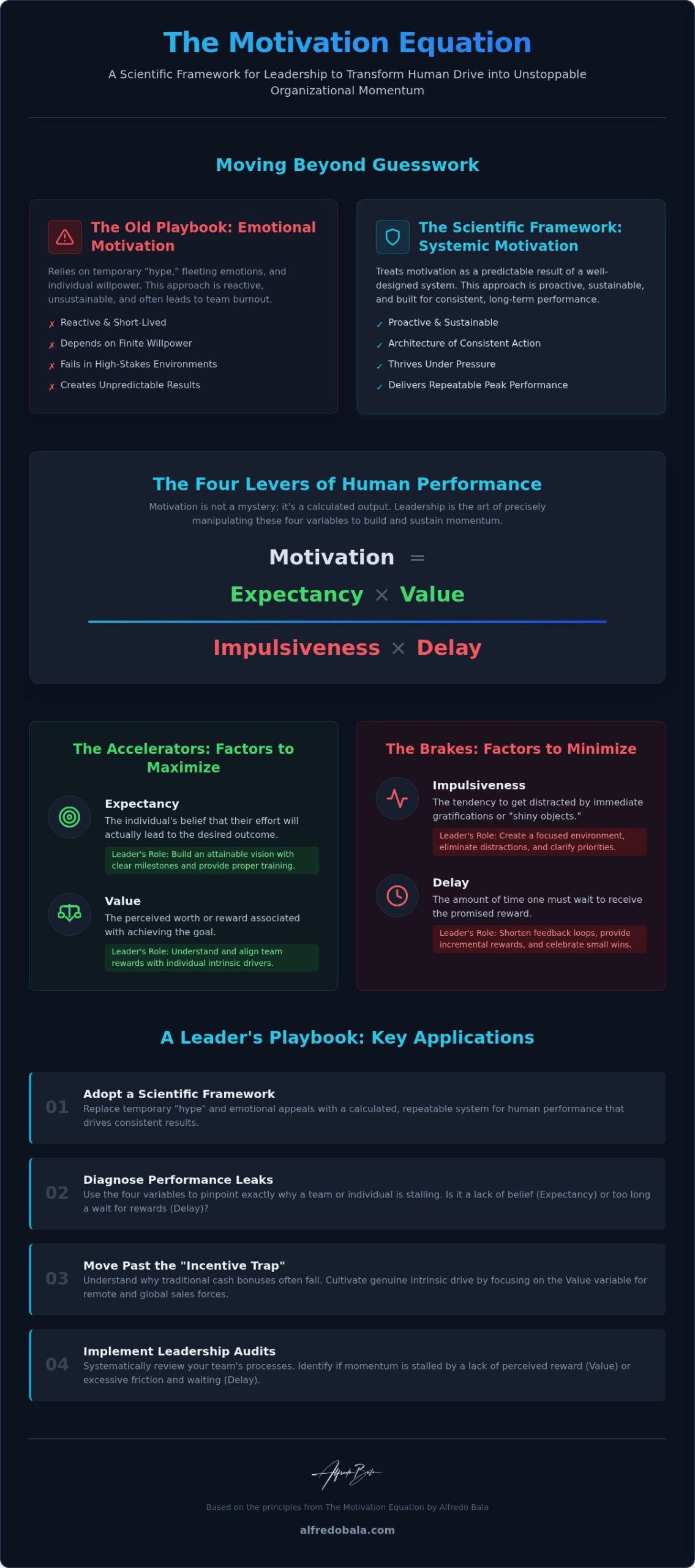
Master the mechanics of drive to transform your leadership from a series of guesses into a precise discipline. In The Motivation Equation book, human performance is stripped of its mystery and presented as a calculated output. To influence your team effectively, you must understand that motivation is the product of four distinct variables working in tandem. These variables act as levers. When you pull the right ones, momentum builds. When you ignore them, performance stalls.
The framework operates like a mathematical quotient. On the top, we have the drivers that increase motivation: Expectancy and Value. On the bottom, we have the friction points that diminish it: Impulsiveness and Delay. The interaction looks like this:
- Expectancy: The individual’s belief that their effort will actually lead to the desired goal.
- Value: The perceived worth or reward associated with achieving that goal.
- Impulsiveness: The tendency to get distracted by immediate gratifications or “shiny objects.”
- Delay: The amount of time one must wait to receive the promised reward.
Leadership is the art of balancing these variables. Your role isn’t just to “encourage” your team, but to actively manipulate these four factors to ensure the final output of motivation remains high. If you want to dive deeper into how these variables apply to your specific industry, exploring Alfredo Bala’s leadership and team development insights can provide the tactical edge you need.
The Art of Getting People to Take Action
Focus your initial efforts on the “Expectancy” and “Value” variables. This is where leaders create the spark. If a team member doesn’t believe they can win (low Expectancy), they won’t even start. You must build a vision that feels attainable through clear milestones and proper training. Simultaneously, you have to amplify the “Value.” The reward must be significant enough to justify the struggle. When belief in success meets a high-stakes reward, you create an environment where action becomes the natural choice. Belief is the fuel of the motivation process; without it, the engine never turns over.
The Science of Sustainable Results
Execution requires mastering the “Impulsiveness” and “Delay” variables. These are the silent killers of productivity. In a world of constant notifications and remote work, impulsiveness is at an all-time high. Leaders must implement strategies to reduce distractions and keep the team focused on the mission. Shortening the feedback loop is equally critical. Delay is the primary killer of organizational momentum. When the gap between effort and reward is too wide, the human brain naturally loses interest. By creating “quick wins” and frequent recognition, you neutralize the negative impact of delay and keep the momentum moving forward. The Motivation Equation book provides the roadmap to manage these denominators and protect your team’s focus.
Why Traditional Incentive Models Fail Global Teams
Abandon the outdated carrot-and-stick philosophy. It’s a relic of a bygone era that simply doesn’t hold up in a hyper-connected, global economy. For decades, leaders have relied on external rewards to “buy” performance, only to find that these incentives often backfire. This is the “Incentive Trap.” When you focus purely on extrinsic rewards, you inadvertently signal that the task itself lacks inherent value. Over time, this dependency erodes the very intrinsic drive you need to sustain a high-performing culture. The Motivation Equation book provides a sophisticated alternative, moving leaders away from transactional management and toward a systemic architecture of achievement.
The 2026 workforce demands more than a paycheck; it requires a sense of mastery and purpose. Traditional models fail because they don’t account for the psychological complexity of modern professionals. Alfredo Bala’s framework replaces guesswork with a precise formula that addresses why people actually do what they do. It’s the difference between a temporary spark and a self-sustaining engine. By focusing on the variables we discussed earlier, you can build a team that performs not because they’re being chased by a stick, but because the system itself makes success the most rewarding path.
The Trap of Short-Term External Rewards
Cash bonuses are often a temporary stimulant. They create a “sprint” mentality that leads to psychological fatigue. When your team is constantly sprinting toward the next payout without a deeper framework, burnout is inevitable. This cycle destroys long-term loyalty because the relationship becomes purely mercenary. The Motivation Equation book solves this by teaching you how to anchor motivation in the “Value” and “Expectancy” variables. This shifts the focus from what the team gets to who they are becoming. It builds internal drive that persists even when the external environment is volatile. For a deeper look at how to move past this cycle, the motivation strategies for business leaders that go beyond the sugar high of inspiration offer a structural framework for replacing fleeting rewards with lasting performance architecture.
Building Drive in Distributed Organizations
Motivating a team across different cultures and time zones is a unique challenge that traditional models aren’t equipped to handle. You can’t rely on office culture or physical presence to maintain momentum. You need centralized leadership principles that allow for localized execution. Alfredo Bala’s experience launching networking organizations in China and opening 65 countries worldwide proved that the mechanics of motivation are universal, even if the cultural context changes. The Equation works because it targets the fundamental human drivers of performance. Whether your team is in Dallas or Dubai, the variables of Delay and Impulsiveness remain the primary killers of momentum. Mastering these allows you to maintain a unified, high-performance culture across any border.
Applying the Equation: A Leader’s Guide to Team Performance
Audit your team’s environment with the cold eye of a systems engineer. You cannot fix what you haven’t measured. To move from stagnant performance to organizational momentum, you must follow a disciplined implementation process. Start by identifying the “Leak” in your performance pipeline. Is your team struggling with a lack of Value because the rewards don’t resonate? Or is there too much Delay between their effort and the payoff? Once you’ve diagnosed the friction, you must recalibrate the environment to support the mechanics found in The Motivation Equation book. Finally, communicate this framework to your team. When they understand the science of their own drive, they gain the power to self-calibrate and maintain focus without constant external pressure.
- Step 1: Audit. Evaluate your current team against the four variables. Are goals clearly attainable? Are rewards meaningful?
- Step 2: Identify. Pinpoint whether the issue is a numerator problem (belief and value) or a denominator problem (distraction and timing).
- Step 3: Recalibrate. Alter the workflow to provide faster feedback and higher perceived value.
- Step 4: Empower. Teach the framework to your staff so they can identify their own performance leaks.
From Direct Sales to C-Suite Strategy
Alfredo Bala’s journey proves that these principles are universal. He transitioned from foundational field roles to executive leadership as the CEO of Mannatech Inc. and COO of Britt World Wide. This experience revealed that whether you are leading a single entrepreneur or a global board of directors, human behavior remains consistent. In high-pressure environments like opening 65 international markets, the Equation provides a stable anchor. It scales because it addresses the biological and psychological roots of action, not just corporate titles. If you want to bring this level of precision to your organization, you can explore Alfredo’s speaking and leadership insights to see how these strategies apply to Fortune 500 boardrooms.
Practical Implementation for Managers
Integrate the framework into your weekly habits to ensure it sticks. During performance reviews, don’t just talk about hitting targets; talk about the variables. Ask your team members where they feel the most friction. Is it a belief gap in the current strategy (Expectancy) or a distraction issue (Impulsiveness)? Use your Monday morning huddles to highlight “quick wins” that neutralize the Delay variable. The leader’s role is the Chief Calibration Officer of the Equation. By consistently reinforcing these principles, you turn a complex psychological concept into a simple, actionable culture of success. The Motivation Equation book is your manual for this ongoing transformation. For leaders ready to take this further, exploring executive leadership development strategies for global growth in 2026 provides the high-impact frameworks needed to bridge boardroom vision with ground-level execution across international markets.
Elevate Your Organization with The Motivation Equation
Success at the highest levels of global business is never an accident. It’s the result of a disciplined, repeatable framework. The Motivation Equation book is the essential distillation of Alfredo Bala’s 45 years of experience leading teams across 65 countries. It’s more than a manual; it’s a strategic asset for any executive looking to eliminate the guesswork of human performance. By integrating this equation into your organizational DNA, you move from managing by crisis to leading by design. This book belongs in every leader’s library as a permanent reference for building resilient, high-output cultures.
Transitioning from the literature to the implementation requires a partner who has navigated the complexities of the C-suite. Alfredo doesn’t just write about these principles; he lived them as the CEO of Mannatech Inc. and COO of Britt World Wide. Bringing the Motivation Equation framework to a live corporate event offers an immediate ROI by aligning your entire leadership team under a single, powerful methodology. It transforms the way your organization communicates, evaluates, and rewards achievement. You aren’t just buying a speech; you’re investing in a system that scales. When planning your next event, working with a keynote speaker for organizational growth who delivers a concrete framework rather than empty hype ensures your investment translates into measurable strategic impact. Before booking your next event, consider why choosing a motivation and leadership speaker with real executive experience makes the difference between a temporary emotional high and lasting organizational transformation.
Secure Your Strategy: Getting the Book
Don’t let your team’s potential remain untapped. Secure the latest edition of The Motivation Equation book to provide your managers with the tools they need to audit and recalibrate their own performance. When an entire organization shares this leadership language, the friction of misaligned expectations disappears. You can Explore Alfredo’s full bibliography to find the resources that best fit your team’s current growth stage. Mastery begins with the right information; it ends with consistent, disciplined application.
Beyond the Page: Booking Alfredo Bala
A keynote should deliver a framework, not just a temporary emotional high. Alfredo’s presentations are designed to leave your team with a concrete roadmap for the year ahead. Beyond the stage, he provides high-level board advisory and executive consulting for organizations that demand precision in their global strategy. Whether you need a visionary guide for a distributed sales force or a veteran perspective in the boardroom, his insights are rooted in real-world success. It’s time to move beyond theory and start seeing results. Book Alfredo Bala for your 2026 leadership summit and start building the momentum your organization deserves.
Master the Science of Global Leadership
Take control of your team’s momentum by shifting from reactive management to systemic architecture. You’ve learned that motivation isn’t a random occurrence; it’s a calculated result of balancing expectancy and value against the friction of impulsiveness and delay. By identifying the specific “leaks” in your own performance pipeline, you can create an environment where peak output becomes the natural standard. This isn’t abstract theory. It’s a proven methodology forged through 40 years of international success and executive leadership at the highest levels of global business.
The Motivation Equation book provides the precise roadmap you need to scale this drive across any border or industry. Whether you’re guiding a local sales force or a distributed global organization, these principles offer a shared language for achievement. It’s time to replace the “incentive trap” with a sustainable engine of growth that respects the psychology of your people. Your journey from foundational strategy to global mastery starts with a single, disciplined step toward understanding the human mechanics of performance.
Order The Motivation Equation and Master Your Leadership Strategy
The tools for transformation are in your hands. Go build the momentum your organization deserves.
Frequently Asked Questions
What is the core formula in The Motivation Equation book?
The core formula defines motivation as the product of Expectancy and Value divided by the product of Impulsiveness and Delay. This mathematical approach allows leaders to see that increasing belief and reward while simultaneously reducing distractions and wait times maximizes organizational drive. It moves beyond vague inspiration to provide a diagnostic tool that identifies exactly where a team’s momentum is failing.
How does Alfredo Bala’s framework differ from traditional motivational speaking?
This framework prioritizes a calculated, systemic approach over the fleeting emotional highs typical of standard motivational speeches. While traditional “hype” offers a temporary spark, Alfredo Bala’s methodology is rooted in the disciplined science of human performance. It provides executives with a repeatable strategy that produces consistent results in high-stakes corporate environments. You’re getting a permanent roadmap for achievement rather than a short-lived burst of energy.
Is The Motivation Equation applicable to industries outside of network marketing?
The principles are universal and apply to any professional landscape, from Fortune 500 boardrooms to global sales forces. Human psychology and the biological drivers of action don’t change based on your industry or business model. The Motivation Equation book has been used by leaders across diverse sectors to solve stagnant performance and improve retention in complex, distributed teams. It targets the fundamental mechanics of human drive that govern every workplace.
Can this book help with personal productivity or is it strictly for leaders?
The book serves both individual high-performers and executive leaders looking to scale their organizational influence. While it’s an essential manual for leadership, the framework also provides a roadmap for personal mastery by helping you identify your own productivity bottlenecks. You can use the equation to audit your daily habits and neutralize the impulsiveness that often derails progress. It effectively bridges the gap between individual entrepreneurial ambition and high-level corporate strategy.
Who is Alfredo Bala and what is his background in global business?
Alfredo Bala is a seasoned executive with over 45 years of experience, including serving as the CEO of Mannatech Inc. and COO of Britt World Wide. He has successfully opened more than 65 countries and guided thousands of individuals toward professional success. Known as the “Motivation Guy,” his background blends hard-won wisdom from the field with the strategic gravitas of the C-suite. He currently acts as a global board advisor and mentor to top-tier executives.
What are the four main variables that affect human motivation according to the book?
The four critical variables are Expectancy, Value, Impulsiveness, and Delay. Expectancy is the belief that effort leads to a goal, while Value is the perceived worth of the reward. Impulsiveness represents the tendency toward distraction, and Delay is the time gap before a reward is realized. The Motivation Equation book teaches you how to manipulate these levers to ensure that your team’s drive remains at its peak regardless of external market volatility.
 ES
ES  EN
EN
Comentarios recientes