
What if your strongest performers aren’t burning out because they work hard, but because their effort no longer feels sustainable or meaningful? Preventing employee burnout doesn’t mean lowering performance targets. It means examining the conditions that make sustained performance possible, before exhaustion puts talent, productivity, and innovation at risk.
Depleted teams can’t consistently deliver their best work. When valued employees leave, the pressure on those who remain often grows. Another surface-level wellness initiative won’t address the underlying problem. Leaders need practical ways to spot early warning signs and change the workplace conditions contributing to burnout.
This guide applies the Motivation Equation to workplace culture, manager practices, and team development. Drawing on Alfredo Bala’s experience as a former CEO and COO, it explores ways to identify risks, improve retention, and make sustainable motivation part of how your organization performs in 2026.
Key Takeaways
- Burnout is a strategic risk, not simply a sign that employees need more resilience.
- Use the Motivation Equation to explore where employees’ sense of value or confidence in achieving results may be weakening.
- Make preventing employee burnout a leadership priority by examining workplace conditions, not relying on self-care tools alone.
- A motivation audit and thoughtful workflow design can help leaders identify pressure points and reduce unnecessary cognitive load.
- Support sustainable performance with consistent leadership practices and clear expectations around employee well-being.
Beyond Exhaustion: Redefining Burnout as a Strategic Risk
Burnout is more than feeling tired after a demanding quarter. Leaders should recognize it as a chronic misalignment between the effort employees invest and the value, progress, or recognition they believe that effort creates. The World Health Organization describes burnout as an occupational phenomenon resulting from chronic workplace stress that hasn’t been successfully managed. Occupational burnout also encompasses established models and symptoms that help distinguish it from ordinary fatigue.
Pressure can be useful. Eustress, or positive stress, can focus attention on a meaningful challenge when people have the resources and agency to respond. Burnout is different: prolonged strain drains energy and confidence, while work begins to feel futile. High performers may be especially exposed because they’re often trusted with complex responsibilities, take on extra work, and keep delivering as their capacity erodes. Their output can conceal the risk until engagement, judgment, or health suffers.
The Three Pillars of Burnout: Exhaustion, Cynicism, and Inefficacy
Look beyond visible fatigue. Exhaustion may show up as declining energy or slower recovery between intense periods. Cynicism can appear when a once-committed employee becomes dismissive of priorities, skeptical of leadership, or detached from colleagues. Inefficacy emerges when capable people doubt their impact or struggle to make progress despite sustained effort.
In global sales teams, warning signs might include missed handoffs across time zones, less collaboration, or customer conversations reduced to the minimum. In development teams, they may include fewer experiments, delayed decisions, or talented people avoiding ownership. These aren’t diagnoses. They’re prompts to ask whether expectations, resources, and recognition are aligned. Burnout can weaken motivation, execution, and innovation, creating risks for organizational performance.
The 2026 Economic Impact of Employee Attrition
Burnout becomes a strategic risk when an organization loses people whose experience, relationships, and judgment are difficult to replace. Executive departures can disrupt succession, customer confidence, and institutional knowledge, while replacements need time to build context and trust.
The financial impact starts before anyone resigns. A study published in the American Journal of Preventive Medicine estimated annual burnout costs of $20,683 per executive and $10,824 per manager in 2025. It attributed 89% of these costs to presenteeism, reduced productivity while at work. Burnout can also constrain the curiosity and risk-taking needed for executive leadership development strategies.
Leadership behavior matters, too. A depleted leader can normalize constant urgency, discourage candor, and pass pressure down to direct reports. That pattern is a warning about the working environment, not proof of individual weakness. Preventing employee burnout starts with examining how work is led, rewarded, and resourced. Alfredo Bala, a former CEO and COO, frames this as a leadership responsibility: align effort with meaningful value before strain becomes attrition.
The Science of Disengagement: Burnout through the Lens of the Motivation Equation
Burnout prevention needs more than a warning-sign checklist. Leaders need a way to explore why effort is no longer translating into engagement. The Motivation Equation offers a lens: examine Value, Expectancy, Impulsiveness, and Delay to identify where motivation may be weakening. This connects with the World Health Organization’s description of burnout as an occupational phenomenon linked to chronic workplace stress that hasn’t been successfully managed.
Use the framework as a prompt for inquiry, not a label. Ask employees what matters in their work, whether they believe their effort can produce a worthwhile result, how immediate competing pressures feel, and how long they must wait to see progress or recognition. Their answers can help leaders identify whether the strain relates to purpose, resources, competing demands, or slow feedback. Then address the conditions behind it.
When Value Erodes: The Source of Cynicism
When people can’t see why their work matters, the Value variable weakens. An employee may complete tasks competently while becoming increasingly detached from the organizational mission. The gap can widen when company priorities are announced but teams can’t connect daily decisions to those goals. Leaders can restore that line of sight by explaining the purpose behind priorities and showing how individual contributions support shared outcomes.
For a deeper look at this framework, The Motivation Equation book explores motivation and leadership. Use its ideas to guide specific conversations: Which work feels meaningful? What feels disconnected from the mission? What contribution deserves clearer recognition?
Expectancy and the Fear of Failure
Expectancy is an employee’s belief that effort can lead to success. If targets repeatedly exceed available time, authority, or resources, people may stop believing that trying harder will change the outcome. That can look like learned helplessness, not a lack of ambition but a response to repeated barriers. Leaders can test whether goals match capacity, clarify decision rights, and remove obstacles teams can’t resolve themselves.
Impulsiveness and Delay help explain why pressure can outweigh reward. Immediate requests, interruptions, and escalations can crowd out meaningful work, while distant or uncertain recognition makes the payoff feel remote. A global team, for example, may face urgent handoffs across time zones while waiting for a decision that would unblock delivery. Leaders can ease this strain by protecting focus time, setting clear priorities, and shortening feedback loops so progress is visible.
Make preventing employee burnout a recurring leadership review. Identify which variable may be weakening, ask the team what supports that view, then change the working conditions. Alfredo Bala’s leadership and team development insights offer another perspective for leaders applying motivation principles across their organizations.
Systemic Resilience: Why “Self-Care” Apps Won’t Save Your Culture
A mindfulness app may help an employee pause. It can’t fix a workload that doesn’t fit the working day, a manager who overrides every decision, or an expectation to respond across time zones at all hours. Individual wellness tools can support people, but they can’t replace leadership action on the conditions creating chronic strain. Resilience training shifts responsibility onto employees if the organization teaches people to tolerate an unhealthy environment instead of changing it.
Start at the top. A leader’s behavior sends a powerful signal: if executives praise recovery but reward constant availability, the reward system wins. In global teams, establish clear handoff practices, response-time expectations, and protected off-hours so collaboration across regions doesn’t become an unwritten 24/7 obligation. Preventing employee burnout means managing the system, not just teaching individuals to endure it.
The Autonomy Paradox: Control vs. Chaos
Micromanagement can strip capable employees of agency, making them feel like task executors rather than trusted contributors. But autonomy doesn’t mean abandoning alignment. Set clear outcomes, boundaries, and decision rights, then let teams choose how to deliver. For example, a leader can define a customer promise and delivery deadline while allowing the team to organize its workflow. Meaningful decision-making gives people ownership of results and supports a stronger sense of career progress.
Sustainable High Performance vs. Toxic Productivity
A sprint mindset can help a team respond to a genuine short-term challenge. Treat every week like a sprint, however, and urgency becomes the operating model. Organizational growth depends on a marathon mindset: clear priorities, manageable workloads, recovery, and learning that protect the capacity to perform over time. Sustainable performance means maintaining strong output without depleting the people doing the work. Alfredo Bala’s perspective on organizational growth connects leadership choices to the conditions teams need to deliver lasting results.
| Approach | Pros | Cons |
|---|---|---|
| Perk-based wellness | Can offer accessible ways to pause, reflect, or manage stress. | Won’t resolve excessive workload, unclear priorities, or limited autonomy on its own. |
| Culture-based resilience | Addresses work design through realistic demands, trust, clear boundaries, and manager behavior. | Requires leaders to examine established habits and sustain changes over time. |
Keep the perks if employees value them, but pair them with structural change. Leaders can review workload and decision bottlenecks, clarify which messages require an immediate response, and model the boundaries they expect teams to follow. That’s how resilience becomes an organizational practice rather than another personal assignment for an already depleted employee.
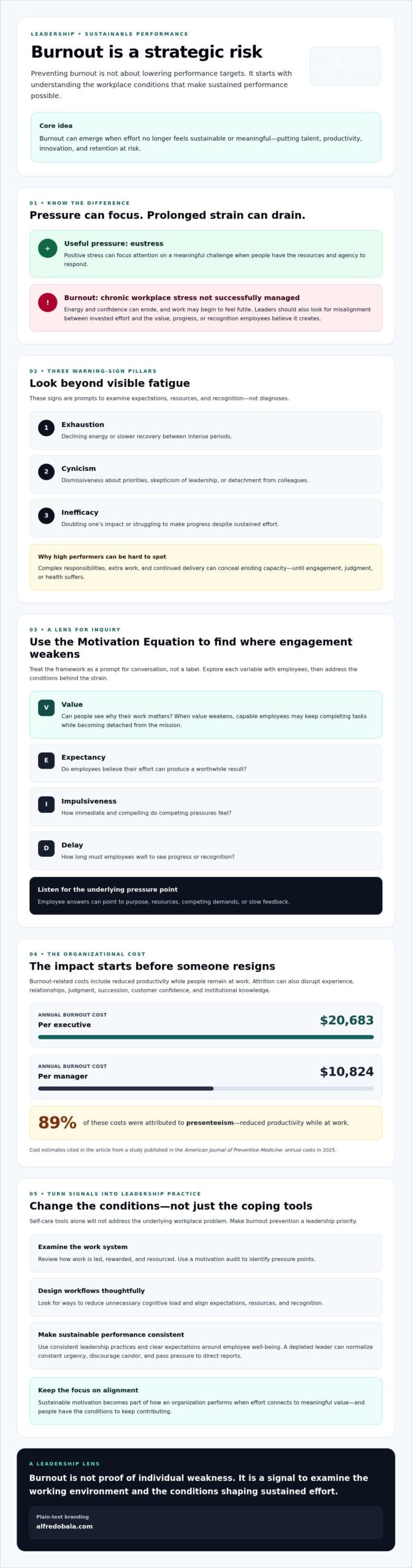
The Executive Blueprint: 5 Steps to Preventing Employee Burnout
Turn concern into action. Preventing employee burnout takes a repeatable leadership process: surface friction, change the conditions driving strain, and check whether those changes are working. Use these five steps as a starting point, then revisit them as team needs and priorities evolve.
Step 1: Audit the Motivation Equation
Ask where motivation may be breaking down across Value, Expectancy, Impulsiveness, and Delay. Combine anonymous feedback with one-on-one conversations. Explain what you’re examining, how input will be used, and when employees will hear what happens next. A survey that produces no visible response can deepen distrust. Look for specific sources of friction, such as repeated approvals in a sales process or unclear ownership between global operations teams.
Step 2: Redesign Work to Reduce Load and Delay
Map a demanding workflow from start to finish. Look for duplicate reporting, excessive handoffs, unclear priorities, and decisions waiting on a single approver. Remove or simplify steps where possible, clarify who can decide, and shorten feedback loops. The goal isn’t to ask people to work faster. It’s to make important work easier to complete without constant context switching or avoidable delays.
Step 3: Recognize Contributions with Specificity
Generic awards can feel disconnected from the work they’re meant to recognize. Name a concrete contribution, explain its impact, and tailor the acknowledgment to the person. One employee may value public credit; another may prefer a private note or a meaningful development opportunity. In distributed teams, make recognition timely and accessible across locations. Don’t let visibility in one office determine whose work gets noticed. Explore these team retention strategies for ideas relevant to maintaining engagement across distributed teams.
Step 4: Make It Safe to Raise Concerns
Set regular channels for employees to flag unmanageable workloads, conflicting goals, or risks without being dismissed. Listen without rushing to defend a decision, clarify what can change, and follow through. Psychological safety grows when people see that honest input leads to thoughtful action, even when not every request can be granted.
Step 5: Model Boundaries from the Top
Executives set standards through what they reward and model. Protect time away, avoid treating every message as urgent, and plan leadership coverage so work doesn’t depend on constant availability. An executive sabbatical may be one way to demonstrate that recovery is compatible with responsibility, but consistent boundaries matter more than a single gesture.
Make the audit and follow-up part of normal leadership practice, not a one-time campaign. To bring these motivation principles into a wider organizational conversation, explore Alfredo Bala’s keynote speaking.
Cultivating Long-Term Vitality: The Leader’s Role in Sustainable Performance
Burnout prevention isn’t a campaign with a launch date and finish line. It’s an ongoing leadership discipline: check whether expectations match capacity, listen for emerging pressure points, and adjust how work gets done as conditions change. Organizations that make sustainable performance part of everyday practice may be better positioned to retain experienced people and compete for talent. The goal isn’t effortless work. It’s a culture where people can contribute at a high level without treating depletion as the price of commitment.
Boards can help set that direction. A corporate board advisor can bring employee well-being into strategic conversations, encourage leaders to examine the working conditions behind performance, and support consistent expectations from the top. Standards matter when they shape decisions about priorities, management behavior, and sustainable growth, not just statements of intent.
From Manager to Mentor: Shifting the Leadership Paradigm
Move beyond managing tasks alone. The “Motivation Guy” approach, reflected in Alfredo Bala’s work on The Motivation Equation, invites leaders to understand what gives effort meaning and what makes success feel achievable. A manager who mentors connects daily work to purpose, provides direction without controlling every move, and helps people develop greater ownership. Over time, that approach can build a leadership legacy that values human performance alongside financial performance.
That balance needs to be visible in how leaders define success. If targets are met only through constant urgency, the organization should question whether its performance model can last. Make motivation and team health part of recurring leadership discussions, then follow through on the issues employees raise.
Scaling These Strategies with Professional Keynotes
For global organizations, shared language can help teams in different locations recognize the same principles: meaningful contribution, clear expectations, trust, and sustainable effort. A keynote can introduce those ideas across an organization and give leaders a common starting point for discussion. The real test comes afterward, when managers translate the message into practical choices about priorities, communication, and workload.
Alfredo Bala draws on his experience as a former CEO and COO and a global perspective on team development. Explore his work as a leadership speaker for corporate events to consider how a shared motivational framework could support your organization’s culture.
Motivation is fuel for growth. Don’t let your engine run dry. Make preventing employee burnout a continuing leadership priority, and build the conditions for people and performance to thrive together.
Build the Conditions for Lasting Performance
Preventing employee burnout isn’t about asking people to endure more or adding a temporary wellness initiative. Treat motivation as a leadership priority: check whether work feels valuable, success seems achievable, and teams have the resources and space to perform sustainably. Keep listening, address friction early, and make these practices part of how the organization operates.
That discipline can strengthen retention and help protect the energy people need to contribute, adapt, and innovate. It starts with leadership. Alfredo Bala created The Motivation Equation, a framework for understanding the conditions that influence motivation. His global perspective and experience serving corporate boards can help leaders connect human performance with long-term organizational goals.
Ready to turn motivation into a foundation for sustainable growth? Explore booking Alfredo Bala for a corporate event or discussing a board seat, and consider how the Motivation Equation could support your organization’s next chapter.
Motivation is fuel for growth. Protect it, invest in it, and give your people the conditions to thrive.
Frequently Asked Questions
What are the first signs of employee burnout a leader should look for?
Look for sustained changes in energy, attitude, and confidence, not one difficult day. An engaged employee may become unusually detached, cynical about team goals, slower to make decisions, or less willing to take ownership. You might also notice missed handoffs or withdrawal from collaboration. Treat these as reasons to check in, not proof of burnout. Ask what’s changed and whether priorities, workload, or support need attention.
Is burnout the same as being stressed or overworked?
No. Stress and overwork can contribute to burnout, but they aren’t the same thing. A demanding period may ease when deadlines pass or workload changes. The World Health Organization describes burnout as an occupational phenomenon resulting from chronic workplace stress that hasn’t been successfully managed. It’s associated with exhaustion, increased distance or cynicism toward work, and reduced professional efficacy. Leaders should address persistent workplace conditions rather than assume time off alone will resolve them.
How can I prevent burnout in a high-pressure sales environment?
Preventing employee burnout in sales starts with making performance expectations achievable and the path to success clear. Review targets against territory conditions, staffing, and available tools. Remove unnecessary reporting or approval steps, clarify which tasks take priority, and give representatives timely coaching and specific recognition. Track patterns such as repeated after-hours work or difficulty handing off customers. Use those signals to improve work design, not to blame employees for struggling under pressure.
Can a “Motivation Equation” really solve systemic burnout?
No framework can solve burnout on its own, and The Motivation Equation shouldn’t be treated as a substitute for changing harmful working conditions. It can help leaders identify where motivation may be weakening, such as whether work feels valuable, success seems achievable, or progress is delayed by barriers. Use those insights to guide practical action on workload, resources, decision-making, and recognition. Then ask employees whether the changes are making work more sustainable.
How do I talk to an employee who I suspect is burning out?
Choose a private, calm setting and describe specific changes you’ve observed without labeling or diagnosing the person. Try, “I’ve noticed you’ve been carrying several urgent projects. How is the workload feeling?” Listen without immediately defending priorities, and ask what would help. Agree on a practical next step, such as clarifying deadlines or redistributing work, then follow up. If the employee raises health concerns, encourage them to seek appropriate professional support.
What is the role of the C-suite in preventing burnout across the whole company?
The C-suite sets the conditions managers are expected to uphold. Executives can align goals with available resources, reward sustainable results rather than constant availability, and make it safe to raise concerns about workload. They should also review whether teams have clear priorities, decision authority, and realistic delivery timelines. Preventing employee burnout requires visible follow-through: leaders need to act on patterns employees report and check whether those actions improve day-to-day work.
Does remote work increase or decrease the risk of burnout?
Remote work can reduce some pressures, such as commuting, while introducing others, including social disconnection and blurred boundaries between work and personal time. The effect depends on how the work is managed. Teams spread across time zones may feel pressure to stay available beyond their local workday. Set clear response-time expectations, plan handoffs, protect off-hours, and create deliberate opportunities for connection instead of relying on constant online presence.
How long does it take to recover from burnout once it has happened?
There’s no reliable single recovery timeline. It depends on the person, how long the strain has continued, their circumstances, and whether the conditions causing burnout change. Leaders shouldn’t promise a quick return to full capacity or assume a short break will resolve persistent problems. Discuss work adjustments with the employee, agree on manageable priorities, and check in regularly. If symptoms are severe or continue, encourage them to consult a qualified health professional.
 ES
ES  EN
EN
Comentarios recientes