
That persistent dread that you were promoted by mistake isn’t a sign of failure. It is the natural friction of rapid executive growth. Stepping to the head of the conference room often triggers an exhausting instinct to overwork, micromanage, and fear making an incorrect strategic decision in public. If you constantly discount your achievements or quietly worry that direct reports will question your credibility, you aren’t alone. In reality, overcoming imposter syndrome as a new leader isn’t about eliminating every trace of hesitation. It is about learning to channel that cognitive tension into operational clarity and disciplined command.
You already have the talent to hold the room; now you need the systematic framework to own it. In this strategic roadmap, you will master practical, executive-tested strategies to reframe self-doubt, command authority, and lead teams with unshakeable confidence. Across the sections ahead, we examine concrete behavioral tools to make firm decisions under scrutiny, distinguish legitimate skill growth from irrational anxiety, and successfully shift your identity from individual contributor to strategic organizational leader.
Key Takeaways
- Discover why self-doubt surges during major career transitions, and apply a four-step operational protocol for overcoming imposter syndrome as a new leader.
- Break the producer trap by pivoting your daily mindset from hands-on technical execution to high-impact strategic orchestration.
- Build a trusted personal advisory council of mentors and executive peers to dismantle isolation and validate your decision-making under pressure.
- Establish an authentic executive presence anchored in steady composure and clear boundaries rather than an unsustainable mask of perfection.
- Convert your professional growing pains into high-leverage coaching insights that inspire confidence and resilience across your entire team.
Decoding Imposter Syndrome in New Leadership Roles
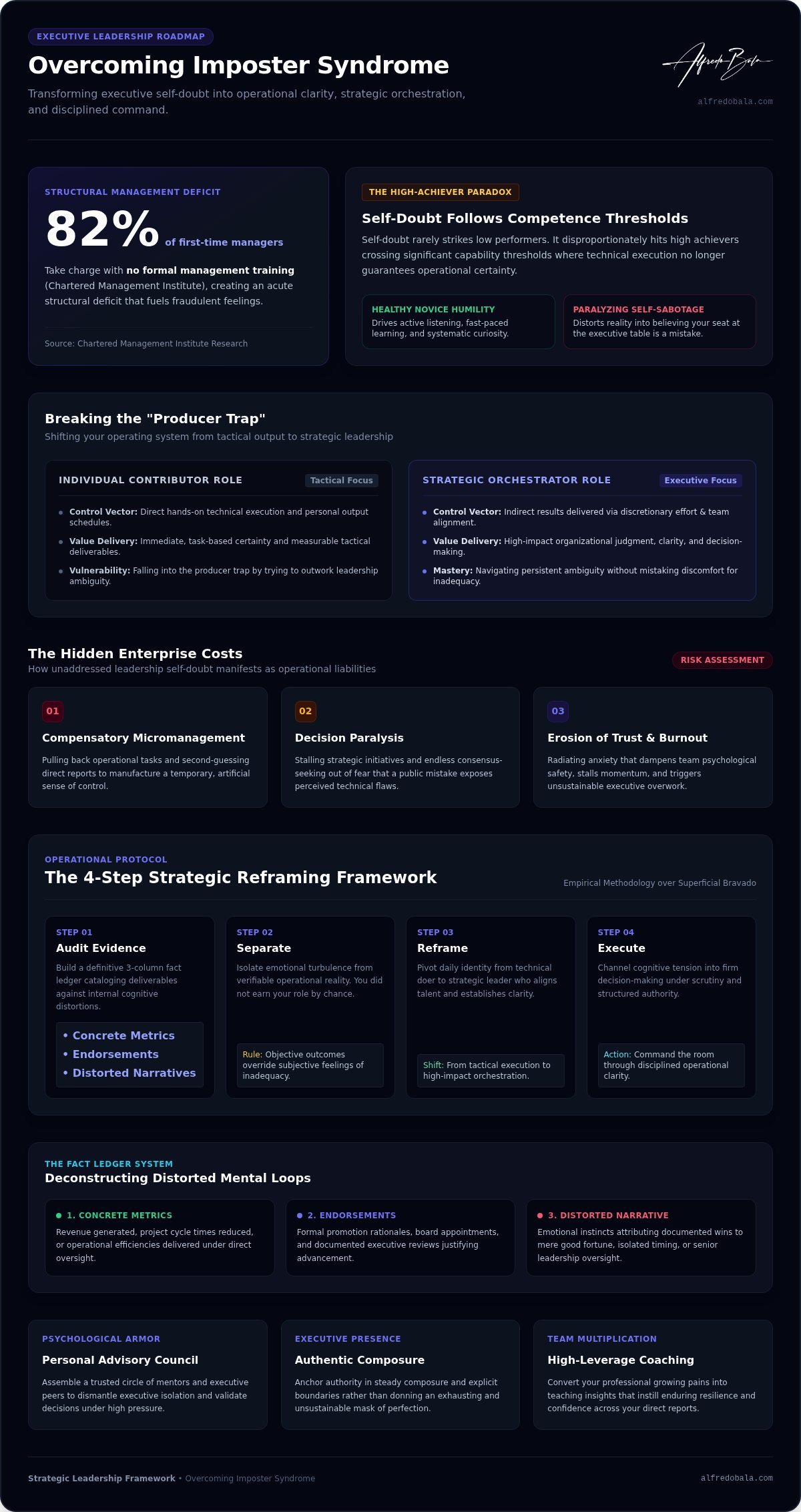
Promotion changes the rules overnight. One day your value rests on individual technical execution; the next, your standing depends entirely on organizational orchestration, strategic judgment, and human alignment. Executive growth reveals a universal truth: self-doubt rarely strikes low performers. Instead, it disproportionately hits high achievers crossing significant capability thresholds. In executive leadership, this internal friction is recognized not as an incurable character flaw, but as impostor syndrome, a predictable cognitive reaction when technical competence no longer guarantees operational certainty. Successful leadership requires drawing a clear line between healthy novice humility, which fuels active listening and rapid learning, and paralyzing self-sabotage, which convinces you that your seat at the executive table is an administrative mistake. Mastering this distinction represents your primary baseline for overcoming imposter syndrome as a new leader.
The Root Mechanics of Leadership Self-Doubt
Self-doubt begins with the sudden loss of task-based certainty. As an individual contributor, you controlled the tactical inputs and outputs of your schedule. As a leader, your results are indirect, realized through the discretionary effort and execution of your team. Data from the Chartered Management Institute highlights that 82% of first-time managers take charge with no formal management training, creating an acute structural deficit that feeds fraudulent feelings. New managers immediately stumble into a dangerous psychological trap: assuming every peer and executive in the room possesses complete clarity. They don’t. Seasoned leaders simply know how to navigate persistent ambiguity without mistaking temporary discomfort for personal inadequacy.
The Hidden Cost of Unchecked Imposter Anxiety
Unchecked insecurity extracts a heavy toll across the enterprise. When self-doubt goes unexamined, it manifests as concrete organizational liabilities:
- Compensatory micromanagement: Pulling back operational tasks and second-guessing direct reports to manufacture a temporary, artificial sense of control.
- Decision paralysis: Stalling strategic initiatives and endless consensus-seeking out of fear that a public mistake will expose perceived technical shortcomings.
- Erosion of trust: Radiating anxiety that destabilizes direct reports, dampening team psychological safety and stalling organizational momentum.
The resulting cycle of compensatory overwork creates severe executive burnout. Overcoming imposter syndrome as a new leader is not a luxury or a soft corporate platitude; it is a fundamental business imperative to protect both personal stamina and organizational performance.
The 4-Step Strategic Reframing Framework for Emerging Leaders
Dismiss the cliché of faking it until you make it. In high-stakes corporate environments, superficial bravado collapses under operational scrutiny. Lasting leadership confidence requires an empirical methodology that transforms subjective anxiety into disciplined strategic clarity. Clinical research on strategies to overcome the impostor phenomenon emphasizes that self-efficacy grows through behavioral interruption rather than passive affirmations. Overcoming imposter syndrome as a new leader demands a structured four-phase protocol: Audit, Separate, Reframe, and Execute.
Step 1 & 2: Auditing Evidence and Separating Emotion from Fact
Begin by assembling a definitive fact ledger. Imposter anxiety thrives on cognitive distortions, particularly catastrophizing and the systematic discounting of positive feedback. To break this mental loop, catalog your verifiable career deliverables into three clear columns:
- The Concrete Metric: Revenue generated, project cycle times reduced, or operational efficiencies delivered under your direct oversight.
- The Organizational Endorsement: Formal promotion rationales, board appointments, and documented executive reviews that led to your advancement.
- The Distorted Narrative: The emotional instinct attributing those wins to good fortune, isolated timing, or temporary oversight by senior leadership.
Comparing raw outcomes against internal stories separates emotional turbulence from operational reality. You did not stumble into your role by accident. The ledger proves your seat was earned through consistent output.
Step 3 & 4: Embracing the Growth Edge and Executing With Velocity
Treat every operational unknown as an active laboratory. The expert trap tempts managers to believe they must hold every technical answer before speaking. True strategic leaders focus on improving organizational capability rather than proving personal perfection. When faced with an unfamiliar workflow, reframe the discomfort from “I am inadequate” to “I am expanding my operational range.”
Action dissolves dread. Establish a non-negotiable operational rule: execute critical, low-risk decisions within 24 hours. Prolonged deliberation feeds the cycle of self-doubt, whereas rapid, calibrated execution builds immediate momentum. Integrating the behavioral principles found in The Motivation Equation book provides a systematic foundation for aligning intrinsic purpose with daily organizational performance. If you want to deepen your executive readiness, exploring focused leadership and team development insights will help you solidify this decision-making cadence across your entire business unit.
Transitioning from Individual Contributor to Strategic Orchestrator
Your identity must evolve before your team will follow. The fundamental tension of new management lies in clinging to the tools that earned your initial promotion. As an individual producer, value came from hands-on craftsmanship, immediate task completion, and visible personal output. Strategic orchestration demands the opposite. Your core deliverable is no longer direct execution; it is the clarity, alignment, and momentum of the people carrying out the work. Relying on technical mastery to feel authoritative is an addiction. It comforts your ego while suffocating your team’s autonomy, making true executive growth impossible. In organizational dynamics, overcoming imposter syndrome as a new leader requires trading the dopamine of personal finishing lines for the compounding leverage of collective performance.
Breaking the Specialist Addiction and Letting Go of the Tools
Stepping back into the weeds to fix deliverables signals acute operational insecurity. According to the DDI Global Leadership Forecast, only 19% of rising leaders possess the foundational delegation skills needed to operate as strategic orchestrators. To break this reflex, apply a three-tiered ownership rubric:
- Tier 1 (Direct Ownership): High-stakes strategic decisions and organizational architecture where the risk profile requires executive sign-off.
- Tier 2 (Guided Autonomy): Core operational initiatives managed independently by team members, with scheduled milestone reviews.
- Tier 3 (Total Delegation): Routine tactical tasks transferred entirely to direct reports with zero managerial interference.
When direct reports bring challenges to your desk, resist giving instant answers. Ask probing questions that coach them to build their own decision architecture. Reviewing evidence-based strategies for overcoming impostor phenomenon confirms that relinquishing granular control reinforces mutual capability and reduces personal cognitive strain.
Embracing Influence and Strategy Over Task Execution
Protect your calendar with absolute discipline. Block out four hours every week exclusively for horizon scanning, cross-functional risk assessment, and resource allocation. If you fill every open hour with tactical meetings, you abandon your primary organizational duty: pointing the ship in the right direction. Mastering the shift from functional operator to enterprise visionary requires studying proven executive leadership development strategies. Communicate clear, high-level objectives that articulate the strategic “why” while leaving room for diverse execution styles. Overcoming imposter syndrome as a new leader happens when you realize that your authority doesn’t stem from having all the answers, but from framing the right questions.
Building Psychological Armor: Mentorship, Feedback, and Peer Alliances
Isolation amplifies every silent insecurity. When you step into executive responsibility, the natural camaraderie of being one of the team dissolves, leaving a vacuum that self-doubt eagerly fills. Navigating this transition alone is dangerous; it turns routine operational friction into distorted evidence of personal inadequacy. Data confirms this vulnerability: the KPMG Women’s Leadership Summit Report revealed that 72% of executives identify trusted advisors and mentors as the single most critical factor in overcoming transition-induced doubt. Building a fortified sounding board outside your immediate chain of command is essential for overcoming imposter syndrome as a new leader, giving you an objective mirror when high-pressure scenarios distort your perspective.
Architecting a Safe Executive Sounding Board
Never rely on a single voice for executive counsel. Construct a personal advisory council made up of three distinct profiles:
- The Organizational Guide: An internal senior leader who understands internal corporate politics, institutional history, and cultural dynamics without sitting in your direct reporting line.
- The Domain Expert: A functional veteran who can sanity-check operational strategies and resource models without evaluating your personal performance.
- The Neutral Veteran: An external executive or cross-industry peer who offers complete psychological safety, completely detached from your enterprise’s internal politics.
Schedule a recurring monthly review with this group. Focus specifically on your decision architecture, stakeholder friction, and strategic communication rather than day-to-day tactical updates.
Calibrating Feedback Without Validation Traps
Stop asking people how you are doing. That question invites empty reassurances or polite affirmations that your internal critic will dismiss as flattery within minutes. Instead, solicit concrete developmental data. Ask targeted questions: “What was the single biggest gap in the business case presented yesterday?” or “Where did my delivery during the board review lose strategic momentum?”
Treat the answers as empirical operational telemetry. Cross-reference incoming critique against team output and strategic milestones, discarding emotional noise while extracting the technical lesson. Real executive composure comes from knowing you can absorb intense scrutiny without internalizing it as proof of personal fraudulence. If you want to accelerate your transition and sharpen your operational instincts, explore practical leadership and team development insights to build the systematic resilience required at the executive level.
Sustaining Executive Presence and Long-Term Leadership Mastery
True executive presence is not an untouchable posture or theatrical bravado. It is grounded composure, operational transparency, and the discipline to maintain clear strategic boundaries when market conditions shift. The self-doubt you faced when stepping into authority is not a liability to hide; it is your greatest leadership asset. When you harness that past vulnerability, you gain the empathy required to mentor high-potential talent facing their own capability leaps. Sustained authority is never an endpoint where all anxiety permanently disappears. It is a continuous practice of anchoring your focus in organizational purpose rather than internal insecurity.
The Core Pillars of Authentic Executive Command
Commanding a room requires emotional regulation and linguistic discipline. Under intense pressure, your team takes its cues from your nervous system. Cultivate steady situational composure by adopting three non-negotiable operational habits:
- Decisive economy: Strip away qualifiers like “I just think” or “This might be wrong, but.” State your strategic rationale directly and invite objective stress-testing.
- Radical accountability: Own strategic miscalculations swiftly. Research from the DDI Global Leadership Forecast highlights that employees are 7.5 times more likely to trust leaders who transparently acknowledge their own mistakes or limits.
- Calibrated boundaries: Protect organizational focus by saying no to low-yield initiatives that dilute team velocity.
Transparently addressing missteps does not undermine your credibility; it solidifies your stature as an executive secure enough to let facts govern decisions.
Scaling Beyond the Self into Transformational Leadership
Your ultimate transition is moving from personal survival to organizational multiplication. Long-term mastery means designing an environment where psychological safety and high performance co-exist. Celebrate calculated risk-taking openly so your teams operate with boldness rather than defensive caution. When senior teams require alignment around sustained execution, bringing in an experienced keynote speaker for organizational growth can bridge high-level strategy with actionable motivation across business units.
View every organizational disruption and career milestone as an executive crucible. Ultimately, overcoming imposter syndrome as a new leader is not about reaching a state where doubt never surfaces. It is about building the psychological armor and operational clarity to lead decisively regardless of whether it does.
Step Into Decisive Executive Command
Stepping into management tests your identity, but self-doubt doesn’t define your capability. True authority begins when you stop measuring worth through personal output and start measuring it through organizational velocity. Overcoming imposter syndrome as a new leader means grounding your decisions in objective data, delegating with conviction, and relying on trusted peer alliances during high-stakes transitions.
Navigating this crucible demands battle-tested frameworks rather than trial and error. Backed by over 40 years of global executive leadership, experience as a former CEO and board advisor to high-growth international enterprises, and as author of The Motivation Equation, Alfredo Bala equips rising executives to convert internal friction into peak operational performance. Accelerate your executive trajectory with leadership keynote speaker Alfredo Bala and empower your organization to execute with unshakeable clarity. Your seat at the table was earned; now command it.
Frequently Asked Questions
Is imposter syndrome common among newly appointed managers and executives?
Yes, self-doubt is standard among high-achieving leaders stepping into expanded authority. Research shows that roughly 75% of female executives report experiencing imposter phenomenon during major career transitions, while 71% of all new leaders report elevated stress post-promotion. Stepping into ambiguity without prior management training naturally provokes internal friction. Feeling uncertain does not mean you lack capability; it simply indicates that your operational scope has expanded beyond your previous comfort zone.
What is the difference between normal beginner humility and clinical imposter syndrome?
Imposter syndrome is not an official clinical diagnosis or psychiatric disorder in the DSM-5-TR or ICD-11; behavioral scientists classify it as a cognitive attribution style. Beginner humility is a healthy awareness that you have technical skills to master, driving curiosity and active listening. In contrast, imposter phenomenon is irrational self-sabotage where high performers systematically discount verifiable achievements, attributing genuine operational success entirely to luck, timing, or external error.
How can I stop micromanaging my team when I feel insecure about my own performance?
Stop micromanaging by defining clear parameters of outcome rather than dictating tactical processes. Agree on what successful delivery looks like, establish milestone check-ins, and step back from daily mechanics. Recognize that taking back work is an anxiety response designed to manufacture control. Overcoming imposter syndrome as a new leader requires building comfort with indirect output, trusting your team to execute, and shifting your focus toward removing organizational roadblocks.
Should I ever admit to my direct reports or executive team that I feel out of my depth?
Never confess feelings of generalized inadequacy to direct reports; instead, practice curated transparency. Acknowledge when a specific technical challenge is new or when data is incomplete, while maintaining calm confidence in the team’s ability to solve it. Reserve raw discussions about personal doubt for an external mentor or your personal advisory council. Direct reports need to see steady emotional composure, clear operational direction, and intellectual honesty about strategic unknowns.
How long does leadership imposter syndrome typically last after stepping into a new role?
Acute transition anxiety generally peaks during the first six to twelve months of a new executive appointment. As you make decisions, navigate organizational friction, and observe the tangible outcomes of your direction, objective evidence begins replacing irrational self-doubt. However, internal friction often re-emerges whenever you take on larger operational scopes or lead restructuring efforts. Lasting mastery comes from managing that discomfort effectively rather than waiting for it to permanently vanish.
Can imposter syndrome actually be converted into a competitive leadership advantage?
Yes, acute self-awareness can make you a sharper, more empathetic organizational strategist. Leaders who experience self-doubt often listen more attentively, examine risk scenarios thoroughly, and reject complacency. When channeled constructively, this cognitive friction prevents arrogance and encourages continuous learning. The key to overcoming imposter syndrome as a new leader is using that heightened vigilance to stress-test business strategies without allowing it to paralyze your final decision-making.
What daily routines help maintain executive presence when internal self-doubt strikes?
Begin each morning by identifying your top three strategic needle-movers before checking email or chat channels. Ground yourself in an objective fact ledger recording quantifiable wins whenever catastrophizing thoughts surface. Before high-stakes meetings, practice steady, deliberate breathing and strip apologetic qualifying language from your speaking notes. Holding disciplined boundaries around your calendar reinforces mental clarity, ensuring you lead with focused intent rather than reactive emotional turbulence.
 ES
ES  EN
EN
Comentarios recientes