
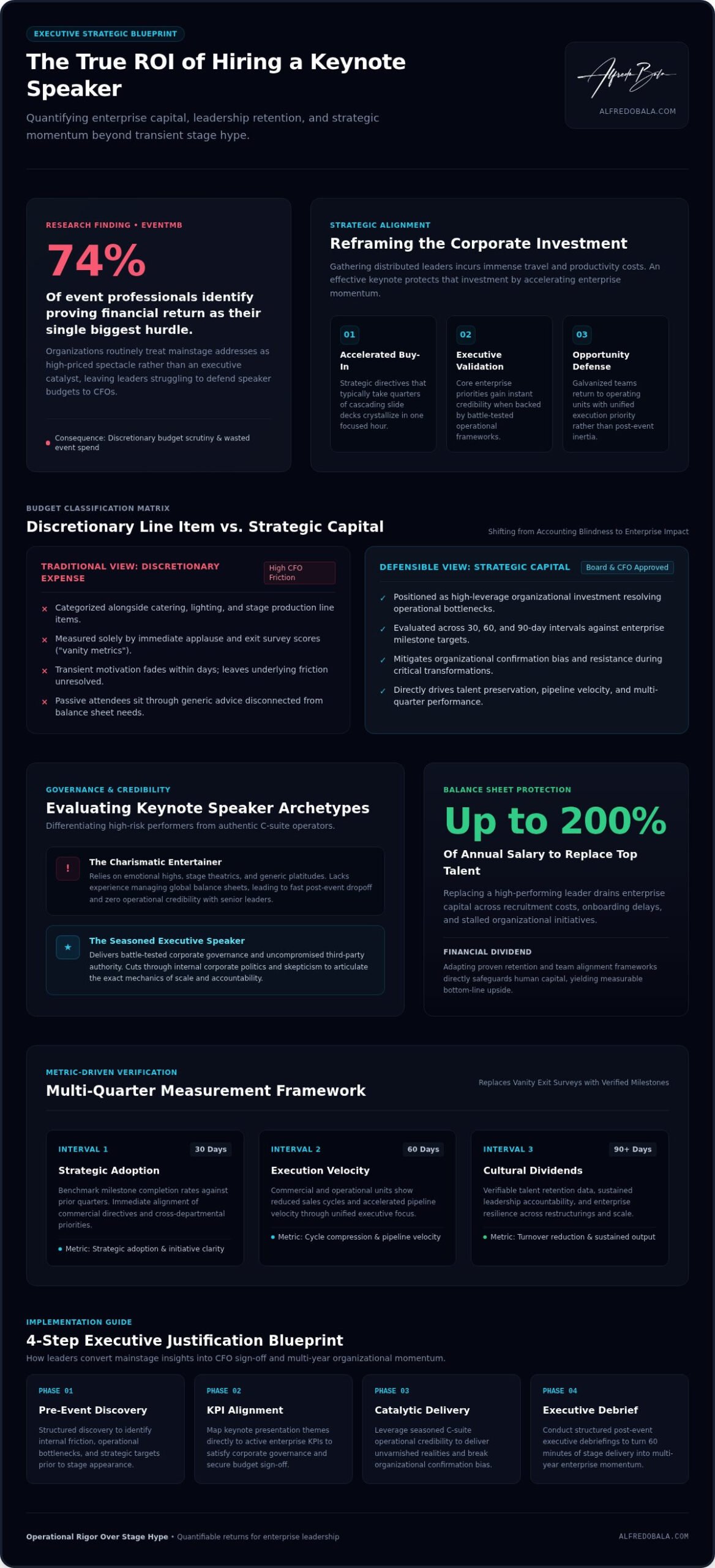
According to research from EventMB, 74% of event professionals report that proving financial return is their single biggest hurdle when justifying speaker budgets. It makes complete sense. Too often, organizations treat mainstage presentations as high-priced spectacle rather than an executive catalyst, leaving leaders struggling to defend the true ROI of hiring a keynote speaker when facing scrutiny from their CFO. When the applause fades and the room empties, transient hype doesn’t resolve operational friction or shift team performance.
You already know that sustainable organizational growth requires rigorous strategic alignment, not superficial platitudes from stage performers who haven’t managed a global balance sheet. In this guide, you’ll discover how to quantify the bottom-line business value, cultural dividends, and tangible returns of bringing proven executive leadership to your organization. We’ll provide a defensible, metric-driven framework that satisfies board governance, eliminates wasted event spend, and turns stage inspiration into measurable enterprise momentum.
Key Takeaways
- Reframe stage presentations from discretionary line items into strategic capital investments that directly resolve operational friction.
- Establish a metric-driven framework to evaluate the true ROI of hiring a keynote speaker by balancing immediate engagement with multi-quarter performance dividends.
- Differentiate high-risk charismatic entertainers from seasoned executive speakers who bring battle-tested corporate governance and C-suite operational credibility.
- Deploy a defensible, four-step internal business case blueprint designed to align speaker themes with enterprise KPIs and secure CFO budget sign-off.
- Implement structured pre-event discovery and post-keynote executive debriefings to convert mainstage insights into multi-year organizational momentum.
The Strategic Business Case: Why Keynote Speakers Are Investments, Not Line Items
Corporate finance teams reflexively categorize guest speakers under discretionary event production costs, right next to catering, staging, and lighting. This accounting convention blinds leadership to reality. A well-crafted keynote address is not an entertainment expense; it is a capital investment in organizational momentum. When leadership teams evaluate the true ROI of hiring a keynote speaker, they must measure how effectively an engagement accelerates enterprise-wide priorities, unifies fragmented business units, and removes operational friction across key growth initiatives.
Reframing Corporate Events from Expense to Strategic Capital
Passive conferences drain resources. Gathering hundreds of distributed directors, managers, and executives into an auditorium incurs immense travel costs and lost operational hours. If that assembly merely sits through status reports and routine slide decks, the enterprise absorbs a quiet loss in productivity. A catalytic keynote reframes that entire gathering into a high-leverage alignment opportunity.
- Accelerated buy-in: Strategic directives that normally take quarters of cascading slide decks can crystallize in an hour of focused delivery.
- Executive validation: Core corporate initiatives gain immediate credibility when substantiated by proven, global operational frameworks.
- Mitigated opportunity cost: Galvanized teams return to their operating units with unified focus rather than post-conference inertia.
The Power of the Outside Perspective in Overcoming Executive Resistance
Internal leadership often faces institutional headwinds during major restructurings, mergers, or cultural shifts. Familiarity breeds skepticism; teams discount executive memos because they suspect internal politics or short-term maneuvering. Breaking this organizational confirmation bias requires an uncompromised third-party voice. An external leader who has occupied the C-suite speaks with distinct operational authority, delivering unvarnished realities that internal executives cannot voice without triggering defensive posturing.
Partnering with a seasoned leadership speaker for corporate events cuts through corporate inertia. When a battle-tested executive unpacks the exact mechanics of international scale, cultural alignment, and team accountability, organizational resistance dissolves. Evaluating the long-term ROI of hiring a keynote speaker requires looking past immediate stage charisma and recognizing the operational clarity that only seasoned executive peers can deliver.
Measuring the ROI of Hiring a Keynote Speaker: Hard Metrics vs. Cultural Dividends
Immediate applause is a vanity metric. While positive post-session survey scores show initial enthusiasm, finance committees require balance sheet verification. Modern frameworks for measuring the ROI of a keynote speaker evaluate organizational change across 30, 60, and 90-day intervals instead of relying on exit surveys. Quantifying the true ROI of hiring a keynote speaker requires analyzing both verifiable operational indicators and the lasting cultural dividends that sustain enterprise momentum.
Hard Metrics: Quantifying Performance, Retention, and Revenue Velocity
High-impact keynotes deliver measurable operational results. When an executive speaker clarifies strategic objectives, commercial teams align quickly, reducing sales cycles and accelerating pipeline velocity. Execution tracking provides the clearest balance sheet proof; organizations benchmark milestone completion rates against previous quarters to confirm strategic adoption.
Talent preservation yields immediate financial upside. Replacing a high-performing leader costs up to 200% of their annual salary in recruitment, onboarding, and stalled initiatives. Adapting battle-tested team retention strategies for network marketing and corporate divisions safeguards valuable human capital. Lower turnover among top performers quickly covers the initial keynote investment.
Cultural Dividends: Aligning Morale, Purpose, and Resilience
Cultural capital compounds quietly across an organization. When an authentic executive speaker provides a common operational vocabulary, cross-departmental friction drops. Teams stop defending silos and start executing cross-functional initiatives. According to data from RESET published in March 2026, companies with highly engaged workforces achieve 23% higher profitability. That performance gap represents the pure financial power of discretionary effort.
Stage inspiration must translate into lasting behavioral transformation. Leveraging principles outlined in The Motivation Equation book shifts motivation from an emotional feeling into a repeatable operational discipline. For executive teams navigating complex transitions, seeking seasoned leadership and team development insights turns a single presentation into a sustainable competitive advantage.
Evaluating Keynote Speaker Archetypes: Entertainment vs. Authentic Executive Impact
Procurement committees often stumble when categorizing platform talent. They balance four archetypes: marquee celebrities, career motivators, theoretical academics, and seasoned business operators. While charismatic figures light up a ballroom, calculating the true ROI of hiring a keynote speaker demands distinguishing between stage theatricality and operational depth. Energy without execution leaves strategy untouched.
The Celebrity and Entertainer Trap: Flash Without Strategic Substance
Booking a household name or former champion generates instant buzz among attendees. Yet that excitement carries significant operational risk. When a sports star shares locker-room memories or an entertainer recounts Hollywood set pieces, audience engagement peaks on emotion. Then reality sets in.
- Contextual disconnect: Overcoming physical exhaustion on a mountain does not map to managing supply chain bottlenecks or enterprise margin pressures.
- Zero execution architecture: Dramatic storytelling entertains, but it provides no repeatable operational frameworks for line managers.
- Rapid drop-off: Within days of the session, attendee enthusiasm collapses because the content failed to address day-to-day corporate friction.
The Operator Advantage: Why Enterprise Experience Transforms Audiences
Enterprise audiences spot theoretical advice immediately. Cynical directors and overburdened vice presidents have sat through countless generic motivational talks. They respect one credential above all others: proven operational execution. A speaker who has directed international operations, balanced quarterly earnings, and navigated boardroom scrutiny speaks their language. That shared reality shatters audience skepticism instantly.
Authentic authority transforms passive listeners into engaged leaders. Drawing on decades of hands-on leadership as an enterprise CEO, COO, and experienced corporate board advisor, Alfredo Bala bridges high-level corporate strategy with front-line performance dynamics. Seasoned executive speakers don’t rely on manufactured stage tricks. Instead, they share tested systems for global scaling, accountability, and cultural resilience.
Evaluating your speaker roster through an operator-first lens protects the event budget. When platform leaders understand corporate governance, board accountability, and cross-border expansion, the message sticks. That authentic alignment maximizes the ROI of hiring a keynote speaker by delivering practical solutions that drive quarterly performance long after the conference adjourns.
The Executive Justification Blueprint: Building the Internal ROI Proposal
According to research from Elif Stewart published in April 2026, organizations using structured evaluation frameworks are 3.2 times more likely to secure repeat speaker budgets. Approaching the C-suite with vague promises of inspiration triggers immediate budget cuts. Securing fiscal approval requires treating the keynote engagement as an operational intervention, complete with defined success criteria, risk-mitigation plans, and measurable return schedules. When you frame your presentation as a calculated catalyst for enterprise priorities, defending the ROI of hiring a keynote speaker becomes a straightforward financial presentation.
Step 1 & 2: Diagnostic Alignment and Enterprise Metric Mapping
Start by diagnosing your organization’s primary execution bottlenecks. Never pitch a speaker simply because they hold compelling credentials; map them directly against active organizational friction points, such as cross-border alignment, market disruption, or post-merger integration. Selecting a battle-tested keynote speaker for organizational growth grounds the event around measurable operational progress rather than abstract inspiration.
Next, isolate three non-negotiable enterprise performance indicators to track across the subsequent two quarters. Incorporate proven executive leadership development strategies into the proposal, establishing clear baselines for sales cycle velocity, voluntary turnover rates, and milestone delivery speeds. CFOs approve investments when they see documented metrics connecting stage time to enterprise performance.
Step 3 & 4: Stakeholder Vetting and Pre-Event Customization Requirements
Secure cross-functional alignment before presenting the final budget to procurement. Position the keynote as an enterprise-wide asset rather than a departmental cost by outlining how different divisions benefit from a unified operational framework:
- Finance: Frame the fee against the high cost of executive turnover and project slippage.
- Operations: Highlight the immediate productivity gains from broken cross-silo bottlenecks.
- Commercial: Emphasize accelerated pipeline velocity and higher close rates.
Finally, mandate rigorous pre-event discovery. High-impact speakers don’t deliver off-the-shelf presentations. Require dedicated briefing calls between the speaker and your business heads to align company jargon, competitive pressures, and board expectations. If you need a battle-tested perspective that unifies your team around strategic objectives, explore how Alfredo Bala’s corporate speaking programs transform organizational strategy into measurable execution. Securing this level of strategic depth guarantees that your business case stands up to executive scrutiny while cementing the ROI of hiring a keynote speaker.
Maximizing the Dividend: Turning a 60-Minute Keynote into Multi-Year Momentum
The final round of applause should mark the start of organizational transformation, not its conclusion. Extracting full value from platform talent requires treating the keynote address as the catalyst for an operational campaign. When leadership institutes a structured post-event execution model, the overall ROI of hiring a keynote speaker multiplies across subsequent quarters, turning single-day inspiration into permanent operating capabilities.
Structured Reinforcement: The 30-60-90 Day Post-Keynote Cadence
Sustainable momentum requires deliberate enterprise infrastructure. Within 72 hours of the presentation, host an executive debriefing to translate stage insights into immediate departmental priorities. Distribute foundational literature, such as The Motivation Equation, providing managers with a shared blueprint to translate human motivation into measurable performance.
- Days 1-30: Form operational working groups tasked with removing the specific execution bottlenecks spotlighted during the event.
- Days 31-60: Deploy monthly leadership checkpoints tracking behavioral shifts, execution speed, and employee engagement metrics.
- Days 61-90: Embed core presentation principles into quarterly executive reviews, performance scorecards, and divisional town halls.
Partnering with Alfredo Bala for Proven Enterprise Transformation
Sustained operational transformation requires a speaker who understands corporate governance from the inside. With over four decades of global leadership experience, including tenures as Chief Executive Officer of Mannatech Inc. and Chief Operating Officer of Britt World Wide, Alfredo Bala commands the respect of enterprise audiences. He replaces superficial motivational platitudes with battlefield-tested operating principles, showing global teams how to navigate friction, lead through change, and scale performance.
A high-yield keynote should never stand alone as an isolated event. By pairing mainstage delivery with executive debriefings and strategic advisory, organizations maximize the lasting ROI of hiring a keynote speaker and secure permanent cultural dividends. Partner with Alfredo Bala to drive measurable leadership ROI at your next event.
Transform Stage Inspiration into Measurable Enterprise Value
Treating your mainstage as a strategic lever changes everything. When you look beyond transient entertainment, map presentation themes directly to enterprise benchmarks, and enforce a disciplined 90-day execution cadence, the true ROI of hiring a keynote speaker becomes undeniable. You protect organizational capital, unite fragmented teams, and build cultural resilience that compounds across successive quarters.
Achieving this level of organizational transformation requires guidance from an executive peer who has navigated board governance and delivered global operational results. Backed by over four decades of global leadership experience as a former CEO and COO, Alfredo Bala grounds every presentation in the battle-tested performance frameworks of The Motivation Equation. Your leaders don’t need another fleeting pep talk; they deserve proven operational clarity that breaks corporate inertia and accelerates enterprise growth. Book Alfredo Bala for Your Next Corporate Keynote and give your organization the strategic focus it needs to thrive.
Frequently Asked Questions
How do you calculate the financial ROI of a corporate keynote speaker?
Calculate financial return by comparing measurable monetary impact against total engagement costs. Aggregate quantifiable benefits such as reduced executive turnover costs, accelerated sales pipeline velocity, and shortened project execution cycles over the subsequent two quarters. Subtract the speaker fee and travel expenses, then divide that net gain by total engagement costs. Tracking these verified metrics across a 90-day post-conference window gives finance committees clear, balance-sheet proof for the ROI of hiring a keynote speaker.
What is the average cost range when investing in an executive keynote speaker?
Investment tiers vary significantly based on a speaker’s executive background, market reputation, and commercial impact. While emerging practitioners focus strictly on local workshops, high-caliber corporate speakers command enterprise investments reflecting their operating credentials. Executive operators with past CEO or board experience represent the premier corporate tier. Organizations evaluate these investments against business outcomes, recognizing that seasoned executive expertise delivers strategic returns far outweighing initial budget outlays.
How does an executive operator speaker differ from a traditional motivational speaker?
Executive operators build their keynotes on decades of operational governance, P&L management, and organizational restructuring. They speak as peers who understand boardroom friction and cross-border alignment. Traditional motivational speakers rely on charismatic storytelling, theatrical stage presence, and emotional climaxes without addressing enterprise systems. While motivational talks produce brief emotional highs, executive operators provide actionable frameworks that directly tackle systemic friction and operational bottlenecks.
Can a 60-minute presentation truly drive permanent cultural change in a corporation?
A single keynote cannot overhaul enterprise culture in isolation. It serves as an organizational catalyst, disrupting complacency and introducing a unified strategic language. Permanent change takes root when corporate leadership uses that 60-minute address to anchor subsequent operational initiatives. By reinforcing mainstage principles through structured post-event debriefs and performance milestones, executive teams convert temporary inspiration into lasting behavioral shifts.
What questions should an executive committee ask when vetting potential keynote talent?
Committees should ask questions targeting enterprise depth rather than stage polish. Inquire how the speaker customizes content to internal operational challenges, and request unedited video footage of previous presentations. Ask what direct C-suite or board experience they possess to ensure operational credibility. Most importantly, question how they bridge stage concepts into concrete post-event execution, confirming that their message aligns with existing corporate key performance indicators.
How far in advance should an organization book a keynote speaker to maximize ROI?
Organizations should secure platform talent four to nine months before an event. Early booking guarantees speaker availability during peak conference seasons, but the strategic advantage lies in pre-event alignment. Securing your speaker months ahead enables deep diagnostic briefing calls between executive leadership and the speaker. This extended preparation period allows custom messaging to permeate event marketing, building anticipation and maximizing the ROI of hiring a keynote speaker.
What steps ensure that keynote concepts are retained long after the corporate event ends?
Retention requires an operational cadence rather than passive hope. Host executive debriefings within 72 hours of the event to translate presentation concepts into departmental targets. Distribute foundational literature, such as The Motivation Equation, to give managers concrete performance playbooks. Finally, track implementation through 30, 60, and 90-day leadership checkpoints, ensuring that core stage themes become embedded in quarterly performance reviews.
 ES
ES  EN
EN
Comentarios recientes