
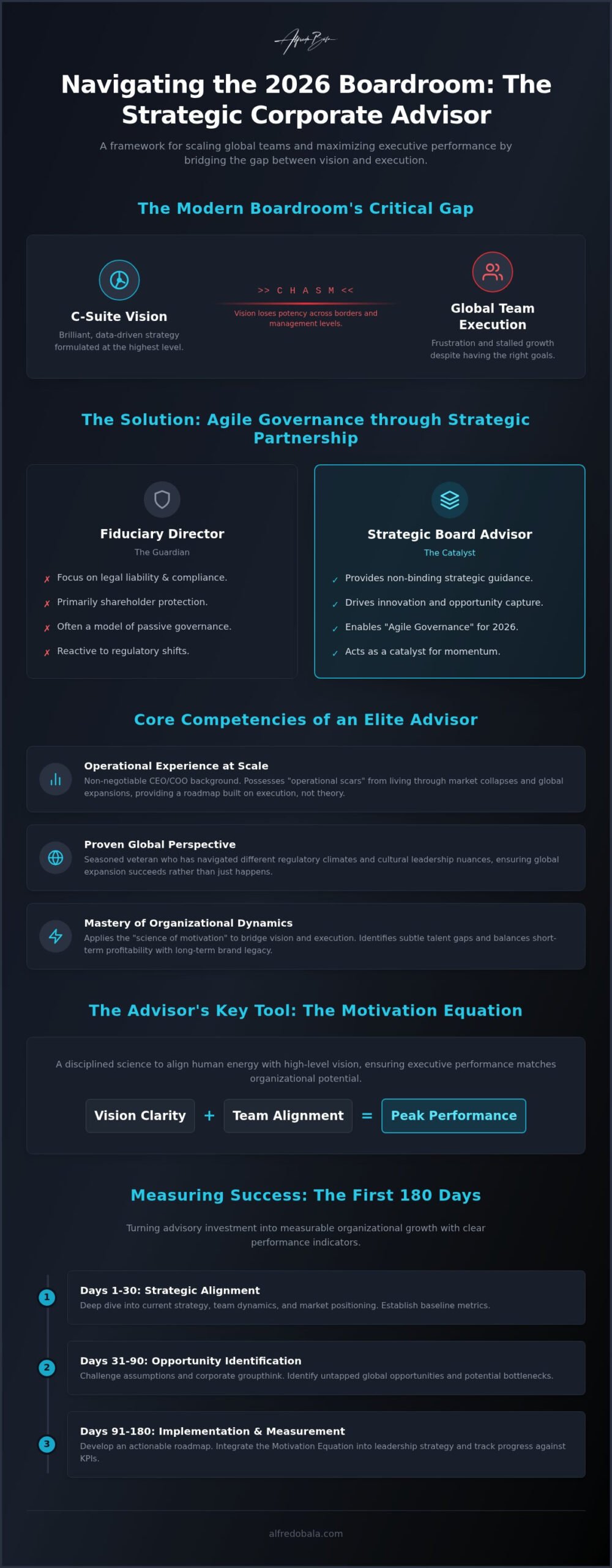
The most dangerous gap in a modern boardroom isn’t found in the balance sheet. It’s the widening chasm between high-level vision and the human energy required to execute it on a global scale. You’ve likely felt the frustration of a brilliant strategy stalling at the mid-management level or watched your C-Suite’s vision lose its potency as it crosses international borders. It’s a common pain point that leads to stagnant growth despite having the right data. Engaging a seasoned corporate board advisor is no longer a luxury for the elite. It’s a strategic necessity for any organization aiming to maintain agility in a 2026 market defined by rapid SEC regulatory shifts and plateauing diversity metrics.
I’ve spent decades navigating these complex professional landscapes and I’ve seen how the right external perspective acts as a catalyst for total transformation. In this guide, you’ll master the selection and utilization of an advisor who understands that success is both a disciplined science and a nuanced art. We’ll examine a clear framework for scaling global teams and increasing board-level agility. You’ll also learn how to implement proven leadership methodologies, such as the Motivation Equation, to ensure your executive performance finally matches your organizational potential.
Key Takeaways
- Distinguish between a fiduciary director and a strategic partner to ensure your leadership structure supports rapid scaling.
- Select a corporate board advisor with deep operational scars and a proven global perspective rather than relying solely on a prestigious resume.
- Compare advisory and fiduciary board models to determine which structure offers the agility and legal protection your organization requires in 2026.
- Integrate the Motivation Equation into your high-level strategy to bridge the gap between executive vision and global team execution.
- Establish clear performance indicators for the first 180 days to turn your advisory investment into measurable organizational growth.
The Role of a Corporate Board Advisor in 2026
The landscape of global business has reached a tipping point. In 2026, the traditional model of passive governance is obsolete. A corporate board advisor serves as a high-velocity strategic partner who operates far beyond the constraints of simple compliance. While a standard fiduciary director carries the weight of legal liability and shareholder protection, a member of an advisory board offers specialized, non-binding guidance that fuels innovation. We are seeing a definitive shift toward “Agile Governance” in global markets, where boards must respond to SEC technical amendments and shifting shareholder engagement models with unprecedented speed. The advisor role is the catalyst for executive clarity and organizational momentum.
Strategic vs. Tactical Advisory
Move past the idea that an advisor is just a consultant with a better title. Tactical advice focuses on fixing immediate problems; strategic advisory focuses on identifying and capturing global opportunities before the competition wakes up. I’ve seen too many organizations succumb to “corporate groupthink,” where internal teams become echoes of the CEO’s own biases. An elite advisor provides the “outside-in” perspective necessary to challenge assumptions. When you’re scaling across international borders, you need a seasoned veteran who has navigated different regulatory climates and cultural leadership nuances. This isn’t about theory. It’s about applying hard-won operational wisdom to ensure your global expansion doesn’t just happen, but succeeds.
The Evolution of Board Influence
Influence in the modern boardroom has moved from quarterly reviews to continuous strategic alignment. The role of the corporate board advisor has evolved into a mentoring partnership with the CEO and the C-Suite. In 2026, the complexities of AI integration and a volatile geopolitical landscape require more than just a passing glance at a slide deck. Advisors now act as a confidential sounding board, helping leaders maintain their focus on human capital and the “science of motivation” while navigating digital disruption. It’s a steady, building rhythm of achievement. You aren’t just looking for someone to check your work; you’re looking for a partner who can help you elevate your entire leadership methodology to meet the demands of a new era.
Core Competencies: What Makes an Elite Board Advisor?
Elite performance in the boardroom isn’t born from academic theory. It’s forged in the fires of operational reality. An elite corporate board advisor must possess more than just a list of soft skills; they require the hard-won wisdom that only comes from occupying the corner office. While many focus on networking, true value lies in understanding the Essential Corporate Governance Duties through the lens of a practitioner who has lived through market collapses and global expansions. This operational wisdom allows an advisor to challenge the status quo with precision, ensuring that growth doesn’t come at the expense of organizational harmony.
Operational Experience at Scale
Consulting theory often falls apart when it meets the friction of executive reality. This is why a background in global operations, specifically as a CEO or COO, is non-negotiable for high-impact advisory work. You need someone who understands how a decision in the boardroom ripples through a supply chain in Asia or a sales team in Europe. When evaluating executive leadership development strategies, an advisor with 40 years of international experience can spot the difference between a scalable process and a bottleneck disguised as a solution. They’ve seen the “scars” of failed initiatives and use that data to steer your organization toward proven success. They don’t just suggest ideas; they provide a roadmap built on execution.
Mastery of Organizational Dynamics
Success is a disciplined science. An elite advisor masters the human element by applying the Motivation Equation to the corporate hierarchy. They identify the subtle talent gaps that internal teams, blinded by proximity, often overlook. It’s about balancing the immediate pressure for short-term profitability with the long-term integrity of your brand legacy. If you’re ready to bridge the gap between high-level vision and global execution, consider how a seasoned board advisor can redefine your trajectory. By predicting market shifts before they hit the balance sheet, these veterans ensure your board remains agile and your leadership stays inspired. This foresight is the difference between reacting to the market and defining it.
Advisory Board vs. Fiduciary Board: Selecting Your Model
Choosing between a fiduciary board and an advisory board isn’t just a legal formality. It’s a strategic decision that dictates your organization’s speed and risk appetite. A fiduciary board of directors carries the heavy burden of legal liability and shareholder protection. Their primary focus is often compliance and risk mitigation, which can sometimes slow the pace of innovation. In contrast, an advisory board offers non-binding guidance, allowing for a higher degree of flexibility. For a rapidly scaling global company, the presence of a corporate board advisor provides the specialized insight needed to navigate complex markets without the administrative drag of a formal fiduciary structure.
We often see high-growth firms adopt a Hybrid Model. In this scenario, strategic advisors are brought in to solve specific challenges, eventually transitioning into full board seats as the company matures and governance requirements evolve. This “test drive” approach ensures that when a director finally takes on fiduciary duties, they already possess a deep understanding of the company’s operational DNA and the human elements of the Motivation Equation. It’s a disciplined way to build a leadership team that is both legally sound and strategically aggressive. For executives looking to make this transition themselves, a dedicated board seat advisory can provide the structured roadmap needed to align your value proposition with the evolving expectations of 2026 boards.
The Agility of the Advisory Board
Speed is the ultimate currency in 2026. Advisory boards act as an “accelerant” because they don’t require the same level of formal documentation and voting protocols as fiduciary boards. This allows a corporate board advisor to focus exclusively on growth levers like international expansion or digital transformation. By removing the administrative burden from the CEO, the advisory model creates space for visionary thinking. You don’t have to wait for a quarterly meeting to pivot your strategy; you can leverage your advisors’ wisdom in real-time to capitalize on emerging global opportunities. Working alongside a skilled corporate strategy advisor ensures that this real-time guidance is grounded in proven frameworks for navigating global complexity.
When to Appoint a Strategic Advisor
Timing is everything. Specific trigger points usually signal the need for external perspective: a planned global expansion, intense M&A activity, or a period of stagnant growth despite a solid product. An advisor also serves as a critical tool for succession planning, helping to mentor the next generation of C-Suite leaders. If you are currently evaluating these shifts or looking for a keynote speaker for organizational growth to align your team, you’re likely at a crossroads. Bringing in a seasoned veteran at these moments ensures that your leadership transition is a catalyst for momentum rather than a source of disruption.
Evaluating and Onboarding Your Corporate Advisor
Vetting a corporate board advisor requires a level of scrutiny that goes beyond the standard executive interview. You aren’t just looking for a prestigious CV or a list of high-profile connections. You’re searching for “operational scars,” the hard-won wisdom that only comes from navigating a global crisis or leading a massive organizational pivot. A successful onboarding process starts with a “Chemistry Check.” This ensures the advisor can mentor the CEO and C-Suite with radical candor without bruising the collective ego of the leadership team. Your advisory agreement must be surgical, clearly defining the scope of work, compensation, and your specific expectations for the partnership.
Establishing clear KPIs for the first 180 days is essential. Without measurable benchmarks, the relationship risks becoming a series of vague, high-level conversations that don’t move the needle. You need to see a tangible shift in how your board approaches complex decision-making. If you’re ready to bring this level of precision to your organization, consider securing a board seat with a veteran who understands the mechanics of global influence.
The 5-Step Vetting Framework
- Step 1: Global Vision Alignment. Do they understand the nuances of your specific markets, or are they applying a one-size-fits-all strategy?
- Step 2: Evidence of Scaling. Look for a track record of growing organizations of a similar size and complexity to your own.
- Step 3: Mastery of Leadership Frameworks. Ensure they can implement proven systems like the Motivation Equation to drive team performance.
- Step 4: Radical Candor. Test their willingness to challenge the status quo during the interview process.
- Step 5: Assessing Influence. Evaluate their global network to see if they can open the specific doors your company needs to enter.
Measuring Advisory ROI
Measuring the ROI of a high-impact corporate board advisor requires looking at both qualitative and quantitative data. While you’ll certainly track growth metrics and expansion milestones, don’t ignore the “multiplier effect” on your internal culture. A seasoned advisor impacts executive morale and team retention by providing the clarity and confidence your C-Suite needs to lead. This shift in organizational energy is a leading indicator of long-term financial health. When your leadership team is aligned and motivated, the speed of execution increases, and the cost of missed opportunities decreases. Success is a disciplined science; your metrics should reflect that reality.
Alfredo Bala: Integrating the Motivation Equation into Board Strategy
Strategy remains a static document until it’s ignited by human will. Alfredo Bala understands that a corporate board advisor must act as the bridge between the cold logic of the balance sheet and the warm-blooded reality of global team execution. During his tenure as CEO of Mannatech Inc. and COO of Britt World Wide, Alfredo managed the complexities of a global public company while maintaining a pulse on the individual distributor. This dual perspective informs an advisory style that treats motivation not as a “soft skill,” but as a disciplined science. He applies the principles of his Motivation Equation to ensure that board-level decisions are designed to resonate across every level of the organization.
Most boards fall victim to what I call the “1% Rule” of leadership failure. They spend 99% of their time on the technicalities of governance and only 1% on how those decisions will actually motivate their global base. This disconnect is why brilliant strategies often fail to gain traction in the field. By positioning human performance at the center of the boardroom, Alfredo helps organizations avoid this trap. He provides the clarity needed to transform high-level vision into a movement that drives measurable growth and sustained executive performance. Organizations facing this vision-execution gap benefit most from engaging a dedicated corporate strategy advisor who can translate board-level decisions into ground-level momentum across diverse global markets.
The Boardroom Motivation Framework
Alignment is the precursor to achievement. Using the framework found in The Motivation Equation book, Alfredo works with boards to align global sales forces with corporate staff. It’s a methodical process of ensuring that every policy change or strategic pivot accounts for the human “why.” When board-level decisions trickle down, they shouldn’t lose their energy; they should gain momentum. As a corporate board advisor, Alfredo ensures that the leadership methodology used at the top is robust enough to inspire a team of thousands across diverse cultural landscapes. This approach turns stagnant organizational structures into agile, high-performance machines. For organizations in direct sales, this same discipline must extend beyond the boardroom to address team retention strategies for network marketing, where the revolving door of distributor churn can undermine even the most well-crafted board-level strategy.
Securing a Board Seat with Alfredo Bala
Success leaves clues, and Alfredo Bala is a “Success Story” archetype who brings 40 years of hard-won wisdom to your table. His advisory is specifically tailored for the unique challenges of international network marketing and global direct sales, where the “Motivation Equation” is the primary driver of revenue. He doesn’t just offer advice; he offers a roadmap based on real-world application at the highest echelons of business. If your organization is ready to move beyond standard governance and embrace a strategy rooted in human mastery, it’s time to elevate your board’s perspective. Inquire about Alfredo Bala’s availability for board advisory or speaking engagements.
Elevate Your Boardroom for the Global Era
The era of the “ceremonial” board is over. To thrive in 2026, your leadership must move with the precision of a science and the heart of a movement. You’ve now seen how a seasoned corporate board advisor transforms stagnant strategy into global momentum by bridging the gap between C-suite vision and human execution. We’ve explored the necessity of operational wisdom and the transformative power of the Motivation Equation in driving peak executive performance across diverse markets.
Alfredo Bala brings the gravitas of a former CEO of Mannatech Inc. and over 40 years of global operational experience to every advisory engagement. As the author of ‘The Motivation Equation’, he provides the clarity needed to turn high-level strategy into a scalable, high-performance culture. If you’re ready to master the mechanics of influence and scale your organization with confidence, it’s time to secure a veteran perspective. Partner with Alfredo Bala for Strategic Board Advisory and implement a roadmap based on real-world application rather than abstract theory. Your organization’s elevation is a disciplined choice; make it today and define your market’s future.
Frequently Asked Questions
What is the primary difference between a consultant and a corporate board advisor?
A consultant typically addresses a specific, time-bound problem with a tactical deliverable, while a corporate board advisor serves as a long-term strategic partner focused on high-level direction. Advisors operate at the board level to provide ongoing mentorship to the C-suite rather than just producing reports. This relationship is built on deep experience and a global perspective, ensuring that the organization stays aligned with its long-term vision rather than just fixing immediate bottlenecks.
How much should a company compensate a strategic board advisor in 2026?
Compensation for a corporate board advisor varies significantly based on the company’s stage and the advisor’s level of experience. Early-stage startups often use equity-based models to align interests, while established private and public firms typically provide a combination of annual retainers and meeting fees. You should research current industry standards for your specific sector and company size to ensure you are offering a competitive package that attracts elite-level operational talent.
Can a corporate board advisor help with international market entry?
Yes, an elite advisor with global operational experience is invaluable for navigating the complexities of international market entry. They provide the cultural leadership nuances and regulatory insights needed to scale across borders without the typical friction. By leveraging their global network, an advisor can help you identify strategic partners and avoid the common pitfalls that often stall international expansion efforts for even the most successful domestic firms.
How often should an advisory board meet to be effective?
Most effective advisory boards meet formally on a quarterly basis, though high-growth organizations often benefit from monthly touchpoints. The frequency should mirror the pace of your strategic initiatives. Between formal meetings, a corporate board advisor often remains available for as-needed consultations with the CEO. This steady rhythm ensures that strategic alignment remains consistent and that the board can respond quickly to emerging market shifts or internal challenges.
Is a board advisor necessary for a private company or only for public entities?
Strategic advisory is essential for both private and public entities, though the focus often differs. Private companies use advisors to prepare for rapid scaling, M&A activity, or eventual public offerings. Public companies rely on them to maintain agility and provide a seasoned external perspective that challenges internal groupthink. Regardless of your corporate structure, the goal is to bridge the gap between high-level strategy and the human energy required to execute it.
What is the typical term length for a corporate board advisory seat?
The typical term length for an advisory seat ranges from one to two years, often with the option to renew based on performance and evolving needs. This timeframe is long enough to see the impact of strategic shifts but short enough to maintain fresh perspectives in the boardroom. Some organizations use shorter, project-specific terms for advisors brought in to guide a particular phase, such as a digital transformation or a global merger.
How does the ‘Motivation Equation’ apply to corporate governance?
The Motivation Equation applies to governance by ensuring that board-level decisions account for the human element of execution. Governance isn’t just about compliance; it’s about creating a framework where leaders are empowered to drive growth. By integrating this science into your strategy, you ensure that every policy or pivot is designed to resonate with your global team. It turns abstract governance into a practical tool for maximizing organizational performance and collective will.
Can a board advisor assist in CEO succession planning?
A board advisor is a critical asset in CEO succession planning because they offer an objective, external perspective on internal talent. They help the current board identify high-potential candidates and can provide the mentoring necessary to prepare them for the corner office. By focusing on both operational readiness and the science of motivation, an advisor ensures that the transition is a catalyst for momentum rather than a period of organizational instability. This same focus on long-term talent development is equally critical at the field level, where implementing effective team retention strategies for network marketing can prevent the costly churn that undermines organizational growth from the ground up. When planning large-scale leadership transitions, many organizations also find value in engaging a skilled leadership speaker for corporate events to unify the executive team around a shared vision and reinforce the cultural momentum needed to sustain the change.
 ES
ES  EN
EN
Comentarios recientes