
Executive authority doesn’t erode when you show human care; it collapses when you mistake passive sympathy for decisive leadership. If you’ve ever hesitated to lean into your team’s struggles out of fear that kindness invites complacency, you aren’t alone. In high-stakes environments, leaders frequently dread absorbing emotional exhaustion or losing control over measurable results. Yet, mastering the art and science of leading with empathy and compassion is precisely what distinguishes exceptional executive presence from fragile command-and-control management.
You don’t have to choose between genuine care and rigorous accountability. In this guide, you’ll discover how to balance deep diagnostic empathy with uncompromising standards to drive sustainable performance and build a culture top talent refuses to leave. We’ll explore actionable protocols for high-leverage one-on-ones, constructive feedback frameworks that address underperformance with dignity, and vital boundaries to shield you from compassion fatigue.
Here is your executive roadmap to elevating psychological safety, commanding respect, and turning human connection into measurable operational momentum.
Key Takeaways
- Redefine your leadership model by discovering how leading with empathy and compassion serves as a strategic performance driver rather than a soft corporate concession.
- Implement a practical four-step execution framework that translates emotional intelligence into tangible daily leadership rituals across one-on-ones and team forums.
- Address underperformance decisively using an accountability-versus-care model that preserves personal dignity while upholding elite operational standards.
- Establish essential psychological and operational boundaries to safeguard your executive resilience against compassion fatigue and emotional burnout.
- Scale human-centered motivation across global and hybrid organizations by embedding empathetic criteria directly into reviews, promotions, and recognition structures.
What Does Leading with Empathy and Compassion Really Mean in Modern Business?
Many executives still treat human empathy as a soft luxury, something reserved for annual culture surveys rather than quarterly reviews. That is an expensive tactical error. In volatile global markets and fragmented hybrid environments, leading with empathy and compassion isn’t an emotional concession; it is a rigorous, performance-enhancing operational discipline. When pressures mount, rigid command-and-control management alienates top talent. Genuine human acuity, by contrast, gives senior leaders the clarity required to diagnose organizational friction early while sustaining uncompromising performance standards.
The Spectrum: Sympathy vs. Empathy vs. Compassion
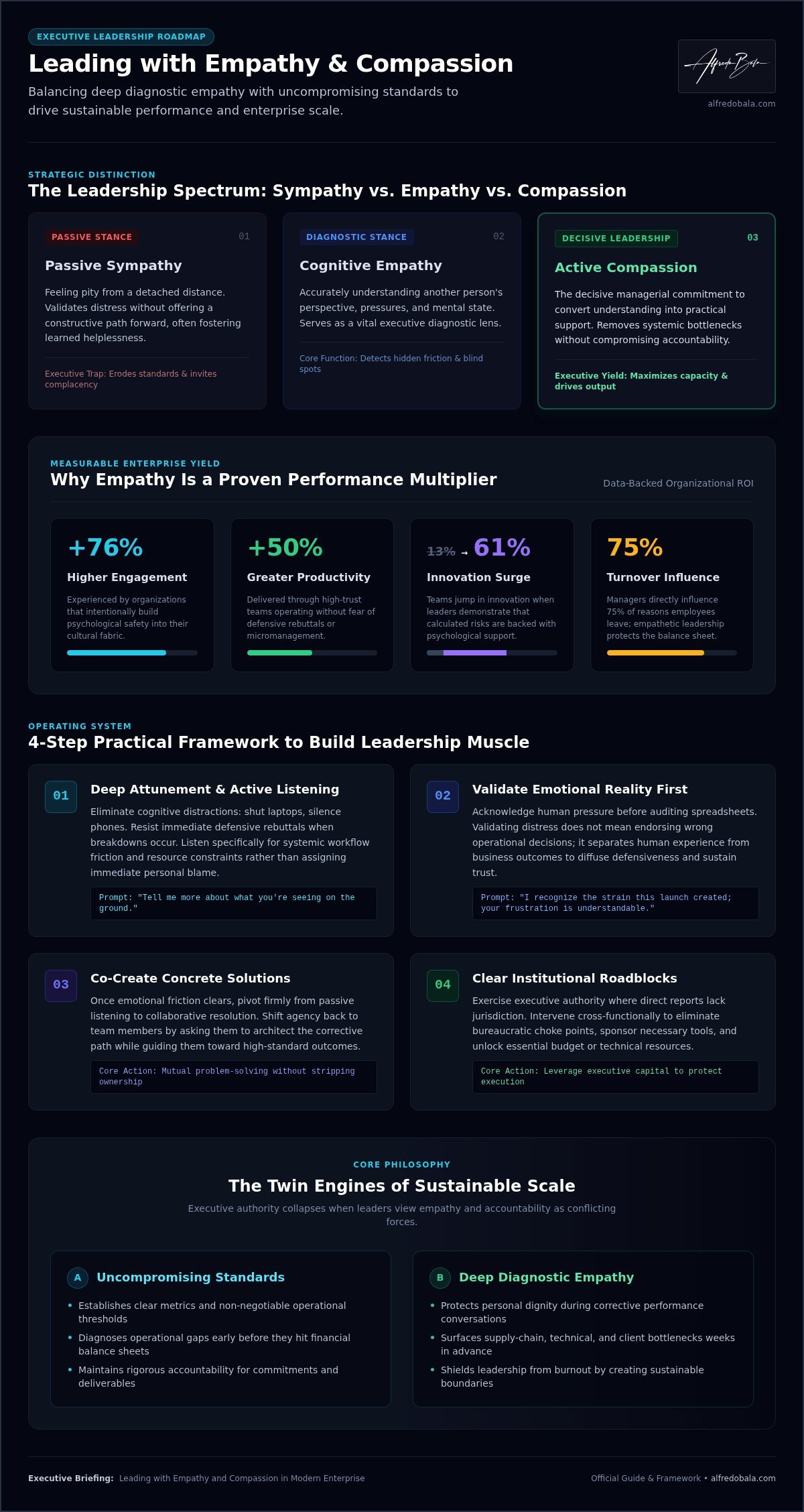
To lead effectively, executives must separate three distinct emotional postures that are often confused:
- Passive Sympathy: Feeling pity from a detached distance. It validates distress without offering a constructive path forward, often fostering learned helplessness.
- Cognitive Empathy: Accurately understanding another person’s perspective, pressures, and mental state. It acts as an executive diagnostic tool.
- Active Compassion: The decisive managerial commitment to convert understanding into practical support.
While sympathy merely observes, compassionate leadership steps forward to remove operational bottlenecks, sponsor solutions, and elevate individual capacity without eroding personal accountability.
Why Empathy Is an Executive Multiplier, Not a Soft Trait
Empathy isn’t sentimental; it multiplies enterprise yield. Organizations that deliberately cultivate psychological safety experience 76% higher engagement and 50% greater productivity. What’s more, companies led by empathetic executives see team innovation jump from 13% to 61%, because people take calculated risks when they know leadership supports them.
Empathetic executives also spot blind spots faster. When teams trust their leadership, they surface supply-chain breakdowns, software defects, and client friction weeks before those issues derail financial statements. Considering that managers influence 75% of the reasons employees walk away, leading with empathy and compassion directly protects your balance sheet against the crushing costs of executive turnover. Care and accountability aren’t rivals; they are the twin engines of sustainable scale.
How to Build Your Empathetic Leadership Muscle: A 4-Step Practical Framework
Building executive empathy is not an abstract exercise in mindfulness. It is a systematic, repeatable behavioral discipline. When you approach leading with empathy and compassion as a measurable management operating system, you turn good intentions into predictable team output. Here is the four-step protocol to shift your daily communication from friction to focus.
Step 1: Practice Deep Attunement and Active Listening
Shut your laptop. Silence your phone. Full cognitive presence is your first display of respect. When a direct report shares an operational breakdown, resist the urge to offer an immediate defensive rebuttal. Instead, use diagnostic inquiry: “Tell me more about what you’re seeing on the ground.” Listen specifically for friction points in workflow and systemic resource gaps rather than assigning personal blame.
Step 2: Validate Emotional Reality Before Problem-Solving
Acknowledge human pressure before auditing spreadsheets. Studies documented by Harvard Business Review highlight the extensive research-backed benefits of this approach, showing how genuine care directly accelerates recovery and focus. Validating someone’s emotional state doesn’t mean agreeing with an inaccurate conclusion. It simply separates their personal experience from the operational outcome. A statement as direct as, “I recognize the strain this launch cycle created, and your frustration is understandable,” diffuses defensiveness while protecting executive trust.
Step 3 & 4: Co-Create Solutions and Clear Institutional Roadblocks
Once emotional tension clears, shift decisively from diagnostic understanding into collaborative execution. Pivot the dialogue with one transformative question: “What do you need from me to succeed?” This executive prompt achieves two distinct outcomes:
- Transfers Ownership: It challenges the employee to formulate their own tactical solutions rather than passively waiting for top-down instructions.
- Defines Executive Sponsorship: It isolates the bureaucratic red tape, resourcing deficits, or cross-departmental friction points you must personally eliminate.
Document these commitments immediately. True leadership requires you to follow through on structural fixes while holding team members accountable for their agreed deliverables. If you want to embed these frameworks across your enterprise, exploring field-tested leadership and team development insights will help your management tier turn these conversational protocols into enduring organizational strength.
Navigating Difficult Conversations: Compassion Paired with Uncompromising Accountability
A persistent fear among senior executives is that leaning into human care strips critical feedback of its teeth. It doesn’t. Ambiguity is cruelty; clarity is compassion. When you master leading with empathy and compassion, you realize that high standards and deep empathy are not opposing forces. Executive maturity requires holding an unyielding standard of operational excellence while fiercely respecting the dignity of the human being tasked with reaching it.
The Four Quadrants of Executive Care and Accountability
To master high-stakes performance conversations, evaluate where your daily leadership lands across two crucial axes: personal care and operational standards:
- Neglectful Leadership (Low Care, Low Standards): Absentee management that disengages teams and breeds widespread operational cynicism.
- Authoritarian Command (Low Care, High Standards): High pressure paired with zero safety, driving rapid burnout and quiet quitting.
- Ruinous Empathy (High Care, Low Standards): Well-intentioned shielding of poor performance that damages overall organizational discipline and demoralizes your highest performers.
- Wise Compassion (High Care, High Standards): The executive gold standard where radical transparency is matched by active managerial sponsorship.
Research by the Center for Creative Leadership on empathy in the workplace shows that executives who master this quadrant build teams capable of weathering intense market pressure without fracturing trust.
Scripting High-Stakes Performance and Restructuring Discussions
Deliver tough critiques by anchoring the conversation in objective behavioral data rather than subjective moral judgment. Open the discussion by establishing fundamental trust: “I value your strategic contributions to this enterprise, which is why we need to address a critical performance variance directly.”
Next, outline the gap clearly: “Here is the objective benchmark we established, and here is where the deliverable currently lands.” Remove ambiguity, invite their diagnosis, and align on immediate benchmarks. Integrating tested executive leadership development strategies into these conversations ensures you build structured remediation plans with defined checkpoints. Ultimately, leading with empathy and compassion during tough conversations is not about softening reality; it is about providing the unvarnished truth paired with an authentic pathway toward redemption and operational growth.
Preventing Compassion Fatigue: Setting Sustainable Boundaries as an Executive
You cannot pour from an empty vessel. In a 2025-2026 clinical review, 71% of CEOs met the diagnostic criteria for significant burnout. Much of this executive exhaustion stems from a fundamental misunderstanding of emotional connection. Leaders often absorb their people’s anxieties instead of anchoring them. True mastery in leading with empathy and compassion requires recognizing that you are an executive leader, not a corporate therapist. If you collapse under the collective emotional weight of your organization, you abandon the strategic post your team relies upon.
Differentiating Emotional Absorption from Grounded Presence
Compassion fatigue begins when emotional resonance turns into over-identification. When you internalize a direct report’s crisis as your personal trauma, you sacrifice the clear-headed objectivity required to resolve it. Watch for early warning signs: sudden cynicism, chronic decision fatigue, and dread before scheduled one-on-ones.
Grounded presence looks entirely different. It acknowledges suffering without absorbing distress. Instead of stepping into the victim mindset with an employee, maintain a calm, detached vantage point. Your role is not to rescue people from every professional discomfort. It is to create a secure psychological container where they develop self-efficacy and resolve their own problems.
Designing Operational Boundaries That Safeguard Leadership Energy
Compassion without architecture quickly devolves into chaos. If your calendar allows non-stop, unstructured venting sessions, you jeopardize your core responsibilities. Protect your executive capacity by putting three non-negotiable operational boundaries into practice:
- Designated Debriefing Windows: Restrict emotional updates and grievance escalations to structured, recurring one-on-one sessions rather than fielding panicked Slack messages throughout the day.
- Sacred Strategic Focus Blocks: Guard dedicated, distraction-free mornings for high-level decision-making where urgent emotional interruptions are blocked entirely.
- Sustainable Team Pacing: Study proven team retention strategies for network marketing to understand how top field leaders protect their personal energy across high-turnover, distributed environments.
Sustaining elite performance across decades requires deliberate pacing and strategic protection of your mental bandwidth. If you want to equip your senior leadership team with the operational stamina to practice leading with empathy and compassion without burning out, book Alfredo Bala for an executive speaking session to transform your leadership culture from the top down.
Scaling a Culture of Compassion: Embedding Human Motivation into Organizational Strategy
Culture isn’t defined by what you broadcast on boardroom slides. It is proven by what you tolerate, reward, and measure across distributed teams. Leading with empathy and compassion at an enterprise scale requires moving beyond individual goodwill and embedding human acuity directly into your corporate operating system. If your promotion criteria solely reward quarterly financial output while ignoring relational destruction, you silently incentivize toxic behavior. Sustainable growth happens when compassionate leadership becomes a non-negotiable metric of executive competence.
Institutionalizing Empathy into Daily Operating Rhythms
Transformation begins by institutionalizing empathy into standard workflows. Replace cold corporate announcements with transparent, human-centered communications that explain the strategic “why” behind executive shifts. Integrate brief qualitative check-ins into weekly operating reviews before diving into pipeline metrics. More importantly, realign performance reviews: evaluate managers on talent retention and psychological safety alongside numeric targets. Bringing in a seasoned keynote speaker for organizational growth can unify distributed business units, aligning global managers around shared standards of operational empathy.
The Motivation Equation: Uniting Compassion with Strategic Vision
Decades of leading global sales forces and public enterprises reveal a fundamental truth: motivation is not a random spark. It operates as an actionable equation. In The Motivation Equation, high performance emerges when deep human psychology meets relentless operational rigor. Leading with empathy and compassion supplies the critical psychological foundation; clear vision channels that energy into measurable execution. When team members realize you genuinely care about their elevation, their commitment ceases to be transactional. They unlock discretionary effort that no command-and-control directive could ever demand.
Ready to transform your leadership bench into an unstoppable force? Explore Alfredo Bala professional speaking and executive development insights to build a high-retention, high-performance culture that wins across global markets.
Step Forward as the Leader Your Organization Needs
True executive mastery rejects the false choice between human kindness and operational excellence. When you diagnose friction early, pair transparent feedback with active support, and guard your personal energy, you forge an unbeatable enterprise. Leading with empathy and compassion isn’t about lowering expectations; it’s about providing your people with the psychological security and strategic clarity they need to exceed them.
Scaling this mindset across global teams requires proven, battle-tested methodology. Drawing on over 40 years of international executive leadership and the principles behind The Motivation Equation, Alfredo Bala serves corporate boards and global conventions as a trusted advisor and keynote speaker. Explore keynote speaking and advisory with Alfredo Bala to equip your senior leadership bench with the tools to ignite peak performance.
You have the framework. Step forward with conviction, lead with deep purpose, and build an organization that thrives through every market shift.
Frequently Asked Questions
What is the primary difference between leading with empathy and leading with compassion?
Empathy is diagnostic, while compassion is operational. Empathy allows you to perceive, understand, and feel another person’s cognitive and emotional reality. Compassion takes that understanding and pairs it with constructive action to eliminate friction. In corporate leadership, empathy identifies where an employee is struggling, but compassion steps in to clear obstacles, provide tactical resources, and guide that individual toward professional success.
Can an executive be empathetic while still enforcing strict accountability and deadlines?
Yes, because genuine empathy requires clear boundaries. When leading with empathy and compassion, clarity is an act of respect, not cruelty. You demonstrate empathy by listening to operational constraints and providing support. You enforce accountability by holding team members responsible for agreed deliverables. High standards and human care reinforce one another; lowering standards out of pity only robs employees of the opportunity to grow into their potential.
How do you lead with empathy in a fully remote or hybrid workplace?
Distributed environments require proactive, intentional touchpoints rather than sporadic reactions. Start structured virtual meetings with brief personal check-ins before opening slide decks. Monitor digital work patterns for silent overwork, such as late-night emails or skipped leave. Focus entirely on clear outputs and milestones rather than micromanaging screen time. Most importantly, pick up the phone for spontaneous, informal check-ins that show you value the person behind the screen.
What are the first signs that a leader is suffering from compassion fatigue?
Early indicators include emotional numbness, cynicism toward team struggles, and chronic dread before scheduled one-on-ones. Leaders experiencing compassion fatigue often exhibit sudden decision fatigue and feel personally responsible for fixing every employee’s emotional state. When you notice yourself withdrawing from critical conversations or snapping under routine pressure, your internal reserves are spent. It signals an immediate need to re-establish strict boundaries around your calendar and mental energy.
How can I measure the business impact of leading with empathy across my organization?
Track specific operational indicators alongside cultural metrics. Monitor voluntary retention rates among key talent, internal promotion velocities, and project turnaround times. Organizations that excel at leading with empathy and compassion also measure engagement survey trends, particularly questions evaluating psychological safety and managerial support. When operational friction decreases and high performers remain with the enterprise across multiple quarters, your leadership framework is delivering measurable ROI.
Is empathy an innate personality trait, or can experienced corporate executives learn it?
Empathy functions as a trained executive discipline, not fixed genetic wiring. While natural emotional resonance varies, cognitive empathy and compassionate action rely on learned behaviors: asking diagnostic open-ended questions, withholding premature judgment, and practicing disciplined active listening. Seasoned executives can deliberately build this capability by treating relational interactions like any other strategic initiative, refining their conversational habits through structured practice and intentional feedback loops.
How do you handle an employee who repeatedly takes advantage of compassionate leadership?
Address the pattern immediately with objective documentation and unwavering resolve. Compassion does not tolerate manipulation or persistent underperformance. Schedule a direct conversation that reviews agreed commitments against actual output, removing ambiguity entirely. Emphasize that while you fully support their personal growth, their deliverables must meet organizational standards. If non-performance continues despite targeted managerial support, transitioning that individual out of the organization is the ultimate act of organizational integrity.
 ES
ES  EN
EN
Comentarios recientes