
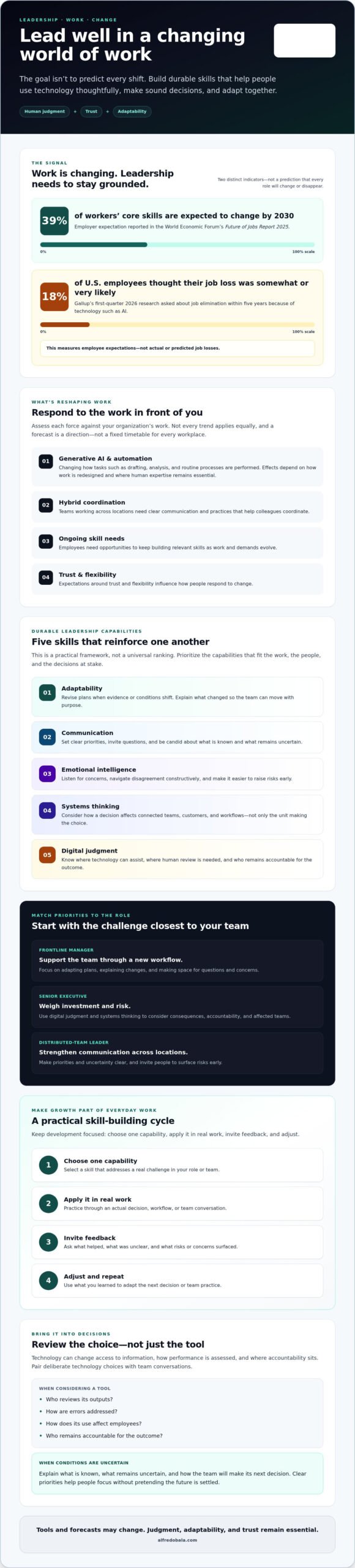
By 2030, employers expect 39% of workers’ core skills to change, according to the World Economic Forum’s Future of Jobs Report 2025. That doesn’t mean leaders should chase every new tool or workplace trend. The leadership skills for the future of work help leaders use technology to strengthen, not replace, human judgment, trust, and adaptability.
If you’re unsure which shifts will last, how to balance AI with people’s needs, or where to begin developing future-ready capabilities, you’re asking the right questions. The challenge isn’t predicting every change. It’s building a focused set of durable skills that helps you respond well as conditions evolve.
This article connects the forces reshaping work to practical leadership actions. You’ll learn how to pair digital fluency with sound judgment, foster trust and psychological safety, and help teams keep learning through change. You’ll also find a practical way to identify development priorities for yourself and your team, without turning every emerging trend into another item on the agenda.
Key Takeaways
- Identify the leadership skills for the future of work that address real challenges, from adapting to change to communicating clearly.
- Match development priorities to your role, whether you lead a frontline team, set organizational direction, or manage distributed colleagues.
- Make skill-building a practical cycle: choose one capability, apply it in real work, invite feedback, and adjust.
- Use decision reviews and team conversations to make leadership growth part of everyday work, not another disconnected initiative.
- Make deliberate technology choices and adapt team practices to respond realistically to change.
Why leadership skills for the future of work are changing
Work is changing quickly, but people still need clear priorities, credible communication, and confidence that decisions are fair. Leaders have limited attention, so they can’t treat every new tool or forecast as a permanent shift. Their task is to distinguish what needs a response now from what calls for closer observation.
Future-ready leadership means adapting decisions and relationships as work conditions evolve. It builds on foundational leadership concepts, while recognizing that leaders must apply them in response to changing teams, technologies, and demands. The goal isn’t prediction for its own sake. It’s sound judgment under changing conditions.
Which forces are reshaping work in 2026?
Generative AI and automation are changing how tasks are performed, from drafting and analysis to routine processes. That doesn’t mean every role will disappear. The effect depends on how organizations redesign work and where human expertise remains essential. Gallup’s first-quarter 2026 research found that 18% of U.S. employees believed it was very or somewhat likely their job would be eliminated within five years because of technology such as AI. This measures employee expectations, not actual or predicted job losses.
Other pressures are less dramatic but just as consequential. Hybrid teams must coordinate across locations, employees need to keep building relevant skills, and expectations around trust and flexibility shape how people respond to change. The World Economic Forum’s Future of Jobs Report 2025 reflects employer expectations about changing skill needs through 2030. Those projections indicate a direction, not a fixed timetable for every workplace. Assess these forces against your organization’s work rather than assuming every trend applies equally.
Why do leadership capabilities need to evolve?
Uncertainty makes clear priorities more valuable. When information is incomplete, explain what is known, what remains uncertain, and how the team will make its next decision. That clarity helps people focus without pretending the future is settled.
Technology choices also shape culture. A tool may change who can access information, how performance is assessed, or where accountability sits. Ask not only whether a tool is useful, but who reviews its outputs, how errors are addressed, and how its use affects employees. These questions connect digital judgment to trust and responsibility.
Skill priorities vary by role, industry, workforce, and organizational maturity. A frontline manager may need to support a team through a new workflow; a senior executive may need to weigh investment and risk; a distributed-team leader may need stronger communication practices. Durable leadership capabilities outlast workplace predictions: tools and forecasts may change, but judgment, adaptability, and trust remain essential.
The leadership skills for the future of work that matter most
Effective leadership isn’t a contest to master the latest tool or adopt every new management idea. It’s the ability to choose a useful response to the challenge in front of you. The leadership skills for the future of work reinforce one another: adaptability helps leaders adjust course, while communication and emotional intelligence help people understand and contribute to change.
- Adaptability: Revise plans when evidence or conditions shift, and explain what changed so the team can move with purpose.
- Communication: Set clear priorities, invite questions, and be candid about what is known and what remains uncertain.
- Emotional intelligence: Listen for concerns, navigate disagreement constructively, and make it easier for people to raise risks early.
- Systems thinking: Consider how a decision affects connected teams, customers, and workflows, not only the unit making the choice.
- Digital judgment: Understand where technology can assist, where human review is needed, and who remains accountable for the outcome.
This is a practical framework, not a universal ranking. A leader managing rapid process changes may prioritize adaptability; someone coordinating across functions may need to strengthen communication and systems thinking first. McKinsey’s discussion of 21st-century leadership traits also points to the enduring importance of qualities such as resilience and humility. The right blend depends on the work, the people, and the decisions at stake.
How do leaders combine digital fluency with human judgment?
Digital fluency doesn’t require becoming a technical specialist. It means understanding a tool’s purpose and limits well enough to ask informed questions. Generative AI can help produce a draft or organize information, for example. Before relying on its output, check it against relevant context, consider who may be affected, and make sure a person remains accountable for the final decision. Treat the technology as an input, not an authority.
Why do adaptability, communication, and trust remain essential?
Change tests relationships as well as plans. Explain the reason for a decision, what it means in practice, and when the team will review its effects. Then listen. Emotional intelligence helps leaders recognize friction and respond without dismissing concerns. Psychological safety grows when people can question assumptions and surface mistakes. Systems thinking completes the picture: before changing a workflow, consider how the change shifts responsibilities and dependencies elsewhere.
These capabilities work best together. Alfredo Bala’s leadership and team development insights can complement your own reflection on how motivation and leadership shape a team’s response to change.
How to prioritize future-of-work leadership skills for your role
Don’t try to improve every capability at once. Start with a recurring work challenge you can influence, then choose a skill that would change how you handle it. The leadership skills for the future of work are most useful when matched to your decision authority, team experience, and organization’s current needs.
Use this framework to find a starting point, not a universal prescription. Observable practices make development concrete and help you assess whether a new approach is working.
| Role or context | Common challenge | Priority capability | Observable practice |
|---|---|---|---|
| Emerging leader | Taking responsibility without formal authority | Self-awareness and dependable communication | Clarify commitments, meet them, and ask for specific feedback. |
| Frontline manager | Keeping daily work clear during process changes | Adaptability and emotional intelligence | Explain what is changing, invite concerns, and adjust team routines based on what you hear. |
| Senior executive | Balancing investment, risk, and organization-wide priorities | Strategic judgment and systems thinking | Review cross-functional effects and make decision ownership explicit. |
| Distributed-team leader | Maintaining alignment and connection across locations | Communication and inclusive participation | Share decisions in accessible channels and create deliberate ways for everyone to contribute. |
Which skills should emerging leaders develop first?
Begin with self-awareness, clear communication, and follow-through. These foundations matter whether you’re coordinating a project or taking on your first leadership responsibility. Connect each priority to a real situation: if handoffs are often missed, practice confirming ownership and deadlines. Ask colleagues what helps or hinders collaboration, then reflect on specific examples. Assess readiness through behavior and feedback, not job title alone.
What changes for executives and distributed-team leaders?
Executives often need to focus on strategic judgment, cross-functional alignment, and responsible technology governance. That includes deciding who can approve a tool, how its use will be reviewed, and which teams may be affected. For further executive-level guidance, explore executive leadership development strategies.
Distributed-team leaders may need to make expectations and decisions visible across locations while building relationships intentionally. The right approach also depends on organizational maturity: a team new to a process may need more structure, while an experienced team may benefit from greater autonomy. Prioritize the capability that addresses your most consequential gap, within the authority and resources you have.
How to build future-ready leadership skills through daily practice
Leadership develops through repeated choices, not a checklist completed once. Pick one capability tied to a real responsibility, practice it in the flow of work, ask for feedback, and adjust. This makes the leadership skills for the future of work practical and observable, even as priorities shift.
- Choose one capability: Name a specific challenge, such as decisions being reopened because ownership isn’t clear.
- Practice one behavior: In the next decision review, state who owns the decision, what information shaped it, and when it will be revisited.
- Gather feedback: Ask the people involved what was clear and where uncertainty remained.
- Adjust and repeat: Use what you learn to refine your approach in the next conversation or review.
Look for observable signs of progress: colleagues can explain the decision and next steps, concerns surface earlier, or fewer handoffs are left ambiguous. These are useful signals, not a complete measure of leadership quality. Context matters, and no single metric captures trust, judgment, or the quality of a team’s work. A short reflection after a consequential conversation can be as revealing as a dashboard: What did I intend? What happened? What will I do differently?
How can leaders turn feedback into a development plan?
Ask peers, direct reports, and relevant stakeholders for specific examples, not general ratings. For instance: “When did my update help you act, and when did it leave questions?” Choose one behavior to test and define what progress would look like in practice. Set a follow-up reflection, compare feedback with what you observed, and revise the behavior. Keep the focus narrow enough to use during real work.
How can teams learn while work keeps changing?
Build brief retrospectives into completed projects or meaningful decisions. Ask what the team expected, what happened, which assumptions held up, and what should change next time. Before finalizing consequential decisions, invite questions and dissent so risks can be considered early. This makes learning part of delivery rather than a separate initiative. For a framework on motivation and leadership, explore The Motivation Equation.
One-off training can introduce ideas, but daily practice gives leaders the chance to apply them, receive feedback, and build consistency. For more leadership and team development insights, explore Alfredo Bala’s leadership resources.
What future-ready leadership looks like in practice
Future-ready leaders don’t choose between technology and people. They use technology deliberately while strengthening human judgment, clear accountability, and the team’s ability to adapt. The leadership skills for the future of work show up in everyday decisions, especially when evidence is incomplete and the stakes affect people across the organization.
What does a balanced leadership response to change look like?
Imagine a team considering generative AI to help summarize customer feedback. A balanced leader explains what the team knows about the tool, what still needs to be tested, and how its output will be checked before informing decisions. They invite input from employees who understand the customer interactions and workflow, while making clear who owns the final decision. Then they review the approach in light of evidence and feedback, adjusting it to fit the organization’s needs.
Technology can inform the work, but people provide context, judgment, and accountability.
This isn’t a one-time display of confidence. Leadership development continues as tools, teams, and business conditions change. Strong leaders pay attention to evidence, seek candid feedback, and adapt their approach to the workforce and organizational context. They don’t assume a promising idea will work everywhere, or that one successful decision settles the question for good.
Where can leaders continue learning and put insight into action?
For leaders considering how motivation and performance shape teams, Alfredo Bala’s team development and organizational growth insights offer a relevant next resource. Use what you learn alongside feedback from your own team and the realities of your organization. Development is most useful when it informs real choices rather than adding another trend to follow.
Start now: name one challenge your team is facing, choose the capability most relevant to it, and practice that capability in your next decision or conversation. Notice what changes, ask for feedback, and refine your approach. To explore more of Alfredo Bala’s leadership work, visit Alfredo Bala’s leadership insights.
Lead with clarity as work continues to change
The leadership skills for the future of work aren’t about mastering every trend. They’re about adapting with sound judgment, communicating clearly, and building trust while technology and work practices evolve. A strong starting point is specific: identify a challenge your team faces, choose the capability that would help, and practice it in a real conversation or decision. Then seek feedback and refine your approach.
Leadership growth is ongoing, shaped by evidence, relationships, and your organization’s needs. Alfredo Bala brings a perspective informed by his work as a leadership expert, author, professional speaker, and corporate board member, along with former leadership roles as CEO of Mannatech Inc. and COO of Britt World Wide.
Explore Alfredo Bala’s leadership insights for more perspectives on leadership and team development. You don’t need to predict every change to lead well. Choose one meaningful step, take it with intention, and keep learning as you go.
Frequently Asked Questions
What are the most important leadership skills for the future of work?
The most important leadership skills for the future of work include adaptability, clear communication, emotional intelligence, systems thinking, and sound digital judgment. Their relative importance depends on your role and the challenges your team faces. For example, a manager introducing a new workflow may need to explain the change and listen to concerns, while an executive may focus on cross-functional effects and decision accountability. These capabilities work best together, not as a universal ranking.
How is AI changing the skills leaders need?
AI makes it more important for leaders to understand how technology informs work and where human review remains essential. You don’t need to become a technical specialist, but you should be able to question an output, check it against relevant context, and clarify who is accountable for decisions made with its help. For example, AI may help organize information, while a leader assesses its relevance and considers its effects on employees and customers.
Can leadership skills be learned, or are they innate?
Leadership skills can be developed through deliberate practice, feedback, and reflection. Some people may find particular aspects of leadership more natural, but that doesn’t prevent others from improving them. Start with a specific behavior, such as clarifying ownership in meetings or inviting quieter colleagues to contribute. Ask others what they observed, reflect on the outcome, and adjust your approach. Repeated practice in real situations helps turn an intention into a more dependable habit.
How can leaders prepare their teams for the future of work?
Prepare your team by connecting change to the work people actually do. Explain what is changing, what remains uncertain, and how decisions will be reviewed. Make room for questions, identify skills the new work may require, and give people opportunities to practice them in everyday tasks. A short project retrospective can help the team name lessons, test assumptions, and agree on next steps without treating every forecast as certain.
Why is emotional intelligence important for future leaders?
Emotional intelligence helps leaders understand how their words and decisions affect people, especially during disagreement or change. It supports attentive listening, constructive conflict navigation, and an environment where team members can raise concerns or admit mistakes. For example, a leader who notices confusion can pause to clarify expectations rather than assuming silence means agreement. These behaviors can strengthen trust and help surface useful information before a problem grows.
How do I create a leadership development plan for 2026?
Build your 2026 plan around a real responsibility, not a broad list of trends. Identify one recurring challenge, choose the capability that would help address it, and define a behavior you can practice. Ask peers or team members for specific feedback, then review what changed and adjust your approach. For instance, if decisions stall, practice naming an owner and next step. Keep the plan responsive to your role and organizational context.
 ES
ES  EN
EN
Comentarios recientes