
Trust grows in small moments when your words match your actions. To understand how to build trust with a new team, communicate openly, listen before responding, keep your commitments, and recognize people fairly. Consistency creates the conditions for honest dialogue and stronger working relationships.
A new team needs more than a confident introduction. People need to know it’s safe to speak up, ask for help, and raise concerns. Transparent communication, integrity, recognition, and dependable actions turn that principle into everyday leadership practice. The steps ahead focus on listening with intent, setting clear expectations, sharing credit, and responding constructively when something goes wrong, so trust can grow through the way you work together.
Key Takeaways
- Set a clear communication rhythm and invite input before decisions that affect the team.
- Build credibility by making realistic commitments, following through, and taking responsibility when plans change.
- Recognize contributions promptly and fairly, and make space to share credit across the team.
- Give people clarity on outcomes while allowing them room to decide how to do the work.
- Start by learning each person’s priorities, role, and preferred way of working before introducing changes.
1. Transparent communication and consultation
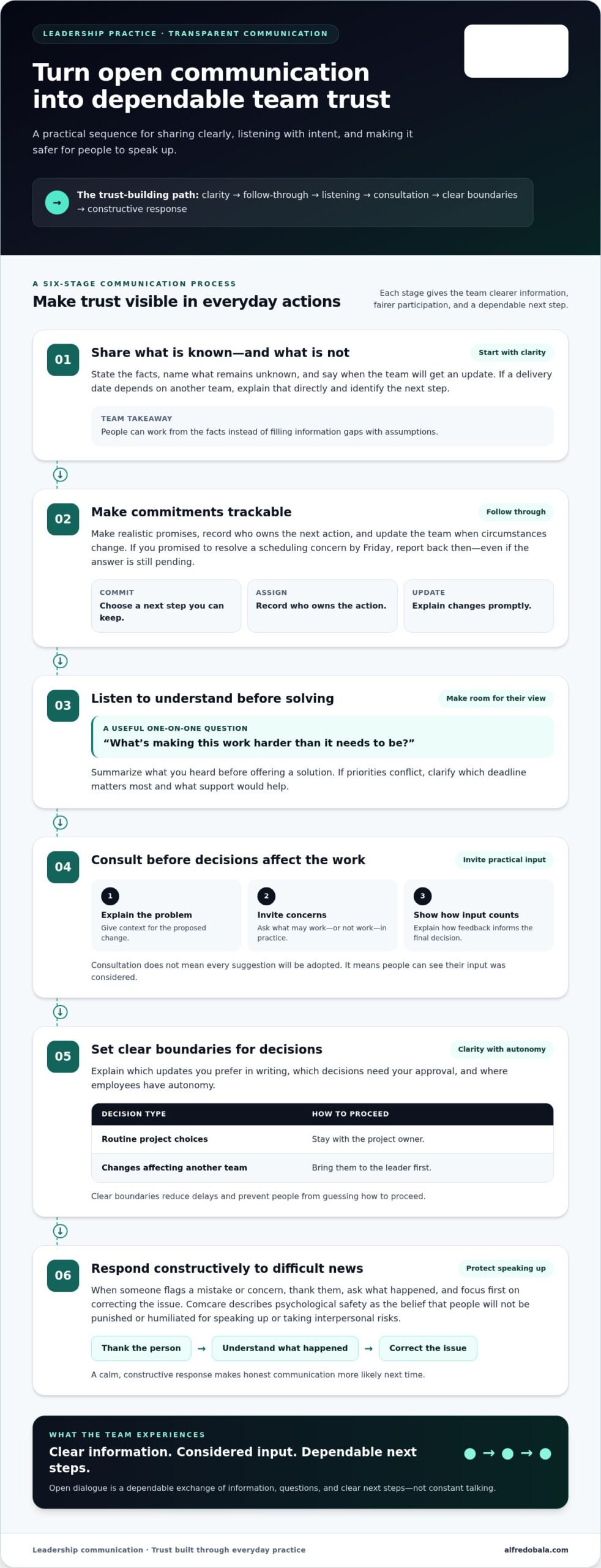
Start with clarity, not a performance of certainty. A new leader earns credibility by sharing what they know, naming what remains unknown, and explaining when they’ll provide an update. If a delivery date depends on another team, say so directly and identify the next step. This helps people understand the facts instead of filling gaps with assumptions.
Reliability shows in follow-through. Make commitments you can keep, record who owns the next action, and update the team if circumstances change. If you promise to resolve a scheduling concern by Friday, report back then, even if the answer is still pending. The Centers for Disease Control and Prevention states that doing what you said you would do builds trust and confidence in organizational leadership.
Listen to understand, not just to prepare a response. In a one-on-one, ask, “What’s making this work harder than it needs to be?” Summarize the answer before offering a solution. If an employee describes conflicting priorities, clarify which deadline matters most and what support would help. The person sees their perspective shaping the conversation, which helps build the relationship.
Consult people before decisions that affect their work. A manager changing a reporting process can explain the problem, invite practical concerns, and describe how feedback will inform the final decision. Consultation doesn’t mean every suggestion will be adopted. It means team members can see how their input was considered instead of learning about a change after it’s underway.
Set communication expectations early. Explain which updates you prefer in writing, which decisions need your approval, and where employees have autonomy. For example, routine project choices can stay with the project owner, while changes affecting another team come to you first. Clear boundaries reduce delays and prevent people from guessing how to proceed.
Make it safer to speak up through your response to difficult news. According to Comcare, psychological safety is the belief that people won’t be punished or humiliated for speaking up or taking interpersonal risks. When someone flags a mistake, thank them, ask what happened, and focus first on correcting the issue. This makes honest communication more likely next time.
For a new team, face-to-face meetings can convey warmth, while virtual conversations still require undivided attention. Put distractions aside, ask each person about role-related challenges, and explain your intentions when proposing a change. Open dialogue isn’t constant talking. It’s a dependable exchange of information, questions, and clear next steps that supports trust and productivity.
2. Integrity, consistency, and personal accountability
Trust depends on what leaders do after making a commitment. The Centers for Disease Control and Prevention says doing what you said you would do builds trust and confidence in organizational leadership. If someone asks you to resolve a workload issue, agree on a next step and return with an update. If circumstances change, explain what happened and reset expectations clearly.
Consistency matters in everyday decisions, not just major promises. If one team member can adjust a deadline, apply the same principle fairly to others facing similar circumstances. Unpredictable expectations and policies can erode trust because people spend energy guessing which rules apply. Leaders can hold weekly or biweekly conversations about team commitments, progress, and obstacles, then record the agreed actions.
Accountability becomes visible when a leader owns a mistake without shifting blame. Suppose you gave someone outdated information that delayed their work. Acknowledge the error, explain its impact, correct the record, and identify how you’ll prevent a repeat. A genuine apology recognizes the effect on others; meaningful repair also states what you’ll change. Follow through so responsibility becomes behavior, not just words.
Personal connection can strengthen professional relationships, but it requires good judgment. Invite team members to share experiences that shaped how they work, while letting each person decide what feels comfortable. Someone who has managed a difficult handoff may value written responsibilities, while another may prefer a short verbal check-in. Ask rather than assume, and respect boundaries around personal history.
Use these conversations to support growth, not label people by past setbacks. Ask what skill each person wants to develop and what stretch assignment would help. If an employee wants more ownership, agree on a defined outcome, available support, and a follow-up point. Assess the work against those expectations, not shifting standards. This makes development concrete and shows that leaders take individual ambitions seriously.
Empathy also means noticing how decisions affect people’s daily work. Before changing a process, ask who will carry the extra steps and what practical obstacles might arise. If a colleague is handling a demanding project, clarify priorities instead of adding urgency without context. Small acts of attention build connection, while fair treatment shows that accountability applies to everyone.
Make the practice repeatable: keep a record of commitments, communicate changes promptly, and review progress in regular conversations. For leaders looking to strengthen these habits across a team, Leadership and Team Development Insights can help frame accountability and growth as shared leadership practices.
3. Recognizing employees and sharing credit
Leaders create psychological safety by responding to feedback without punishment or humiliation. Comcare describes it as the belief that people can speak up and take interpersonal risks safely. Invite honest feedback, thank employees for raising concerns, and address the issue rather than attacking the messenger. For example, ask what would improve a process before deciding how to change it.
Recognition works best when it is specific, timely, and connected to an achievement. After an employee meets a demanding goal, describe the action and its effect: “Your careful handoff helped the next team meet its deadline.” Give credit soon after the achievement, while the contribution is clear. A vague “great work” is less useful than naming behavior others can learn from.
Make appreciation personal without making recognition unequal. Some employees welcome public praise; others prefer a direct note or private conversation. Ask how each person likes to receive feedback, then use that preference when recognizing strong work. Apply the same standards across the team. Favoring a few visible contributors can create unfairness and weaken trust in employees whose work also matters.
Share credit accurately. If several people contribute to a successful project, name their distinct roles in a team meeting or written update. A colleague who handled testing, for instance, deserves acknowledgment alongside the person presenting the results. Team members can also build trust by thanking coworkers, recognizing their skills publicly, and speaking up about their achievements when they’re absent.
Indra Nooyi, Pepsi’s CEO, wrote letters to the parents of 29 senior Pepsi executives, praising their children. The example shows how recognition can reach beyond a routine workplace compliment, while keeping the employee’s achievement at its center. Leaders need not copy the gesture; they can demonstrate sincere appreciation by identifying what someone did and why it mattered to the team.
Use recognition to reinforce progress, not just final outcomes. If a new employee asks for help early and prevents a missed handoff, praise that judgment as well as the result. In a project review, invite teammates to name a contribution they valued. This makes appreciation part of everyday work, rather than a rare event reserved for formal milestones.
Feedback should also help people grow. When appropriate, pair recognition with a clear next step: identify a strength, explain where it made a difference, and invite the employee to apply it again. Keep correction separate from praise so appreciation doesn’t feel like a setup for criticism. Consistent, fair acknowledgment helps employees understand what the team values and how they can contribute.
4. Actions that build or break trust
Make decisions clear. Explain the reasoning behind a change, who it affects, and what outcome you expect. If you alter an employee’s workflow, show how the change addresses a real need and invite questions about its practical impact. This turns disruption into a learning opportunity instead of leaving people to interpret silence as disregard or arbitrariness.
Delegate outcomes, not just task lists. Give an employee a clear result, relevant boundaries, and a deadline, then let them choose the approach. For example, ask a project owner to deliver a client-ready report while giving them room to organize the analysis. Set regular check-ins without constant oversight. Excessive control can signal distrust and contribute to resentment or disengagement.
Trust grows when responsibility is visible. If you make a mistake, acknowledge it openly, correct the record, and explain what you’ll change. A genuine apology recognizes the impact of your actions; rebuilding trust also requires making amends and preventing a repeat. A consistent series of trustworthy actions can counter untrustworthy behavior, but deception can leave trust permanently damaged.
Address sensitive dynamics directly. If someone applied for your leadership role, acknowledge it respectfully rather than pretending it didn’t happen. Recognize their contribution and clarify how you’ll work together. Then set shared expectations for decisions and collaboration. Avoiding the conversation can leave that person guessing about your intentions and the team uncertain about how to move forward.
Small actions in meetings also matter. In 2010, Ford CEO Alan Mulally greeted each dealer at a Ford dealer’s meeting by name, asked about the dealer’s business, and posed for a picture. The example demonstrates attentiveness through specific actions. In virtual conversations, give people your full attention, act naturally, and remove distractions instead of dividing focus between the meeting and other work.
Build a plan from observation, not assumption. First learn how the team operates, then develop a 30-60-90 day plan with team input. For each proposed change, explain the reason and how success will be assessed. Invite employees to identify risks you may have missed. That process makes the plan a shared direction, not a verdict imposed before you understand the work.
Use clear goals to balance direction with autonomy. Set individual outcomes and timelines, then follow up regularly without taking over every decision. When someone misses a commitment, discuss the cause, its impact, and a realistic recovery action. Apply expectations consistently across the team. These choices make a leader’s values visible, while secrecy, favoritism, and unpredictable behavior can undermine confidence.
5. Building trust with a new team
The first steps in learning how to build trust with a new team are straightforward: listen, learn each person’s role, and clarify how you’ll work together. Ask team members about their priorities, challenges, and what helps them do their best work. Reflect back what you hear before proposing changes, so your early actions show respect for the team’s existing knowledge.
Start with individual conversations, then bring shared themes into team discussions. The Agency for Toxic Substances and Disease Registry (ATSDR) toolkit suggests beginning with one-on-one meetings to build trust. Ask each person how they prefer to receive feedback and what responsibilities they own. This creates a practical foundation for collaboration and helps you spot unclear roles or conflicting expectations that may hinder progress.
Remote and hybrid teams need deliberate connection, not constant meetings. In a video call, give each speaker your full attention, invite quieter members to contribute, and close by assigning clear owners to agreed actions. Use written updates to keep decisions visible across locations. For example, summarize a project decision in the shared workspace, including the rationale and who will handle the next step.
Trust has no standard timetable. It develops through repeated interactions and leaders’ responses under pressure. Early signs include team members raising concerns, asking for help, and following through on shared work. If people remain cautious, examine whether your behavior supports openness, expectations are consistent, and team members can see their input shaping decisions.
To measure trust and cohesion, invite people to rate a work relationship from 1 to 5 across six trust categories, with 1 as the lowest rating and 5 as the highest. Repeat the reflection later and discuss where perceptions differ. Pair those ratings with observable signals, such as whether colleagues share information, ask for support, and coordinate across roles.
Team culture takes shape through small moments. A leader who admits uncertainty, asks for help, or acknowledges an error models vulnerability without surrendering authority. Team members can also strengthen connection by offering help and, when appropriate, discussing a shared experience afterward. These behaviors make learning and cooperation part of the group’s daily practice.
High-trust organizations experience 50% higher productivity and 76% greater engagement than low-trust organizations. Use those findings as a reason to build trust intentionally, not as a promise of automatic results. To apply these principles to team development, explore practical leadership insights.
Alfredo Bala (The Motivation Guy): The Motivation Equation
The Motivation Equation offers a practical next step for leaders who want to turn trust-building principles into consistent team practices. Its frameworks connect motivation and leadership, helping you consider how communication, recognition, and accountability shape the way people work together.
Turn to Alfredo Bala’s Leadership and Team Development Insights when working through team challenges or developing your approach to leadership. Organizations that want to bring these ideas into a broader conversation can also use his Speaking offering to explore motivation and team development.
To explore how these leadership ideas could support your next step, visit alfredobala.com.
Make your next conversation a starting point
Trust grows through choices repeated over time, but your next move can start today. Choose one conversation where you’ll ask more, listen carefully, and act on what you learn. Reflect on the response and use it to shape how you lead. That practical cycle is central to how to build trust with a new team: turn intention into visible behavior, then keep learning from the people around you.
To develop that practice further, Alfredo Bala (The Motivation Guy) offers The Motivation Equation and Leadership and Team Development Insights. His Speaking offering can also bring leadership and motivation themes into a broader organizational conversation. Each offers a different way to explore how leaders create conditions for people to contribute and grow.
Take the next step when you’re ready. Contact Alfredo Bala to continue the conversation, and keep building the kind of team where trust can take root.
Frequently Asked Questions
So how do you build trust?
Build trust by making your intentions clear and matching your behavior to your words. If you’re learning how to build trust with a new team, ask what the group needs from you before setting a new direction. For example, invite each person to name one obstacle affecting their work, then identify a practical response together. Keep listening after the first conversation; trust depends on what happens next.
What Breaks Trust With Employees?
Trust breaks when employees see a gap between what leaders say and what they do. A manager who asks for candid feedback but dismisses criticism, for example, teaches the team to stay silent. Taking credit for someone else’s contribution, carelessly sharing sensitive information, or applying standards unevenly can also damage confidence. Address the specific impact promptly, and make the repair visible through changed behavior rather than relying on an apology alone.
Why does Trust matter?
Trust shapes whether people feel able to contribute honestly and work through uncertainty together. A team member who trusts colleagues can raise a concern before it becomes a larger problem, rather than quietly working around it. Trust also supports belonging: people can disagree about a decision without treating disagreement as personal rejection. This gives teams a stronger basis for learning, cooperation, and handling change.
Why is trust important for team performance?
Trust supports performance by making collaboration more direct. If a designer trusts a colleague to share accurate project details, they can focus on improving the work instead of repeatedly checking every handoff. Trust also makes it easier to flag risks early, ask for expertise, and coordinate across roles. These behaviors can reduce avoidable confusion and help the group focus on shared priorities.
How can a new manager build trust with team members?
A new manager can build trust by learning the team’s working relationships before changing established processes. Ask who depends on each person’s work, where handoffs commonly stall, and which strengths the group relies on. Then choose one manageable improvement with the team and explain how you’ll evaluate it. This respects existing knowledge while giving people a tangible role in shaping how the group works.
How important is listening and asking questions when joining a new team?
Listening and asking questions are essential because a new leader can’t understand team dynamics from job titles alone. Ask an employee what a successful week looks like, then listen for competing demands or hidden dependencies. Before offering advice, summarize what you heard and check that you understood correctly. That small step prevents assumptions from driving your response and gives the employee a chance to clarify their priorities.
How can leaders build trust through transparency and clear communication?
Leaders can build trust by making decisions understandable and information accessible to the people doing the work. When announcing a change, explain its purpose, who will be affected, and what remains open for discussion. For instance, if a deadline moves, clarify which deliverables take priority and how teams should handle dependencies. Clear context helps employees make sound decisions without relying on hallway speculation.
What mistakes can damage trust when leading a new team?
Common mistakes include changing processes before understanding why they exist, making comparisons that embarrass team members, and treating questions as resistance. A new leader may also overpromise to make an early impression, then lose credibility when commitments prove unrealistic. Slow down, learn the history behind current practices, and distinguish genuine obstacles from preferences. If a decision causes harm, name the impact and make a concrete correction.
 ES
 EN
Comentarios recientes