
A shared project won’t break down departmental silos on its own. To understand how to improve cross-functional collaboration, align teams around a clear shared goal, define who owns each decision and deliverable, and create regular opportunities to communicate, share expertise, and resolve obstacles. Leaders reinforce these practices by welcoming different perspectives and keeping progress visible.
It’s easy to see why collaboration matters: when teams understand how their work connects, they can coordinate decisions and bring distinct expertise to a shared challenge. The question of how to improve cross-functional collaboration is really about turning that intent into consistent ways of working. This article explains how to improve cross-functional collaboration through shared goals, clear roles, leadership habits, and practical team practices that help departments move forward together.
Key Takeaways
- Bring departments together around a shared outcome, then make each team’s contribution and decision-making role clear.
- Use recurring check-ins and visible progress updates to surface dependencies and resolve obstacles before they slow the work.
- Invite different forms of expertise into problem-solving to spot risks, reduce duplicated effort, and uncover fresh solutions.
- Leaders strengthen collaboration when they listen, recognize each team’s capabilities, and remove barriers to joint work.
- Build practical team habits, from clear meeting actions to feedback and retrospectives, and refine them as priorities shift.
1. What is cross-functional collaboration?
Cross-functional collaboration brings people from different departments together to achieve a shared goal. A technology initiative, for example, might involve programmers, designers, and market researchers developing a product. Each group contributes distinct skills, while coordinating decisions, information, and work instead of operating separately. To understand how to improve cross-functional collaboration, focus on how teams share knowledge and connect their contributions.
Start with a clear communication channel for project decisions, updates, and questions. A central channel gives employees one place to find current information instead of searching through scattered messages. Set simple norms: record decisions, name owners, and share relevant updates where every participating department can see them. For example, a product team can use one shared project space to track design questions and launch dependencies.
Build recurring touchpoints into the work, not just the calendar. Scheduled check-ins help teams surface blockers, clarify handoffs, and track progress against milestones. Organizations can choose weekly, monthly, or quarterly progress meetings based on the project’s pace. Keep each meeting focused: review changes, identify what another function needs, and agree on actions with owners and due dates.
Choose collaboration technology to support these habits. Project management tools make tasks and deadlines visible, while Slack and Microsoft Teams help employees share timely updates. Video conferencing supports live discussion, and shared cloud spaces let teams work on common documents. Tools help when they reduce friction; competing records or decisions buried in private chats only create confusion.
Remote teams need deliberate ways to stay connected across locations and time zones. Use video calls for discussions that benefit from real-time exchange, then document decisions for colleagues who can’t attend. Shared virtual workspaces keep files and updates accessible across departments. Pair each live meeting with a written recap of decisions, open questions, and the next owner.
Leaders build trust and psychological safety by inviting feedback, listening without punishing disagreement, and responding visibly to concerns. Give every function room to explain its constraints, then recognize shared achievements publicly. For example, a team shoutout can credit customer support for surfacing an issue and product employees for addressing it. Recognition shows that teamwork matters alongside departmental results.
Measure collaboration through project completion times, team performance, and business outcomes. Compare progress with milestones, then examine whether handoffs, delays, or duplicated work affected results. Pair those indicators with employee feedback about communication and decision-making. Together, these measures show what the team delivered and how effectively departments worked together.
The BBC employed more than 100 teams for work connected to the 2006 World Cup, covering areas such as promotions and news. The example highlights the coordination challenge at scale: teams need shared information and dependable communication to connect distinct responsibilities. For a practical way to consider how to improve cross-functional collaboration, map who contributes, where updates belong, and which recurring touchpoints will keep work aligned.
2. Shared goals and vision across departments
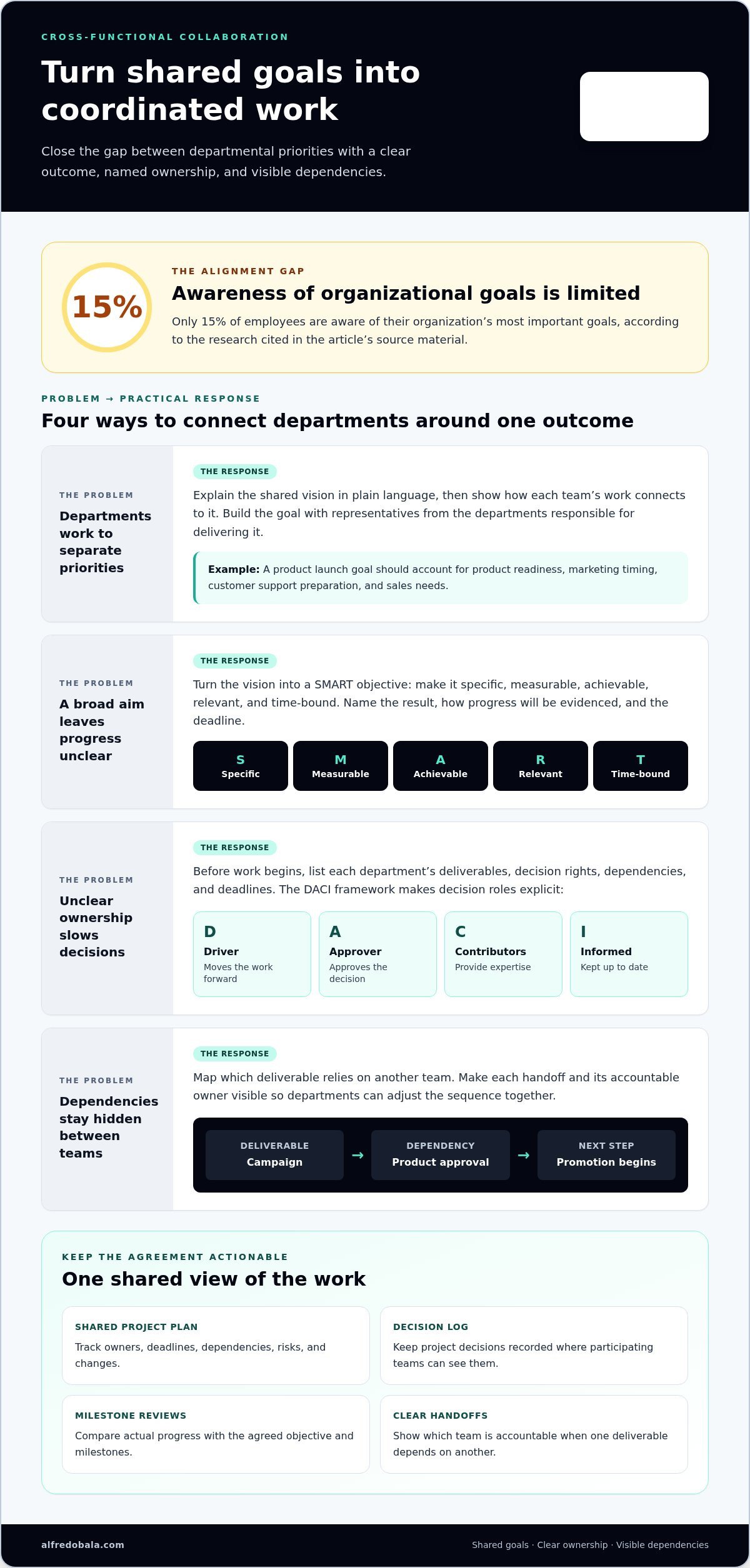
Give every department a clear reason to work together. A shared vision connects daily tasks to the organization’s wider objectives, so members can see how their contributions fit. Yet only 15% of employees are aware of their organization’s most important goals, according to the research cited in the article’s source material. Leaders can close this gap by explaining priorities in plain language and linking each team’s work to them.
Build the goal with the people responsible for delivering it. Invite representatives from relevant departments to identify the desired result, the customer or business need behind it, and the constraints each team must manage. This surfaces different perspectives early. For example, a product launch goal should account for product readiness, marketing timing, customer support preparation, and sales needs, not just one department’s target.
Turn the shared vision into a defined objective. SMART goals are specific, measurable, achievable, relevant, and time-bound. A broad aim such as “improve the customer experience” gives team members little direction. A stronger objective names the experience to improve, the evidence of progress, and the deadline. Teams can then agree on milestones to show whether their combined work is advancing.
Clarify roles before work begins. List each department’s deliverables, decision rights, dependencies, and deadlines in one project plan. The DACI framework identifies a Driver, Approver, Contributors, and people to keep Informed. For instance, a marketing lead might drive a launch plan while product and support contribute expertise. This structure reduces overlapping ownership and prevents decisions from getting stuck between teams.
Communication silos grow when departments track separate objectives without seeing their shared dependencies. Map which deliverable relies on another team, then identify the handoff and the person accountable for it. A shared milestone can reveal that a campaign depends on product approval before promotion begins. Teams can adjust the sequence together instead of discovering the dependency after work has stalled.
Project management processes make these agreements actionable. Use a shared project plan, a decision log, and recurring milestone reviews to track owners, deadlines, dependencies, risks, and changes. At each review, compare actual progress with the agreed objective, resolve blockers, and record decisions. Team-level OKRs can also connect departmental work to shared outcomes instead of isolated functional wins.
Keep expectations visible as priorities shift. When scope changes, revisit the objective, deliverables, and deadlines with affected departments, then update the shared plan. A change to a product feature, for example, may affect training materials and customer communications. Recording the impact on each team helps members make informed trade-offs and work together toward the outcome they need to achieve.
Finally, use shared measures to reinforce the vision. Combine an organization-level outcome with milestones that show each department’s contribution. Review the measures together, not only in separate departmental meetings. This gives leaders a practical way to spot misalignment, recognize dependencies, and guide teams toward the same result.
3. Benefits of diverse expertise and viewpoints
A functional team can solve the problem it understands best, but complex challenges rarely belong to one function alone. Bring different skills into the same discussion, and employees can see how a decision affects the whole process. For example, a product team can consider usability, engineering limits, customer needs, and launch timing together. That wider view helps teams identify trade-offs before one department commits to a solution.
Diverse perspectives can make innovation more practical. A designer may propose a simpler customer journey, while an engineer identifies the technical requirements and a support specialist flags recurring user confusion. Their combined insight can shape a creative solution that addresses both experience and feasibility. Rather than treating innovation as a separate exercise, teams connect ideas to the conditions needed to put them into practice.
Cross-functional work can also uncover risks earlier. In a healthcare initiative, doctors, nurses, and administrative professionals bring different knowledge of patient care and operational processes. Discussing a proposed change together can reveal workflow obstacles before implementation advances. The same principle applies to a new service: frontline employees may identify customer questions that planning teams have not considered.
Efficiency improves when departments understand one another’s processes. A sales team that knows which product details support staff need can set clearer customer expectations. Support teams can share recurring questions with product colleagues, who can address confusing features or instructions. These exchanges help reduce duplicated work and unnecessary handoffs, making it easier to direct effort toward the issue that matters.
Collaboration also creates learning opportunities. When marketing employees work with analysts, they can learn how customer data informs campaign choices; analysts, in turn, can understand how teams use those insights. Organizations can support this exchange through cross-departmental peer groups, project partnerships, or role shadowing. Employees gain context beyond their own function, which can strengthen future decisions and broaden their workplace skills.
Make the benefit tangible by choosing a real challenge and bringing in the expertise it requires. Ask each participant to identify a risk, an opportunity, and a dependency from their function’s perspective. Then compare the answers and agree on a shared strategy. For a product launch, this might reveal that customer education needs to begin before release, not after support inquiries arrive. Diverse viewpoints add value when teams turn them into coordinated action.
4. Leadership preparation and mutual recognition of skills
Leaders set the standard for collaboration through everyday decisions. If a department head asks other functions for input before approving a launch, employees see partnership modeled in practice. If leaders reward only local targets, teams learn to protect their own priorities. Align expectations across departments, then make shared outcomes part of leadership conversations and decisions.
Set a regular leadership forum to resolve competing priorities before they reach project teams. Quarterly leadership alignment meetings give functional leaders a structured opportunity to agree on organizational goals and discuss dependencies. For example, a product leader and a sales leader can identify where launch timing, product readiness, and customer commitments need joint decisions. Record decisions and communicate them to the teams doing the work.
Prepare managers to lead across functions, not only within their specialties. A manager coordinating a service change needs to listen to different concerns, clarify decisions, and address conflict without dismissing another team’s expertise. Leaders can practice these skills through realistic scenarios, such as handling a missed handoff between operations and customer support. Preparation gives managers a way to guide discussions toward solutions.
Make expertise visible. Ask each team to explain its responsibilities, constraints, and strengths at the start of a joint project. Role shadowing or empathy swaps can help employees experience another department’s perspective. For instance, a marketing employee observing customer support can hear the questions customers actually ask. That direct insight encourages better decisions and mutual respect.
Leaders also need to remove barriers that teams cannot solve alone. If a project stalls because approval authority is unclear, assign a decision owner and explain what the team can decide independently. Provide the resources and permissions needed to act. A visible progress platform can help leaders spot stalled work, while regular check-ins give team members a way to raise obstacles early.
Recognition reinforces the behaviors leaders want repeated. Credit the product, finance, and support employees who jointly resolve a recurring customer issue, rather than praising only the final presenter. Invite each function to name another team’s contribution during project reviews. This simple practice makes shared effort visible and helps build a culture where employees value skills beyond their own department.
Leaders can strengthen their approach through Leadership and Team Development Insights, especially when managers need practical ways to prepare teams for joint work. Apply the learning to a current initiative: identify a barrier, an underused skill, and a leadership behavior that can move the group toward its shared objective. Revisit those choices during the next project review.
5. Best practices for cross-functional teams
Build teamwork into how functional teams operate, not just into project kickoffs. Start with a compact working agreement covering decision rights, meeting norms, response expectations, and how members raise risks. For example, a marketing and product team can agree to share campaign changes in one project workspace and flag customer-impacting decisions directly. Clear habits make coordination part of the work itself.
Give the group a dedicated lead or project manager to track dependencies and keep actions moving. Assign one contact for each function so team members know where to take questions and decisions. Use a RACI chart to distinguish who is Responsible, Accountable, Consulted, and Informed. This prevents two departments from assuming the other owns a critical task.
Keep objectives measurable and revisit them as conditions change. A team working on a new customer onboarding process might review project milestones, open questions, and handoffs during recurring check-ins. Close each meeting with named owners, due dates, and expected deliverables. Written follow-ups help employees who missed the discussion stay aligned and give the team a reliable record.
Make progress and learning visible beyond the core project group. Share a concise update explaining what changed, what the team learned, and which departments need to act next. A marketing team might share customer feedback with product and support, helping each function respond to the same insight. Retrospectives can then identify helpful practices and where coordination created friction.
Resolve conflict by bringing departments together around the shared objective, the facts, and the impact of each option. Give each team space to explain its constraints, identify the decision owner, and agree on a documented next step. For example, marketing and product can compare campaign timing with product readiness, then choose a sequence that protects customer expectations.
Choose team structures to fit the work rather than copying a popular model. Spotify’s Squad Model uses small cross-functional squads for specific aspects of its services and products. The useful lesson is to organize people around a defined outcome while keeping their responsibilities and connections to functional teams clear. For a short-lived challenge, a temporary task force may be more practical.
Strengthen teamwork through cross-functional workshops, brainstorming, or training in communication and conflict resolution. A shared problem-solving session lets employees practice listening and develop solutions together. Remote teams can pair project-management tools with transparent task visibility, so colleagues across time zones understand progress and dependencies. Gather feedback in a retrospective, then adjust the working agreement to address real challenges.
Put these practices into action with leadership and teamwork insights that help teams turn collaboration principles into everyday habits.
Alfredo Bala (The Motivation Guy): The Motivation Equation
The Motivation Equation by Alfredo Bala (The Motivation Guy) offers practical frameworks for applying motivation and leadership principles to team development. Turn to it when your organization wants to move beyond collaboration practices and strengthen the leadership habits that help employees work toward shared goals. The book complements the strategies in this guide with a focused framework for understanding motivation. Alfredo Bala also offers Leadership and Team Development Insights and Speaking. These are relevant when leaders want to develop their approach or bring a leadership perspective to a team or organizational discussion.
Visit alfredobala.com to explore The Motivation Equation and Alfredo Bala’s leadership insights.
Turn collaboration into a lasting habit
Learning how to improve cross-functional collaboration is the starting point, not the finish line. Choose an active project and examine how people make decisions, raise concerns, and learn from setbacks. Ask the team what would make working together easier, then agree on a practical change to test. A clearer handoff, a more inclusive discussion, or a shared review of lessons can give employees a meaningful way to shape how they work.
Keep the conversation open as the project develops. Notice which behaviors help different perspectives lead to useful action, and make space to adjust when the team encounters friction. This discipline turns collaboration from a temporary initiative into a capability the organization can strengthen over time.
For a fresh leadership perspective, explore Alfredo Bala’s Speaking and contact Alfredo Bala to discuss your next step. Your team can start building stronger partnerships with one deliberate conversation.
Frequently Asked Questions
What is cross-functional collaboration?
Cross-functional collaboration is coordinated work among people with different specialties who contribute to one outcome. For example, when a company updates customer onboarding, product employees can shape the process, legal colleagues can review requirements, and customer support can flag confusing steps. The defining feature is shared responsibility for the result, not simply having employees from different departments attend the same meeting.
What are the best strategies to improve cross-functional collaboration?
Start with a live project where coordination is falling short. Ask each participating function to name its biggest dependency, then map where work slows down or gets repeated. Choose one improvement to test, such as a handoff checklist or a designated decision owner. Review whether it reduced friction during the next project retrospective. This focused approach turns broad collaboration goals into an observable change the team can refine.
How can teams set shared goals and align priorities across departments?
Have each department explain its current priorities before agreeing on a joint outcome. Then identify trade-offs, such as a marketing launch date that conflicts with product readiness. Decide together which outcome takes precedence and what each function must adjust. Put the decision into the project plan so employees can see how local priorities support the collective result and raise changes before they disrupt another team.
What roles and responsibilities help prevent silos and confusion?
Give the project a coordinator to track dependencies, a decision-maker for disputed choices, and a named representative from each function. For a customer-service improvement, the support representative can gather frontline observations while the operations representative assesses process changes. Clarify who can approve changes and who needs to be consulted. These role distinctions help employees know where to contribute without creating unnecessary approval loops.
Which communication tools and meeting practices work best for cross-functional teams?
Choose tools based on the work: a task board for ownership and deadlines, a shared document for evolving plans, and messaging for quick coordination. Use meetings for decisions, complex discussions, or unresolved dependencies, rather than reading updates aloud. Send a short agenda beforehand and capture decisions afterward. For example, a project review can focus on a blocked handoff and conclude with an owner and next action.
What are common barriers to cross-functional collaboration and how can teams overcome them?
Conflicting incentives, unclear authority, competing deadlines, and unfamiliar terminology can all strain collaboration. When a dispute arises, separate the underlying business need from each department’s preferred solution. Let both teams explain the impact, identify the decision-maker, and compare options against the agreed outcome. Record the decision and its rationale. If the same conflict returns, leaders should examine whether goals or decision rights are driving it.
How can remote and hybrid teams improve cross-functional collaboration?
Make project information accessible to employees working remotely, in the office, or across time zones. Share decisions and meeting notes in a common workspace, and allow written input before live discussions so quieter or absent colleagues can contribute. In hybrid meetings, include remote participants in the same conversation rather than holding side discussions in the room. Clear ownership and visible updates help prevent location from limiting involvement.
 ES
 EN
Comentarios recientes