
A leadership transition should never begin with a resignation. Succession planning best practices treat continuity as an ongoing process: identify critical roles, prepare potential successors, document essential knowledge, and review the plan as the organization changes. The goal is not simply to name a replacement, but to build the capability and clarity needed to carry the work forward.
It’s natural to start by asking who might step into a senior role. A durable plan also defines what that role requires, which skills future leaders need, and how they can build them through coaching, mentoring, and meaningful assignments. This guide to succession planning best practices explains how to identify critical roles and use assessments and practical tools to uncover readiness and development gaps. It also covers when professional advisors can help, so you can prepare for leadership continuity instead of making a last-minute decision.
Key Takeaways
- Make leadership continuity an ongoing practice: communicate openly, document essential knowledge, and give emerging leaders meaningful development opportunities.
- Prioritize roles whose absence would disrupt strategy or operations, then define the capabilities and success criteria each role requires.
- Use structured assessments and regular talent reviews to distinguish current performance from future potential and pinpoint development gaps.
- Bring professional advisors into complex transitions when legal, financial, or wealth considerations need to be weighed alongside leadership readiness.
1. What is succession planning?
Build continuity before a leadership vacancy appears. A succession plan identifies critical responsibilities, prepares future leaders, and clarifies how decisions will continue during a transition. Effective succession planning links employee development to organizational goals, so the leadership pipeline can grow alongside the business. Explain the plan’s purpose and process candidly, while handling candidate discussions with appropriate discretion.
U.S. legal and tax considerations depend on the business structure, ownership, and proposed transfer. Map decision authority and ownership changes, then involve attorneys and accountants to address the transaction’s legal and tax implications.
Develop successors through specific learning plans, not assumptions about potential. Discuss each employee’s career goals, desired next steps, learning needs, and interest in other areas of the company. Compare those goals with the capabilities the future role requires. Then set development actions, such as leading a project, owning a function, receiving coaching, or learning from an experienced executive. Cross-functional assignments can introduce emerging leaders to different teams, customers, and decisions. Link each assignment to a skill gap and a clear measure of progress.
Review and update succession plans regularly, and revisit them after restructuring, leadership changes, growth, or shifts in strategy. Track progress with practical measures, such as whether a successor has led a key project or learned essential workflows. Common mistakes include choosing one successor too early, overlooking employee goals, relying only on technical performance, and leaving critical knowledge undocumented. Open communication helps employees understand development opportunities without promising a specific promotion.
Small businesses can start with a focused plan for roles whose absence would disrupt operations. Document core tasks and workflows, identify who could cover each responsibility, and choose practical development steps using current projects and peer mentoring. Schedule reviews alongside career conversations, then update responsibilities as the business changes. If no internal employee is ready, consider other coverage options, such as dividing duties or hiring externally.
2. Identifying critical leadership roles
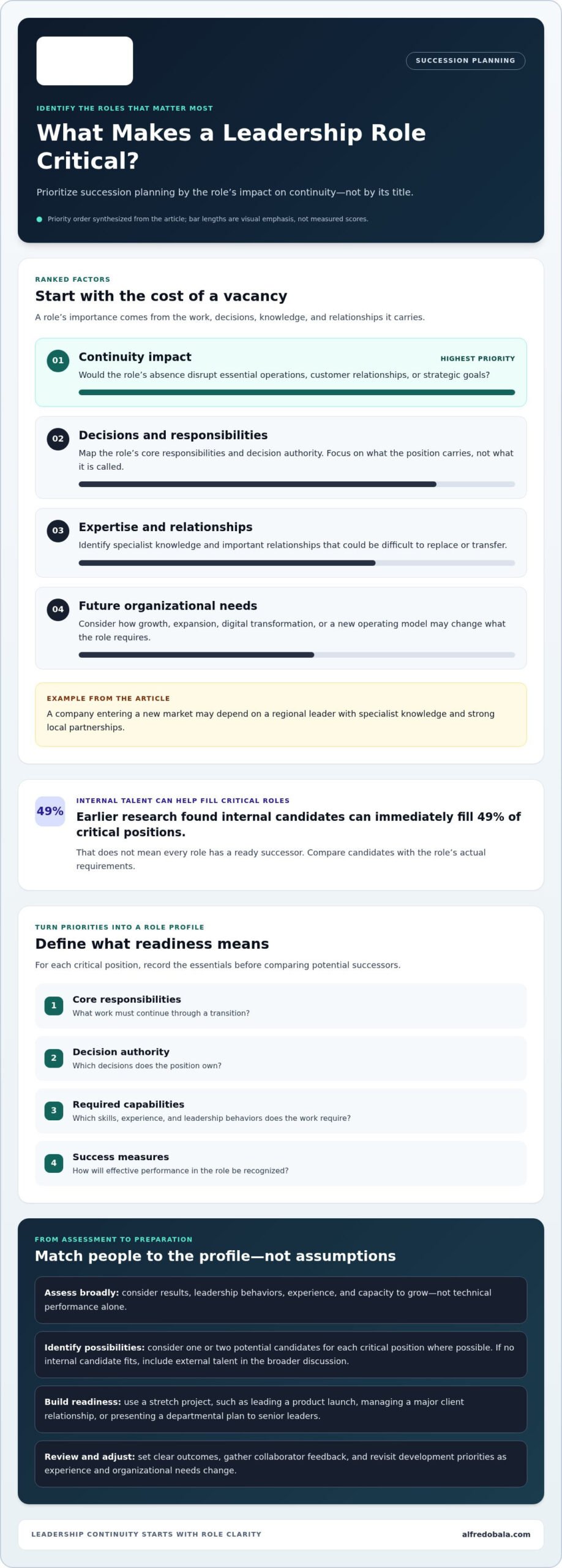
Start with the roles, not a shortlist of favored employees. Identify positions whose vacancy could disrupt essential operations, customer relationships, or strategic goals. For example, a company entering a new market may depend on a regional leader with specialist knowledge and strong local partnerships. A role’s title matters less than the decisions, expertise, and relationships it carries. A core principle of succession planning best practices is to prioritize roles by their impact on continuity.
Map each critical position against current and future organizational needs. Record its core responsibilities, decision authority, required skills, and measures of success. Then consider how expansion, digital transformation, or a new operating model could change those needs. A role that is manageable today may require different leadership capabilities as the organization evolves. These succession planning best practices keep the process tied to strategy, rather than preserving yesterday’s structure.
Build a candidate profile from those requirements. Assess employees’ results, leadership behaviors, experience, and capacity to grow, rather than relying on technical performance alone. Earlier research found internal candidates can immediately fill 49% of critical positions. Internal talent is valuable, but that doesn’t mean every role has a ready successor. Compare each candidate’s capabilities with the role profile, and identify one or two potential candidates for each critical position where possible. If no internal candidate fits, include external talent in the broader discussion.
Turn gaps into a preparation plan. Give a candidate a stretch project, such as leading a product launch, managing a major client relationship, or presenting a departmental plan to senior leaders. Set clear outcomes and gather feedback from collaborators afterward. Track progress against the role’s success criteria, then adjust development priorities as the candidate gains experience or organizational needs shift. This keeps succession focused on qualified talent and future readiness, not simply matching current employees to predetermined positions.
3. Leadership assessments and succession planning tools
Assess readiness against each leadership role’s demands, not personal impressions. Start with the role profile: list its core responsibilities, required skills, decision-making demands, and success measures. If the position is vacant, consult close collaborators, review performance records and job descriptions, and compare the findings with organizational objectives. This grounds the assessment in the work itself.
Use several forms of evidence to understand each candidate. Performance reviews show delivery over time; structured interviews reveal how employees reason through realistic leadership challenges. A 360-degree feedback process can surface how colleagues experience a candidate’s communication, collaboration, and judgment. Leadership self-assessments add the employee’s perspective, including interest in advancement and perceived development needs. No single measure should decide readiness.
The 9-box grid is a tool for comparing current performance with potential for growth, with each dimension ranging from low to high. Use it to organize discussion, not as a final verdict. Annual or biannual talent reviews give managers a chance to revisit placements as results, skills, and ambitions change. An employee with strong delivery but limited experience leading across teams may need a broader assignment before taking on a larger role.
Pair the assessment with a succession depth chart. For each critical position, record potential internal successors, their readiness, key strengths, and development gaps. Add actions such as leading a cross-functional project or presenting strategic recommendations to senior leaders. A succession template can capture owners, milestones, and progress in one place, making gaps visible across the leadership pipeline.
Keep the process fair and evidence-based. Don’t choose a successor simply because they resemble the predecessor; weigh relevant experience, values alignment, adaptability, and growth potential. Promotions are 1.6 times more likely to succeed when assessments inform leadership selection. Revisit evidence after assignments and feedback, then update readiness judgments before a transition decision.
4. Using professional succession-planning advisors
Bring in professional advisors when a transition involves more than leadership readiness. Attorneys, accountants, insurance agents, and wealth advisors can each offer a distinct perspective. Start by defining the decisions your organization must make, such as ownership transfer, financial planning, risk management, or leadership authority. Then match each question to the relevant professional expertise.
For an expected transition, an attorney can help clarify ownership arrangements and decision authority, while an accountant can evaluate financial records and tax considerations. A wealth advisor can help owners consider personal financial goals, and an insurance agent can explain how coverage relates to continuity planning. These discussions are most useful when advisors have a clear outline of the organization’s goals, timeline, and current succession options.
Unexpected departures require a different perspective. Ask advisors to help identify immediate decision-makers, essential records, and responsibilities that need temporary coverage. For example, if a founder becomes unavailable, the plan should clarify who can authorize payments, communicate with clients, and oversee operations. Advisors can help document these arrangements, while leaders determine which internal employees need support or further development.
Keep the work coordinated. Assign one internal owner to track recommendations, decisions, and outstanding questions. Share relevant information among advisors with appropriate permission, so financial, legal, and operational plans don’t conflict. Record who has authority at each transition stage and how the organization will communicate changes to employees and clients. Effective succession aligns expert input with practical leadership preparation, rather than treating each conversation as a separate project.
Use advisors to sharpen the plan, not replace leadership judgment. Senior leaders still need to define the capabilities future leaders require, evaluate readiness, and create development opportunities. If your organization is strengthening its leadership pipeline, explore guidance on leadership continuity as a practical next step.
An attorney can help clarify ownership arrangements and decision authority during a transition, such as guiding business owners on the cost to set up a trust in Cupertino when transferring company assets into protective family trusts. An accountant can review financial records and evaluate tax considerations.
Alfredo Bala (The Motivation Guy): The Motivation Equation
Alfredo Bala (The Motivation Guy) offers The Motivation Equation, a practical resource for strengthening motivation and leadership. Use its frameworks alongside a succession plan when emerging leaders need clearer development priorities, stronger ownership, and the ability to guide teams through change.
For organizations building leadership capability, Alfredo’s Leadership and Team Development Insights can connect individual growth with team needs and organizational direction. His Speaking can bring leadership and motivation concepts into a shared conversation, while a Board seat offers a governance perspective for organizations seeking leadership continuity at that level.
These offerings complement internal planning; they don’t replace role assessments or legal and financial advice. To develop leadership capability with greater purpose, contact Alfredo Bala (The Motivation Guy) or visit alfredobala.com.
Build continuity into your leadership culture
Make the next step a leadership habit, not a document left on a shelf. Build development conversations, role-readiness discussions, and knowledge sharing into the organization’s regular rhythm. This keeps succession planning best practices connected to how people work and grow, rather than treating continuity as a one-time project. It also helps leaders keep priorities visible as strategy and responsibilities evolve.
For teams looking to strengthen motivation and leadership capability, The Motivation Equation offers practical frameworks. Leadership and Team Development Insights can connect individual growth with team development, while Speaking can bring leadership themes into a shared conversation. Each can support a culture where people take responsibility for their development and contribute to future leadership.
Choose one useful action, then make it part of the way your team leads. Contact Alfredo Bala (The Motivation Guy) to explore a leadership-focused next step. Strong continuity is built through deliberate choices, and your organization can begin shaping that future now.
Frequently Asked Questions
What is succession planning?
Succession planning is the ongoing work of preparing people and processes for leadership changes. It helps an organization protect important decisions, relationships, and expertise when a leader leaves or responsibilities shift. For example, a department can identify who handles urgent approvals during an absence, then develop longer-term leadership capability. The process supports continuity, not just the selection of a replacement.
What Are the Elements of a Succession Plan?
A succession plan brings together critical roles, role requirements, candidate readiness, development actions, knowledge transfer, decision authority, and review measures. It should also clarify interim coverage if a permanent appointment takes time. For example, a plan might identify who approves a key contract during a transition, what experience a future role requires, and how leaders will track candidate development.
What are the key steps in a succession planning process?
Start by linking succession priorities to the organization’s strategy, then identify roles that could cause disruption if vacant. Define each role’s responsibilities and capabilities, assess potential successors, and assign development actions. Document interim coverage and decision authority. Finally, review progress and revise the plan as strategy or talent changes. This sequence turns broad intentions into clear ownership and follow-through.
How do companies identify and assess high-potential successors?
Companies assess potential successors by comparing role requirements with evidence of performance, leadership behavior, and capacity to grow. Consider feedback from people who have worked with the employee, alongside results from challenging assignments. For example, leading a cross-team initiative can reveal how someone handles competing priorities. Discuss the employee’s career interests too, since both readiness and willingness matter.
How should organizations create a succession plan for critical roles?
For each critical role, document its essential outcomes, decisions, relationships, and knowledge. Consider what would happen if the role became vacant tomorrow, then name interim coverage and identify longer-term candidate options. A plan for a customer-facing leader, for example, should clarify who maintains key relationships and how unresolved decisions move forward during the transition.
How should organizations communicate succession plans while protecting confidentiality?
Communicate the process openly while limiting sensitive candidate details to people who need them for planning decisions. Tell employees how roles are identified, what development opportunities are available, and how career conversations work. Discuss an individual’s candidacy privately rather than implying a promotion is guaranteed. During a transition, clearly explain decision authority, responsibilities, and next steps to affected teams.
 ES
 EN
Comentarios recientes