
A perfect strategy on paper is a liability if it fails to ignite the people responsible for executing it. You’ve likely sat in boardrooms where the data is impeccable and the spreadsheets project exponential growth, yet the actual momentum on the ground feels stagnant. It’s the classic vision-execution gap; a space where even the most seasoned leaders often feel isolated and unheard. You know the “what” and the “why,” but the “how” of global scalability continues to slip through the cracks of daily operations.
This disconnect is exactly why a veteran corporate strategy advisor is no longer a luxury for 2026; they’re a necessity for survival. I understand the weight of making high-stakes decisions while trying to keep a global team inspired. This article promises to show you how to bridge that gap between high-level board governance and the raw motivation required for real-world results. We’ll examine a proven framework for aligning organizational goals with human energy, providing you with a roadmap to transform complex theory into disciplined, profitable action.
Key Takeaways
- Understand the shift from project-based consulting to a long-term strategic partnership that aligns board vision with operational reality.
- Discover how a seasoned corporate strategy advisor uses “The Motivation Equation” to bridge the gap between high-level goals and ground-level execution.
- Learn to distinguish between fiduciary oversight and strategic execution to ensure your leadership remains focused on high-impact growth.
- Identify the specific organizational triggers—such as global expansion friction or vision-execution gaps—that signal the need for a veteran executive guide.
- Move beyond theoretical models to implement a grounded, results-oriented framework for leadership and team development in 2026.
What is a Corporate Strategy Advisor in the 2026 Economy?
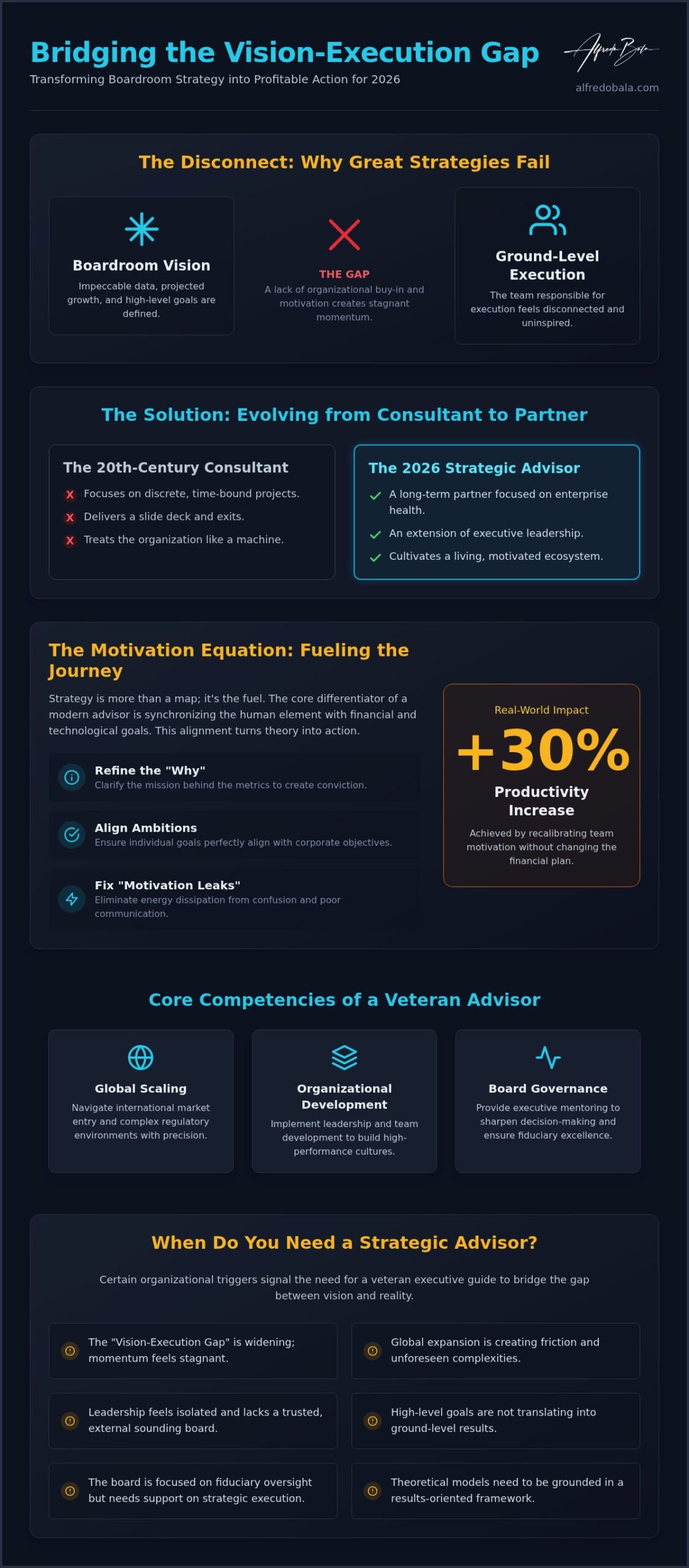
The boardroom has evolved. In the 2026 economy, a corporate strategy advisor isn’t a temporary vendor who provides a 100-page slide deck and exits. They’re a seasoned partner to the C-suite and the Board, operating as a high-level extension of executive leadership. While traditional management consultants often focus on discrete, time-bound projects, an advisor focuses on the long-term health and trajectory of the entire enterprise. This role requires a mastery of this Strategic Management Overview to ensure that high-level goals aren’t just theoretical aspirations but actionable realities.
Success in today’s market requires navigating extreme volatility. Geopolitical shifts, rapid AI integration, and fluctuating supply chains demand more than just “right” data; they demand agility. A modern advisor introduces the concept of Strategic Motivation. This is the core differentiator. It’s the art of ensuring that the human element of the business is perfectly synchronized with its technological and financial goals. Without this alignment, even the most brilliant strategy remains a document gathering digital dust.
The Evolution from Consultant to Strategic Partner
Stop relying on 20th-century consulting models. They’re failing in our decentralized, global economy because they treat organizations like machines rather than living ecosystems. The shift has moved toward a holistic advisory approach that prioritizes culture and motivation alongside governance. It’s no longer enough to have a vision; you must have the collective will to see it through. The advisor is the bridge between the boardroom and the front lines.
Core Competencies of a Veteran Advisor
Experience is the only currency that matters when the stakes are high. A veteran advisor brings a specific set of tools forged over 40 years in the field. This isn’t about theory; it’s about hard-won wisdom from the CEO chair. Key competencies include:
- Global Scaling: Navigating international market entry and complex regulatory environments with precision.
- Organizational Development: Implementing Leadership and Team Development Insights to build high-performance cultures.
- Board Governance: Providing executive mentoring that sharpens decision-making and ensures fiduciary excellence.
A true corporate strategy advisor doesn’t just suggest a path. They walk it with you, providing the clarity and confidence required to lead in an era of constant disruption.
Bridging the Gap: Why Strategy Fails Without Motivation
Strategy is more than a map; it’s the fuel that powers the journey. Most failures in the boardroom don’t stem from poor data or incorrect market analysis. They stem from a lack of organizational buy-in. When the team doesn’t understand their role in the grand design, execution grinds to a halt. As a corporate strategy advisor, I’ve seen brilliant plans fail because the human element was treated as an afterthought rather than the engine of growth.
To solve this, we must look at The Motivation Equation. This framework ensures that individual ambitions align perfectly with corporate objectives. It’s about identifying “motivation leaks” where energy is dissipated through confusion, lack of purpose, or poor communication. These leaks often occur at the intersection of departments where goals are siloed. Understanding the nuance between Corporate vs. Business Strategy is vital, but without motivation, these distinctions remain academic and uninspired. For a deeper look at how this impacts the highest levels of leadership, explore my insights on the Strategic Corporate Board Advisor.
The Motivation Equation in the Boardroom
Quantifying team energy is an art as much as a science. An advisor helps the board refine the “Why” behind the “What.” When a company shifts from a defensive posture to aggressive global expansion, the team’s motivation must be recalibrated. I’ve guided organizations where a simple shift in how the strategy was “sold” to the front lines resulted in a 30% increase in productivity without changing a single line of the financial plan. It’s about clarity and conviction. When your team knows they’re part of a winning story, they’ll move mountains to achieve the KPIs.
Overcoming Executive Isolation
Isolation is the silent killer of great leadership. CEOs often have the least visibility into the true motivation levels of their middle management and front-line staff. Information gets filtered and sanitized as it moves up the chain. An external corporate strategy advisor provides the unfiltered truth that internal teams are often too hesitant to share. This outside perspective allows for a culture of real accountability rather than performative compliance. It builds a bridge between the vision held at the top and the reality lived at the bottom, ensuring that the executive team isn’t leading in a vacuum. A trusted advisor tells you what you need to hear, not just what you want to hear.
If you’re ready to close the gap between your vision and your results, it’s time to apply Leadership and Team Development Insights that actually move the needle.
The Strategic Advisor vs. The Board of Directors
Distinguish between duty and drive. Boards of directors hold the keys to fiduciary duty. They act as the guardians of shareholder value, focusing heavily on risk mitigation and legal compliance. However, a corporate strategy advisor occupies a different space. While the board asks if a move is legal and safe, the advisor asks if it’s fast and effective. This distinction is critical for 2026. In an era of Navigating Strategic Paradoxes, boards need more than just oversight; they need a conduit for execution.
An advisor can step into a formal Board Seat Advisory role to bridge the communication gap between visionary directors and operational executives. This isn’t about replacing the board’s function. It’s about augmenting it with a global perspective that understands how a decision made in London impacts motivation in Tokyo. Without this bridge, the friction between high-level governance and daily operations can stall even the most well-funded initiatives.
Enhancing Board Governance with Strategic Insight
Prepare the C-suite for the boardroom. This is a high-stakes rehearsal that many leaders fail to master. Executives often enter board meetings feeling defensive, armed with data to justify the past rather than ideas to build the future. A seasoned advisor transforms this dynamic. By bringing a “Motivation Guy” perspective to the table, the advisor reminds the board that people, not just spreadsheets, drive ROI. Governance ensures safety, but strategy ensures growth. This balance allows the board to move beyond a checklist mentality and into a state of active, strategic contribution.
Navigating Global Team Growth
Scaling across time zones and cultures is the ultimate stress test for any strategy. It’s easy to maintain a unified voice in a single office. It’s an entirely different challenge when your workforce is spread across six continents. My 40 years of experience in global leadership serves as a blueprint for this complexity. You must maintain a unified corporate voice while allowing for local flexibility. This prevents the fragmented market trap where regional offices start operating as independent kingdoms. A unified strategy requires a unified spirit. When a corporate strategy advisor aligns these global teams, the organization achieves a level of scalability that competitors simply can’t match.
When Does Your Organization Need a Strategy Advisor?
Identify the ceiling. Every high-growth organization eventually reaches a point where the strategies that fueled its initial rise become the very anchors holding it back. It isn’t always a crisis that signals the need for external intervention; often, it’s the frustration of hitting a growth plateau despite having the “right” data and a capable team. When your internal compass begins to spin, a corporate strategy advisor provides the recalibration necessary to navigate the next level of complexity.
Recognize the specific triggers for 2026. If you’re entering a new global market, the geopolitical and economic volatility can overwhelm even the most experienced internal teams. According to Accenture research, 68 percent of leaders list resilience as a top transformation goal for 2026. This resilience is tested during rapid expansion or leadership transitions. If there’s a visible disconnect between your high-level strategic goals and your actual quarterly results, your strategy isn’t just failing; it’s disconnected from the reality of your execution.
Symptoms of Stagnant Strategy
Look for the friction within your culture. High turnover in key leadership positions is rarely just about compensation; it’s often a symptom of a vision that no longer inspires. When mid-management expresses confusion about long-term goals, the “motivation leaks” mentioned earlier have become floods. Another red flag is an over-reliance on historical data. If your board meetings focus exclusively on what happened last quarter rather than how to motivate the team for next year, you’re driving by looking in the rearview mirror.
Evaluating an Advisor: Experience vs. Methodology
Demand more than theory. When vetting a corporate strategy advisor, you must look for someone who has actually “sat in the chair.” Theoretical consultants can provide beautiful charts, but only a veteran who has navigated the CEO role can understand the weight of executive decision-making. You need a partner with a proven, proprietary framework like The Motivation Equation to ensure that human performance is baked into the strategic design. Ask these questions during your vetting process:
- Has this advisor successfully scaled a global organization through market volatility?
- Do they offer a clear methodology for aligning team energy with corporate KPIs?
- Can they demonstrate a track record of bridging the gap between board governance and front-line execution?
If your organization is ready to move beyond the status quo, it is time to book a consultation to break through your growth ceiling and implement a strategy that actually scales. Before making that decision, reviewing a comprehensive organizational leadership consulting buyer’s guide for 2026 can help you identify the right advisory partner for your specific growth challenges.
Implementing High-Impact Strategy with Alfredo Bala
Success is both a disciplined science and a nuanced art. To master it, you need a partner who understands the mechanics of influence as deeply as the mechanics of a balance sheet. Alfredo Bala brings this duality to the table, offering a perspective forged through 40 years of global executive leadership. He doesn’t just analyze your business; he recalibrates your organization for peak performance. As a corporate strategy advisor, Al bridges the distance between high-level theory and the hard-won wisdom of the CEO chair.
The journey from authoring “The Motivation Equation” to guiding global boards has been driven by a singular mission: ensuring that strategy never exists in a vacuum. Al specializes in professional development and organizational growth that sticks. He moves beyond the “what” of your corporate goals to master the “how” of human execution. This approach transforms stagnant growth into a scalable, high-velocity engine that can withstand the volatility of the 2026 market.
From Keynote to Consultant: A Holistic Approach
Transformation often begins with a spark of inspiration, but it’s sustained through rigorous application. Al’s work as a keynote speaking professional provides the infectious energy required to move a room. However, his long-term advisory work is where the real evolution happens. By acting as a “Success Story” archetype for your leadership team, Al helps you build a detailed roadmap for the next 12 to 24 months. This isn’t a generic plan. It’s a bespoke strategy that includes culture, motivation, and precise governance structures designed for your specific industry challenges.
Securing Your Strategic Future
Urgency is the ally of the proactive leader. The best time to engage a corporate strategy advisor is before the market shifts or a crisis hits. With major regulatory changes like the July 21, 2026, revision of Japan’s Corporate Governance Code impacting global standards, the need for veteran oversight has never been higher. Al’s availability for high-level board seat placements is limited, reflecting the demand for his specific blend of CEO experience and motivational mastery.
The ROI of professional leadership advisory is found in the clarity of your decisions and the speed of your results. Don’t let your organization settle for “right” data that yields wrong outcomes. It’s time to position your company for its next phase of global dominance. Reach out to secure a strategic partnership that brings the gravitas of a veteran executive to your most critical challenges.
Secure Your Global Growth Trajectory
Navigating the complexities of the 2026 global market requires more than just a well-documented plan. It demands a seamless bridge between board-level governance and the deep-seated motivation of your front-line teams. You’ve seen how the vision-execution gap can stall even the most promising initiatives. By integrating the “Motivation Equation” into your high-level planning, you ensure that every member of your organization is moving in the same direction with the same level of conviction.
This is where the role of a seasoned corporate strategy advisor becomes your greatest competitive advantage. With over 40 years of global executive experience as a former CEO and COO of multi-million dollar entities, I bring a roadmap forged in real-world application, not just theory. Authoring “The Motivation Equation” allowed me to codify the mechanics of influence that drive true organizational growth.
Don’t wait for a growth ceiling or a market crisis to recalibrate your path. Take the next step toward disciplined, scalable success today. Partner with Alfredo Bala for Strategic Advisory and turn your corporate vision into a global reality. Your organization’s highest potential is within reach.
Frequently Asked Questions
What is the difference between a corporate strategy advisor and a business consultant?
A corporate strategy advisor functions as a long-term strategic partner to the C-suite and Board rather than a project-based vendor. While business consultants often address specific, isolated problems, an advisor focuses on the holistic health and trajectory of the enterprise. This role involves bridging the gap between high-level governance and operational execution to ensure sustainable growth. It’s a partnership built on deep executive experience rather than temporary tactical support.
How does a corporate strategy advisor help with global expansion?
Global expansion requires navigating a complex web of geopolitical risks, cultural nuances, and regulatory shifts. An advisor provides a proven blueprint for scaling operations across borders while maintaining a unified corporate voice. By leveraging decades of international experience, they help you identify high-potential markets and avoid common pitfalls that stall global momentum. They ensure your strategy is resilient enough to withstand the volatility of diverse international markets.
Can a strategy advisor also serve on a corporate board of directors?
Yes, a strategy advisor can occupy a formal board seat to provide ongoing fiduciary oversight and strategic guidance. This dual capacity allows the advisor to act as a vital link between visionary directors and the executive team. They ensure that board-level decisions are grounded in the practical realities of team motivation and market execution. This integration helps the board move beyond simple oversight and into active strategic contribution.
What industries benefit most from having a corporate strategy advisor?
Any organization facing rapid growth, market disruption, or global complexity will see significant benefits. Industries like technology, healthcare, and network marketing particularly profit from this high-level guidance. These sectors often face intense volatility where a disciplined strategy and a motivated workforce are the primary differentiators between market leaders and those who fall behind. The focus remains on scalability and high-performance team development regardless of the specific sector.
How long does a typical engagement with a strategy advisor last?
Engagements are typically long-term and building, often spanning 12 to 24 months to ensure deep organizational transformation. Unlike quick-fix consulting, strategic advisory requires time to align culture with corporate goals. This duration allows for the implementation of robust frameworks and the mentoring of leadership teams through multiple cycles of growth. The goal is to create a sustainable system for improvement that continues long after the formal engagement concludes.
What is the “Motivation Equation” and how does it apply to corporate strategy?
The Motivation Equation is a proprietary framework designed to quantify and align team energy with corporate objectives. It applies to strategy by treating human performance as a core component of the business plan rather than a secondary concern. When individual ambition is synchronized with executive vision, the organization achieves a level of execution that spreadsheets alone cannot produce. It turns the “Why” of your business into a measurable engine for growth.
How much does a corporate strategy advisor cost?
The cost of a corporate strategy advisor is best viewed through the lens of return on investment and risk mitigation. High-level advisory prevents costly strategic missteps and accelerates global scalability, often yielding value that far exceeds the initial engagement. You’re investing in decades of executive wisdom and a proven methodology for breaking through growth ceilings. The focus isn’t on the expense but on the massive value created through precision and alignment.
How do I know if my company is ready for external strategic advisory?
Your company is ready when you notice a persistent gap between your strategic vision and your quarterly results. If your leadership team feels isolated or your growth has hit a ceiling that internal resources can’t break, it’s time for an external perspective. Readiness often coincides with major transitions like global market entry or C-suite restructuring. Don’t wait for a crisis to seek the guidance of a veteran who has navigated these challenges before.
 ES
ES  EN
EN
Comentarios recientes