
What has the biggest influence on your team’s morale: a perk or celebration, or what you do every day? Creating a positive work environment depends on consistent leadership practices. Unclear expectations, uneven follow-through, and silence in meetings can weaken trust, even when wellbeing and recognition are priorities.
Leaders can shape a healthier workplace through ordinary, repeatable choices. This guide explains how to build trust and psychological safety, set clear expectations, communicate consistently, and make recognition part of everyday work. You’ll also learn how to invite honest feedback and use observable signals, such as whether people raise concerns or understand their priorities, to adjust your approach.
A positive culture doesn’t come from a slogan. It grows when leaders make their values visible in how they listen, respond, and hold themselves and others accountable. Start with those daily habits, and your team has a stronger foundation for doing good work together.
Key Takeaways
- Recognize the difference between lasting workplace culture and temporary morale boosts or attractive perks.
- Build trust by aligning leadership decisions with stated values, clear standards, and consistent follow-through.
- Identify everyday practices that support a positive environment, from role clarity and manageable workloads to inclusion and meaningful recognition.
- Start creating a positive work environment by listening to employees, choosing one priority, testing a practical change, and reviewing feedback.
- Adapt your approach as teams and working conditions change, so supportive habits remain effective as the organization grows.
What creating a positive work environment means in everyday practice
A positive work environment is a consistent experience of respect, clarity, support, and accountability in the way work gets done. Creating a positive work environment means making those qualities visible in everyday decisions, not just expressing them in a mission statement. Employees notice whether expectations are clear, questions are welcomed, and commitments are kept.
Culture isn’t the same as a generous perk, a team celebration, an attractive office, or a short-term morale campaign. Those may add value, but they can’t substitute for fair treatment and dependable leadership. Organizational culture describes the shared expectations and behaviors that shape how people work together. The overview of organizational culture and positive work environments offers useful context, but leaders can see culture most clearly in repeated choices: whose input is considered, how mistakes are handled, and whether standards apply consistently.
Look at ordinary moments. A manager changes a deadline without explaining why, or gives one employee flexibility while denying it to another in a similar situation. Each decision may seem small in isolation. Repeated over time, these choices signal what the organization truly values. The real test is whether stated principles guide behavior under pressure, during disagreement, or when a trade-off is inconvenient.
What does a positive workplace feel like to employees?
People can ask for clarification, raise concerns, and offer a different idea without being mocked, ignored, or quickly shut down. That doesn’t mean every suggestion is adopted. It means leaders listen, respond respectfully, and explain decisions where appropriate. Clear roles and fair, consistent expectations also reduce avoidable uncertainty. Employees know what they own and where to turn when priorities conflict.
Support doesn’t mean expecting people to stay cheerful or agree with leadership. A team can address difficult news, admit frustration, and challenge a decision while treating one another with respect. Leaders set the tone by making room for honest discussion instead of rewarding only positive-sounding updates.
How can leaders recognize an unhealthy work environment?
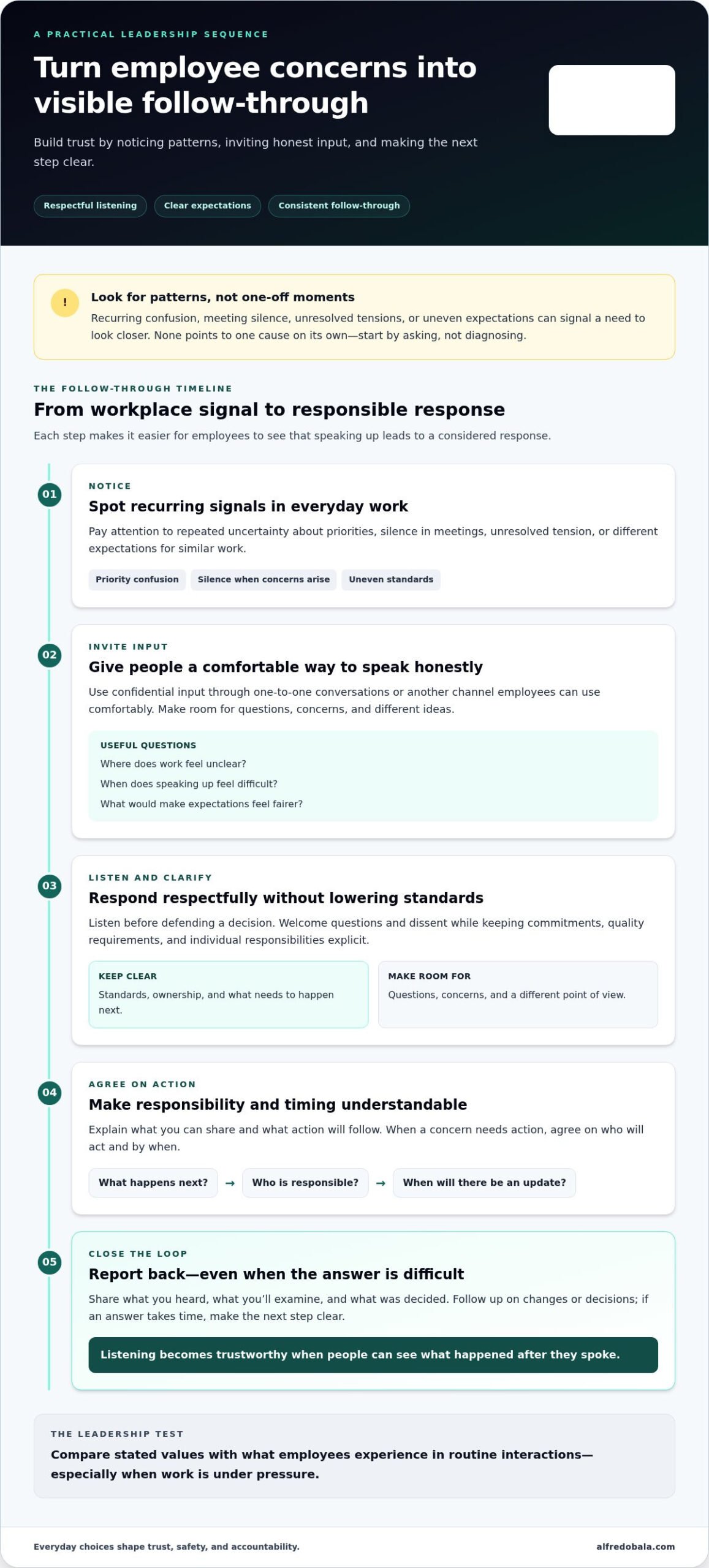
Pay attention to patterns, not isolated moments. Recurring confusion about priorities, silence during meetings, unresolved tensions, or different expectations for people doing similar work can all signal a need to look closer. None points to one cause on its own. A quiet meeting, for example, might reflect uncertainty about the topic, a lack of preparation, or concern about how disagreement will be received.
Start with inquiry rather than a quick diagnosis. Invite confidential input through one-to-one conversations or another channel employees can use comfortably. Ask where work feels unclear, when speaking up feels difficult, and what would make expectations fairer. Then close the loop: share what you heard, explain what you’ll examine, and follow up on changes or decisions. Listening without visible follow-through can deepen doubt, so make the next step clear even when the answer takes time.
For leaders, the practical discipline is to compare stated values with observable behavior. Ask what employees experience in routine interactions, especially when work is under pressure. That honest comparison gives you a more useful starting point than a slogan or a single morale activity.
How leadership behavior creates trust, safety, and accountability
Trust grows when leaders’ actions match their stated values. If a manager says quality matters but rewards speed at any cost, employees learn from the reward, not the slogan. If a leader promises to address a concern and reports back, even when the answer is difficult, people see that speaking up leads to a responsible response. Employees experience workplace culture through the consistency of leaders’ decisions, not just the values printed on the wall.
Creating a positive work environment doesn’t mean removing expectations. It means making standards clear, applying them fairly, and giving people a respectful path to meet them. When something goes wrong, avoid both blame and avoidance. Ask what happened, what conditions contributed, who was affected, and what needs to change. Then be clear about responsibility and next steps.
How can managers build psychological safety without lowering standards?
Make it clear that questions and dissent are welcome, while commitments, quality requirements, and individual responsibilities remain explicit. A team member who flags a risk before a deadline isn’t failing to support the team. They’re giving the team a chance to respond. Invite that information early, then agree on who will act and by when.
Leaders can model accountability by acknowledging uncertainty or owning a mistake without treating the standard as optional. When an employee raises a concern, listen before defending a decision. Explain what you can share, what action will follow, and when you’ll update the team. Closing the loop shows that candor is taken seriously, even if the requested change isn’t possible.
How do recognition and fairness shape the work environment?
Recognition carries more weight when it’s specific, timely, and tied to a meaningful contribution. Instead of a generic “great job,” explain what the person did and why it mattered. For example, they surfaced a delivery risk early, helping colleagues adjust their plans. Specific praise helps employees understand which actions are valued; broad compliments can feel disconnected from the work.
Fairness requires consistent expectations and clear explanations for decisions that affect the team. If priorities or flexibility differ, explain why rather than leaving people to guess. This doesn’t mean every decision will please everyone. It does mean people can see the standard behind it and have a chance to ask questions.
Don’t use praise to cover for unresolved problems. Thanking employees for their effort won’t address a workload that repeatedly exceeds available capacity. Pair recognition with honest attention to the conditions affecting the work, and follow through on what can be changed.
For leaders looking to deepen their approach to motivation and team development, The Motivation Equation offers a practical framework to explore alongside these everyday habits.
Which workplace practices make a positive environment sustainable?
Sustainable culture is built into how work is organized, communicated, and recognized. A gesture may lift the mood for a day; a reliable practice helps employees understand what to expect and how to contribute. The right approach depends on the team’s needs, job design, and organizational context. A practice that works for a customer-facing team, for example, may need adjustment for employees working across time zones or handling unpredictable demands.
Use this distinction to assess whether an effort addresses everyday conditions or simply creates a brief impression of change:
| Durable practices | Surface-level gestures |
|---|---|
| Agree on how priorities, decisions, feedback, and handoffs are communicated. | Announce an open-door policy without making time or a safe channel for questions. |
| Clarify role ownership, deadlines, and how to resolve conflicting priorities. | Distribute a new values statement while leaving responsibilities unclear. |
| Review workload, learning opportunities, inclusion, and recognition as part of regular management. | Offer a wellness message or celebration without addressing recurring work pressures. |
The goal isn’t to dismiss perks or celebrations. It’s to make sure they complement dependable ways of working rather than stand in for them. Creating a positive work environment means choosing practices employees can experience consistently and adjusting them when they don’t fit the work.
How can clear communication and expectations improve daily work?
Set practical norms for how priorities are shared, who makes which decisions, when feedback is given, and how work passes between teams. Make ownership and deadlines visible, and agree on what an employee should do if two urgent priorities conflict. A clear protocol can prevent people from guessing whose request takes precedence.
Use check-ins to uncover blockers and agree on support, not to track every action. Ask, “What’s getting in the way of this commitment?” The answer may reveal a dependency, an unclear decision, or a workload conflict that a status report alone would miss.
How can leaders support wellbeing, growth, and belonging?
Look at work conditions, not just wellbeing messaging. Review whether the workload fits the available time, whether employees can recover after demanding periods, and whether urgent work has become the default. Support also includes opportunities to learn, contribute beyond routine tasks, and receive feedback specific enough to guide development.
Belonging requires attention to participation. Ask whose perspectives are missing and whether meeting formats, schedules, or decision processes make it harder for some people to contribute. Then make an adjustment, such as gathering input before a meeting or rotating who presents ideas. Pair that with timely recognition that names the contribution and its value. These habits make culture practical while leaving room to adapt as the team’s work changes.
How to create a positive work environment with a practical 30-day plan
Keep the work manageable: don’t try to change everything at once. A focused 30-day cycle gives you time to hear what employees experience, test one practical adjustment, and decide what to do next. Treat it as a learning process, not a promise that one month will solve every challenge. Creating a positive work environment starts with understanding the team’s needs rather than assuming you already know the main problem.
- Listen. In the first week, ask employees what helps them do good work and what creates avoidable friction. Use conversations, existing team feedback, and observable signals such as recurring blockers or missed handoffs. Offer more than one way to respond, such as a one-to-one discussion and a written channel, so people can choose what feels comfortable.
- Choose a priority. Look for a specific issue that appears across feedback or repeatedly disrupts work. Narrow it to something the team can influence, such as unclear ownership during handoffs. Explain why you selected it, and be candid about what falls outside the team’s control for now.
- Test a practice. Agree on one change, name an owner, set a timeframe, and choose a review point before you begin. For example, the team might use a shared handoff note that records the next owner, deadline, and open question. Keep the test simple enough to use during normal work, not just when everyone has extra time.
- Review feedback. At the agreed review point, ask whether the practice reduced friction and what still feels difficult. Consider employee comments alongside relevant indicators, such as repeated delays at handoffs. Share what changed, what didn’t, and whether you’ll keep, revise, or stop the practice.
What should leaders ask employees before changing team practices?
Use questions that invite specific examples: “What helps you do your best work?” “Where do tasks or decisions get stuck?” and “What’s one small change that would make this process clearer?” Explain how responses will inform the decision and who will see them. Protect confidentiality where appropriate, and don’t imply that comments are anonymous if they aren’t. Most of all, make it safe to disagree with your initial view.
How can a team tell whether a change is helping?
Compare patterns, not isolated reactions. A new handoff routine may coincide with fewer missed details, but that alone doesn’t prove the routine caused the change. Ask employees what they notice, check whether the original friction is still present, and consider other factors that may have shifted. If feedback is mixed, treat that as useful information, not a reason to declare success or failure too soon.
Close the cycle by reporting back to the team. State what you heard, the decision you made, and when you’ll revisit it. This follow-through helps employees see that their input matters, even when the team can’t adopt every suggestion. For a broader framework on motivation and leadership, explore The Motivation Equation as you shape your next practical step.
How to sustain a positive work environment as the organization grows
Growth changes the conditions people work in. Teams gain members, responsibilities shift, and priorities compete. Informal habits that once worked may stop serving everyone. A positive work environment can’t depend on one launch, event, or manager’s personal effort. It needs repeated practices that remain visible as the organization evolves, with room to adjust when employees’ experiences change.
Build useful habits into existing routines and leadership responsibilities. If a team has agreed to clarify ownership at handoffs, make that part of project planning. If managers are expected to invite input, make space for it in decision-making, not only in an occasional survey. Then review whether formal policies and informal norms support the same expectations. A policy may encourage time off, for example, while team habits reward people for staying available. That mismatch deserves attention.
How can leaders keep workplace improvements from fading?
Assign responsibility for revisiting each practice, and connect the review to a routine the team already uses. Periodically ask whether the practice still fits the work, whether people are using it, and what friction remains. Revisit employee feedback when team membership, priorities, or working conditions change. Recognize progress honestly, but don’t present partial improvement as a finished solution. If concerns persist, name them and clarify what the next review will consider.
This approach keeps workplace culture responsive rather than fixed. The aim isn’t to preserve every process indefinitely. It’s to preserve the intent behind it, such as fair communication or clear ownership, while adapting how that intent is put into practice.
How can leadership development reinforce positive workplace habits?
Ask managers to reflect on the effects of their decisions, not only the decisions themselves. Did a change in priorities reach everyone who needed to know? Were different perspectives heard before a conclusion was reached? Could employees raise a concern without being treated as disloyal? These questions turn broad leadership values into behaviors managers can examine and strengthen.
Leadership development can give managers a structured way to build self-awareness and apply it as responsibilities expand. Explore executive leadership development strategies for a deeper look at leadership growth. Alfredo Bala shares leadership insights on the practical relationship between motivation, people, and organizational growth. No single approach guarantees results, so use these ideas to inform reflection and action within your team.
As a next step, choose one existing team routine and ask whether it still supports the experience you want employees to have. Gather their perspective, make one deliberate adjustment, and return to the question as the organization changes. Explore The Motivation Equation leadership framework for another perspective on motivation and leadership.
Make your next leadership choice count
Culture shifts through the choices leaders make when no formal initiative is underway: what they prioritize, what they make room to hear, and what they follow through on. Choose one moment in your next workday to lead more deliberately. You could clarify a decision, invite a perspective you haven’t heard, or pause to ask what would help someone move forward.
That small action won’t transform a workplace overnight, and it doesn’t need to. Creating a positive work environment is an ongoing leadership practice, strengthened as you stay curious about how your choices affect the people around you. Keep learning, make adjustments, and let your actions demonstrate the standards you want your team to experience.
Alfredo Bala, known as The Motivation Guy, is a leadership expert, author, and professional speaker whose work focuses on motivation, team development, and organizational growth. As the author of The Motivation Equation, he offers a framework for leaders who want to keep growing. Explore Alfredo Bala’s leadership insights and choose one practical step to put into action with your team. Steady, thoughtful leadership can help create a workplace where people have greater clarity and room to contribute.
Frequently Asked Questions
What is a positive work environment?
A positive work environment is one where respect, clarity, support, fairness, and accountability shape how people work together. Employees experience these principles in ordinary moments, such as whether a manager explains a change that affects schedules or treats questions seriously. A team’s specific needs vary by role and working conditions, but the underlying principles can remain steady. Perks and written values alone don’t show how the workplace feels day to day.
How can a manager create a positive work environment?
A manager can start by asking employees where work gets unnecessarily difficult, then act on a practical issue within the team’s control. For example, if requests arrive through several channels, agree on one place to record changing priorities. Set a time to review whether the adjustment helped, and tell the team what you learned. Creating a positive work environment takes consistent attention; no single change can resolve every workplace challenge.
Can a positive work environment improve employee performance?
Supportive working conditions can help people focus, collaborate, and contribute, but performance has multiple causes. A team may communicate well and still struggle if roles are poorly designed, necessary resources are missing, or goals keep shifting. Rather than assume a culture change caused a performance shift, examine relevant work indicators alongside employee feedback. For instance, consider whether a process is clearer and whether delays have other contributing factors.
What are the signs of a toxic work environment?
Possible warning signs include employees avoiding honest questions, expectations changing unpredictably, disrespect going unresolved, unclear responsibility, or communication repeatedly breaking down. Look for recurring patterns, not a single tense exchange or difficult deadline. Ask employees for specific examples and listen for where the work system may be contributing. Address the behavior and conditions you can identify instead of relying on a broad label, which can obscure what needs to change.
How can leaders build trust in the workplace?
Leaders strengthen trust by communicating decisions clearly, keeping commitments, applying standards fairly, and responding respectfully when feedback is uncomfortable. If a manager changes a project’s direction, explaining what changed and what it means for each person is more useful than expecting the team to infer the reason. Acknowledge your own mistakes, too. Invite employees to say whether your actions match your intentions, then show how their input informs your next decision.
Are workplace perks enough to create a positive work environment?
No. Perks and social activities can add value, but they can’t make up for persistent confusion, unfair treatment, weak communication, or demands that exceed reasonable capacity. A team lunch won’t resolve a recurring problem with unclear ownership. Treat benefits as additions to sound day-to-day management, not substitutes for it. Ask employees which parts of the work help them contribute and which create friction, then consider whether a practical adjustment is needed.
 ES
ES  EN
EN
Comentarios recientes