
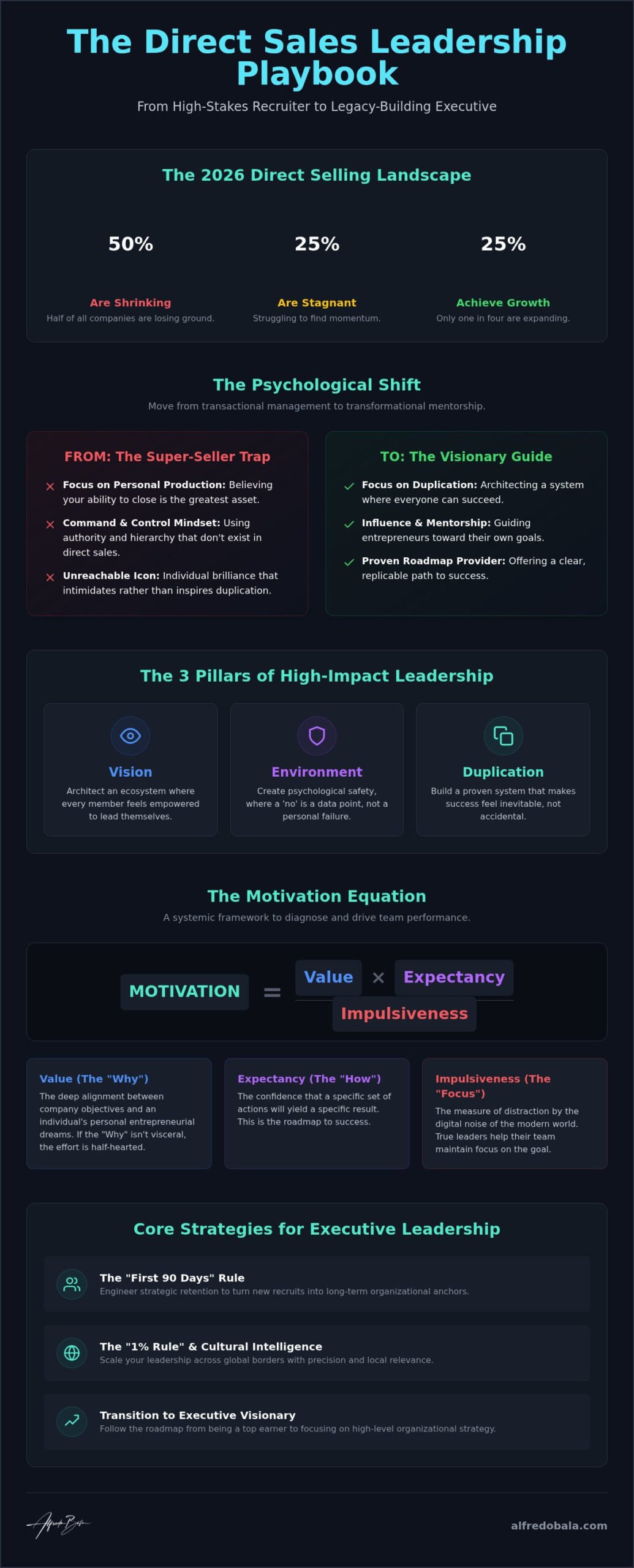
Did you know that in 2026, exactly half of all direct selling companies are actually shrinking while only one in four manages to achieve significant growth? If you feel like you’re stuck in the “super-seller” trap, doing all the heavy lifting while your team churns through the revolving door of attrition, you aren’t alone. It’s frustrating to build a global organization only to see it stall because of cultural disconnects or a lack of true duplication. To break through this ceiling, you need a shift in perspective. You must move beyond basic management and implement sophisticated direct sales leadership strategies that transform your organization into a high-retention, self-sustaining engine.
You deserve to transition from a high-stakes recruiter to a legacy-building executive who leads with precision. I’ve spent decades in the trenches and the boardroom, launching markets from China to South America, and I’ve learned that sustainable success isn’t about working harder; it’s about mastering the human mechanics of performance. In this playbook, I’ll share the high-level framework used by global CEOs to foster long-term loyalty and create a culture of autonomous leaders. We’ll break down the Motivation Equation and provide a duplicatable roadmap that allows you to step into your role as a visionary guide.
Key Takeaways
- Discover how to escape the “super-seller” trap by shifting your focus from personal production to the sophisticated art of influence.
- Master the specific variables of The Motivation Equation to implement direct sales leadership strategies that foster high-performance, self-sustaining teams.
- Learn the “First 90 Days” rule for engineering strategic retention; this ensures your recruits become long-term anchors for your organization.
- Explore the 1% Rule and Cultural Intelligence to scale your leadership across global borders with precision and local relevance.
- Identify the roadmap for transitioning from a high-earning recruiter into a legacy-building executive role focused on organizational strategy.
Beyond the Quota: The Psychological Shift in Direct Sales Leadership
Leadership in the modern era is far more than a title; it is the art of influence without formal authority. As we look toward 2026, the global marketplace demands a shift from transactional management to transformational mentorship. Those who thrive will be the ones who implement sophisticated direct sales leadership strategies that prioritize the development of others over personal accolades. You aren’t merely overseeing a sales force. You’re guiding a collective of independent entrepreneurs who need a roadmap, not a ruler.
Many high achievers fall into the “Super-Seller Trap” early in their careers. They believe their personal ability to close deals is their greatest asset. In reality, your individual brilliance can hinder team growth if it isn’t duplicatable. If your team views you as an unreachable icon, they won’t believe they can replicate your success. High-impact leadership rests on three pillars: Vision, Environment, and Duplication. Your job is to architect an ecosystem where every member feels empowered to lead themselves through a proven system.
The Death of Command and Control
Traditional corporate hierarchies fail in decentralized models because they rely on leverage that doesn’t exist here. You cannot fire an independent distributor for poor performance; they are their own boss. Therefore, you must shed the corporate “Boss” mindset and embrace the role of a “Visionary Guide.” Success begins with understanding the direct sales model as a voluntary association of motivated individuals. Influence Leadership is the ability to move others toward their own goals. When you help people get what they want, they’ll naturally help you build the organization.
Architecting a Culture of Belief
Building a team identity that survives market fluctuations requires more than just high commission checks. It requires psychological safety. In high-stakes sales environments, your team needs to know that a “no” from a prospect isn’t a failure of their character. This safety allows for the persistence necessary to scale. You must link belief to performance at every level. The “Why” must always precede the “How” because a person with a strong enough reason will eventually figure out the mechanics of the business. By focusing on belief and integrating these direct sales leadership strategies, you create a self-sustaining engine of growth that doesn’t require your constant intervention to stay fueled.
Implementing The Motivation Equation for High-Performance Teams
Stop chasing the temporary high of a “rah-rah” speech. While emotional rallies might spark a weekend of activity, they rarely sustain a global organization through the rigors of a calendar year. To build a high-performance team in 2026, you must pivot to a systemic framework. I call this The Motivation Equation. It’s a precise methodology for mastering human performance that replaces vague inspiration with hard-won strategy. When you understand the science of why people move, your direct sales leadership strategies become surgical rather than generic.
When a team member stalls, don’t just tell them to “work harder.” Use the equation to diagnose the specific friction point. Is it a lack of Value (the goal isn’t big enough)? Is it low Expectancy (they don’t believe the system works for them)? Or is it high Impulsiveness (they are distracted by the digital noise of the modern world)? By identifying the specific variable, you can provide the exact coaching needed to restart their momentum. This systemic approach is what separates the executive visionary from the frustrated manager.
Calculating Value and Expectancy
Value is the cornerstone. It represents the deep alignment between company objectives and an individual’s personal entrepreneurial dreams. If the “Why” isn’t visceral, the effort will always be half-hearted. Expectancy, on the other hand, is the roadmap. It’s the confidence that a specific set of actions will yield a specific result. You build this by creating a system where success feels inevitable, not accidental. Many leaders use various motivational tactics for sales reps to boost these numbers, but the most effective approach is a clear, duplicatable path. To dive deeper into these mechanics, I recommend exploring The Motivation Equation: A Masterclass in Leadership and Human Performance.
Managing Time and Distraction (Impulsiveness)
In the digital-heavy landscape of 2026, the “Impulsiveness” variable is your greatest enemy. Your team is constantly bombarded by short-term dopamine hits from social media and competing opportunities. High impulsiveness divided by a long “Delay” (the time it takes to see a real return) is a recipe for attrition. As a leader, you must teach “Deep Work” habits. Encourage your part-time force to block out focused windows of activity where the phone is away and the focus is solely on revenue-generating tasks. Increasing the Delay factor requires building a long-term vision that outweighs the immediate temptation of distraction. If you want to refine your personal approach to these challenges, consider how a session on leadership insights could sharpen your perspective.
Strategic Retention: Engineering Loyalty in Decentralized Organizations
Exponential growth is a mathematical impossibility without high retention. While many leaders obsess over the “front door” of recruitment, the true masters of direct sales leadership strategies focus on closing the “back door” of attrition. In a decentralized environment where no one is forced to show up, loyalty is the only currency that matters. You aren’t just managing a sales force; you’re engineering a culture where staying is more rewarding than leaving. Success in 2026 requires moving from a transactional mindset to an organizational one.
The “First 90 Days” Rule is your most potent weapon in this battle. This window is when a recruit is most vulnerable to doubt and external criticism. Your leadership must provide immediate “micro-wins” that anchor them to the vision. By establishing “Community Anchors,” such as social ties and shared goals, you keep members engaged even during the inevitable slow cycles of the business. For a deeper dive into these mechanics, see my guide on Mastering Team Retention Strategies for Network Marketing in 2026.
The Leadership Retention Framework
Retention requires a shift in how you reward your people. Recognition systems must move beyond mere commission checks to status and contribution. People will work for a living, but they will die for recognition. Position your team as a “Personal Development School” that happens to sell a product. When team members feel they’re becoming better versions of themselves, they’ll stay for the growth even if their sales temporarily dip. Managing high-earning teams also means navigating the “Ego Economy.” You must act as a mediator, resolving conflicts with a focus on the shared mission rather than individual dominance.
Monitoring the ‘Churn’ Pulse
Vigilance is the price of a stable organization. You must learn to spot the key indicators of disengagement: a sudden drop in call attendance, a shift in communication tone, or a plateau in recruitment activity. When a leader stalls, don’t ignore it. Use a “Re-Ignition” Strategy to bring them back to the variables of the Motivation Equation we discussed earlier. Re-evaluate their “Value” and “Expectancy” to find the spark. Retention ROI is the lifetime value of a fully developed leader compared to the high cost of finding and training a new recruit. Investing in your existing leaders isn’t just good mentorship; it’s the most profitable business decision you can make.
The Global Playbook: Scaling Leadership Across Borders and Cultures
Expansion is the ultimate stress test for any organization. To scale across borders with precision, you must master the “1% Rule.” This principle suggests that achieving dominant market share in a small, focused region often generates more stability and profit than maintaining a thin, scattered presence across multiple continents. By concentrating your efforts, you create a density of belief and activity that becomes self-sustaining. Implementing global direct sales leadership strategies requires a delicate balance of maintaining brand purity while allowing for local flexibility. Your core values must remain non-negotiable, but the delivery must resonate with the local heartbeat of the market you’re entering.
Cultural Intelligence (CQ) has emerged as a non-negotiable competency for the 2026 executive. It’s about more than just translating marketing materials; it’s about understanding the subtle psychological nuances that drive value in different societies. If you want to master this level of expansion, you need specialized Leadership Training for Network Marketing Leaders: How to Scale Your Business in 2026. This training provides the tactical depth needed to bridge the gap between your current success and a truly global legacy.
Launching New Markets with Executive Precision
Launching a new market is a three-step surgical process. First, identify your “Cultural Catalyst.” This is the local leader who doesn’t just speak the language but embodies the vision and can translate it effectively for their peers. Second, adapt the Motivation Equation to local economic realities. What motivates a leader in a high-tech urban hub might differ significantly from what drives someone in an emerging island nation. Finally, establish a cross-border mentorship loop. This allows your veteran leaders to share best practices while learning from the fresh innovations happening on the new frontier.
Virtual Leadership in a Globalized World
Technology allows us to maintain “High-Touch” leadership across time zones, but it requires intentionality. Global events remain the glue that cements a unified culture, providing the shared experience necessary for long-term loyalty. However, you must avoid the trap of “Colonial Leadership.” This occurs when a central office attempts to micro-manage local teams from afar, stifling local initiative. Instead, focus on empowering local autonomy. Provide the framework and the tools, then trust your local catalysts to execute. Your role is to be the visionary guide, not the distant dictator. If you’re ready to elevate your organization’s global reach, let’s discuss how team development insights can transform your international expansion.
From Top Earner to Executive Visionary: Your Leadership Evolution
Reaching the pinnacle of a sales organization is a monumental achievement, but for the true visionary, it is merely the beginning of the “Legacy Phase.” This is the point in your career where you shift your focus from personal production to organizational influence. You’ve mastered the mechanics of the field; now you must master the mechanics of the boardroom. Transitioning into this phase requires a new set of direct sales leadership strategies that prioritize long-term governance over short-term quotas. It’s about evolving from a manager of people to an architect of systems.
This evolution demands a commitment to professional development that mirrors the training of a C-Suite executive. As a top earner, your next level of growth isn’t found in a sales manual. It’s found in understanding global market dynamics, corporate fiscal responsibility, and strategic oversight. To prepare for this transition, you must engage with Executive Leadership Development Strategies for Global Growth in 2026. This high-level education ensures that your influence extends far beyond your immediate downline, positioning you as a peer to global business leaders.
The Path to Corporate Board Advisory
Your years of experience in the field have provided you with something most corporate executives lack: “Front-Line Intelligence.” You understand the psychology of the consumer and the distributor because you’ve lived it. This perspective is a massive asset for corporate boards looking to navigate the complexities of decentralized markets. To make this move, you must develop an “Executive Voice.” This means moving away from the high-energy motivational speaking of the field and toward the measured, data-driven language of strategic consulting. You aren’t just telling people they can win; you’re showing a board of directors how the organization will sustain its competitive advantage over the next decade.
Your Next Chapter with Al Bala
The journey from being “Successful” to being “Significant” is the most rewarding transition a leader can make. Significance is measured by the leaders you’ve developed and the legacy you’ve built within the industry. Expanding your personal brand authority through professional keynote speaking allows you to share your hard-won wisdom with a global audience, cementing your status as a thought leader. It’s time to take your place at the table where the future of this profession is decided. If you’re ready to transcend the field and step into a role of global influence, I invite you to Explore Executive Advisory and Keynote Speaking with Alfredo Bala. Let’s design the legacy your career deserves.
Chart Your Course to Global Significance
Mastering the high-level direct sales leadership strategies required for 2026 isn’t about working more hours; it’s about refining your psychological influence. We’ve explored how to dismantle the super-seller trap by implementing The Motivation Equation and how to anchor global teams through strategic retention. By shifting from a management mindset to a visionary executive role, you ensure your organization doesn’t just grow; it endures. Success is a science, but legacy is an art. It’s time to stop reacting to the market and start architecting it.
Your evolution from top earner to board-level advisor requires a mentor who has walked that specific path. As a former CEO of a global $500M+ organization with over 40 years of field and executive experience, I’ve refined these frameworks to help you bypass the friction of trial and error. My book, The Motivation Equation, provides the roadmap you need to transition into a legacy-building role. Elevate your leadership with ‘The Motivation Equation’ and Alfredo Bala’s Executive Insights. You have the potential to move beyond success and into true significance. Let’s build your engine of influence together.
Frequently Asked Questions
What is the most effective leadership style for direct sales teams?
The most effective approach is a “Visionary Guide” style that prioritizes influence over formal authority. In decentralized models, you can’t rely on corporate leverage. You must move others toward their own goals. By implementing sophisticated direct sales leadership strategies, you create an environment where independent entrepreneurs choose to follow you. This style balances high accountability with deep psychological safety, ensuring your team feels empowered to lead themselves through proven systems.
How do I motivate a direct sales team when sales are down?
You must move past the “rah-rah” speech and apply systemic frameworks like The Motivation Equation. When sales plateau, diagnose the friction. Is the Value of the goal still clear? Does the team have high Expectancy in the current roadmap? Re-ignite momentum by providing immediate micro-wins. This shifts the focus from the slump to the process. Systemic motivation is far more resilient than emotional peaks during market fluctuations.
What are the biggest mistakes new direct sales leaders make?
The most common pitfall is falling into the “Super-Seller Trap,” where the leader continues to do all the heavy lifting. If your success isn’t duplicatable, your team will stall. Another mistake is attempting to use “Command and Control” tactics in a voluntary organization. New leaders often forget that their job has shifted from selling products to selling a vision and a duplicatable system that others can actually follow.
How can I improve retention in my network marketing organization?
Improving retention requires a focus on the “First 90 Days” and the creation of “Community Anchors.” Recruits need immediate wins to validate their decision. Beyond money, you must offer status and contribution. Position your team as a personal development school. When people feel they’re growing as individuals, they stay for the culture even when sales cycles are slow. Retention is the only path to true exponential growth.
Is ‘The Motivation Equation’ applicable to all types of sales teams?
Yes, it’s applicable because it’s rooted in the universal mechanics of human performance. Whether you lead a traditional corporate sales force or a decentralized network, the variables of Value, Expectancy, and Impulsiveness remain constant. Every high-performing individual must weigh the reward against the effort and the potential for distraction. By mastering these direct sales leadership strategies, you gain a tool that’s effective across diverse cultural and professional contexts.
How do I transition from being a top producer to a team leader?
You must intentionally shift your identity from a “closer” to an “architect.” Stop measuring success by your personal volume and start measuring it by the number of leaders you develop. This transition requires learning how to teach your skills rather than just executing them. Focus on building a duplicatable system. Your value now lies in your ability to create an environment where others can achieve their own high-performance results.
What role does technology play in direct sales leadership in 2026?
In 2026, technology is the bridge for “High-Touch” virtual leadership across global time zones. It allows for real-time mentorship and global events that cement a unified culture. However, you must also use technology to mitigate the “Impulsiveness” variable. Leaders must teach their teams to use digital tools for revenue-generating tasks while avoiding the distraction of social media noise. Technology should enhance the human connection, not replace it.
How can I prepare for a corporate board advisory role as a sales leader?
Preparation begins with developing an “Executive Voice” and pursuing C-Suite level training. You must translate your field experience into the language of strategic oversight and global governance. Boards value your “Front-Line Intelligence,” but they need you to apply it to organizational strategy. Focus on professional development that covers fiscal responsibility and market dynamics. This shift allows you to move from field success to significant corporate influence.
 ES
ES  EN
EN
Comentarios recientes