
Delegation doesn’t fail because leaders hand off too much work. It fails when they hand off tasks without transferring ownership. If you’re searching for how to delegate tasks effectively, the real challenge is clear: give someone room to deliver while staying confident the work will meet the mark.
It’s understandable to hold on. Explaining a task can feel slower than doing it yourself, and a vague handoff can bring back work that’s incomplete or off target. But keeping every decision in your hands limits your capacity and your team’s opportunity to grow. Effective delegation isn’t about stepping away or hovering over every detail. It’s about setting people up to take responsibility and make sound decisions.
In this article, you’ll learn how to choose what to delegate, define the outcome, and equip a team member with the context, authority, and resources to succeed. You’ll also see how to follow progress without slipping into micromanagement. The result is a practical leadership framework for building capability across your team while making more room for the work only you can lead.
Key Takeaways
- Learn how to delegate tasks effectively by matching the work to its risk, repeatability, and the team member’s readiness.
- Use a clear delegation brief to connect the task’s purpose with the expected outcome, decision-making authority, resources, and boundaries.
- Sort responsibilities into work to retain, delegate, redesign, or stop to make workload decisions more deliberate.
- Set progress checkpoints based on the work and the person’s experience, and distinguish status updates from coaching.
- Build a weekly delegation habit that creates opportunities for team members to strengthen their capabilities over time.
How to Delegate Tasks Effectively Starts With a Leadership Shift
If you’re the person everyone turns to, handing work over can feel like a risk. You know the standards, the history, and the pressure behind the deadline. It may seem faster to make every decision yourself. Yet a leader who remains the answer to every question can become a bottleneck, even when a capable team is ready to contribute. Learning how to delegate tasks effectively starts with shifting from doing or approving everything to setting others up to deliver.
Effective delegation is the transfer of responsibility, decision-making authority, and accountability to a team member for an agreed outcome, with appropriate oversight from the leader.
That distinction matters. Delegation isn’t dumping an unwanted task on someone without context, nor is it outsourcing work and stepping away from its impact. It also isn’t abandoning oversight: the leader remains responsible for setting expectations, providing support, and addressing risks. The team member takes meaningful ownership within agreed boundaries. The broader idea of Delegation in Management includes assigning authority and responsibility. Effective leadership makes those expectations explicit so both people understand the handoff.
Why leaders struggle to hand work over
Perfectionism can make a leader believe there’s only one acceptable way to complete a task: their way. Speed concerns add another layer. Explaining the work, answering questions, and reviewing an early attempt may take longer than doing it alone, especially at first. Some leaders feel guilty asking a busy team member to take on responsibility, while others fear that sharing authority means losing control.
Those concerns are real, but keeping every decision close has a cost. People get fewer chances to practise judgment, and the leader’s capacity stays tied to work others could learn to own. Delegation isn’t a quick fix for an overloaded team. If the workload exceeds the team’s capacity, adding assignments without adjusting priorities or resources can make the pressure worse. Delegate responsibly, rather than simply moving tasks off your desk.
What effective delegation gives the team
Meaningful responsibility gives a team member a chance to build capability through real work, not just observation. Trust becomes tangible when someone has room to make appropriate decisions and is accountable for an agreed result. Clear ownership also helps everyone see who is responsible for progress, where support is needed, and when an issue should be raised.
For example, in a hypothetical project, a leader might ask a team member to coordinate a department briefing. Rather than assigning only the slide deck, the leader explains the purpose, defines what a successful briefing should achieve, and gives the team member authority to gather input and shape the presentation. They agree on a review point, leaving the owner in charge of the work while keeping the leader informed.
As team members take on appropriate ownership, the leader can redirect attention toward priorities that require broader judgment, such as strategy, cross-functional alignment, or developing future leaders. This is one reason delegation belongs in a wider approach to executive leadership development strategies: it develops people while creating more space for leadership work. The aim isn’t to withdraw. It’s to lead at the level the organization needs while helping others grow into greater responsibility.
A Clear Delegation Brief Defines the Outcome, Authority, and Boundaries
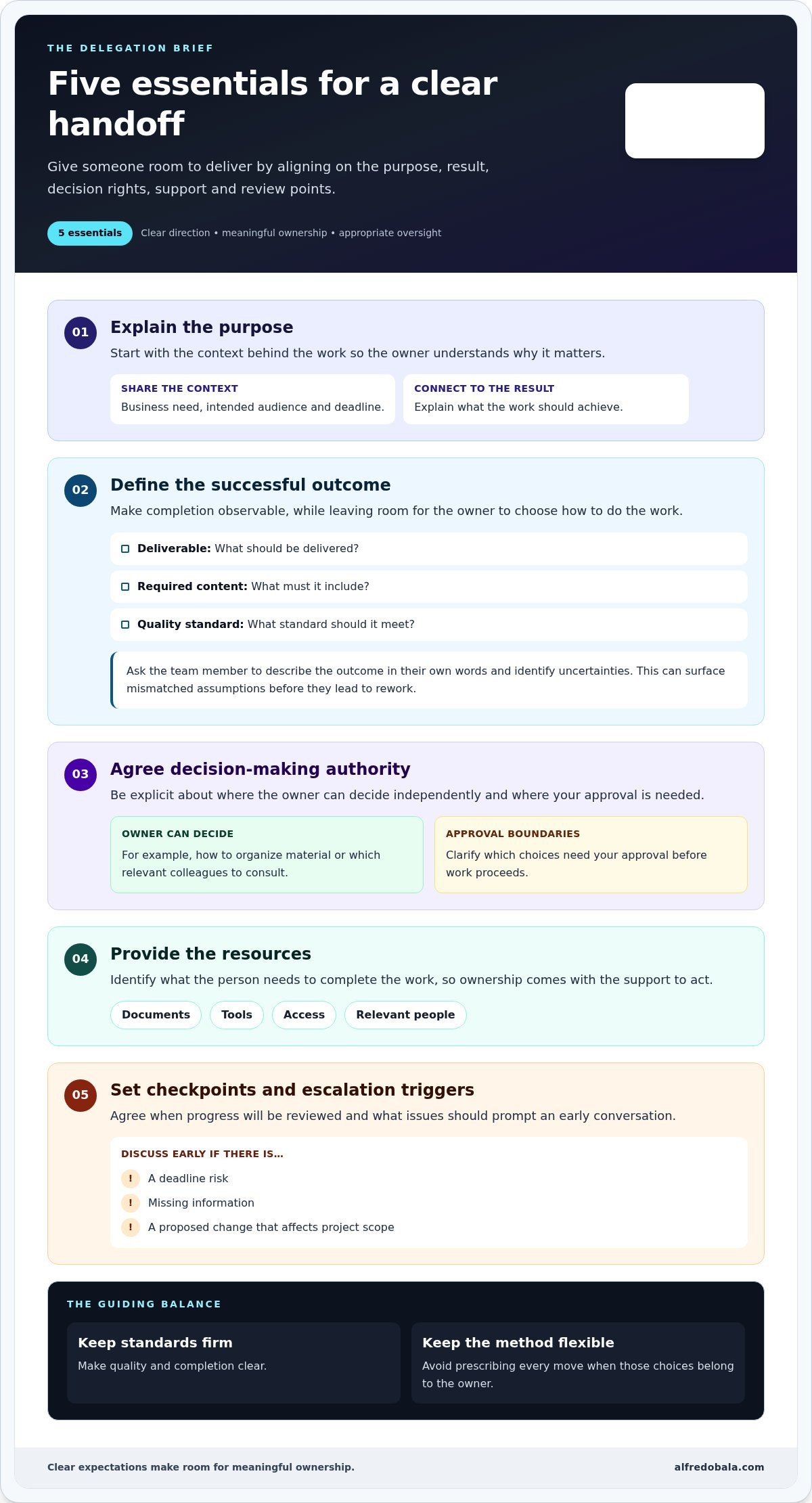
A handoff becomes meaningful when both people share the same picture of success. Before assigning work, align on five essentials: explain the purpose, define the outcome, agree on decision-making authority, provide resources, and set checkpoints. This gives the person doing the work enough direction to act without turning the brief into a script for every step.
A useful delegation brief explains why the work matters, what success looks like, which decisions the owner can make, what support is available, and when progress will be reviewed.
Explain the purpose and define a successful result
Begin with context. Explain the business need, intended audience, deadline, and result the work should achieve. Then make completion observable: what should be delivered, what must it include, and what standard should it meet? Ask the team member to describe the outcome in their own words and identify uncertainties. This surfaces mismatched assumptions before they lead to rework.
For example, in a hypothetical project, you might ask a team member to prepare a short onboarding guide for new staff. Explain who will use it and what they need to be able to do after reading it. Agree on the sections it must cover, the review date, and how the draft will be assessed. You don’t need to dictate the exact wording or research process if those choices belong to the owner.
Agree decision rights, resources, and escalation boundaries
Clarity must extend beyond the deliverable. Specify which choices the team member can make independently, such as organizing the material or consulting relevant colleagues, and which need your approval. Identify necessary documents, tools, access, and people. Then agree on triggers for an early discussion, such as a deadline risk, missing information, or a proposed change that affects the project’s scope.
Keep the standards firm and the method flexible. A completion measure should make quality visible, not prescribe every move. For the hypothetical guide, the owner might be free to choose the format, while the agreed criteria require it to cover key procedures, use plain language, and be ready for review by the agreed date. Assess the result against those criteria rather than personal preferences about how each paragraph was written.
Use a brief written summary for work with several stakeholders or dependencies. Capture the purpose, expected result, decision rights, available support, and check-in dates in one place. For simpler work, a focused conversation may be enough, provided both people leave with the same understanding. If the team member can’t explain the outcome or identify when to raise a concern, refine the brief before work begins.
This discipline is central to how to delegate tasks effectively: define the destination and guardrails, then leave room for the owner to choose a sound route. Leaders looking to strengthen that wider practice can explore leadership and team development insights.
Choose the Right Task and Delegate by Readiness, Not Convenience
Start with an inventory, not a name. List the work on your plate, then sort each responsibility into four categories: retain what requires your unique authority or strategic judgment; delegate work someone else can own; redesign work that is unclear or needlessly complicated; and stop work that no longer serves a meaningful purpose. This keeps delegation from becoming a way to pass along tasks simply because they’re inconvenient.
The best candidates often have clear deliverables, recur over time, or give someone practice with a relevant skill. Keep decisions that depend on confidential judgment, organization-wide commitments, or your distinct strategic ownership. If a process is confusing or repeatedly creates errors, improve it before assigning it. You remain accountable for choosing the work and supporting the person who takes it on.
Which responsibilities are strong candidates for delegation?
Consider risk and repeatability together. Repeated work can be easier to teach, but repetition alone doesn’t make a task suitable: the consequences of a mistake still matter. Use the matrix as a starting point, then adjust decision authority and oversight to the person’s experience and the impact of the work.
| Task profile | Readiness | Leadership approach |
|---|---|---|
| Low risk, highly repeatable | Strong candidate | Provide clear standards, then give the owner room to manage the routine. |
| Low risk, less repeatable | Good learning opportunity | Clarify the desired result and offer support as the person works through unfamiliar steps. |
| High risk, highly repeatable | Conditional candidate | Delegate to someone prepared for the responsibility, with defined controls and review points. |
| High risk, less repeatable | Usually retain or share carefully | Keep decisions requiring your authority; delegate bounded research or preparation where appropriate. |
How do you match the work to the right person?
Look beyond who has the most open calendar. Consider current capability, workload, interest, and whether the task offers relevant development. A stretch assignment can build skill, but it should stretch judgment, not set someone up to fail. Match independence to both the person’s experience and the consequences of an error.
Discuss the opportunity directly. Explain why you’re considering them, ask how it fits with their current commitments, and invite them to raise concerns or express interest. Don’t assume someone has capacity because they’re reliable, or motivation because the assignment looks like a promotion. If their workload is already full, agree what will shift before adding responsibility.
For example, in a hypothetical operations team, a repeatable internal update might be a suitable first ownership opportunity for a colleague who wants to build coordination skills. A high-impact decision affecting several departments may call for a more experienced owner, narrower decision rights, or a shared approach. This is how to delegate tasks effectively: match the task, the risk, and the person without quietly increasing someone’s workload or transferring your accountability.
Monitor Delegated Work Without Taking Ownership Back
Once work is underway, stay connected to the outcome without becoming the person doing the work again. Set checkpoints based on the task’s risk, deadline, and the delegate’s experience. A familiar, low-risk responsibility may need only a brief review near completion. A new assignment with important dependencies may call for earlier updates, giving you time to address obstacles.
Accountability keeps progress, risks, and support visible; micromanagement takes control of the decisions and methods the owner was trusted to manage. Agree on the review rhythm at the outset, including what evidence the delegate will bring. That might be a draft, a completed milestone, or a concise update on decisions made and still pending. If milestones are being met and agreed standards remain on track, resist adding approvals just to feel involved.
Set checkpoints that protect the outcome
Make each check-in useful. Rather than asking for constant updates, tie the conversation to a meaningful milestone or point of risk. For example, a hypothetical launch-planning assignment might include a review of key dependencies before final commitments are made, followed by a later check on readiness. Agree in advance which changes, delays, or resource gaps warrant an early conversation instead of waiting for the next scheduled meeting.
At each checkpoint, use a simple three-part review:
- Progress: What’s complete, and what milestone comes next?
- Risk: What could affect the outcome, quality, or timing?
- Support: What decision, resource, or connection would help?
This keeps the discussion focused on the work and the support required. If a risk crosses an agreed boundary, step in promptly to resolve it. If the work is progressing as planned, let the owner continue without adding unnecessary oversight.
Coach through setbacks and close the learning loop
Separate a status review from a coaching conversation. Status questions establish what’s happening; coaching helps the person think through what to do next. Ask, “What’s working?”, “What’s blocked?”, and “What decision or support would help you move forward?” These questions invite ownership instead of prompting the leader to take over at the first sign of difficulty.
Not every misstep demands intervention. If an error is recoverable and doesn’t put an important commitment at risk, help the team member identify the lesson and adjust the approach. Address material risks early, with clarity about what must change and what support you’ll provide. Once the work is complete, debrief the result: compare it with the agreed outcome, discuss what the owner learned, and recognize their contribution accurately.
That follow-through is part of how to delegate tasks effectively. A clear review rhythm builds confidence because the team member knows when to raise concerns and the leader knows when to offer help. To strengthen your approach to leadership and team development, explore Alfredo Bala’s leadership insights.
Make Effective Delegation a Repeatable Leadership Practice
Delegation becomes part of how a team works when it’s built into a regular leadership rhythm, not reserved for moments when a leader is overwhelmed. A weekly review can turn good intentions into practical choices: check current commitments, spot work or decisions someone else could own, and agree on follow-up that supports that ownership. Keep the review brief and consistent. Its purpose is to make responsibility visible, not create another layer of administration.
Create a simple delegation rhythm
Start by looking at recurring work and noticing where decisions are being held farther from the work than they need to be. Could a team member take ownership of preparing a recurring update, coordinating a routine process, or making a decision within agreed boundaries? Before assigning it, consider existing commitments and discuss the opportunity so delegation doesn’t quietly become extra workload.
Record the essentials in a shared note or task system: the owner, intended outcome, decision authority, deadline, and next checkpoint. This gives both people a common reference and makes follow-through easier. At the next weekly review, look at progress and ask what the process has taught each of you. Perhaps the owner needs more context, a decision boundary needs adjusting, or a recurring task should be redesigned. Treat these insights as part of the practice.
Connect delegation to leadership development
Each well-chosen responsibility can give someone a chance to practise judgment and initiative in a real work setting. That doesn’t mean every assignment will be a perfect fit or that capability develops automatically. It means leaders can use appropriate ownership opportunities to help people build experience while remaining available to guide them through new decisions. Over time, these opportunities can strengthen the team’s ability to take responsibility and contribute with greater confidence.
There’s a leadership lesson here: people are better placed to own work when they understand why it matters, have suitable authority, and can access support. These conditions connect delegation to motivation as well as execution. Alfredo Bala’s book, The Motivation Equation, offers practical frameworks for thinking about motivation and leadership alongside the habits in this article.
To put how to delegate tasks effectively into practice, choose one recurring commitment this week and assess whether it should be retained, redesigned, or entrusted to a prepared team member. Discuss the opportunity, agree on ownership and follow-up, then review what both of you learn. For further perspective on leadership, motivation, and team development, explore Alfredo Bala’s leadership work.
Make Ownership Your Next Leadership Move
The next step doesn’t need to be a major handoff. Choose one responsibility that’s ready to move, talk through what successful ownership would look like, and give a team member the chance to take it forward. Your first attempt is also a chance to learn: refine the support or boundaries, then build on what worked. That steady practice is how to delegate tasks effectively while creating more room for your team to contribute.
Delegation is ultimately a commitment to developing people, not just managing a workload. Alfredo Bala brings leadership and team development insight informed by his experience as former CEO of Mannatech Inc. and COO of Britt World Wide, along with a career in the networking profession since 1980. Explore Alfredo Bala’s leadership insights for further perspective on growing people and organizations.
Start with one meaningful opportunity. Give ownership room to take root, and keep leading with purpose. Explore Alfredo Bala’s leadership insights and The Motivation Equation at alfredobala.com.
Frequently Asked Questions
What tasks should a manager delegate first?
For a first handoff, choose a recurring task with a visible finish line, such as compiling a weekly project update or preparing a standard meeting agenda. Check that the work won’t expose confidential information or require a decision reserved for your role. Then assess the person’s capacity and whether the assignment develops a useful skill. This is a practical starting point for how to delegate tasks effectively. Clarify the available inputs and what completion looks like.
How do you delegate a task without micromanaging?
Agree on the destination and limits, then let the person decide the route. For example, ask for a brief update when a draft is ready rather than reviewing every research choice or edit. Make clear which developments should trigger an earlier conversation, such as a missed dependency or a change in scope. If the work is on track, resist adding approvals. If it isn’t, ask what would help before proposing a fix.
Why is delegation difficult for new managers?
New managers often carry the habits that helped them succeed as individual contributors: solving problems quickly and taking personal responsibility for details. Handing work over can feel like risking the standard or spending scarce time explaining it. Start with a contained assignment, such as coordinating one part of a team meeting. Agree on the result, then reflect afterward on what you could clarify or let go of next time.
How do you choose the right person for a delegated task?
Choose someone whose skills and current workload fit the task, while considering whether it connects to an interest or development goal. For instance, a colleague who wants to strengthen presentation skills may welcome preparing a short internal briefing if their schedule allows. Ask directly rather than treating willingness as a given. Explain why you have them in mind, invite an honest response, and discuss the support they’d need to take it on.
What is the difference between delegation and assigning a task?
Assigning can mean asking someone to complete a defined action while you retain the key decisions. Delegation gives that person responsibility for a result and room to make appropriate choices along the way. For example, asking for data entry specifies an activity; asking someone to maintain an accurate monthly tracker gives them ownership of the result. You still answer for the broader work, but the delegate has meaningful decision space.
How often should a manager check in after delegating?
Set the check-in rhythm around the work, not a fixed rule. For a short task with few dependencies, one review before completion may be enough. For a complex assignment with several contributors, agree on updates at key handoff points, such as after receiving input or before sharing a final recommendation. Tell the owner what changes warrant an immediate conversation, then adjust future check-ins based on how the work progresses.
What should a manager do if a delegated task is not going well?
Speak up as soon as a concern could affect an important commitment, and start by identifying the gap: is the deliverable late, incomplete, or based on a wrong assumption? Ask the owner what caused it and what options they see. Together, decide whether to change the plan, add support, or narrow the work. Once the immediate issue is addressed, use the experience to improve future handoffs without turning one setback into a reason to withdraw trust.
 ES
ES  EN
EN
Comentarios recientes