
The founder can’t be the growth system. If every new team depends on your recruiting, coaching, and constant presence, expansion will eventually strain the relationships that made the business work. Learning how to scale a network marketing business means building a model others can lead, not simply asking a few top performers to do more.
As a team grows, new leaders may struggle to repeat early successes, while communication and retention become harder to manage across different markets. The answer isn’t to script every conversation or leave each team to work things out alone. Set shared practices, develop leaders who can teach others, and adapt how you build relationships locally.
Drawing on Alfredo Bala’s experience in the networking profession since 1980, this practical 2026 roadmap shows how to create that balance. You’ll learn to clarify repeatable team practices, coach leaders to support others, and strengthen engagement as the organization expands. The approach connects leadership development with the motivation principles explored in The Motivation Equation.
Key Takeaways
- Measure scale by growing leadership capacity and customer value, not simply adding recruits.
- Learn how to scale a network marketing business by clarifying core practices before expanding into new teams or markets.
- Identify what every team should share, then adapt communication to fit local relationships and leadership styles.
- Use a phased roadmap to diagnose bottlenecks, strengthen the foundation, develop leaders, and expand with intention.
- Build lasting momentum by connecting leadership development with the motivation and support people need to stay engaged.
What Does It Really Mean to Scale a Network Marketing Business?
Scaling a network marketing business means expanding leadership capacity and consistent team practices so growth can continue without relying on one person to manage every relationship, decision, or new recruit. Headcount may rise along the way, but scale depends on whether people can learn, serve customers, and develop as leaders within a clear, supportive structure.
That distinction matters in multi-level marketing, a business model built around product sales and a network of participants. Recruiting activity alone doesn’t show whether an organization is becoming more capable. Without thoughtful onboarding, ongoing support, and genuine customer value, a larger team can mean more unanswered questions and more pressure on the same few leaders.
Growth versus scale: what changes as a team expands?
Growth adds people. Scale develops people who can help others learn and contribute. If every recruit depends on the founder for basic guidance, decisions, or encouragement, the founder’s time becomes a bottleneck. The team may be larger, but its ability to operate independently hasn’t necessarily grown.
Consider an experienced leader supporting three developing leaders. Instead of personally welcoming every new person, the leader helps those three learn how to introduce newcomers, explain shared practices, and provide follow-up support. The shift is simple but important: guidance starts moving through the team instead of flowing only from the top.
Repeatable onboarding helps make that shift possible. New team members should know what to expect, where to find useful information, and how to get guidance. Leaders still bring their own judgment and personality, but they don’t have to invent every basic step from scratch. That creates a foundation for practices the team can repeat while keeping local relationships personal.
Why trust and customer value must remain central
Scale is sustainable only when the business continues to earn trust. Customers need clear, honest product information and attentive service, not pressure or promises about income. Team members also deserve transparent communication about expectations and the work involved. A growth plan that weakens those standards may increase activity, but it undermines the relationships an organization depends on.
Keep customer needs at the center of decisions. Ask whether each practice helps people understand the product, make an informed choice, and receive appropriate follow-up. Review how leaders discuss the business opportunity, too. Avoid guarantees and unsupported claims, and communicate openly about what participation involves. These habits are part of the operating foundation, not extras to add once the organization is large.
So, how to scale a network marketing business responsibly? Build leadership and repeatable support around real customer value. Start by identifying which practices should be shared across the team and where leaders should adapt to local needs.
Build a Repeatable Network-Marketing System Before Expanding
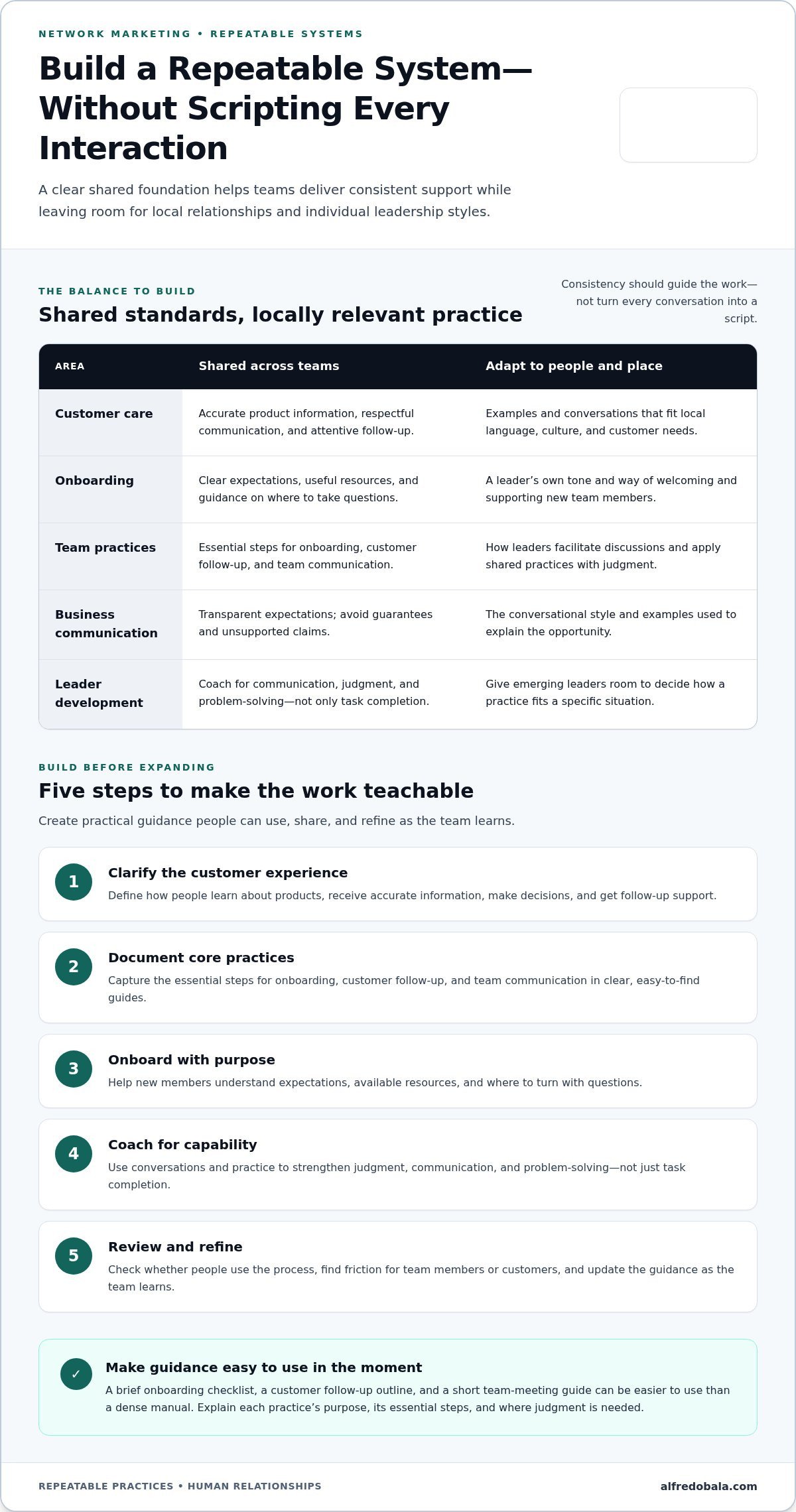
Before entering another market or adding more people, make the work teachable. A repeatable system helps leaders deliver a consistent customer experience and support new team members, while leaving room for personal judgment. It should guide everyday actions, not turn every interaction into a script.
Build the system in sequence:
- Clarify the customer experience. Define how people learn about products, receive accurate information, make decisions, and get follow-up support.
- Document core practices. Capture essential steps for onboarding, customer follow-up, and team communication in clear, easy-to-find guides.
- Onboard with purpose. Help new members understand expectations, available resources, and where to turn with questions.
- Coach for capability. Use conversations and practice to strengthen judgment, communication, and problem-solving, not just task completion.
- Review and refine. Check whether people use the process and where team members or customers encounter friction. Update the guidance as the team learns.
Keep standards focused on accuracy, respectful communication, customer care, and clear expectations. Let individual leaders choose their own conversational style and adapt examples to local language and culture. Shared principles can travel across teams while their expression remains human and relevant.
Document the practices new leaders need to repeat
Make guidance useful in the moment. A brief onboarding checklist, a customer follow-up outline, and a short team-meeting guide are often easier to use than a dense manual. For each practice, explain its purpose, list the essential steps, and include prompts for situations that require judgment. Short training materials also give leaders something they can revisit and share as responsibilities grow.
Separate non-negotiable standards from flexible choices. Accurate product information and transparent business communication belong in the first category. A leader’s tone, examples, and way of facilitating a discussion can vary. This balance protects consistency without requiring duplication.
Develop leaders through coaching, not duplication alone
Coaching helps emerging leaders understand why a practice matters, then decide how to apply it thoughtfully. Invite them to facilitate a small discussion, respond to a common question, or plan a follow-up conversation. Afterwards, review what went well and what they would change. Clear expectations, meaningful progress, and specific feedback can make development more motivating than simply asking people to copy a top performer.
Track a few leading indicators, such as whether onboarding steps are completed, coaching conversations happen consistently, and customer follow-up is carried out. These signals can reveal gaps early, but they don’t guarantee business results. For responsible communication about products and business opportunities, consult the FTC guidance on network marketing.
For additional perspective on motivation and leadership development, explore Alfredo Bala’s leadership insights.
How to Balance Consistency, Retention, and Local Relationships
Scaling doesn’t mean every leader must sound alike. It means people across the organization can rely on shared standards while communicating in ways that fit their communities. This balance supports retention: people are more likely to stay engaged when expectations are realistic, support is accessible, contributions are recognized, and development feels relevant to their goals.
Use this comparison to decide what your team should standardize and where leaders need room for local judgment:
Keep consistent
- Accurate, transparent communication about products and the business opportunity.
- Customer care, respectful follow-up, and a clear way to raise questions.
- Training quality and shared expectations for supporting team members.
Adapt locally
- Language, examples, and the tone leaders use to communicate.
- Meeting formats and the ways people prefer to participate.
- How leaders build relationships and recognize meaningful contributions.
Think of standards as the organization’s common foundation, not a script for every conversation. That’s a durable way to scale a network marketing business across communities: preserve trust and quality, then let local leaders make the experience personal.
What should stay consistent across every team?
Set clear expectations for customer care, ethical communication, and training quality. Check whether those practices are understood through questions, conversation, and observation. Can team members explain the shared standard? Do their day-to-day interactions reflect it? When activity differs from the intended practice, coach to the principle rather than demanding identical wording. For market-specific compliance guidance, verify the relevant requirements for each location.
What should adapt to each community or market?
Local leaders understand which language, meeting format, examples, and communication norms help people feel heard. Involve them before rolling out a new practice. Ask what may need translation, what feels unfamiliar, and how the guidance can fit local relationships without changing its purpose. Listening early can surface friction that a one-size-fits-all rollout misses. Adaptation isn’t a lower standard; it’s a more thoughtful way to uphold one.
Retention also requires more than a welcoming start. Set realistic expectations, offer useful opportunities to practise leadership, and recognize specific contributions rather than relying only on broad praise. Regular check-ins can reveal whether someone needs clearer direction, encouragement, or a new development challenge. For more ideas, explore these network-marketing team retention strategies.
A Practical Roadmap for Scaling a Network Marketing Business
Expansion is easier to manage when it follows evidence rather than enthusiasm alone. Use this phased roadmap to identify what needs attention, assign clear ownership, and decide whether the organization is ready for its next step. It offers a practical way to approach how to scale a network marketing business without treating activity as proof of progress.
- Diagnose the bottleneck. Owner: the founder or current team lead. Action: identify where work gets stuck, such as onboarding questions that only one person can answer or customer follow-up that varies between teams. Checkpoint: review recurring questions, delays, and feedback from team members and customers. Choose the constraint to address first.
- Strengthen the core. Owner: the leaders closest to the work. Action: close gaps in training materials, customer support routines, and communication channels. Make sure existing leaders can support new people without routinely exceeding their capacity. Checkpoint: look for clear onboarding progress, reliable customer care, and team members who know where to find guidance.
- Develop leaders. Owner: experienced leaders, with emerging leaders taking on supported responsibilities. Action: give people opportunities to practise facilitation, coaching, and problem-solving before assigning broader responsibility. Leadership readiness means more than enthusiasm; it includes sound judgment and consistent support for others. Explore these executive leadership development strategies for additional perspective. Checkpoint: review how well developing leaders communicate expectations and handle common team needs.
- Expand deliberately. Owner: the leadership group. Action: define a clear reason for entering a new market beyond adding headcount. Consider whether the team can provide relevant communication, training, and customer support there. Checkpoint: revisit team capacity, customer experience, and local leader feedback before extending the approach further.
Review progress and adjust without losing momentum
Set a regular review cycle that fits the team’s work. Separate activity measures, such as training participation or completed follow-up, from experience indicators, such as whether customers feel supported and new team members understand their next steps. Neither category tells the whole story on its own. Use both to identify where coaching, clearer guidance, or stronger support is needed.
Invite leaders to share what they learned, including approaches that needed adjustment. Keep the discussion focused on observable practices and useful lessons, not unsupported claims of success. Assign an owner to each improvement and revisit it at the next checkpoint. For leadership and motivation insights to inform your roadmap, explore Alfredo Bala’s leadership resources.
Lead Sustainable Growth with Experience, Motivation, and Clear Next Steps
A growth roadmap becomes useful when leaders put it into practice. Alfredo Bala has been active in the networking profession since 1980, with experience that includes serving as CEO of Mannatech Inc. and COO of Britt World Wide. That background informs his perspective on organizational growth and leadership, while your team’s progress depends on the choices, practices, and relationships you build.
At its core, how to scale a network marketing business is an ongoing leadership challenge. Systems help people know what to do; motivation helps them stay engaged and develop the judgment to lead well. Both require continued attention as the team and its needs evolve.
Turn the growth plan into a leadership commitment
Start with one bottleneck, not a complete overhaul. Choose a clear first action, name the person responsible, and set a time to review what changed. For example, if new team members regularly need the same answers, a leader could create a concise guide and ask new members whether it made those answers easier to find.
Then establish a steady rhythm for coaching, learning, and reviewing the team experience. Use those conversations to recognize specific contributions, surface obstacles, and agree on a practical next step. This keeps development connected to the actual work rather than treating motivation as a speech or a temporary push. Durable scale depends on people, useful systems, and trust working together.
Explore leadership resources for the next stage
For a deeper look at motivation and leadership, explore The Motivation Equation and its leadership framework. Alfredo Bala’s book presents frameworks readers can apply to their own team context. Relate an idea to a current leadership challenge and discuss how it might inform coaching or development practices. The value lies in thoughtful application, not copying another organization’s approach wholesale.
Choose one principle to discuss with your leaders, then use your regular review rhythm to assess whether it helps clarify expectations, strengthen communication, or support development. That makes learning part of the growth system, not a separate activity.
For further perspective as you refine your next steps, explore Alfredo Bala’s leadership insights.
Build the Next Stage of Growth with Purpose
Sustainable expansion isn’t a headcount target. It comes from repeatable practices, leaders who can support others, and relationships grounded in trust and customer value. The roadmap is clear: identify the constraint holding your team back, strengthen onboarding and coaching, then expand when your leadership capacity is ready.
That’s the practical answer to how to scale a network marketing business without making every decision depend on one person. Keep shared standards clear, adapt communication to each community, and review how the team and its customers experience the business. Small, deliberate actions can build a stronger foundation for what comes next.
Alfredo Bala has been active in the networking profession since 1980 and has served as CEO of Mannatech Inc. and COO of Britt World Wide. He is also the author of The Motivation Equation, a book on motivation and leadership. Explore Alfredo Bala’s leadership insights, read The Motivation Equation, or connect through his website about a speaking engagement or executive advisory. Keep building with intention, and help your people grow alongside the organization.
Frequently Asked Questions
How do you scale a network marketing business?
To scale a network marketing business, first find where progress relies too heavily on one person. Document essential customer and onboarding practices, then coach emerging leaders to teach and support others. Set a regular review rhythm and expand only when the current team can support new people well. Track onboarding progress and customer experience alongside activity, so growth reflects stronger capability, not just a larger organization.
Can a network marketing business grow without constant recruiting?
Yes. Growth can also come from improving customer experience, developing leaders, supporting team engagement, and making existing practices more consistent. Recruiting may be part of expansion, but it can’t replace clear onboarding or capable leadership. Strengthening these foundations helps the organization serve customers and support its existing team more effectively, while preparing it to consider future growth with greater care.
What is the biggest challenge when scaling a network marketing business?
A common challenge is maintaining reliable support and communication as more teams and leaders become involved. If key knowledge stays with a few experienced people, they can become bottlenecks and new leaders may struggle to guide their teams. Documenting core practices, coaching emerging leaders, and reviewing team needs regularly can spread capability while preserving flexibility and strong working relationships.
How do you build leaders in network marketing?
Build leaders by giving emerging team members practical responsibility, clear expectations, and regular coaching. Let them practise tasks such as onboarding a new member, facilitating a discussion, or responding to common questions. Then offer specific feedback and time to reflect. The goal isn’t to make everyone copy one leader’s style. It’s to develop sound judgment, clear communication, and the ability to support others consistently.
How do you retain people while growing a network marketing team?
Support retention with realistic expectations, respectful communication, useful development opportunities, and access to leaders who can help people learn. Make onboarding clear and recognize specific contributions without exaggerating what they mean. Invite feedback and address avoidable friction, such as unclear guidance or inconsistent follow-up. Don’t frame participation or earnings as guaranteed; individual experiences and results vary, and transparent communication helps build trust.
How can a network marketing business expand into another country?
Start by learning about the local market, language, relationship norms, and customer needs. Prepare leaders who can support the team and adapt communication while maintaining shared standards for customer care. Review company requirements and verify the rules that apply in the new market before proceeding. Don’t assume a process that works in one country will transfer unchanged; listen to local leaders and adjust thoughtfully.
Which numbers should a network marketing leader track when scaling?
Choose a small set of measures that show both team activity and organizational health. Depending on your business, track onboarding progress, coaching frequency, customer feedback, team engagement, and leader readiness. Define each measure clearly and review trends over time, rather than reacting to a single data point. Recruitment counts alone don’t show whether people are supported or customers are having a good experience, and no metric guarantees income.
 ES
ES  EN
EN
Comentarios recientes