
The fastest way to stall a creative team is to lead every challenge the same way. The leadership styles for creative teams that encourage initiative during brainstorming may not provide enough direction when deadlines tighten or a decision is due. Creative leaders need to protect space for original thinking while keeping the work focused, accountable, and moving forward.
If you’ve ever worried that too much direction will suppress ideas, or that too little will leave people guessing, it’s worth looking beyond a single leadership formula. Creative work can be difficult to measure by conventional output alone, and people need different kinds of support at different stages. The answer isn’t to choose between freedom and structure. It’s to know when each matters most.
This guide covers leadership approaches that can help creative teams, when to use them, and how to adapt your approach to the people, task, and project stage. You’ll find practical ways to encourage original work while setting expectations and maintaining momentum.
Key Takeaways
- Leadership style shapes how decisions, communication, and responsibility flow through a creative team.
- Use five leadership styles for creative teams as flexible approaches, not fixed labels or universal solutions.
- Match your approach to the project’s clarity, urgency, team experience, and need for collaboration.
- Set a clear purpose, success criteria, constraints, ownership, and decision rights before work begins.
- Use a brief self-review to strengthen your direction, listening, feedback, and follow-through.
Why leadership styles matter for creative teams
Creative people need room to explore, and they also need to understand what the work must achieve. Lean too far toward control and you can narrow the search for strong ideas. Offer freedom without clear expectations and the team may spend time on competing priorities or unresolved decisions. The challenge is to create both space and direction.
A leadership style is a pattern for guiding decisions, communication, and responsibility. Learning about different leadership styles can help you examine how you set direction and involve others. For creative teams, the goal isn’t to adopt a label. It’s to choose the kind of guidance that fits the work and the people doing it.
Creative work rarely moves in a straight line. A design team may test several concepts before settling on one; writers may revise as the audience or brief becomes clearer; product developers may need input across disciplines. Progress also requires judgment. A draft or prototype can be assessed against goals, but originality, usefulness, and resonance may not show up in a simple count of completed tasks.
Adaptive leadership for creative teams means changing how much direction and support you provide while keeping the desired outcome clear.
What makes creative teams different?
Creative teams can bring together design, marketing, writing, product development, and creative direction. Each role contributes a different perspective, so collaboration can reveal options one person might miss. Experimentation and iteration are part of the process, which means early work may be exploratory rather than polished. That variation isn’t automatically a sign of poor performance. Leaders need to distinguish productive discovery from work that has lost focus.
Creative freedom isn’t the same as unclear priorities. People can have latitude in how they solve a problem while still knowing the deadline, intended audience, scope, and who owns the next decision.
The leadership tension: autonomy and accountability
Excessive control can limit exploration. If a leader dictates every step, team members may stop taking initiative or feel little ownership of the result. Too little direction can leave people unsure which idea matters, who makes the call, or when a decision is due. Neither extreme creates the conditions for dependable creative work.
Set accountability around agreed outcomes, decision rights, and useful feedback. Clarify what success looks like, where the team can make choices, and which decisions need a lead’s input. Then review progress against those agreements, offering feedback that helps improve the work rather than prescribing every move. The best leadership styles for creative teams balance clear expectations with meaningful ownership.
Five leadership styles creative-team leaders should understand
Think of leadership styles as approaches you can draw on, not fixed personality types or universal prescriptions. Each shapes who makes decisions, how much autonomy the team has, and how the leader communicates. The right choice depends on the work in front of you.
No single leadership style fits every creative task: the approach that unlocks ideas in a concept review may slow a time-sensitive campaign decision. Use these five styles as a practical toolkit, adjusting the balance of direction and involvement as the task changes.
Transformational, democratic, and servant leadership
- Transformational: Connects daily work to an ambitious shared purpose. For a campaign, a leader can remind the team of the impact the work should have on its audience, then give specialists room to shape the creative direction. This can energize people, but a compelling vision still needs clear priorities and decisions.
- Democratic: Invites team members to contribute before a decision is made. In a concept review, a leader might ask design, writing, and marketing for their perspectives, then state who makes the final call and by when. Broad input can improve a choice, but relying on consensus alone may delay progress.
- Servant: Focuses on enabling the team by removing obstacles, securing needed input, and making space for people to do their best work. A leader might resolve a cross-team dependency holding up product design while keeping ownership and deadlines visible. Support shouldn’t mean avoiding difficult feedback or accountability.
Situational and laissez-faire leadership
- Situational: Adjusts direction and support to the task and the individual’s experience. A new team member tackling an unfamiliar creative brief may benefit from examples, frequent check-ins, and clear milestones. A seasoned colleague working in a familiar area may need the outcome and constraints, then room to deliver.
- Laissez-faire: Offers substantial autonomy and limited day-to-day direction. It can suit experienced, aligned professionals who understand the brief, their responsibilities, and how decisions get made. It becomes neglect when priorities are absent, ownership is murky, or a leader delays a decision the team needs.
Each style has a trade-off: more direction can add clarity but restrict choice; more autonomy can encourage ownership but depends on shared understanding. In practice, leadership styles for creative teams work best as flexible responses to the task, not permanent labels for a leader or team. For more perspective on leadership and team development, explore Alfredo Bala’s leadership insights.
Which leadership style works best for a creative team?
There isn’t one winning style. The best fit depends on how clear the project is, how experienced the people are, how urgent the decision is, and how closely their work depends on one another. Creative teams don’t need hands-off management by default. They need the right balance of guidance and autonomy for the work at hand.
| Style | Useful situation | Risk | Leader response |
|---|---|---|---|
| Transformational | Early work needs a compelling purpose | Vision stays too broad to guide choices | Connect the goal to clear priorities |
| Democratic | Several perspectives can strengthen concept selection | Input delays a decision | Invite views, then name the decision-maker and deadline |
| Servant | Obstacles or dependencies are slowing delivery | Support replaces needed accountability | Clear barriers while keeping ownership visible |
| Situational | Tasks or experience levels vary | Support feels inconsistent without explanation | Adapt guidance and clarify what has changed |
| Laissez-faire | Experienced contributors are aligned and self-managing | Important priorities or decisions go unattended | Set boundaries, remain available, and check progress at agreed points |
Match leadership to the project stage
During idea generation, invite broad exploration while keeping the brief, audience, and boundaries in view. When it’s time to choose a concept, shift toward structured facilitation: compare options against agreed criteria, surface trade-offs, and make the decision clear. During production and final delivery, reinforce ownership, dependencies, and timelines so a promising idea reaches completion.
This isn’t a rigid sequence. An urgent deadline may call for a faster, more directive decision during concept development, while a complex design challenge may need more exploration late in the process. Match the structure to the decision, not simply the calendar.
Match leadership to experience and team needs
Someone learning a task or entering unfamiliar work may benefit from coaching, examples, and frequent feedback. An experienced contributor can take greater decision-making responsibility when the goal, responsibilities, and boundaries are clear. Also consider confidence, collaboration needs, and obstacles. A capable person can still need support when a dependency blocks progress or a decision affects several roles.
Use leadership styles for creative teams as a flexible guide. Ask what the work needs now: open exploration, a timely decision, focused coaching, or space to deliver. Then make your level of involvement explicit so the team knows where it has freedom and where your direction is needed.
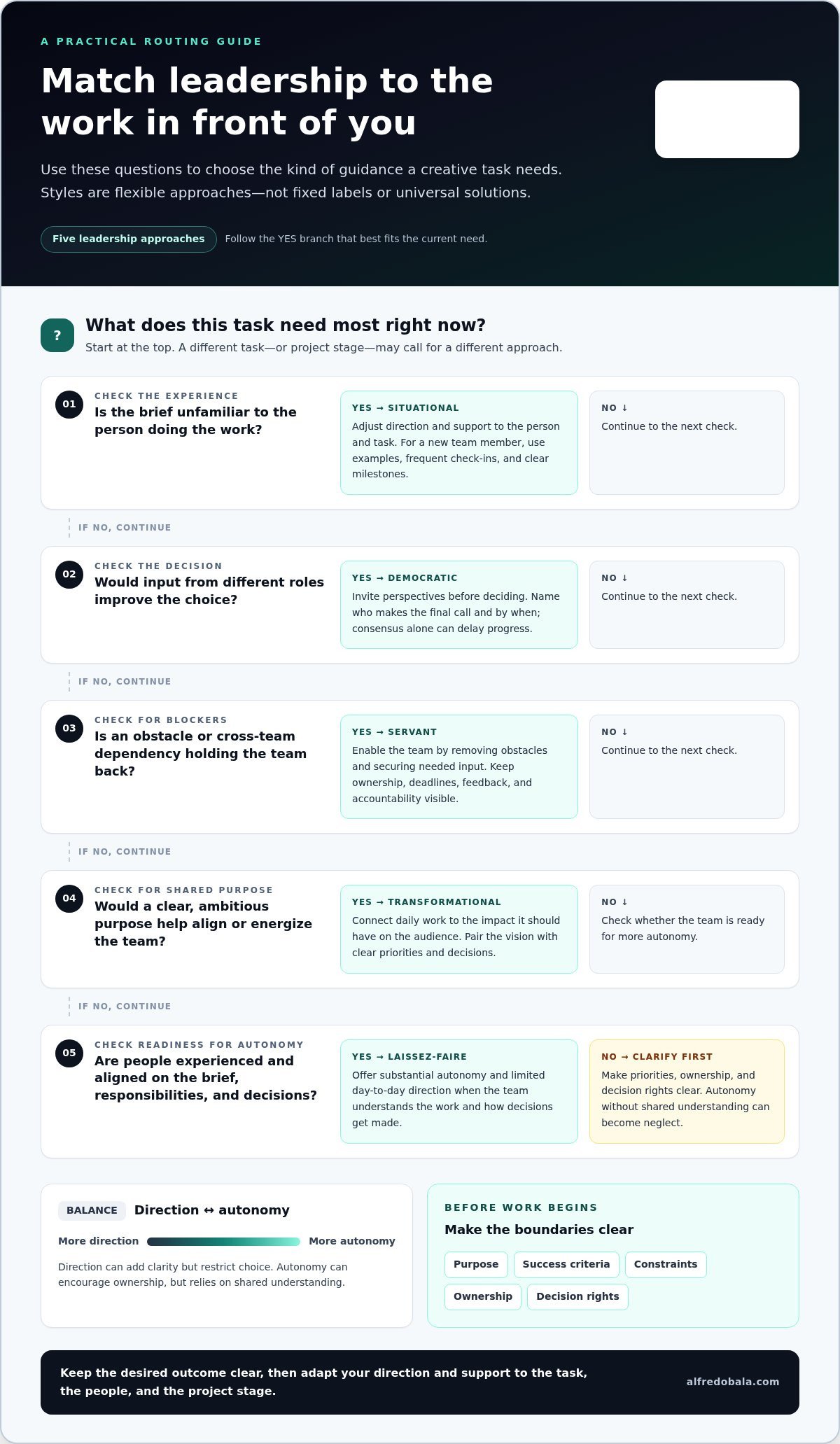
How to adapt your leadership style for a creative team
Adaptation works best as a deliberate cycle, not a last-minute change in tone. Use this five-step process to give people enough structure to move with confidence while preserving room for sound creative judgment.
- 1. Clarify the work. State the purpose, intended audience, desired outcome, success criteria, constraints, and timeline. Make clear what must be achieved and where the team can choose its own approach.
- 2. Assess the team. Consider each person’s experience with the task, confidence, current workload, and need to collaborate. Look for obstacles or dependencies that could affect progress, not just individual skill.
- 3. Choose the right support. Offer coaching, examples, or closer guidance for unfamiliar work. Give experienced contributors more room to make decisions when responsibilities and goals are understood.
- 4. Review the work. Agree on checkpoints that surface risks early without turning every small choice into an approval request. Use critique to test whether the work meets the brief and quality standards.
- 5. Adjust as needed. If the team is blocked, unclear, or working from conflicting assumptions, step in with direction or help resolve the issue. If the work is on track, avoid adding control that doesn’t improve the outcome.
Set the conditions for creative autonomy
Before work begins, agree on the outcome, audience, constraints, timeline, and who owns final decisions. These boundaries give people a dependable frame for making choices. Set checkpoints around meaningful milestones or risks, rather than requiring approval for every detail. Also agree on how to handle disagreement: invite opposing views, return to the criteria, and identify who resolves an impasse if discussion doesn’t produce a decision.
Use feedback and motivation to keep work moving
Make feedback specific to the brief and to aspects of the work people can observe. Instead of saying an idea simply “doesn’t feel right,” identify where it misses the audience’s needs, the objective, or the agreed criteria. Ask what is enabling progress and what obstacle you can remove. This keeps critique focused on improvement, not personal taste.
Motivation is also shaped by whether people can see the purpose of their work and take meaningful ownership of it. The Motivation Equation offers a perspective on motivation and leadership. For broader leadership development, explore Executive Leadership Development Strategies for Global Growth in 2026. Strong leadership styles for creative teams depend on making clear calls, listening well, and adjusting support as the work evolves.
Explore Alfredo Bala’s leadership insights to continue developing your approach to team leadership.
Build a leadership approach creative teams can trust
Trust grows when leaders make the destination clear, adapt their support, and leave people meaningful ownership of the route. The most effective leadership styles for creative teams aren’t rigid formulas. They help leaders respond to the project while remaining consistent about expectations, respect, and follow-through.
Signals that your current approach needs adjustment
Repeated rework can signal that the team lacks clarity about goals, decision authority, or what useful feedback looks like. Other clues are quieter: people wait for permission on routine choices, or contributors make conflicting assumptions about who owns a decision. Treat missed expectations as a reason to diagnose the working system before blaming individuals. Ask what was unclear, where a decision stalled, and whether the team had the support it needed.
Turn leadership insight into consistent practice
Choose one behavior to change, then explain why. For example, you might name the final decision-maker before the next review or ask the team to surface risks earlier. Invite feedback on whether the change helped, and assess its effect on clarity, collaboration, and progress. Adjust the practice if needed, without abandoning the standards the work must meet.
Use this short self-review after a project milestone:
- Direction: Did I make the purpose and expected outcome clear?
- Listening: Did I make room for the team’s perspectives and concerns?
- Decisions: Were decision owners and next steps understood?
- Feedback: Was my input specific, timely, and connected to the work?
- Follow-through: Did I remove obstacles and honor the agreements we made?
Leadership is a capability developed through reflection and practice. Alfredo Bala’s leadership insights offer further perspective on motivation, leadership, and team development.
Put the ideas to work on a manageable scale: choose an upcoming project and agree with the team on the leadership approach, decision rights, and checkpoints you’ll use. Then review what helped the work move forward and what you’ll adapt next time.
Put adaptive leadership into practice
The strongest leadership approach isn’t a fixed style. It’s the ability to match your direction and support to the team, the task, and the stage of the work. The leadership styles for creative teams explored here offer options, but clarity about outcomes, decision rights, and feedback helps people use their autonomy well.
Start small. On your next project, agree on the goal, who owns key decisions, and when you’ll review progress. Then pay attention to what the team needs: more guidance, room to experiment, or help removing an obstacle. Adjust your approach without compromising the standards the work must meet.
Alfredo Bala is a leadership expert, author, speaker, and executive advisor. His experience includes serving as CEO of Mannatech Inc. and COO of Britt World Wide. Explore Alfredo Bala’s leadership insights for further perspective on leadership, motivation, and team development.
Lead with intention, stay open to what your team tells you, and give creative people the clarity and trust to do their best work.
Frequently Asked Questions
What leadership style is best for creative teams?
There’s no single best style for every creative team or project. Leaders often combine approaches: invite ideas during exploration, use a clear process to narrow options, and add structure as work moves toward delivery. The right balance depends on the task, team experience, project clarity, and support people need. Reassess as conditions change. A style that helps a team generate possibilities may not suit a time-sensitive final decision.
How do you lead a creative team without micromanaging?
Set a clear outcome, audience, constraints, timeline, and decision owner, then let people determine how to do the work. Agree on useful review points rather than approving every small choice. For example, review a concept against the brief at a planned milestone while leaving everyday design decisions with the designer. Ask what’s blocking progress and offer support where it’s needed. This keeps accountability visible without taking away professional judgment.
Can a democratic leadership style work for a creative team?
Yes, democratic leadership can help creative teams develop ideas and build ownership by drawing on different expertise. It works best when participation has clear boundaries. Explain how input will inform the choice, who makes the final decision, and when discussion ends. For example, invite comments on campaign concepts, then have the designated lead select an option by an agreed date. Without those agreements, discussion can delay action or leave priorities unclear.
What is the difference between transformational and servant leadership?
Transformational leadership connects people to a shared purpose and encourages them to grow toward an ambitious goal. Servant leadership focuses on listening, supporting the team, and removing obstacles so people can do their work effectively. A leader using the first approach might connect a project to its intended impact; using the second, they might resolve a dependency blocking progress. Both approaches still need clear expectations, sound decisions, and accountability for agreed outcomes.
How should a leader handle disagreement on a creative team?
Bring the discussion back to the brief, audience, and agreed success criteria. Invite each person to explain the reasoning behind their idea, and keep critique focused on the work rather than the individual. Then clarify who owns the final decision. If the team remains divided, use a timely decision process instead of letting debate stall the project. This approach respects different perspectives while giving everyone a clear path forward.
How can leaders motivate creative teams?
Connect the work to a meaningful purpose, clarify expectations, recognize useful contributions, and give people appropriate ownership. Ask team members what helps them do their best work rather than assuming everyone is motivated in the same way. Remove avoidable obstacles, and offer specific feedback that helps people improve. These leadership styles for creative teams support motivation through consistent practices and meaningful work, rather than relying on a burst of enthusiasm to carry a project.
 ES
ES  EN
EN
Comentarios recientes