
Stop acting as your team’s primary cheerleader and start becoming their chief architect. You’ve likely felt the crushing weight of being the sole source of energy for your organization, only to watch attrition rates climb and duplication stall. It’s a common trap for high achievers who haven’t yet mastered the mechanics of scale. The secret to motivating a network marketing team doesn’t lie in more pep talks or louder shouting. It requires a fundamental shift into executive-level leadership architecture.
You deserve a business that grows predictably without your constant intervention. With the global direct selling market projected to reach $252.3 billion in 2026, the opportunity for professional growth is immense for those who lead with precision. This article reveals how to apply the same strategic frameworks used to build global organizations to create a self-sustaining culture. We’ll explore ten executive strategies that move you from a manager of tasks to a visionary leader. You’ll learn to replace the exhausting hustle with a proven methodology that fosters independent leadership and long-term stability. It’s time to transition from the foundational levels of the industry to its highest echelons.
Key Takeaways
- Learn why the “cheerleader trap” leads to inevitable burnout and how to cultivate intrinsic drive within a volunteer-led organization.
- Discover how to apply the variables of The Motivation Equation-Expectancy, Value, and Impulsiveness-to drive predictable and scientific team engagement.
- Master the art of motivating a network marketing team by building a Leadership Flywheel that ensures growth continues even when you aren’t in the room.
- Understand the strategic difference between public and private recognition to maximize the impact of validation on performance across global borders.
- Elevate your role from a tactical manager to an executive visionary using proven frameworks designed for large-scale organizational leadership in 2026.
Beyond the Hype: Why Traditional Motivation Fails in Network Marketing
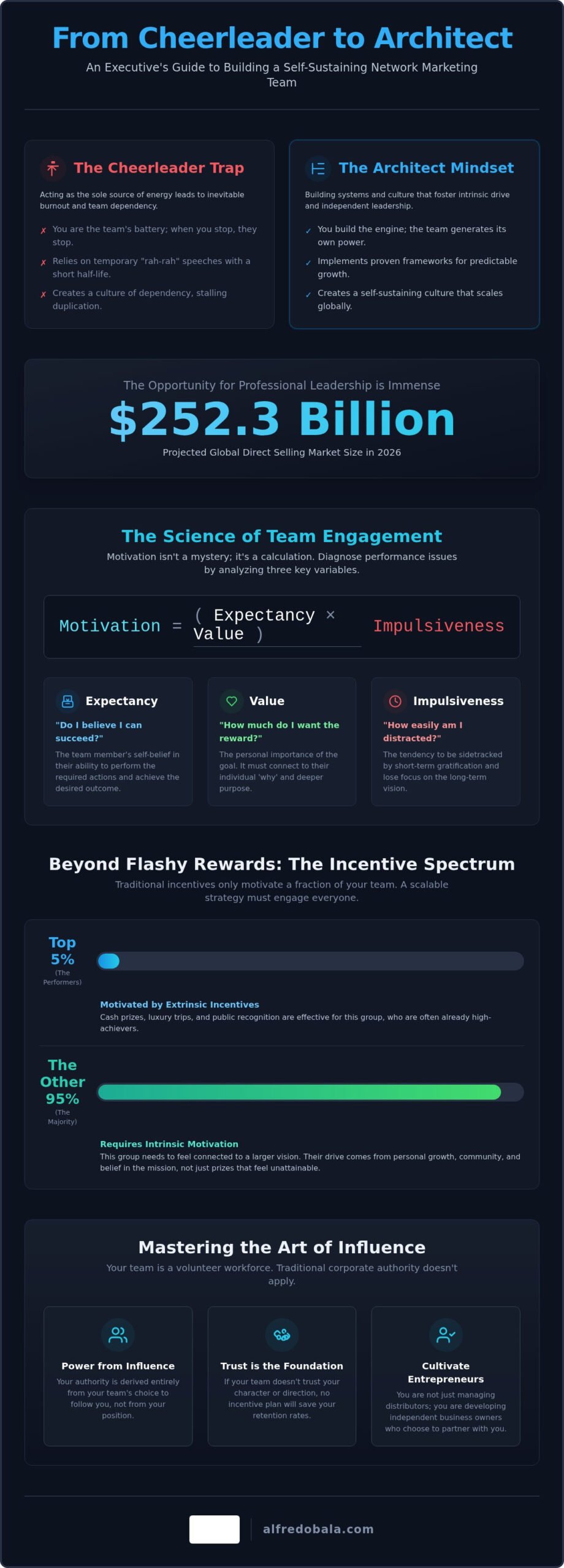
Stop trying to be the battery for your entire organization. Many leaders fall into the “cheerleader trap,” believing that their primary role is to provide a constant stream of high-octane energy to keep their downline moving. This is a recipe for catastrophic burnout. When you are the sole source of energy, your team’s progress stops the moment you stop shouting. In 2026, the psychological half-life of a standard “rah-rah” speech has never been shorter. People don’t need another temporary spark; they need a permanent internal engine. Motivating a network marketing team effectively requires moving away from the “push” of external pressure and toward the strategic “positioning” of your leaders.
The Limits of Extrinsic Incentives
Cash prizes, luxury trips, and flashy rewards have their place, but they are fundamentally limited. These extrinsic incentives typically only engage the top 5% of your producers who were already likely to perform. For the other 95%, these rewards can feel unattainable, leading to a sense of detachment rather than inspiration. Within the Multi-level marketing business model, constant recognition without substance eventually hits a point of diminishing returns. To build a global organization, you must transition from short-term transactional rewards to a long-term vision that resonates with the individual’s personal “why.” If you don’t bridge the gap between the prize and the person’s deeper purpose, you’ll find yourself in a perpetual cycle of buying temporary activity.
Understanding the Volunteer Workforce
Leadership in this industry is the purest form of executive management because you lack the traditional levers of corporate authority. You cannot fire your team, and you don’t sign their paychecks. This means your power is derived entirely from influence, not position. Building trust is the non-negotiable foundation for any motivational effort. If your team doesn’t trust your direction or your character, no incentive plan will save your retention rates. This is where executive leadership development strategies become essential for your network. You aren’t just managing distributors; you’re cultivating entrepreneurs who choose to follow you every single day.
True mastery comes from understanding that motivating a network marketing team is a science, not a mood. Instead of hoping for a burst of inspiration, you should apply the frameworks found in The Motivation Equation. This approach shifts the focus from managing daily tasks to developing high-impact people. When you lead by architecture rather than just by example, you create a self-sustaining culture that thrives on intrinsic drive. You move from being a manager who demands activity to a visionary who facilitates achievement, allowing you to scale from a local group to a global powerhouse.
Solving The Motivation Equation: The Science of Team Engagement
Motivation is not a mystery; it is a calculation. To excel at motivating a network marketing team, you must stop relying on chance and start using a repeatable framework. I call this The Motivation Equation. This system moves you away from the tactical guesswork of social media planners and into the realm of human performance science. The Motivation Equation is a strategic balance of belief and reward.
The equation consists of three primary variables: Expectancy, Value, and Impulsiveness. When a team member’s activity drops, it isn’t because they are “lazy.” It’s because one of these variables is out of alignment. As an executive leader, your job is to diagnose the leak. Is the individual lacking the belief that they can succeed? Do they fail to see how the work connects to their personal dreams? Or are they simply distracted by short-term impulses? By identifying the broken variable, you can provide the specific support needed to reignite their momentum. This ethical approach aligns with FTC guidance on MLMs, focusing on genuine business building rather than deceptive hype.
Expectancy: Building the Belief in Success
Expectancy is the internal confidence that effort will lead to a result. Many new distributors stall because they hit the “I can’t do this” barrier. They see your success but don’t see a path for themselves. You solve this by implementing simple, duplicatable systems that prioritize small, immediate wins. When a team member completes their first successful reaching-out call or secures their first customer, their expectancy rises. High-impact training shouldn’t be about complex theory. It should be about providing the tools that make success feel inevitable. Understanding how to build a network marketing team using an executive leadership approach ensures these early wins are built into a scalable system from the very start.
Value: Connecting Goals to Personal Meaning
Value is the perceived worth of the reward. Generic incentives like luxury cars or exotic trips often fail because they don’t resonate with everyone. To truly master motivating a network marketing team, you must conduct “Value Discovery” sessions with your key leaders. Ask them what they actually want. For some, it’s the ability to pay for a child’s private education; for others, it’s the peace of mind that comes from a debt-free life. Aligning the organization’s growth with their personal legacy creates an intrinsic drive that no external prize can match. If you want to refine your approach to high-level team development, consider exploring more leadership and team development insights.
Leadership by Architecture: Building Systems That Drive Results
Leading by example is the entry fee for leadership, but it’s not the engine for global expansion. If your organization’s growth depends entirely on your personal activity, you haven’t built a business; you’ve created a high-stress job. To scale, you must transition from a performer to an architect. This involves creating a “Leadership Flywheel,” a self-reinforcing system where leadership development happens by design rather than by accident. True mastery in motivating a network marketing team comes from building structures that empower others to lead without your direct supervision.
Implementing specialized leadership training for network marketing leaders is the first step in this transformation. Your role as an executive is to establish the guardrails of the culture. You must ensure that as the team grows, the core values and operational standards remain intact. You aren’t just a recruiter; you’re a systems designer.
Designing the Duplication Framework
A duplicatable system rests on three pillars: simplicity, scalability, and sustainability. You must remove the “Hero Leader” bottleneck. If you’re the only one capable of closing big deals or running training sessions, your organization is fragile. Standardize your recognition processes so they happen automatically at the grassroots level. This ensures that a new distributor in a different time zone feels seen and valued without you needing to send a personal text. By aligning with research-backed sales motivation strategies, you can create different tiers of engagement that cater to stars and core performers alike. This prevents the “middle” of your organization from feeling ignored while your top producers continue to shine.
Strategic Communication Cycles
Ditch the “emergency” calls that only happen when volume is down. Replace them with a structured communication rhythm that provides predictability and calm. I recommend the “1% Rule” for global alignment: use 1% of your week for high-impact, visionary updates that keep everyone focused on the same horizon. In our 2026 digital landscape, technology should be used to maintain a high-touch feel. Use automated platforms to deliver personalized messages or milestone celebrations. This leverages high-tech tools to foster the high-touch relationships that are the lifeblood of this industry. When communication is consistent, trust becomes the default setting of your team culture. Leaders who want to go further should study proven direct sales leadership strategies that transform organizations into high-retention, self-sustaining engines built for global scale.
The Culture of Recognition: Scaling Performance Through Validation
Recognition is the oxygen of this industry; without it, even your most talented leaders will eventually suffocate. While many advisors suggest recognizing people “regularly,” a seasoned executive knows that the method of validation is just as critical as the frequency. Effective leadership in 2026 requires a nuanced “Public vs. Private” strategy. Public recognition on global stages or social feeds fuels those driven by significance, while a private, handwritten note or a personal call often resonates more deeply with those who value intimacy and direct mentorship. By tailoring your approach, you ensure that motivating a network marketing team becomes a personalized exercise in human connection rather than a generic broadcast.
To achieve long-term stability, you must stop recognizing only the final results. When you only celebrate rank advancements, you ignore the daily discipline that builds the business. Transition your focus to recognizing “Lead Measures”, the specific behaviors like prospecting calls, follow-ups, and training attendance that lead to success. This shift is essential for implementing team retention strategies for network marketing. When people feel seen for their effort, they stay engaged long enough to see the outcome. It builds a bridge between their current activity and their future success.
Behavioral Recognition Frameworks
Identify the specific actions that drive your organization’s growth and validate them immediately. This creates powerful social proof that motivates the “middle 60%” of your team, the core group who may not be breaking records but are the backbone of your volume. When this group sees their peers being rewarded for simple, repeatable actions, they believe they can achieve the same. Use a “Surprise and Delight” method by rewarding consistent activity with unexpected tokens of appreciation. These small, executive-level gestures of retention show that you are paying attention to the work, not just the numbers on a spreadsheet. It proves you value the person behind the distributor ID.
Building a Legacy Culture
A legacy culture creates a sense of belonging that transcends the business opportunity itself. When market shifts occur or product trends change, a team anchored in core values will remain steadfast. Encourage peer-to-peer recognition within your downline to decentralize the source of validation. When leaders start celebrating each other, the culture becomes self-sustaining and the burden on you as the visionary leader is greatly reduced. This creates a community where people stay for the relationships even if their business growth hits a temporary plateau. If you are ready to transform your team culture into a high-performance engine, explore my leadership and team development insights today.
Elevating Your Leadership: From Team Builder to Executive Visionary
Stop measuring your worth by your daily call log and start measuring it by the clarity of your strategic vision. The final stage of motivating a network marketing team is the transition from a tactical manager to an executive strategist. This shift requires you to move from “doing” to “thinking.” While the foundational levels of this industry reward activity, the highest echelons reward the ability to architect culture and influence human behavior at scale. You’re no longer just a participant in the business; you’re the designer of the engine that drives it.
Applying executive leadership development strategies to your network isn’t just a corporate exercise. It’s a necessity for survival in 2026. You must develop the “Visionary” muscle, the ability to paint a vivid 5-year picture that anchors your team during periods of volatility. When your leaders can see the horizon you’ve mapped out, their daily motivation becomes a byproduct of their belief in that future. Your role is to provide the long-term context that makes short-term sacrifices meaningful.
The Mindset of a Global Executive
View your organization as a global enterprise rather than just a sales team. This perspective demands continuous personal development at a C-suite level. You’re no longer just teaching people how to sell; you’re teaching them how to build and sustain. Peak performance at this scale isn’t about managing your time; it’s about managing your energy. If you’re constantly drained, your vision becomes blurred and your influence wanes. A true executive knows when to step back to gain the perspective needed to lead with precision and poise.
Your Path to Mastery
Your journey toward mastery begins by auditing your current leadership through the lens of my proven frameworks. Use the variables of The Motivation Equation to pinpoint exactly where your organization’s momentum is leaking. This is the ultimate tool for motivating a network marketing team without the constant need for personal intervention. For those seeking “Board Seat” level influence, the path is clear: you must master the science of influence. The 2026 leadership landscape favors the professional who treats this industry with the same rigor as a Fortune 500 company. It’s time to stop hoping for results and start engineering them. By moving beyond simple incentives and embracing strategic architecture, you don’t just build a team; you leave a legacy.
Architecting Your Global Legacy
Transitioning from a tactical manager to an executive visionary is the only path to building a self-sustaining organization in 2026. You now understand that the secret to motivating a network marketing team isn’t found in louder pep talks. It lies in the precision of your leadership architecture. By solving the Motivation Equation and building a culture that validates specific behaviors, you create a flywheel that operates without your constant intervention. You’re no longer just a participant; you’re the designer of a global enterprise.
It’s time to apply the same frameworks used by a former Fortune 500 CEO to scale your business to thousands of team members. Drawing on 40 years of global leadership experience, these strategies move you beyond the exhausting cheerleader trap. Master the science of team performance with The Motivation Equation book and elevate your influence to the highest echelons of professional leadership. Your journey from a foundational builder to a visionary guide starts with this strategic shift. The future of your organization is ready for you to lead it with purpose.
Frequently Asked Questions
How do I motivate a network marketing team member who has gone silent?
Re-establish connection by reaching out without a business agenda. Focus on understanding their current life circumstances rather than asking about their volume or prospecting numbers. Silence is often a symptom of a broken Expectancy variable; they’ve lost belief that their effort will yield results. By offering support instead of pressure, you can begin to rebuild the trust necessary to reignite their internal drive.
What is the most effective way to recognize a team member without spending money?
Specific, public validation of their effort is the most powerful free tool at your disposal. A personalized video message or a shout-out during a global team call that highlights their recent “lead measures” provides immense emotional fuel. This type of recognition shows you value their discipline, not just their rank. It costs nothing but provides the essential oxygen needed for long-term retention.
How often should I hold motivational meetings for my global team?
Prioritize a consistent monthly rhythm over high-frequency hype. One high-impact visionary call per month, supplemented by short weekly tactical updates, maintains momentum without causing meeting fatigue. Predictability builds more trust than constant, unplanned “emergency” calls. In 2026, your team values their time as much as their growth, so ensure every minute spent together delivers tangible strategic value or deep connection.
Can you motivate someone who doesn’t have a clear ‘Why’?
You cannot build a high-performance engine without fuel. If a team member lacks a clear “Why,” your primary role is to facilitate a Value Discovery session to help them find one. Motivation is a calculation of value; if they don’t see how the business connects to their personal legacy or family goals, they won’t endure the inevitable challenges of the industry.
What is the difference between management and leadership in network marketing?
Management focuses on tracking activities while leadership focuses on architecting vision. In a volunteer workforce, you manage systems but you must lead people. Effectively motivating a network marketing team requires you to shift from policing spreadsheets to inspiring independent action through influence. Managers look at where the team is today; visionary leaders look at where the team will be in five years.
How do I prevent burnout while trying to motivate my entire organization?
Stop trying to be the sole source of energy for your downline. You prevent burnout by shifting from a “cheerleader” role to a “systems architect” role. When you implement duplicatable recognition and training frameworks, the system handles the daily motivation for you. This allows you to focus on high-level strategy and energy management, which is essential for motivating a network marketing team at scale.
What role does technology play in team motivation in 2026?
Technology should be used to automate a “high-touch” feel across your global enterprise. Leverage AI-powered platforms to track distributor milestones and send automated, yet personalized, validation messages. This ensures that a new member in another country feels seen and valued the moment they achieve a win. Technology isn’t a replacement for leadership; it’s the bridge that allows your influence to scale beyond your physical reach.
Is it possible to over-motivate a team and cause pressure?
Yes, excessive hype without a practical system creates performance anxiety and leads to paralysis. When the pressure to perform outweighs a person’s belief in their ability to succeed, they will eventually shut down. True executive leadership balances infectious energy with clear, simple action steps. You want to inspire a sense of possibility, not a fear of failure, to maintain a healthy and productive team culture.
 EN
EN  ES
ES
Recent Comments