
Open important debates and decisions to the people on the team who can contribute relevant insight. A practical starting point for how to run effective team meetings is to invite one or two hot topics from the team 48 hours before the meeting, then give each topic space for informed discussion. Wider participation helps surface context and perspectives that a small group might miss.
It’s frustrating when meetings lack a clear purpose or end without decisions, actions, or useful notes. To learn how to run effective team meetings, make the purpose explicit, give people ownership of key topics, and make it easy for everyone to contribute. This guide explains how to structure open Big Debate and Big Decision discussions, assign topic leads, record decisions and follow-up actions, and decide when a meeting is the right tool. The goal is simple: turn time together into shared clarity and forward movement.
Key Takeaways
- Invite the team to suggest hot topics ahead of time, then circulate an agenda that makes the meeting’s goal and discussion points clear.
- Give important topics an owner who can guide the discussion and help the group reach a decision.
- Share notes within 24 hours, capturing decisions, action owners, due dates, and items set aside for later.
- Use meetings for discussion, problem-solving, and decisions; define the purpose and intended outcome before people gather.
1. Why should Big Debate and Big Decision meetings be open to anyone on the team?
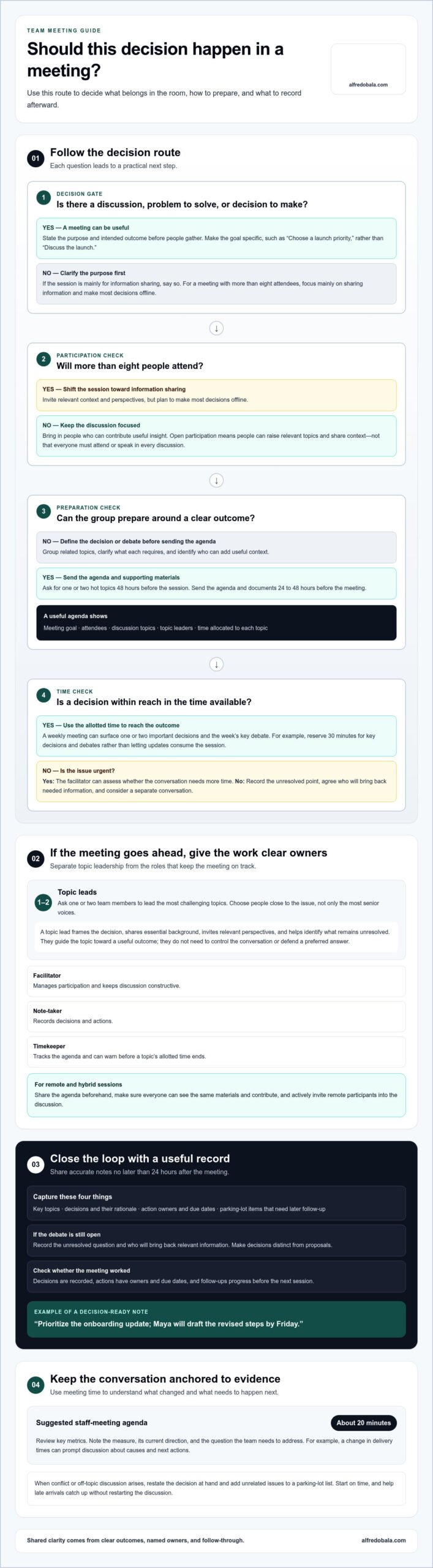
Invite the team to contribute to important debates and decisions. People closest to the work may spot risks, customer needs, or dependencies that leaders have missed. Open participation doesn’t mean everyone must attend or speak in every discussion. It means people have a way to raise relevant topics and share context before a decision is made. With more than eight attendees, use the meeting mainly to share information, then make most decisions offline.
Start with preparation. Ask team members to submit one or two hot topics 48 hours before the session. Group related topics, clarify what decision or debate each requires, and identify who can add useful context. A clear objective might be, “Choose a launch priority,” rather than “Discuss the launch.” This method helps participants prepare and keeps the conversation productive.
Build the agenda around the outcome. Include the meeting goal, attendees, discussion topics, topic leaders, and time allocated to each topic. Send the agenda and supporting documents 24 to 48 hours before the meeting, so people can review materials and arrive ready to contribute. For example, reserve 30 minutes for key decisions and debates rather than letting updates consume the session.
How should in-person, remote, and hybrid meetings differ? Share the agenda beforehand in every format. For remote and hybrid sessions, ensure everyone can see the same materials and contribute, including those joining online. The facilitator should actively invite remote participants into the discussion rather than relying only on people in the room.
How long should meetings be, and how often should they happen? Match the duration to the decision, and use a weekly meeting to surface one or two important decisions and the week’s key debate. Set clear objectives and agendas by stating the desired outcome, listing topics, and assigning time to each. A shared document can serve as a simple agenda template, with fields for topic, owner, and outcome. If conflict or off-topic discussion arises, restate the decision at hand and add unrelated issues to a parking lot list. Start on time, and help late arrivals catch up without restarting the discussion.
2. Assigning owners to important topics
Give every high-stakes topic a clear lead. Ask one or two team members to lead the most challenging topics at each meeting. Choose people close to the issue, not just the most senior voices. For example, a project lead can outline a delivery risk, while a customer support colleague adds frontline context. Naming an owner makes preparation and follow-through visible.
When considering how to run effective team meetings, define the topic owner’s role before discussion begins. They frame the decision, share essential background, invite relevant perspectives, and help the group identify what remains unresolved. They don’t need to control the conversation or defend a preferred answer. Their job is to guide the topic toward a useful outcome and capture any action that requires further work.
Assign meeting roles separately from topic ownership. The facilitator manages participation and keeps discussion constructive; the note-taker records decisions and actions; the timekeeper tracks the agenda. In a small meeting, one person can take on more than one role, but state each responsibility clearly. For instance, ask the timekeeper to give a brief warning before a topic’s allotted time ends.
A timekeeper protects the team’s attention, not just the clock. If a discussion needs more time, the facilitator can ask whether a decision is within reach or whether the topic needs a separate conversation. Unless the issue is urgent, record the unresolved point and agree who will bring back the needed information. This helps teams run effective meetings without letting one topic crowd out other priorities.
Invite feedback on both the issue and the process. After a decision, ask whether affected colleagues have raised key concerns and whether the next action has an owner. A project launch discussion, for example, should end with named follow-ups, not a vague agreement to “keep sharing updates.” Strengthen these leadership habits with practical team development ideas.
3. Reviewing and distributing meeting notes
Turn discussion into a shared record. Review the notes for accuracy, then distribute them no later than 24 hours after the meeting. Capture key topics, decisions, assigned actions with due dates, and parking lot items requiring later follow-up. A concise record lets absent teammates understand what changed and gives action owners a clear reference.
Make the record useful, not exhaustive. Rather than transcribing every comment, capture the decision and its rationale: “Prioritize the onboarding update; Maya will draft the revised steps by Friday.” If the debate remains open, note the unresolved question and who will bring back relevant information. To run effective team meetings, make sure readers can tell decisions apart from proposals.
Use weekly metrics to ground team conversations in evidence. A suggested staff-meeting agenda allocates about 20 minutes to reviewing key metrics. Note the measure, its current direction, and the question the team needs to address. For example, a change in delivery times can prompt discussion about causes and next actions, rather than a vague request to “improve performance.”
Connect meeting records to quarterly performance reviews without treating a single meeting as a verdict. Review agreed objectives, completed actions, recurring barriers, and decisions that shaped the quarter. Regularly maintained notes give leaders specific examples to discuss, while employees can add context or correct missing details. This grounds feedback in shared work.
How can you tell whether meetings are productive? Check that decisions are recorded, actions have owners and due dates, and follow-ups progress before the next session. For weekly updates, team members can note three to five things others need to know, then use those notes to identify dependencies or unresolved work. A practical test for effective team meetings is whether the records help the team make measurable progress.
4. Purpose and benefits of team meetings
Give every meeting a purpose that requires people to think or act together. Use the session to resolve an issue, brainstorm options, make a decision, or approve a proposal. If attendees only need a status update, share it in a document or message instead. This distinction protects team time and gives each meeting a clear reason to exist.
Set the outcome before choosing the structure. “Decide which customer issue to address first” gives the team a clear objective; “talk about customer issues” does not. At the start, state the purpose and what the group should leave with. A decision meeting might produce a selected option, while a problem-solving discussion might identify causes and assign next steps.
The potential value is substantial, but meetings don’t deliver it automatically. Survey findings indicate 75% of employers rated teamwork and collaboration very important, while 39% of employees said their organization didn’t collaborate enough. Another survey found 83% of respondents thought team meetings positively affected their projects. These figures point to an opportunity: make collaboration purposeful, not habitual.
Measure outcomes, not the number of meetings held. After a session, check whether the team made the intended decision, clarified a difficult issue, or agreed on actions and owners. If the same question returns without progress, change the attendees, preparation, or decision process. A useful meeting creates visible progress in people’s work.
Use writing to make the purpose and outcome visible to every attendee. Record the decision, the reason behind it, and the next action in shared notes. A meeting earns its place when people leave with clarity they couldn’t have reached as efficiently alone. To strengthen the leadership practices behind team collaboration, explore Leadership and Team Development Insights.
Alfredo Bala (The Motivation Guy): The Motivation Equation
The Motivation Equation by Alfredo Bala (The Motivation Guy) offers a practical framework for exploring motivation and leadership. After improving meeting agendas, ownership, and follow-through, leaders can use it to consider the deeper factors that shape how people contribute and work together.
Turn to The Motivation Equation when your team needs a clearer foundation for motivation, or explore Leadership and Team Development Insights to support broader team growth. For organizations looking to bring these ideas to a group, Alfredo Bala also offers Speaking. The right next step depends on whether you’re developing your own leadership approach, strengthening team practices, or bringing leadership perspectives into a wider discussion.
To explore how these offerings align with your leadership goals, contact Alfredo Bala (The Motivation Guy).
Make the Next Meeting a Turning Point
Put one change into practice at your next team meeting. Before the session, decide what progress should look like, then notice whether the conversation moves the team toward it. Reflecting on the result turns meeting habits into a leadership discipline: test an approach, learn from it, and refine the next discussion. That’s how effective team meetings become a lasting practice, not a one-time reset.
Keep the standard clear: every gathering should help people make progress they couldn’t achieve as efficiently alone. When your team needs a stronger foundation for motivation, leadership, and collaboration, explore the ideas and perspective Alfredo Bala brings to this work.
Contact Alfredo Bala (The Motivation Guy) to explore a next step for your leadership goals. Take the insight into your next conversation, and give your team a clear opportunity to move forward together.
Frequently Asked Questions
Why should Big Debate and Big Decision meetings be open to anyone on the team?
Invite anyone whose expertise or frontline experience could change the outcome. A product decision, for example, may benefit from input from support staff who hear recurring customer concerns. Include relevant contributors, but don’t make attendance a test of commitment. Share the decision and its rationale afterward so absent teammates can understand the choice and act on it.
How can teams make meetings more productive?
Choose a clear outcome and match the format to the work. For a decision, agree on the criteria before comparing options; for a brainstorm, collect ideas before evaluating them. Close by asking participants to identify a next step or unresolved dependency. If no discussion or joint judgment is needed, send an update asynchronously instead.
How should a manager set up a key metrics dashboard for a staff meeting?
Build the dashboard around the questions the staff meeting needs to answer, not every available number. For each metric, show its definition, data owner, reporting period, current result, comparison point, and direction of change. Add context for unusual movements, such as a temporary reporting delay. Ask attendees to flag exceptions and decisions needed, and leave routine figures in pre-read material.
What is the 3+3 formula for an effective staff meeting?
A useful way to apply a 3+3 structure is to review three key metrics, then identify three priorities or commitments for the period ahead. A service team, for instance, might review response time, unresolved requests, and customer feedback before selecting improvement actions. Treat this as an adaptable planning tool, not a universal formula; choose measures and commitments that fit the team’s objectives.
What roles should be assigned in an effective team meeting?
Assign roles according to authority and responsibility. The facilitator manages the process, the topic owner presents evidence and options, and the decision-maker clarifies who has final approval. A recorder captures outcomes, while a timekeeper flags agenda drift. In a small meeting, one person may hold multiple duties, but name each role beforehand so discussion isn’t mistaken for approval.
How can teams encourage participation and manage dominant speakers?
Use structured turns before opening the discussion: invite each attendee to share an observation, then return to anyone with additional evidence. If one person dominates, acknowledge their point and redirect: “Let’s hear a perspective we haven’t heard yet.” Remote participants can contribute through chat or shared notes. Intervene consistently, focusing on balanced input rather than criticizing someone’s style.
 EN
 ES
Recent Comments