
What if the strongest network marketing team isn’t built around its most charismatic leader, but around people who can lead themselves? The leadership skills in network marketing that matter most help team members make sound decisions, take consistent action, and build confidence without waiting for constant direction.
Leading people with different goals, experience, and levels of commitment takes care. Push too hard and you risk micromanaging; step back too far and momentum can fade. Sustainable leadership means building trust through consistent, credible example and coaching people to think and act independently. Alfredo Bala’s experience in the networking profession since 1980 informs this practical approach.
In this article, you’ll learn five practical skills for developing capable leaders and creating a repeatable approach to team growth without relying on personality alone. We’ll explore how to communicate clearly, coach for independent action, set a credible example, encourage consistent effort, and help team members develop judgment they can pass on to others.
Key Takeaways
- Model the standards you want your team to adopt, especially in how you communicate and follow through.
- Use clear expectations and thoughtful listening to tailor your coaching to each person’s goals and challenges.
- Strong leadership skills in network marketing help people learn a process and develop the judgment to adapt it.
- Make accountability a supportive conversation focused on learning, reflection, and steady effort.
- Develop future leaders gradually by moving from observation to shared responsibility and, ultimately, independent action.
Why leadership skills in network marketing begin with leading by example
Personal selling asks you to take responsibility for your own actions. Leadership adds another responsibility: helping other people learn, make decisions, and develop their abilities. That shift matters in network marketing, where a team includes people with different goals, experience, and levels of commitment. A leader’s role isn’t to make every decision for them. It’s to influence, support, and develop team members so they can act with increasing independence.
Understanding the structure helps clarify that responsibility. Multi-level marketing (MLM) describes a model in which participants can build networks of sellers, making leadership behavior visible beyond one-to-one interactions. Alfredo Bala’s experience in the networking profession since 1980 offers a grounded perspective: people are more likely to trust what a leader consistently does than what a title or motivational slogan promises.
Leadership isn’t simply recruiting people or directing their activity; it’s demonstrating a standard others can understand, practise, and eventually carry forward. That standard starts with your own conduct.
Skill one: model the standards you expect
Make expectations visible. Prepare for conversations, follow through on commitments, and communicate respectfully, especially when plans change. These actions show what reliability looks like more clearly than a reminder to “stay committed.” Team members can observe the behavior, understand the standard, and decide how to apply it in their own work.
Consistency doesn’t mean pretending every effort succeeds. If you miss a commitment or a plan doesn’t work, acknowledge it plainly. Explain what you’ll adjust, then take the next responsible step. Honest reflection gives your team a realistic example of accountability instead of suggesting that leadership requires constant success.
Consider the difference between a leader who works intensely for a few days and then disappears, and one who maintains a manageable routine: preparing for scheduled conversations, responding when promised, and reviewing what was learned. The second example makes steady practice easier to see and discuss. It gives team members a practical pattern to adapt rather than a burst of energy they may struggle to sustain.
Turn personal example into team trust
Trust grows when your actions make your words dependable. If you agree to follow up, do it; if you need to change a plan, communicate early. Keeping commitments gives team members a model they can rely on as they find their own way of working. This doesn’t mean doing everything for them. It means being clear about what they can expect from you as they take responsibility for their next steps.
Stay approachable, too. A leader who admits a mistake, listens to feedback, and takes responsibility shows that learning is part of the work. Humility doesn’t weaken authority; it makes authority credible. In practice, you might say, “I didn’t explain that clearly. Let’s reset the expectation,” then invite the team member to share what they understood. That exchange builds trust through action, not performance.
These leadership skills in network marketing begin with a simple discipline: make your example consistent enough to learn from, and human enough to trust.
Skill two: communicate clearly and listen before you coach
Team members rarely move at the same pace. One may be learning the basics, while another is ready to take on more responsibility. If expectations remain vague, each person has to guess what action matters, when to take it, and how progress will be discussed. Clear communication replaces guesswork with a shared understanding. It doesn’t mean giving everyone identical instructions; it means making the goal, the next step, and the available support clear to each person.
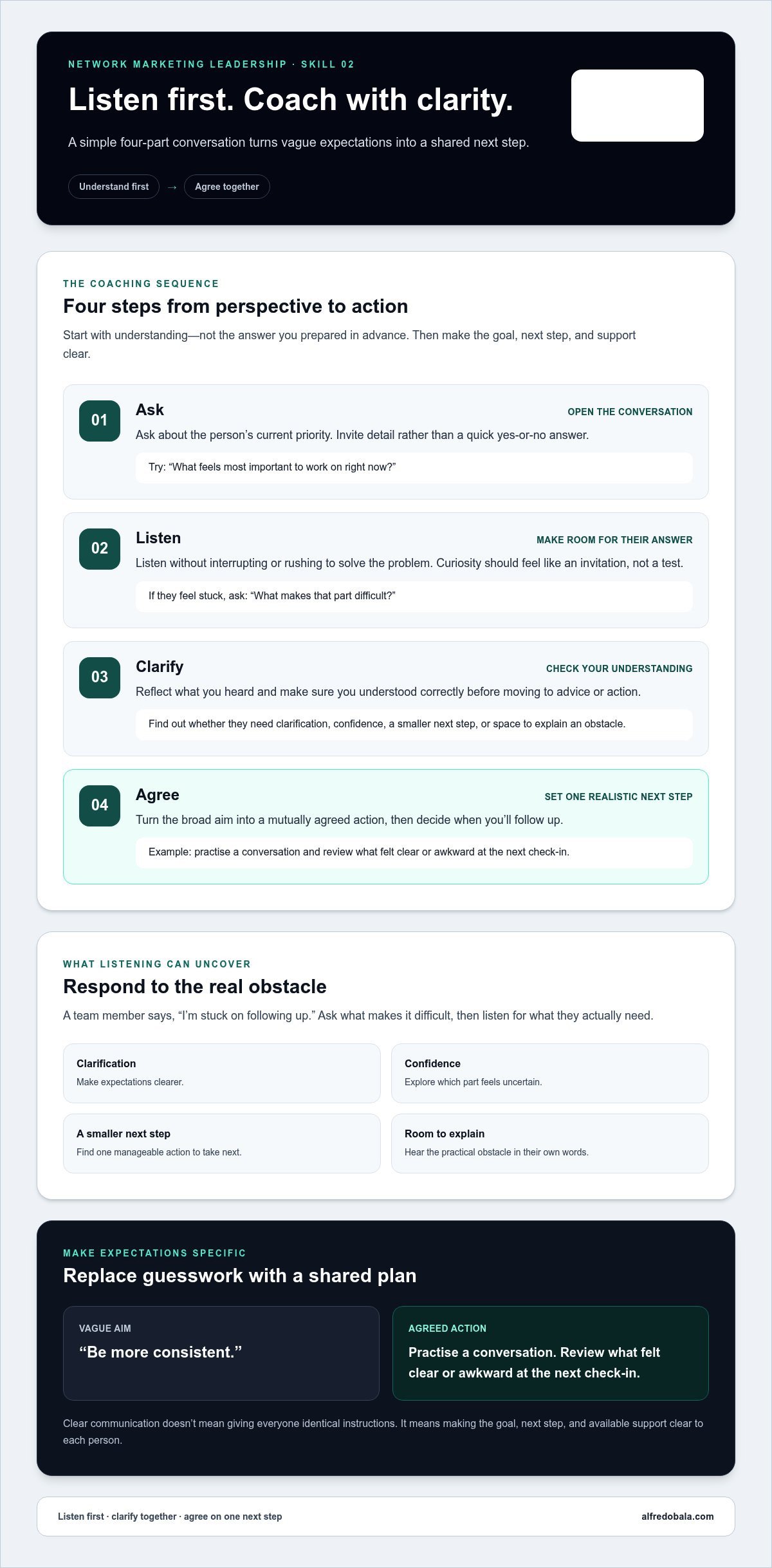
Start with understanding, not advice. Useful coaching begins with understanding the person’s perspective, not delivering the answer you prepared in advance. Listening first helps reveal whether someone needs clarification, confidence, a smaller next step, or space to explain a practical obstacle. A discussion can follow this simple sequence:
- Ask an open question about the person’s current priority.
- Listen without interrupting or rushing to solve the problem.
- Clarify what you heard and check that you understood correctly.
- Agree on one realistic next step and when to follow up.
This approach aligns with the focus on developing independent leaders described in Leadership Skills in Network Marketing. In practice, listening helps you adapt that principle to the person in front of you.
Ask questions that reveal the real obstacle
Use questions that invite detail, not a quick yes or no: “What feels most important to work on right now?” “Which part are you least confident about?” or “What’s one manageable action you could take next?” Then give the team member room to answer. Curiosity sounds like an invitation; interrogation sounds like a test. For example, if someone says, “I’m stuck on following up,” you might ask, “What makes that part difficult?” If they say, “I’m not sure what to say,” that can open a useful discussion. The exchange is a starting point, not a script for every person.
Make expectations and follow-up specific
Once you understand the obstacle, turn a broad aim into a mutually agreed action. Instead of “be more consistent,” you might agree to practise a conversation and review what felt clear or awkward at your next check-in. Set a follow-up point that works for both of you, then keep it. Adapt the amount of detail to experience, not assumptions about motivation: a newer team member may want a clear sequence, while an experienced one may prefer room to shape the approach.
This is a practical way to connect motivation with leadership behavior. The Motivation Equation leadership framework offers a related perspective on how communication supports human performance. For further leadership insights from Alfredo Bala, keep the focus on turning understanding into a clear, agreed next step.
Skill three: coach for duplication, not dependence
Duplication means teaching a clear process that another person can understand, practise, and adapt to their circumstances. It isn’t asking people to copy your personality or repeat your words without thinking. The aim is to pass on both a useful approach and the judgment to decide how it applies in a new situation.
There’s a difference between directing every move and coaching someone to think. Instructions can solve an immediate problem, but if you always write the message, lead the conversation, or make the decision, the team member has little chance to build confidence independently. Explain the reasoning, invite them to try, and let them take responsibility for the next step.
Repeatable leadership multiplies sound judgment; dependence keeps the team waiting for one high performer to provide every answer.
A practical coaching sequence moves responsibility forward in stages:
- Demonstrate the process and explain what you’re paying attention to.
- Practise together so the team member can try it with support.
- Observe their approach without immediately stepping in.
- Reflect on what worked, what felt difficult, and what they might adjust.
- Hand over the task when they’re ready to take it on independently.
Teach the reasoning behind the action
Explain the purpose, not just the steps. If you’re preparing for a conversation, discuss why you’d ask a question, listen to the answer, and respond to what the person actually said. If you’re planning a follow-up, consider what the other person needs to know and agree on a respectful next contact. These examples teach decision-making, not a guaranteed commercial result or a formula that fits every interaction.
Then ask the learner to talk through their own choices. “What would you do if the conversation takes a different turn?” encourages judgment more effectively than supplying a line to memorise. The goal is a team member who can explain their reasoning and adapt thoughtfully, rather than one who can only repeat a script.
Develop people without micromanaging
Agree on the outcome, boundaries, and point for reviewing progress, then leave room for the person to choose how to complete the action. For example, you might agree to prepare for a product conversation while allowing the team member to organise their notes in a way that suits them. At the review, discuss what they learned and where they got stuck, not just how many tasks they completed.
That balance matters: support should be available, but it shouldn’t replace ownership. As you build coaching habits that encourage responsibility, network-marketing team retention strategies offer a related perspective without changing the purpose of this coaching process. The measure of duplication isn’t whether everyone works exactly as you do. It’s whether people can apply sound principles, make considered choices, and help others learn in turn.
Skill four: build resilience through accountability and steady support
Progress in network marketing can vary from person to person and from one period to the next. A missed commitment or difficult conversation is a reason to pause and learn, not an invitation to promise that everything will soon turn around. Resilience isn’t constant optimism. It’s the ability to face what happened honestly, decide what can be learned, and choose a sensible next step.
Accountability is useful when it’s supportive, agreed upon, and focused on learning. Pressure, blame, or nonstop motivational intensity may produce a short burst of activity, but it can also make people reluctant to speak candidly about obstacles. Strong leadership skills in network marketing combine encouragement with clear expectations: a team member should feel supported while still owning the commitments they made.
Resilience is a leadership practice, not a guarantee that every person will remain on a team or reach a particular outcome. A leader can offer consistency, honest feedback, and room to reflect. Each individual still makes their own choices.
Respond to setbacks with a learning conversation
Begin with observable facts, not assumptions about someone’s attitude or intentions. “We planned to review the presentation on Tuesday, and we didn’t connect” describes what happened. “You’re not committed” turns an event into a personal judgment. That difference matters: facts create something you can discuss and address, while blame can close the conversation before you understand the real obstacle.
Ask questions that move the discussion toward learning: “What got in the way?” “What did you learn from this?” and “What practical adjustment would you like to try?” Listen to the answer before deciding what support or accountability makes sense. A calm response protects trust without removing responsibility. If a commitment still matters, restate it clearly and work together on a realistic way forward.
Make accountability useful and sustainable
Set the next step and check-in timing together. Keep the commitment specific enough to review, but realistic enough to fit the person’s circumstances. For example, if someone wants to practise explaining a product, agree on what preparation they’ll complete and when you’ll discuss how it went. The aim is a meaningful conversation, not a tally of activity detached from its purpose.
At the check-in, recognise effort and learning accurately. You might acknowledge that a team member followed through on preparation, then explore what they would change after the conversation. Avoid overstating results or ranking people by visible activity alone; circumstances and experience differ. Clear, fair feedback helps people understand what they can build on and where further practice may help.
Keep the focus on helping an individual regain perspective, reflect, and recommit to an agreed action. That’s distinct from broader team-retention tactics. A steady leader doesn’t manufacture confidence with exaggerated promises; they make space for honest assessment and responsible progress.
Strengthen your approach to accountability with Alfredo Bala’s leadership insights.
Skill five: develop new leaders with a repeatable growth practice
Leadership reaches its full value when it creates room for others to practise responsibility. If every important decision continues to pass through you, the team may get used to waiting for direction. A repeatable development practice shifts that pattern: emerging leaders learn by observing, trying, reflecting, and taking on more ownership as their judgment grows.
Use a simple progression. First, invite a team member to observe how you handle an appropriate task. Next, share responsibility by letting them lead part of it while you offer support. Then give them the opportunity to lead independently, with an agreed point to review what they learned. The steps aren’t a race. Match responsibility to readiness, and make the purpose and boundaries clear.
Meaningful responsibility lets people discover what they’re capable of and where they want to improve. A team member asked to facilitate a discussion, for example, can practise preparing, guiding the conversation, and responding to questions. Resist the urge to take over at the first sign of difficulty. Stay available, then use a follow-up conversation to help them assess their decisions and identify what they’d do differently next time.
Give emerging leaders meaningful responsibility
Choose a task with a clear purpose and enough authority for the person to carry it out. Explain what needs to be achieved, which boundaries matter, and what support is available. Let the emerging leader decide how to approach the work within those limits. Afterward, discuss what they noticed, what challenged them, and which strengths they drew on. That reflection turns an assignment into practice in judgment, not just another item to complete.
Turn the five skills into a weekly leadership rhythm
Make development manageable by choosing one focus for the week. You might model a standard through reliable follow-through, listen more carefully before offering advice, coach someone through a decision, respond calmly to a setback, or delegate a responsibility for practice. Pick one observable behavior, such as asking a team member to explain their plan before you offer suggestions. At the end of the week, review what worked, what challenged the team, and what to try next.
Together, these five skills form a practical cycle: set an example, listen to understand, coach for judgment, support learning through setbacks, and make space for others to lead. They help you develop a team that doesn’t depend on one personality to keep moving. They won’t guarantee a particular outcome, but they can give people a clearer opportunity to practise independent leadership.
Alfredo Bala has worked in the networking profession since 1980 and is the author of The Motivation Equation. His experience and leadership insights offer a relevant perspective as you develop your own approach. This week, choose one team member and give them an appropriate responsibility, then agree to reflect on the experience together. To continue exploring practical perspectives on leadership, explore Alfredo Bala’s leadership insights.
Make your next leadership action intentional
Independent leaders don’t emerge from a single speech or a perfectly planned training session. They develop through everyday opportunities to think, practise, take responsibility, and learn. Choose one person on your team and one responsibility they can begin to own. Agree on the outcome, give them room to decide how to approach it, and make time to reflect on what they learned.
That small step can help turn leadership skills in network marketing into visible, repeatable practice. Keep creating thoughtful opportunities for others to grow, while remaining available to coach rather than taking over. The aim isn’t to make every team member lead in the same way. It’s to help each person build the judgment and confidence to contribute independently.
Alfredo Bala brings network-marketing experience that includes former CEO and COO roles. Explore Alfredo Bala’s leadership insights for more perspectives on developing people and strengthening your leadership approach. Start with one action this week, then build from there. Your next capable leader may be ready for the opportunity you create.
Frequently Asked Questions
What are the most important leadership skills in network marketing?
The most important leadership skills in network marketing include credibility, attentive communication, coaching, resilience, and developing others. Their value becomes clear when a team member faces a decision you can’t make for them. A leader who sets clear principles, invites questions, and lets the person explain their reasoning builds capability beyond a single task. Start by identifying which leadership behavior your team needs to see more consistently, then model it yourself.
How can a network-marketing leader motivate a team without pressuring people?
Motivate without pressure by connecting work to each person’s own goals and giving them room to choose their level of involvement. For example, ask a team member what they want to practise this month, then help them define a step that fits their priorities. Recognise thoughtful effort and honest learning, not just visible activity. Avoid implying that enthusiasm or persistence guarantees a particular income or business result.
Can leadership skills help a network-marketing team become more independent?
Yes. Leadership can support greater independence when team members understand which decisions they can make for themselves and when they should seek guidance. You might agree that a new member can plan their own customer follow-up, while bringing unusual questions to a team discussion. Clear boundaries prevent unnecessary waiting without leaving people unsupported. Review decisions together afterward so they can strengthen their judgment for the next situation.
How do you coach a new network-marketing team member?
Begin by asking what the new member already understands and what they want to learn first. Then choose one relevant task, such as preparing a product explanation, and invite them to describe how they’d approach it. Offer context where needed, let them practise, and discuss what they would keep or change afterward. This makes coaching responsive to their starting point instead of overwhelming them with information they may not use yet.
What is the difference between recruiting and leadership in network marketing?
Recruiting is the process of inviting someone to consider joining a network-marketing business; leadership is the ongoing work of supporting that person’s development and informed choices. An invitation alone doesn’t tell someone how to learn, handle questions, or decide whether the work suits their goals. Responsible leadership sets realistic expectations, encourages questions, and respects individual decisions. The relationship should remain grounded in transparent communication, not pressure or promises of guaranteed success.
How can network-marketing leaders handle setbacks and keep communicating well?
Address a setback promptly and calmly, then agree on when you’ll revisit it. If a team member misses a planned conversation, avoid filling the silence with guesses about why. Ask whether circumstances changed and whether the original plan still makes sense. If your own communication caused confusion, say so and restate the expectation plainly. Timely, respectful follow-up keeps a challenge from turning into an unspoken source of frustration.
Why is duplication important in network-marketing leadership?
Duplication matters because a team needs practical ways to share skills and decision-making, rather than depending on one person to solve every problem. A repeatable approach gives members a starting point they can adjust to their own communication style and circumstances. The aim isn’t identical performance; it’s shared understanding of sound principles. That distinction helps new leaders teach others thoughtfully while adapting their guidance instead of passing along rigid instructions.
 EN
EN  ES
ES
Recent Comments