
Disengagement is not just a morale issue; it is a $10 trillion drain on the global economy that accounts for nearly 9% of the global GDP. If you are tired of watching high turnover rates climb without a clear explanation, it is time to stop guessing and start auditing. Mastering how to measure employee engagement is no longer a simple HR checkbox. It is a fundamental requirement for any leader who intends to turn human potential into a sustainable competitive advantage in 2026.
You likely recognize that your current surveys are failing to capture the true pulse of your organization, often yielding low participation and even lower insight. I have spent decades in the executive suite, and I have learned that the science of motivation requires more than a generic questionnaire. This guide will show you how to master the executive-level methodologies needed to audit your organizational health effectively. We will explore a clear dashboard of engagement metrics and provide a roadmap to align individual effort with your highest corporate goals, ensuring your team delivers the discretionary effort required to win.
Key Takeaways
- Distinguish between baseline employee satisfaction and true strategic commitment to understand why the Board views engagement as a critical leading indicator of ROI.
- Master how to measure employee engagement by moving beyond lagging turnover stats and adopting a dashboard of leading indicators like the Employee Net Promoter Score.
- Uncover the cultural narrative behind the data through Executive Focus Groups; these sessions reveal the unvarnished truth from your front lines.
- Establish a foundation of psychological safety and non-negotiable anonymity to ensure your engagement audit yields honest, high-quality insights.
- Apply the Motivation Equation to bridge the gap between data collection and strategic execution, turning static metrics into a roadmap for increased retention.
Redefining Engagement: Why Measurement is a Strategic Leadership Priority
Leaders frequently mistake a peaceful office for a productive one. I have sat in boardrooms across the globe where executives celebrated high satisfaction scores while their market share evaporated. Understanding employee engagement is not about measuring how many people like the coffee in the breakroom; it is about quantifying the psychological investment your team brings to the mission every morning. Through the lens of global leadership, employee engagement is the strategic alignment of individual purpose with corporate vision that secures long term retention and outsized performance.
Engagement vs. Satisfaction: The High-Stakes Difference
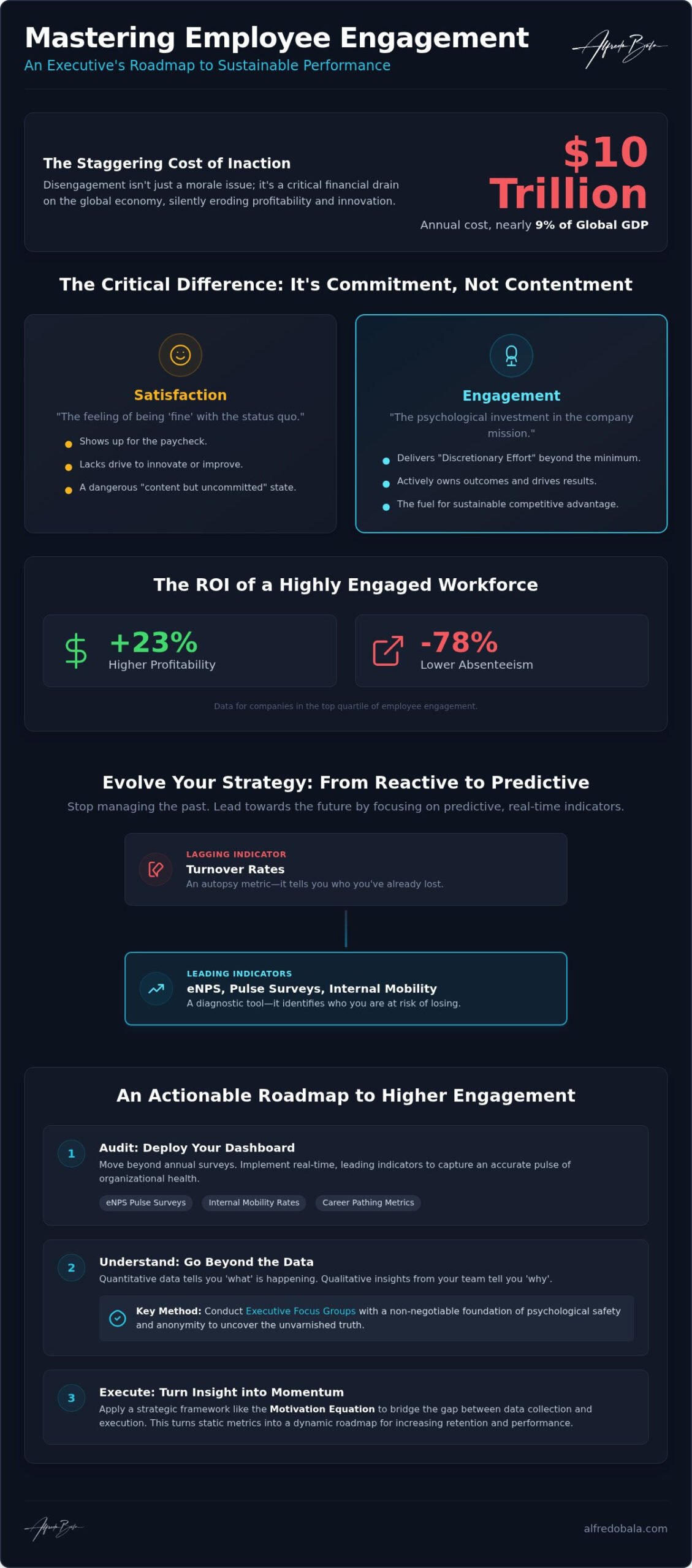
A happy employee can still be a low performer. Satisfaction is often just contentment; it’s the feeling of being “fine” with the status quo. This creates a dangerous “content but uncommitted” workforce that shows up for the paycheck but lacks the drive to innovate. True engagement is commitment. It’s the fuel for “Discretionary Effort,” which is the voluntary energy an employee exerts beyond the bare minimum required to keep their job. When you learn how to measure employee engagement, you are looking for the gap between a person who does their job and a person who owns the outcome. Aligning individual ambition with the organizational mission is the only way to close that gap.
The Economic Impact of Disengagement in 2026
The numbers are staggering. Disengagement is a silent killer, costing the global economy roughly $10 trillion, which is equivalent to 9% of global GDP. For global sales teams, this manifests as lost innovation and brand erosion that no marketing budget can fix. Current research indicates that companies with top quartile engagement are 23% more profitable and experience 78% lower absenteeism. These are not just HR metrics. They are leading indicators of ROI that every Board of Directors monitors to predict future stability.
Establishing a baseline for these metrics is the prerequisite for applying the Motivation Equation. Without accurate data, your leadership remains reactive rather than strategic. If you are managing complex organizational shifts, an executive advisory perspective, such as a dedicated board seat focused on human capital, becomes essential to bridge the gap between potential and actual performance. Success is a disciplined science. It begins with knowing exactly where your culture stands today so you can lead it toward where it needs to be tomorrow.
The 5 Essential Metrics for Quantifying Organizational Health
Stop looking in the rearview mirror. Most organizations rely on turnover rates as their primary barometer for success, but turnover is a lagging indicator; it tells you who you have already lost, not who you are about to lose. To lead effectively, you must pivot toward leading indicators that capture real-time sentiment. Understanding how to measure employee engagement requires a shift from autopsy to diagnosis, allowing you to intervene before a productivity plateau becomes a permanent decline.
ENPS and Pulse Surveys: Real-Time Sentiment Tracking
The Employee Net Promoter Score (eNPS) is the gold standard for a baseline pulse. By asking a single, piercing question about the likelihood of recommending the company, you strip away the noise of complex surveys. To avoid survey fatigue, deploy short pulse surveys that take less than two minutes to complete. A high-performing culture relies on specific employee engagement metrics to identify shifts in morale before they manifest as resignations. The most predictive question for retention isn’t about current happiness; it’s asking if the employee sees a clear path for their own growth within your vision over the next twenty-four months.
Internal Mobility and Career Pathing Metrics
A healthy organization is a fluid one. When your team members actively apply for internal roles, it signals a deep belief in the company’s future. This is where you measure the “Belief Gap.” If mid-level managers are stagnant, it often indicates a breakdown in your leadership development pipeline. Tracking promotion rates and internal transfer requests allows you to audit the health of your team’s ambition. This data is a prerequisite for applying the principles found in The Motivation Equation, ensuring you are fueling the right drivers of performance.
Absenteeism and Productivity Ratios
Unplanned leave is rarely just about physical illness; it is often the first symptom of emotional burnout. By tracking absenteeism alongside productivity ratios, you can identify “Quiet Quitting” before it erodes your bottom line. High-performing teams show 78% lower absenteeism according to industry research. If output quality remains high while participation in optional initiatives drops, you have found a pocket of disengagement. Use Stay Interviews to gather proactive intelligence, asking your top performers what keeps them here and what might tempt them away. This is how you transform raw data into a strategic competitive advantage.
Beyond the Data: Qualitative Methods for Deep Insight
Spreadsheets provide the skeletal structure of your organization, but they rarely capture its heartbeat. While the metrics discussed previously offer a vital baseline, numbers alone never tell the full story of a team’s culture. To truly master how to measure employee engagement, you must listen for the unvarnished truth that data points often obscure. This requires shifting from passive observation to active, strategic inquiry. By applying the frameworks within The Motivation Equation, you can begin to interpret the subtle nuances of human performance and intent that drive long term success.
The Art of the Strategic Stay Interview
Conduct stay interviews that prioritize trust over anxiety. Move away from the rigid structure of traditional performance reviews and adopt a conversational approach that uncovers the “why” behind your team’s daily commitment. Ask questions that pierce through corporate politeness. For example, inquire about what specific project or team dynamic makes them feel most valued, and what friction point consistently dampens their enthusiasm. This process identifies the specific retention drivers unique to your organization. When you listen with the intent to understand rather than to defend, you build a culture of psychological safety that raw statistics simply cannot replicate.
Executive Focus Groups for Global Teams
Bridging the gap between C-suite vision and regional execution is a primary challenge for international leaders. Executive focus groups provide a platform to hear from the front lines in different global markets, offering insights that a digital survey might miss. Cultural nuances often dictate how feedback is given; a team in one region may express concern through silence, while another is more vocal. Navigating these complexities is central to high level corporate board advisory. These sessions allow you to extract strategic insights that inform global governance and growth.
Analyzing the “Language of Leadership” within your internal communications is another sophisticated way to audit organizational health. Look for recurring themes in how your managers speak about challenges. Are they using words of ownership and growth, or is the vocabulary rooted in survival and blame? This qualitative audit reveals the true culture of your team. Mastering how to measure employee engagement involves more than just reading a report; it requires the seasoned intuition of a leader who knows how to ask the right questions and listen for the answers that aren’t on the page.
A Step-by-Step Guide to Implementing an Engagement Audit
Execute with precision. An engagement audit is not an HR formality; it is a diagnostic tool for executive decision-making. If you want to master how to measure employee engagement, you must begin by defining your “North Star.” Are you measuring for retention, innovation, or a total culture shift? Once the target is set, establish psychological safety as your non-negotiable foundation. Anonymity is the only way to ensure the data you collect is honest and actionable. If your team fears retribution, your audit will yield nothing but polite lies.
Step 1: Designing the Inquiry for Maximum Participation
Launch your audit with a “Keynote Mindset.” Communicate the “why” to the entire organization with the same energy you would use to announce a new global merger. In 2026, an annual survey is a relic of the past. Shift to quarterly pulse checks to maintain real-time awareness. Selecting the right frequency is critical when determining how to measure employee engagement effectively in a fast-paced global market. Your questions should be crafted to yield both qualitative depth and quantitative precision, ensuring the audit directly reflects your executive leadership development strategies. This alignment ensures that the data you gather supports your long term growth objectives.
Step 2: Analysis and Thematic Mapping
Data synthesis is where strategy is born. Move beyond raw numbers and identify “Motivation Gaps” across different departments. Cross-reference your engagement scores with actual performance data to see where disengagement is actively eroding your bottom line. When presenting findings to the board, skip the granular spreadsheets. They need to see strategic themes, risk areas, and the direct correlation between culture and ROI. This is the level of insight required to maintain your competitive edge in a fragmented global economy.
Step 3: The Post-Audit Action Ritual
Measurement without movement is a betrayal of trust. Implement the “Transparency Rule” by sharing the results, both the good and the bad, with the entire organization. This radical honesty builds credibility and proves you’re listening. Assign accountability for specific engagement improvements to your department heads; it shouldn’t just be an HR task. By creating a feedback loop that proves their voice drives change, you secure the discretionary effort of your team. To see how these audits integrate into a broader strategy for excellence, explore my leadership and team development insights.
Turning Data into Momentum: Scaling the Motivation Equation
Measurement without movement is a betrayal of trust. If you’ve asked your team to be vulnerable and honest during an audit, failing to act on that data is the quickest way to destroy psychological safety. Once you’ve mastered how to measure employee engagement, the true work of leadership begins. You must position your engagement strategy as a core pillar of organizational growth. The Motivation Equation serves as the vital bridge between the intellectual exercise of data collection and the physical reality of high performance; it turns “knowing” into “doing.”
Aligning Engagement with Global Strategy
Scaling culture across global borders requires more than just a translated handbook. It requires a leader who acts as the “Chief Motivation Officer.” Every individual on your team, from the corporate headquarters to the most remote regional office, must understand their specific role in the organization’s “Big Win.” This role involves more than just oversight; it requires the infectious energy of a mentor who can see the potential in every global representative. When your team sees that their feedback results in tangible changes to workflow or professional development, their belief in the mission is solidified. Your audit data provides the map, but your leadership provides the fuel.
The Role of Professional Speaking in Re-Engaging Teams
There are moments when an organization needs a catalyst to reset its energy and clear the air. This is where the role of professional speaking becomes a strategic asset for the C-suite. A seasoned leadership speaker for corporate events can take the raw findings of your engagement audit and weave them into a compelling narrative that validates the team’s voice. High impact presentations do more than just share information; they ignite a collective commitment. This transition moves your company from a static numerical “score” to a genuine “movement” that drives discretionary effort across the board.
Leadership is both a disciplined science and a nuanced art. You now have the tools, the metrics, and the strategic roadmap to transform your culture. It is time to step into your role as a visionary guide who understands that human potential is your most valuable currency. Stop treating engagement as a secondary HR metric and start treating it as the primary driver of your global competitive advantage. The journey from raw data to unstoppable momentum starts with the very next action you take based on what you’ve learned.
Lead the Movement: From Data Points to Organizational Performance
You now possess the blueprint to transition from reactive management to proactive, visionary leadership. By shifting your focus from lagging turnover stats to leading indicators like eNPS and internal mobility, you gain the foresight needed to protect your bottom line. Mastering how to measure employee engagement is the first step in a larger journey toward unlocking discretionary effort across your global team. Remember that data without a subsequent action ritual is a missed opportunity to build trust and momentum.
As a veteran CEO and global team architect who has served in various corporate board advisory roles, I’ve seen firsthand that a culture of commitment is the only sustainable competitive advantage. It’s time to move beyond the score and start building a movement. Elevate your leadership with the frameworks in The Motivation Equation and transform your organizational health into a measurable engine of growth. Your team is waiting for a leader who listens and acts; go out there and be that visionary guide who turns human potential into a legacy of success.
Frequently Asked Questions
How often should a global organization measure employee engagement?
Organizations should move away from the traditional annual autopsy and toward a continuous listening strategy. Monthly or quarterly pulse surveys are now the standard for global entities. This frequency allows you to catch shifts in sentiment before they lead to high turnover. By maintaining a steady rhythm, you demonstrate to your team that their voice is a constant priority, rather than a once-a-year formality that is quickly forgotten.
What is the most accurate metric for employee engagement in 2026?
The Employee Net Promoter Score (eNPS) remains a foundational pulse metric, but the most accurate gauge in 2026 is a combination of sentiment data and behavioral proxies. You must track discretionary effort through participation rates in optional initiatives and internal mobility. This holistic approach reveals how to measure employee engagement with precision, showing not just what employees say, but how they actually invest their energy in the mission.
How do you measure engagement in a remote or decentralized workforce?
Measuring engagement in a decentralized workforce requires a blend of digital pulse surveys and intentional qualitative touchpoints. Use collaboration data to monitor patterns of isolation or burnout without infringing on privacy. Regular video-based Stay Interviews are essential to bridge the geographic gap. These interactions allow leaders to maintain the human touch and ensure that remote representatives feel as connected to the core vision as those in the home office.
Can you measure employee engagement without using surveys?
You can absolutely gauge organizational health without relying solely on surveys. Analyze behavioral data such as absenteeism rates, internal promotion applications, and voluntary participation in recognition programs. These actions serve as silent votes of confidence or concern. By observing these patterns, you gain a clear view of how to measure employee engagement through the lens of actual commitment rather than just self-reported satisfaction scores found in typical HR tools.
What is a “good” eNPS score for a high-growth company?
For a high-growth company, an eNPS score above 30 is considered strong, while anything over 50 is excellent. It is vital to remember that these scores are relative to your specific industry and growth stage. Rather than obsessing over a single number, focus on the trend line. A score that is steadily climbing indicates that your leadership development and cultural initiatives are successfully scaling alongside your revenue and team size.
How do I ensure employees provide honest feedback in an audit?
Anonymity is the non-negotiable rule for securing honest feedback. Employees won’t share the unvarnished truth if they fear retribution or judgment from management. Use third-party platforms to conduct your audits and clearly communicate the safeguards in place. When you follow up by sharing results transparently, including the negative feedback, you build the psychological safety necessary for your team to be candid in future inquiries.
What happens if our engagement scores are lower than expected?
View low scores as a strategic diagnostic tool rather than a failure. A dip in engagement is an early warning system that allows you to intervene before a full-scale productivity plateau occurs. Conduct executive focus groups to uncover the specific friction points causing the decline. Your response to low scores determines your future credibility; use the data to drive transparent, accountable changes that prove you value the team’s input.
How does the Motivation Equation help in interpreting engagement data?
The Motivation Equation provides the scientific framework needed to turn raw audit data into a strategic roadmap for growth. It helps you identify which specific drivers of commitment are missing in different departments. By applying this methodology, you bridge the gap between “knowing” the engagement score and “doing” the work required to fix it. This approach ensures that your measurement efforts lead to tangible increases in retention and discretionary effort.
 EN
EN  ES
ES
Recent Comments