
In the high-stakes corridors of 2026, the sharpest technical mind in the room is no longer the most powerful; it’s the one who can decode the unspoken currents of human emotion. You’ve likely felt the sting of high team turnover despite offering industry-leading compensation, or perhaps you’ve watched a brilliant strategy crumble because of subtle boardroom politics. It’s a common frustration for executives who realize that technical mastery alone cannot bridge the gap between a plan and its execution. True emotional intelligence in leadership isn’t a soft skill. It’s the strategic operating system that determines whether your global teams thrive or merely survive under pressure.
I’ve spent over 40 years in the trenches of global operations, and I can tell you that the difference between a manager and a visionary leader lies in the ability to master the nuanced art and science of human connection. This article provides you with a definitive roadmap for executive-level personal mastery. You’ll learn how to leverage my proprietary framework, the Motivation Equation, to eliminate burnout and drive peak performance across diverse cultures. We’ll explore a practical system for mastering influence that transforms organizational stress into a competitive advantage. It’s time to move beyond the basics and claim your strategic edge.
Key Takeaways
- Discover why shifting from “Management by Instruction” to “Leadership by Influence” is the essential transition for the 2026 economy.
- Learn how to maintain “Executive Calm” during market volatility by mastering the five pillars of personal mastery.
- Uncover the direct link between emotional intelligence in leadership and the Motivation Equation to drive high-impact results.
- Master a five-step process for building trust and navigating complex communication styles within global teams and boardrooms.
- Access a daily checklist designed to help you leverage emotional strengths and cultivate a legacy of visionary leadership.
Beyond the Buzzword: Why Emotional Intelligence is the Strategic Edge in 2026
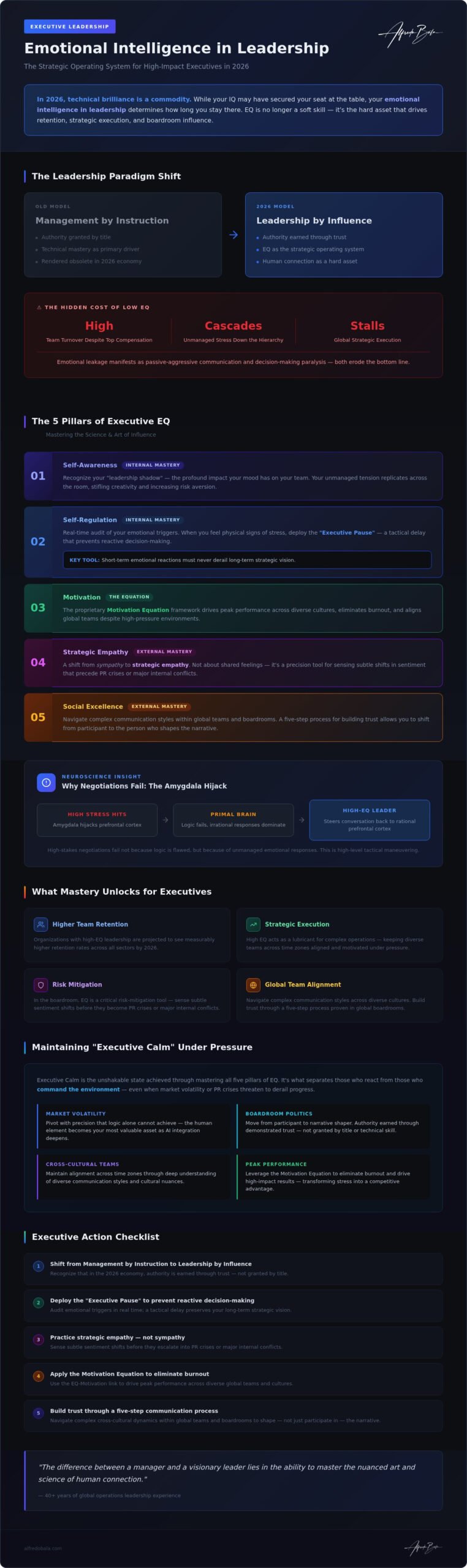
Stop viewing human connection as a secondary concern. In the volatile executive landscape of 2026, emotional intelligence has evolved from a corporate buzzword into the ultimate strategic operating system. For the modern executive, EQ is the refined ability to decode complex human dynamics to drive specific organizational outcomes. It’s the difference between seeing a spreadsheet and seeing the hidden fears of the people who must execute the numbers. Technical brilliance is now a commodity. While your IQ might have secured your seat at the table, your emotional intelligence in leadership determines how long you stay there. Without it, you aren’t leading; you’re simply supervising a slow decline.
The 2026 economy has rendered ‘Management by Instruction’ obsolete. We’ve moved into an era of ‘Leadership by Influence’ where authority is earned through trust rather than granted by a title. High-stakes negotiations often fail not because the logic is flawed, but because the amygdala of a key stakeholder has hijacked their prefrontal cortex. When stress hits, the primal brain takes over. A seasoned leader recognizes this biological shift and uses EQ to steer the conversation back to the rational prefrontal cortex. This isn’t just psychology. It’s high-level tactical maneuvering.
The ROI of High-EQ Leadership
By 2026, organizations with high-EQ leadership are projected to see measurably higher team retention rates across all sectors. The financial cost of emotional leakage in executive teams is staggering. When leaders lack self-regulation, their unmanaged stress cascades down the hierarchy, creating friction that stalls global strategic execution. This leakage often manifests as passive-aggressive communication or decision-making paralysis, both of which erode the bottom line. High EQ acts as a lubricant for complex operations. It ensures that diverse teams across different time zones remain aligned and motivated despite high-pressure environments.
From Soft Skill to Hard Asset
Let’s dismantle the myth that EQ is about being nice. It’s actually about being exceptionally effective. In the boardroom, emotional intelligence serves as a critical risk-mitigation tool. It allows you to sense the subtle shifts in sentiment that precede a PR crisis or a major internal conflict. As we navigate the rapid technological shifts of 2026, including the deep integration of AI, the human element becomes your most valuable hard asset. Leaders who master this science can pivot their organizations with a precision that logic alone cannot achieve. It’s a hard asset that pays dividends in every boardroom interaction.
The 5 Pillars of Executive EQ: Mastering the Science and Art of Influence
Elevating your emotional intelligence in leadership is a journey of precision and discipline. It isn’t enough to be a “people person.” You must become a master of the five pillars that define executive excellence: self-awareness, self-regulation, motivation, strategic empathy, and social excellence. These pillars work in tandem to create a leader who is both grounded and agile. When you master these, you don’t just manage people; you command the environment. You move from being a participant in boardroom politics to the person who shapes the narrative. This mastery allows you to maintain an unshakable “Executive Calm” even when market volatility or PR crises threaten to derail your progress.
Internal Mastery: Self-Awareness and Regulation
Internal mastery starts with the executive mirror. You must recognize your “leadership shadow,” which is the profound impact your mood and behavior have on your direct reports and the broader culture. If you walk into a meeting with unmanaged tension, that energy replicates across your team, stifling creativity and increasing risk aversion. Real-time auditing of your emotional triggers is essential. When you feel the physical signs of stress, employ the “Executive Pause.” This is a tactical delay that prevents reactive decision-making. Consistent self-regulation ensures that short-term emotional reactions never derail your long-term strategic vision.
External Mastery: Strategic Empathy and Social Skills
External mastery requires a shift from simple sympathy to strategic empathy. This isn’t about shared feelings. It’s about the clinical understanding of the strategic drivers and personal anxieties of your stakeholders. By reading the unsaid in the boardroom, you can anticipate objections and pivot your strategy in real-time. Mapping the emotional landscape of a diverse global team is equally critical. You must understand how cultural nuances affect communication and trust. Building “Relationship Capital” serves as a high-value currency. It allows you to forge high-trust alliances across global silos, ensuring your strategic initiatives have the support they need to succeed. If you’re looking for a deeper roadmap for these skills, my leadership and team development insights offer a practical system for real-world application.
The EQ-Motivation Link: How Emotional Intelligence Powers the Motivation Equation
Motivation isn’t a mystery; it’s a calculation. Most executives treat it as a random event or a side effect of a high salary, but that’s a costly misunderstanding. In reality, motivation is the measurable output of a system where emotional intelligence in leadership serves as the primary input. Without the data provided by high-level EQ, you’re flying blind. You’re hoping that a standard bonus structure will ignite a fire in a team that might actually be starving for autonomy or recognition. Traditional incentive programs fail because they ignore the emotional foundation required to sustain effort over the long term.
My framework, The Motivation Equation, relies on identifying specific variables for every individual on your team. EQ is the diagnostic tool that allows you to uncover these variables with precision. When you understand the emotional drivers of your stakeholders, you can calibrate your leadership style to meet them where they are. This positions you as the ‘Chief Motivation Officer.’ You aren’t just managing tasks; you’re managing the energy and drive of your entire organization.
Solving the Equation for Peak Performance
High-performers are rarely driven by compensation alone. They seek mastery, purpose, and a sense of belonging. Using EQ helps you audit these individual drivers in real-time. It also allows you to identify and remove ‘Motivational Blockers,’ such as toxic cultural friction or bureaucratic bottlenecks that drain executive energy. When you proactively clear these obstacles, you facilitate ‘Flow States.’ These are periods of deep, effortless concentration where your team produces their highest-impact work. A leader with high emotional intelligence doesn’t just demand performance; they architect the environment that makes it inevitable.
The Motivation Equation in Action
I recently consulted for a disengaged executive team where productivity had stalled despite aggressive growth targets. By applying EQ-driven insights, we discovered the ‘expectation’ variable was broken. The team simply didn’t believe the goals were achievable, which killed their drive. We pivoted the narrative to focus on small, high-visibility wins, rebuilding their confidence and re-igniting the engine of the organization. This is why EQ is the ultimate multiplier in executive leadership development strategies. The Motivation-EQ Loop represents a continuous cycle where emotional awareness feeds into performance optimization, creating a self-sustaining ecosystem of high-impact delivery.
Leading Across Borders: Applying EQ to Global Teams and Boardrooms
Scaling an organization across borders demands a refined level of emotional intelligence in leadership. You can’t rely on the same communication cues in Tokyo that you use in New York. Success in the 2026 global economy requires you to bridge the “Cultural EQ” gap. This means understanding the shift between high-context and low-context communication. In high-context cultures, the most critical information is often found in what remains unsaid. If you miss the subtle cues of silent dissent or hesitation, your plans for organizational growth in emerging markets will stall before they even begin. You must learn to hear the silence as clearly as the speech.
The Global EQ Framework
Building trust in virtual, global environments is a deliberate five-step process. It starts with active listening that goes beyond language barriers; you’re listening for intent and tone, not just vocabulary. Next, you must adapt your leadership style without losing your core identity. This isn’t about being a chameleon, but about shifting your frequency so your message can be received clearly. Finally, you must validate diverse perspectives. Innovation dies when global teams feel their unique cultural insights are being steamrolled by a centralized headquarters. High-EQ leaders create a “psychological safety net” that spans continents, ensuring every team member feels empowered to contribute their best work.
Boardroom Dynamics and Strategic Influence
In the boardroom, EQ is the ultimate tool for alignment and strategic impact. As a corporate board advisor, I’ve seen how dominant personalities can hijack a meeting while the most critical insights remain trapped in the minds of the quietest members. You must learn to read the “room beneath the room.” This involves identifying hidden agendas and addressing them with precision before they turn into institutional rot. High-EQ governance isn’t just about compliance; it’s about having the emotional maturity to choose long-term sustainability over short-term political wins. When you can manage the silent dissent and align conflicting stakeholders, you transform the boardroom from a place of politics into a center of visionary execution.
If you’re ready to elevate your global influence, consider how my board advisory services can help you master these high-stakes human dynamics.
Cultivating Visionary Leadership: Your Roadmap to High-Impact Influence
Stop obsessing over your technical deficits. Most executive coaching focuses on repairing what’s broken, but visionary leadership is built on the aggressive leverage of emotional strengths. True emotional intelligence in leadership isn’t a remedial tool; it’s an optimization strategy. When you identify your unique “emotional superpowers”-those moments where your intuition and empathy naturally align with organizational goals-you stop being a manager and start being a catalyst. By 2026, the ability to project a clear, emotionally resonant vision will be the primary factor that separates high-impact leaders from the rest of the pack. It’s time to move beyond the basics of “fixing” and start the work of mastering your influence.
The Daily EQ Audit
Visionary leadership is a discipline, not a destination. To maintain your edge, you must implement a rigorous daily EQ audit. This starts with your morning mindset. Before you open a single email, set the emotional tone you intend to project to your organization. Are you the anchor of calm or the engine of urgency? Your team will mirror your state, so choose it with precision. Follow this with a post-meeting reflection after every major interaction. Don’t just analyze the data discussed; analyze the emotional outcomes. Did your stakeholders leave the room feeling empowered or diminished? Finally, commit to continuous learning. As leadership models evolve alongside hybrid and AI-integrated work, staying ahead of the “EQ curve” is essential for maintaining your relevance at the board table.
Your Path to Personal Mastery
Integrating these strategies into your personal brand is what creates a legacy. A high-EQ leader builds a culture that doesn’t just survive their tenure but thrives long after they’ve moved on. This is why EQ has become the ultimate differentiator for leadership speakers for corporate events. In a world of generic advice, the market craves leaders who have lived these challenges and can articulate the nuanced art of human performance. Your roadmap to personal mastery involves moving from abstract theory to the real-world application of the Motivation Equation.
The journey from management to visionary leadership requires a partner who has navigated the highest echelons of global business. If you’re ready to master the science of influence and drive peak performance across your organization, it’s time to take the next step. Partner with Alfredo Bala to implement these frameworks and claim your strategic edge for 2026 and beyond.
Master the Future of Global Influence
The landscape of 2026 demands more than just strategic foresight; it requires the emotional agility to lead through complexity. You’ve seen how mastering the five pillars of executive EQ allows you to maintain calm during market volatility and decode the hidden dynamics of global boardrooms. By integrating emotional intelligence in leadership, you transform from a director of tasks into a visionary who commands respect across borders. This isn’t about soft skills. It’s about utilizing a repeatable system to drive peak performance and organizational growth.
I’ve spent over 40 years as a global executive and trusted board advisor, navigating the very pressures you face today. My proprietary Motivation Equation framework provides the roadmap you need to move from management to true personal mastery. It’s time to stop reacting to organizational stress and start architecting a legacy that outlasts your tenure. Success at this level is both a disciplined science and a nuanced art.
Elevate your leadership with the Motivation Equation framework today. Your journey toward high-impact influence starts with a single, decisive step.
Frequently Asked Questions
Can emotional intelligence actually be learned by adults in leadership roles?
Yes, the brain’s neuroplasticity allows for EQ development at any age. It requires deliberate practice and real-world application rather than just theoretical study. Leaders must actively audit their responses and refine their interpersonal strategies through consistent feedback loops. This is a disciplined science that yields measurable improvements in how you interact with stakeholders and manage high-pressure environments. It’s about transitioning from reactive management to proactive, visionary influence.
How do I measure the ROI of emotional intelligence in my organization?
You measure ROI through tangible metrics like reduced team turnover, improved project delivery timelines, and higher employee engagement scores. When leaders master emotional intelligence in leadership, they eliminate the “emotional leakage” that drains productivity. Look for a decrease in conflict-related downtime and an increase in the speed of strategic execution. These performance indicators provide a clear financial justification for investing in human-centric leadership frameworks that drive results.
What is the difference between emotional intelligence and being an ’empath’?
Emotional intelligence is a strategic skill set focused on recognizing and managing emotions to achieve specific outcomes. An “empath” often absorbs the emotions of others, which can lead to executive burnout. EQ involves “strategic empathy.” This means you understand the emotional drivers of your team without becoming overwhelmed by them. It’s about maintaining executive distance while using human data to make better, more informed business decisions for the organization.
How does EQ help when I have to deliver difficult feedback or fire someone?
High EQ allows you to deliver hard truths with clarity and respect, minimizing organizational trauma. It helps you manage your own discomfort so you can stay focused on the necessary outcome. By recognizing the emotional state of the recipient, you can tailor your delivery to ensure the message is heard without triggering a defensive amygdala hijack. This preserves the dignity of the individual while protecting the company’s culture during difficult transitions.
Is it possible for a leader to have ‘too much’ emotional intelligence?
No, but it’s possible to over-index on empathy at the expense of accountability. True emotional intelligence in leadership includes the pillars of self-regulation and social excellence. This means knowing when to be supportive and when to be firm. If a leader avoids tough decisions to spare feelings, they aren’t using high EQ; they’re demonstrating a lack of the assertiveness required for effective executive governance and long-term strategic success.
How do I use EQ to manage a team that is entirely remote and global?
You must rely on “intentional presence” and active listening to bridge the digital gap. Since you lack physical cues, you need to ask more targeted questions to uncover hidden sentiment. High-EQ leaders use virtual interactions to validate diverse cultural perspectives and foster psychological safety. This ensures that remote team members feel visible and valued, which is critical for maintaining motivation across different time zones and continents while driving global growth.
What are the first signs of a lack of emotional intelligence in a C-suite executive?
The most common signs are high turnover among direct reports and a siloed organizational culture. If an executive is consistently blindsided by boardroom resistance, they likely lack the self-awareness to see their leadership shadow. Other red flags include:
- Reactive decision-making during high-pressure crises.
- Failure to adapt communication styles for different global stakeholders.
- Consistently ignoring the emotional subtext of team interactions.
These deficiencies eventually stall strategic growth and erode institutional trust.
How does the Motivation Equation specifically use EQ to drive results?
The Motivation Equation uses EQ as a diagnostic input to identify the specific variables that drive individual high-performers. Without emotional intelligence, you’re guessing what motivates your team. With it, you can accurately calibrate your leadership style to remove motivational blockers and facilitate flow states. This scientific approach transforms abstract human dynamics into a repeatable system for driving peak performance and achieving the high-impact goals defined in my executive frameworks.
 EN
EN  ES
ES
Recent Comments