
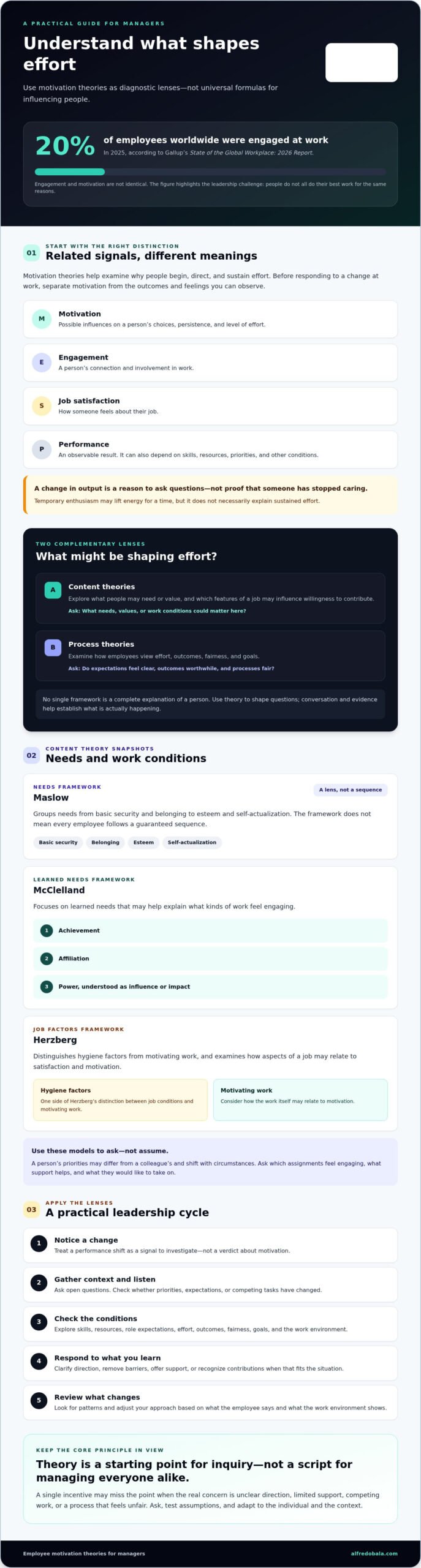
In 2025, only 20% of employees worldwide were engaged at work, according to Gallup’s State of the Global Workplace: 2026 Report. Engagement and motivation aren’t identical, but the figure underscores a real leadership challenge: people don’t all do their best work for the same reasons. Employee motivation theories for managers can help make sense of those differences, provided they’re used as tools for understanding rather than scripts for managing everyone alike.
If motivation advice has ever felt too generic, you’re right to question it. Rewards, pressure, and bursts of enthusiasm may influence behavior, but they don’t necessarily address what an employee needs to contribute consistently. Academic theories can also feel distant from the decisions managers face each day: how to give feedback, recognize effort, or respond when performance changes.
This guide makes leading theories practical. You’ll learn what each framework can help explain, how to assess workplace conditions before choosing a response, and how to adapt your approach to individual differences. From ideas about needs and job satisfaction to theories of expectations and fairness, the goal is a thoughtful, ethical way to support people and help them do their best work.
Key Takeaways
- Use employee motivation theories for managers as diagnostic lenses, not universal formulas for influencing people.
- Distinguish motivation from engagement, job satisfaction, performance, and short-lived enthusiasm before deciding what needs attention.
- Explore content theories to consider how needs and workplace conditions may shape motivation, without treating any framework as a rigid rule.
- Use process theories to examine how employees view effort, outcomes, fairness, and goals, then match your questions to the concern you observe.
- Build a practical leadership cycle: clarify expectations, listen, remove barriers, recognize contributions, and review what changes.
What Employee Motivation Theories Help Managers Understand
Start with a better question than “How do I motivate this person?” Ask what might be shaping their effort. Motivation theories are frameworks for examining why people begin, direct, and sustain effort at work. They help managers consider possible influences, from personal needs and work conditions to expectations about outcomes and perceptions of fairness. They don’t provide a universal formula or reveal an individual’s motives without discussion.
Motivation is also different from related workplace concepts. Satisfaction reflects how someone feels about their job; engagement describes their connection and involvement in work; performance is an observable result. Temporary enthusiasm may lift energy for a time, but it doesn’t necessarily explain sustained effort.
Motivation can influence effort, but it isn’t the same as the performance you observe. Results can also depend on skills, resources, priorities, and other conditions. A change in output is a reason to ask questions, not proof that someone has stopped caring.
What do employee motivation theories explain?
These frameworks help managers consider what may shape an employee’s choices, persistence, and level of effort. The overview of Work motivation theories brings together different approaches, including need-based and cognitive process theories. Each offers a different lens; none should be treated as a complete explanation of a person.
Imagine an employee who becomes less proactive after team priorities shift. A quick judgment might label them disengaged. A more useful inquiry checks whether expectations are unclear, competing tasks are crowding out the work, or the employee sees little value in the new direction. The theory helps shape the questions. Conversation and evidence help establish what’s actually happening.
Why should managers learn more than one theory?
The same performance concern can have very different causes. Someone may lack the skills or tools to meet an expectation, believe effort won’t lead to a valued outcome, perceive an unfair distribution of work, or struggle to see a task’s purpose. A single incentive may do little to address any of those conditions. It can miss the point if the real need is clearer direction, support, or a fairer process.
The value of learning multiple employee motivation theories for managers isn’t collecting labels. It’s building a disciplined way to test assumptions. Notice a change, gather context, ask open questions, and look for patterns before choosing a response. Treat theory as a starting point for investigation, then adjust your approach based on what the employee says and what the work environment shows.
Content Theories: How Needs and Work Conditions Shape Motivation
Content theories focus on what people may need or value, and which features of a job can influence their willingness to contribute. They offer useful starting points for exploring work conditions, not a checklist for sorting employees into fixed types. A person’s priorities may differ from a colleague’s and shift with circumstances. Treat each framework as a question to investigate rather than a conclusion.
Three familiar models provide complementary perspectives. Maslow and McClelland focus on possible human needs; Herzberg examines how aspects of a job may relate to satisfaction and motivation. Together, they help employee motivation theories for managers move beyond one-size-fits-all rewards. They don’t prove what any individual needs. Ask, listen, and consider the context.
Maslow and McClelland: understanding different needs
Maslow’s hierarchy groups needs from basic security and belonging to esteem and self-actualization. It’s a familiar framework, not a guaranteed sequence every employee follows. McClelland’s theory focuses on learned needs for achievement, affiliation, and power, with power understood as influence or impact. These ideas can prompt useful questions: Does the employee value challenging goals, close collaboration, or greater responsibility? Don’t infer the answer from behavior alone.
For example, someone who seeks ambitious targets may enjoy opportunities to master difficult work, but that preference doesn’t establish a fixed “achievement type.” Check directly: ask which assignments feel engaging, what support helps, and what they’d like to take on. Consider their answers alongside role expectations and available resources.
Herzberg: separate job conditions from motivating work
Herzberg distinguished hygiene factors, such as pay, workplace policies, relationships, and conditions, from motivators such as achievement, recognition, responsibility, and opportunities to grow. In this framework, problems with basic conditions may contribute to dissatisfaction, while improving them doesn’t automatically make the work meaningful. The distinction is a prompt for diagnosis, not a universal law about how every employee responds.
Sound conditions can ease dissatisfaction; meaningful responsibility may offer a different source of motivation. If an employee is frustrated by confusing procedures, clarifying them may remove a source of friction. It may not, by itself, make a repetitive assignment more engaging. Explore both questions: What is getting in the way, and what would make the work feel more worthwhile? Responses will vary.
Use the frameworks carefully. If someone raises concerns about security or belonging, explore whether the work environment supports those needs. If they want more challenge, discuss a suitable stretch assignment and the support it would require. If conditions feel unfair or disruptive, address those concerns before assuming a new reward will help. These theories offer different lenses, but employee preferences and workplace evidence should guide the next step.
Process Theories: Why Employees Choose to Invest Effort
Content theories ask what people may need or value. Process theories focus on how employees decide whether to act, how much effort to invest, and whether to keep going. They help managers examine the links employees perceive between effort, performance, outcomes, fairness, and goals. Use these models to explore a concern, not to assume you know what an employee is thinking.
Expectancy and equity: effort, outcomes, and fairness
Vroom’s expectancy theory describes motivation through three judgments: expectancy, the belief that effort can support performance; instrumentality, the belief that performance can lead to an outcome; and valence, how much the person values that outcome. If an employee doubts they have the tools to meet a target, or sees no connection between strong work and a valued outcome, extra pressure may not resolve the issue.
Adams’s equity theory centers on perceived fairness. Employees may compare their contributions and outcomes with those of colleagues or other reference points. Fairness doesn’t mean everyone must receive identical rewards; roles, responsibilities, and circumstances can differ. Ask how the arrangement looks from the employee’s perspective rather than assuming you know their assessment.
| Lens | Manager’s question | Possible concern |
|---|---|---|
| Expectancy | “Do you believe your effort can meet the performance expectation?” | Unclear priorities, limited capability, or missing resources |
| Equity | “Does the balance between your contribution and outcomes feel fair?” | A perceived imbalance in workload, recognition, or rewards |
These are different questions. An employee may believe they can do the work yet feel the outcome is unfair, or consider the reward fair but doubt that effort will lead to success. That distinction makes employee motivation theories for managers more useful in practice: investigate the specific link that may be weakening willingness to contribute.
Goal-setting theory: make direction actionable
Goal-setting theory examines how goals direct effort. Specific, challenging goals can provide clearer direction when employees understand the task, have suitable support, and are willing to commit. A broad instruction such as “improve service” gives less guidance than an agreed target with clear priorities and a way to check progress.
Goals need feedback, too. Regular conversations help employees understand what’s working, raise barriers, and adjust their approach. Commitment matters: invite employees into the discussion so expectations are understood and the goal feels achievable and relevant. If work is complex, priorities are changing, or results depend on other teams, break the goal into learning steps and revisit it as conditions shift. A target should guide effort, not punish people for factors outside their control.
How Managers Can Choose the Right Motivation Lens
Choose a framework to fit the concern, not because it’s your preferred theory. A reliable approach moves from observation to inquiry, then to a response you can review. This keeps employee motivation theories for managers practical and helps prevent a quick assumption from becoming a fixed judgment about someone’s attitude or personality.
- Define the concern. Describe the change you’ve observed, such as missed deadlines or less participation, without assigning a motive.
- Gather context. Ask the employee what’s changed and check relevant factors such as workload, priorities, resources, or dependencies.
- Select a lens. Choose the theory that helps you investigate the likely issue.
- Test a response. Agree on a manageable change with the employee.
- Review what happens. Discuss the result and account for other factors that may have influenced it.
Match the workplace problem to a useful theory
Start by asking whether the challenge involves capability, resources, recognition, fairness, purpose, or clarity. Unclear expectations point toward expectancy questions: Does the employee understand what’s required and believe they can meet it? Perceived unfairness calls for equity questions about how contributions and outcomes are viewed. Weak direction may call for clearer, agreed goals. Needs-based theories can prompt respectful questions about conditions, relationships, achievement, or meaningful work.
Consider an employee whose project progress has slowed. If priorities are unclear, ask what outcome they understand the team to be aiming for. If they know the target but lack access to needed resources, investigate that barrier instead. The visible problem may look the same, but the useful question changes with the evidence. Don’t assign a personality label based on one behavior.
Test a response and learn from the result
Turn the discussion into a small, practical experiment. Agree on a change, such as clarifying priorities or resolving a resource gap, and define together what progress would look like. Set a reasonable point to review it. Ask the employee whether the change helped and consider other influences, including shifting demands or decisions beyond their control. The result can inform your next step, but one intervention can’t prove a theory or guarantee better performance.
Keep the conversation open. If the response doesn’t help, revisit the diagnosis rather than blaming the employee or doubling down on the same tactic. That discipline is central to sound leadership: listen, adjust, and make decisions based on what you learn. For further perspective, explore Alfredo Bala’s leadership and team development insights.
Turn Motivation Theory into Everyday Leadership Practice
Theories become useful when they improve everyday leadership decisions. Build a steady cycle: clarify expectations, listen carefully, remove barriers, recognize contributions, and review what’s changing. This isn’t a formula for guaranteed results. It’s a disciplined way to respond to what an employee says and what the work requires.
Make the cycle fit the role and context. Autonomy may mean giving someone more choice in how they complete a task, as long as essential standards are met. Useful feedback connects observations to clear expectations and next steps. Fairness calls for transparent reasoning, while meaningful goals should reflect the employee’s responsibilities and the team’s priorities. Ask what would help rather than assuming the same approach will work for everyone.
Build a repeatable, ethical motivation conversation
Open with curiosity: “What’s helping you do this work well, and what’s making it harder?” Listen for practical barriers and for what the employee values. Agree on a specific next step together, such as clarifying a priority or adjusting how progress is checked. Preserve the employee’s agency and handle personal information with care. At the agreed review point, discuss what changed and revise the plan if circumstances have shifted.
- Clarify: Confirm the expected outcome and what matters most.
- Listen: Ask about support, obstacles, and the employee’s perspective.
- Act: Choose a practical adjustment and agree on what to review.
- Learn: Consider the outcome together, including factors beyond one person’s control.
This repeatable practice helps managers apply employee motivation theories for managers without turning them into labels or pressure tactics. It also creates room to notice whether expectations, resources, recognition, fairness, or the design of the work may need attention. A change in circumstances deserves a fresh conversation, not an automatic judgment about commitment.
Connect motivation theory with broader leadership learning
Strong motivation practices depend on the surrounding leadership environment, not just one manager’s response. For another perspective, explore The Motivation Equation leadership masterclass. Organizations considering how to strengthen leadership capability more broadly can also read about executive leadership development strategies.
Use these ideas as prompts for thoughtful action, then keep learning from your team’s experience. Alfredo Bala’s leadership resources offer additional perspectives on motivation and leadership practice.
Lead with Curiosity, Then Put Insight into Practice
The most useful employee motivation theories for managers aren’t ready-made answers. They’re lenses for exploring what may shape effort: needs, work conditions, expectations, fairness, and goals. Match the lens to the concern, then check your assumptions through observation and honest conversation.
Keep the practice simple and consistent. Clarify what success requires, listen for what helps or hinders, address practical barriers, recognize contributions, and review what changes. Adapt your approach to the person’s role and circumstances. A management response should be a thoughtful test, not a promise of guaranteed results.
Leadership experience can add perspective to that work. Alfredo Bala, a former CEO of Mannatech Inc. and COO of Britt World Wide, offers The Motivation Equation and leadership speaking as further resources for exploring motivation and leadership.
For more perspectives on motivation and leadership, explore Alfredo Bala’s leadership resources. Then bring the learning back to your team: ask better questions, make deliberate adjustments, and keep refining your practice. Progress begins with the willingness to understand what helps each person contribute.
Frequently Asked Questions
What are the main employee motivation theories managers should know?
Managers can start with Maslow’s needs framework, Herzberg’s distinction between job conditions and motivating factors, and McClelland’s learned needs for achievement, affiliation, and power. Process theories add another perspective: Vroom examines expectations and valued outcomes, Adams focuses on perceived fairness, and goal-setting theory considers how clear, challenging goals guide effort. These employee motivation theories for managers are best used as complementary lenses, not fixed explanations for individual behavior.
Which motivation theory is most useful for managers?
No single theory is most useful in every situation. The right choice depends on what you’re trying to understand. Vroom’s expectancy theory can help explore whether an employee believes effort can lead to performance and valued outcomes. Equity theory can prompt a discussion about perceived fairness, while goal-setting theory may help clarify direction. Start with the workplace concern, then choose the framework that helps you ask better questions.
How can managers apply motivation theories at work?
Apply a theory by using it to guide inquiry, not by assigning an employee a label. Describe the work concern, ask what may be helping or hindering progress, and consider expectations, resources, fairness, recognition, or purpose. Then agree on a practical next step with the employee and decide how you’ll review it. For example, if priorities are unclear, clarify the expected outcome before introducing a new reward or incentive.
Is Maslow’s hierarchy of needs still useful for managers?
Maslow’s hierarchy can still be useful as a broad framework for considering needs such as security, belonging, esteem, and personal growth. It shouldn’t be treated as a proven sequence that every employee follows in the same way. Use it to shape respectful questions about the work environment and what matters to someone. An employee’s priorities can vary by person and circumstance, so conversation is more reliable than assuming a need based on their role or behavior.
What is the difference between content and process motivation theories?
Content theories explore the needs or work factors that may influence motivation. Examples include Maslow’s needs framework, McClelland’s learned needs, and Herzberg’s focus on job conditions and motivators. Process theories examine how people evaluate effort, outcomes, fairness, and goals. Vroom’s expectancy theory and Adams’s equity theory are examples. Managers can use both perspectives: one to consider what may matter to an employee, and the other to explore how they assess a situation.
Can motivation theories improve employee performance?
Motivation theories can help managers identify conditions that may be affecting effort, such as unclear expectations, limited resources, or perceived unfairness. Addressing a relevant barrier may support an employee’s ability to do the work, but no theory or single management action guarantees a performance improvement. Results can also depend on skills, workload, tools, and factors outside an employee’s control. Treat any response as something to review collaboratively, not as proof that one theory explains everything.
How can managers motivate employees without relying only on rewards?
Start by making expectations clear and listening to what employees say about their work. Explore whether they have the resources and autonomy appropriate to their role, receive useful feedback, experience fair treatment, and understand the purpose of their goals. Recognition can acknowledge specific contributions without becoming a substitute for addressing workplace barriers. Ask what would help, agree on a practical action, and revisit the conversation as responsibilities or circumstances change.
 EN
EN  ES
ES
Recent Comments