
What if the most important part of a motivational speech begins after the applause? The message can feel powerful in the room, yet familiar routines quickly take over. Knowing what to do after a motivational speech to keep momentum means turning that energy into a specific action before the day moves on.
Inspiration can open the door to change, but lasting progress takes more than a memorable moment. People need clear commitments, leaders need to make follow-through possible, and teams need a way to see whether actions support shared priorities. Without those supports, good intentions can fade before they become new habits.
This article shows how to translate a speech’s ideas into practical next steps, build accountability that doesn’t depend on temporary enthusiasm, and review progress meaningfully. You’ll learn how to capture individual commitments while the message is fresh, establish regular check-ins, and connect personal actions to team goals. These leadership principles reflect the practical focus of Alfredo Bala’s work, including The Motivation Equation: motivation matters most when it becomes action.
Key Takeaways
- Turn one memorable idea into a clear action, assign responsibility, and share the commitment so it has a better chance of making it into the workday.
- Understand why inspiration alone may not change routines, and identify the practical support that helps people follow through.
- Choose a follow-up approach that fits the goal, whether that means personal reflection, manager check-ins, peer commitments, or team reviews.
- Use a 30-day action plan to set owners, reminders, and evidence of progress at each stage.
- Learn what to do after a motivational speech to keep momentum by connecting individual actions to team priorities and a broader leadership development strategy.
Post-Speech: Capture the Message Before It Fades
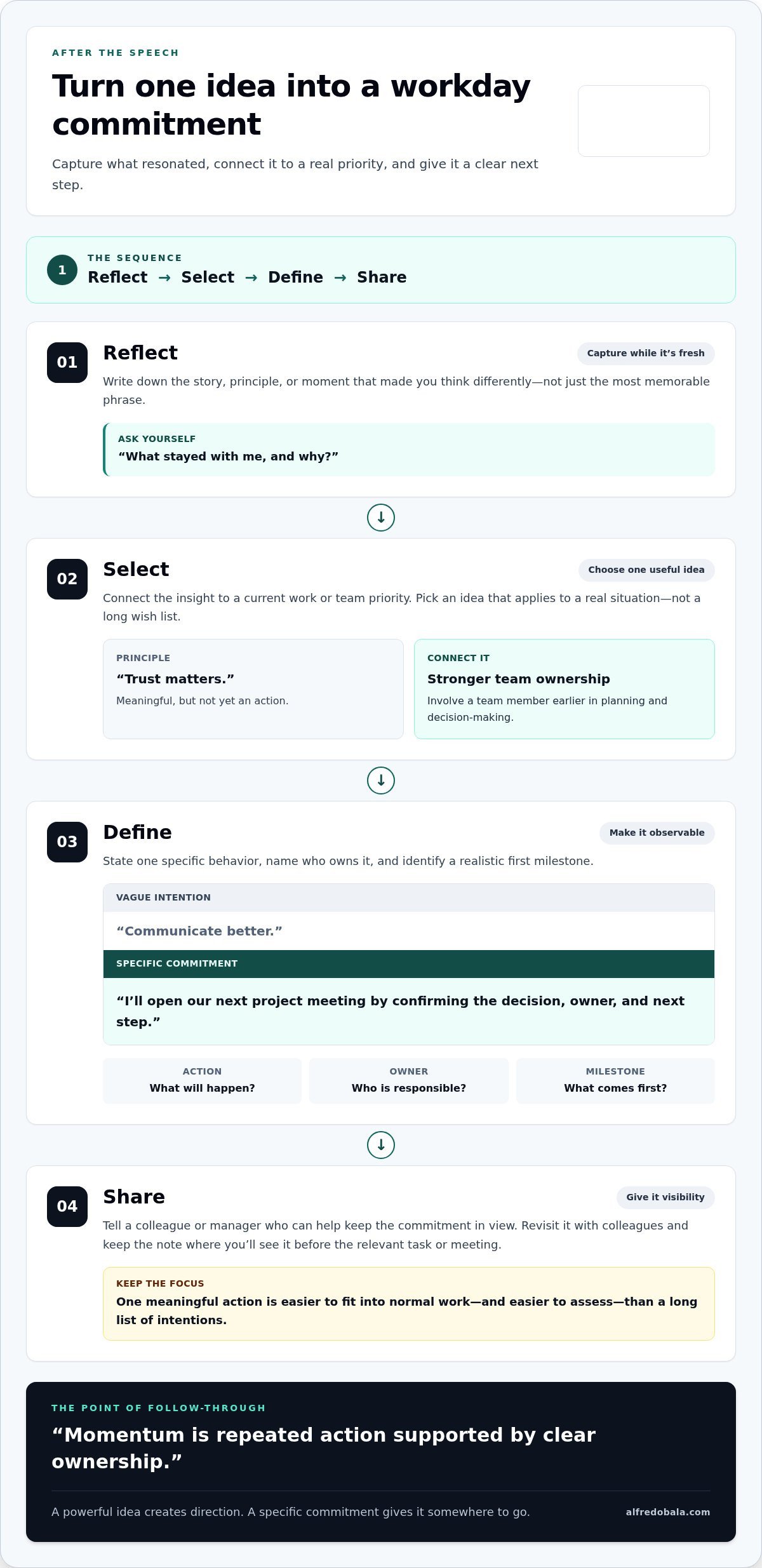
Leaving a speech energized is one thing. Acting differently at work is another. A full inbox, familiar habits, and competing priorities can quickly crowd out a good intention. To understand what to do after a motivational speech to keep momentum, take a few minutes while the message is still fresh: reflect, select one idea, define an action, and share it with someone who can help keep it visible.
Write before moving on to the next task. A brief note preserves what resonated with you, rather than only the speaker’s most memorable phrase. Capture the story, principle, or moment that prompted you to think differently. Then ask: which current leadership or team priority does this connect to? The link might be improving how decisions are communicated, giving clearer feedback, or helping a team take ownership of a shared goal.
Momentum is repeated action supported by clear ownership. A powerful idea creates direction; a specific commitment gives that direction somewhere to go.
Which idea from the speech deserves your attention first?
Choose an idea that applies to a real situation, not simply the line you’re most likely to remember. For example, “trust matters” is a meaningful principle, but it doesn’t yet tell you what to do. If your team priority is stronger ownership, the useful insight may be to involve a team member earlier in planning and decision-making. That connection turns inspiration into a relevant leadership choice.
How do you turn inspiration into a specific commitment?
Make the next behavior observable, name who owns it, and identify a realistic first milestone. Replace “communicate better” with “I’ll open our next project meeting by confirming the decision, owner, and next step.” This commitment is clear enough to act on and straightforward to revisit with colleagues.
Choose one meaningful action, not a long wish list. A focused commitment is easier to fit into normal work and easier to assess. As the principles behind Goal setting theory suggest, a defined goal can provide clearer direction than a broad intention.
- Reflect: Write down the speech moment or principle that stayed with you.
- Select: Connect that idea to a current work or team priority.
- Define: State one observable action, its owner, and the first milestone.
- Share: Tell a colleague or manager who can help keep the commitment in view.
Keep the note where you’ll see it before the relevant task or meeting. The goal isn’t to preserve the feeling of the speech forever. It’s to give its most useful idea a practical place in your work.
Why Motivation Fades After a Speech, and What Keeps the Message Active
A speech can sharpen intent without changing the conditions people return to. The next morning brings the same deadlines, meetings, habits, and systems. If the message isn’t connected to that daily reality, even a strong idea can lose priority. That doesn’t mean the speech had no value; it reflects the challenge of turning insight into practice.
Motivation can start action, while routines and accountability help sustain it. Follow-through needs reinforcement: reminders that keep the idea visible, leaders whose behavior supports it, and progress people can recognize. Without those supports, an intention can be pushed aside by the next urgent task.
What commonly interrupts post-speech follow-through?
Three obstacles often appear quickly: unclear ownership, overloaded calendars, and actions with no practical first step. “We should collaborate more” sounds positive, but it leaves the team unsure what to do, who should initiate it, or when. Even a willing attendee can struggle to act if the commitment competes with existing work and no time or process makes room for it.
Leadership behavior matters, too. If a speech emphasizes listening but managers dismiss concerns in meetings, the daily example can undermine the message. Leaders don’t need to repeat a keynote word for word. They do need to demonstrate its principle in decisions, conversations, and priorities. A missed follow-through is a signal to examine what the environment needs, not a reason to dismiss the original inspiration.
How do leaders keep the message connected to daily work?
Give the central idea a place in conversations the team already has. If the speech focused on ownership, leaders might ask, “Who owns the next step?” during project reviews. If it emphasized trust, managers can make space for people to raise concerns before decisions are finalized. Familiar language and existing routines help the message carry into real work without creating a disconnected initiative.
Then make progress visible. A brief check-in can surface what people have tried, what’s getting in the way, and where leadership can remove friction. Recognition should point to the behavior, not just the outcome. For example, acknowledge a team member who raised a risk early or clarified responsibility. These signals reinforce which actions matter and keep the idea active beyond the event.
For a broader perspective on how motivation connects with leadership and human performance, explore Alfredo Bala’s Motivation Equation leadership framework. The practical test is simple: can people see the speech’s central idea reflected in the priorities, conversations, and behaviors that shape their working day?
Compare Post-Speech Follow-Up Approaches: Personal Goals, Team Commitments, and Check-Ins
There’s no single follow-up format that fits every person or workplace. A personal goal can suit an individual skill, while a shared priority may need a team review. Choose the lightest approach that gives the commitment enough support to move forward. Often, the most practical answer to what to do after a motivational speech to keep momentum is to combine one personal action with a simple team touchpoint.
| Approach | Suitable situation | Strength | Limitation | Owner |
|---|---|---|---|---|
| Individual reflection and goal | A habit or leadership behavior one person controls | Builds personal ownership without adding meetings | Can stall if action depends on others | Individual |
| Manager-led check-in | A commitment needs guidance, resources, or prioritization | Lets a manager remove barriers and reinforce expectations | Can feel like extra oversight if it becomes a status report | Manager and participant |
| Peer commitment | Colleagues are developing similar skills or habits | Creates mutual encouragement and shared learning | May become performative if people feel pressured to report success | Peers together |
| Team progress review | The speech connects to a shared goal or coordinated behavior | Makes collective progress and obstacles visible | Needs a clear link to current priorities to avoid meeting overload | Team lead and team |
When is an individual commitment enough?
Use a personal commitment for an action within the attendee’s control, such as preparing a clearer agenda or asking for feedback after a presentation. A written goal and brief self-review can support ownership without adding another meeting. But if progress depends on a manager’s decision, a colleague’s contribution, or a change in team process, identify that dependency and involve the right person in the follow-up.
When should leaders use team check-ins or peer accountability?
Choose a team review when people need to coordinate around a shared priority. Use peer accountability for support and honest learning, not public pressure. Colleagues might agree to exchange brief updates on what they tried and what they learned. Keep either format focused on useful action and connected to work already underway. For a wider view, explore these executive leadership development strategies.
A balanced approach keeps responsibility clear without making follow-through feel like surveillance: individuals own their next step, while leaders create space to raise obstacles and recognize progress. For more leadership insights from Alfredo Bala, visit Alfredo Bala’s leadership insights.
Build a 30-Day Action Plan After a Motivational Speech
A clear plan gives inspiration a place in the workday. Break follow-through into four phases, each with an owner, a practical action, a reminder, and visible evidence. The aim isn’t perfect execution. It’s to create a structure that helps people act, notice obstacles, and learn what to adjust.
| Phase | Owner | Action | Reminder | Evidence of progress |
|---|---|---|---|---|
| Immediate reflection | Each participant | Record one relevant idea and choose an action tied to a current priority | Personal note or calendar prompt | A written commitment with a first step |
| First week | Participant and relevant manager or partner | Start the action and identify any barriers | Existing meeting or workflow | Action attempted, with obstacles noted |
| Recurring reinforcement | Manager, peer, or team lead | Check progress, offer support, and recognize useful behavior | Regular check-in or team review | Updates on actions taken and lessons learned |
| 30-day review | Participant and relevant team lead | Review what happened and decide what comes next | Scheduled review point | Decision to continue, refine, or retire the commitment |
Progress is easier to sustain when actions have owners and review points. This structure makes responsibility clear without turning follow-through into a test of personal worth.
What should happen in the first week after the speech?
Ask each participant to select one action and share it with the manager or accountability partner who can support it. Leaders can reinforce the commitment by connecting it to an existing meeting, workflow, or team priority, rather than adding a disconnected initiative. Use the first check-in to surface obstacles early. If a new behavior is difficult to apply, agree on a practical response, such as clarifying decision rights or adjusting the sequence of work.
How should leaders review progress after 30 days?
Review what people tried, what got in the way, and what they learned. Look for evidence of useful behavior, such as clearer handoffs, more consistent feedback, or earlier discussion of risks. Avoid claiming broader results unless they’ve been measured. Then decide whether each commitment still matters: continue it if it’s useful, refine it if the approach needs adjusting, or retire it if priorities have changed.
Use the review to set the next step, not to judge imperfect execution. For more guidance on connecting leadership ideas to workplace action, explore Alfredo Bala’s leadership insights.
Make the Speech Part of a Larger Leadership Development Strategy
A keynote can be a powerful catalyst, but it shouldn’t be expected to carry an entire development strategy on its own. One speech may introduce a shared idea, clarify a challenge, or give a team a common language. Ongoing leadership work is also needed when people must build new skills, change established habits, or address barriers in how work gets done.
The difference is the distance between understanding an idea and applying it consistently. If leaders leave with a clear principle they can put into practice immediately, a focused follow-through action may be sufficient. If progress requires repeated practice, feedback, or changes to team processes, connect the speech to those supports. That’s a more sustainable answer to what to do after a motivational speech to keep momentum: make the message part of how the organization develops people and advances priorities.
How can organizations connect a keynote to ongoing development?
Start with the leadership behavior or team goal already in focus. If the organization is working to strengthen accountability, for instance, connect the speech’s theme to how leaders clarify owners, discuss obstacles, and review commitments. Avoid creating an unrelated initiative simply because the event has ended.
Build reflection into discussions that already happen. Managers can ask what participants have applied, where they encountered friction, and what they learned from trying a new approach. These conversations give leaders a chance to reinforce useful behavior and address obstacles while keeping the work tied to organizational priorities. The keynote sets direction; everyday practice gives that direction staying power.
What support can help leaders sustain momentum?
Professional speaking and leadership insights can help frame a shared challenge and give teams a useful starting point for discussion. The next step is to translate that direction into expectations, practice, and reflection that fit the organization’s needs. Alfredo Bala brings together professional speaking and leadership development insights, while The Motivation Equation offers a resource for readers exploring the connection between motivation and leadership.
Keep the next move clear. Choose one follow-through action your team can begin, assign an owner, and connect it to an existing priority. If you’re shaping a broader development approach, explore Alfredo Bala’s leadership insights. The speech may spark the shift; leadership makes room for it to take hold.
Carry the Message Into the Work Ahead
A motivational speech creates an opening, but follow-through turns its ideas into progress. Capture the insight that matters, translate it into one clear commitment, and connect that action to a team priority. Then use suitable check-ins and a 30-day review to recognize learning, address barriers, and decide what to do next.
That’s the practical answer to what to do after a motivational speech to keep momentum: give each action an owner, make progress visible, and reinforce the behaviors that support shared goals. The approach can be simple, but it needs to fit the realities of people’s work.
Alfredo Bala brings leadership and executive experience, including serving as CEO of Mannatech Inc. and COO of Britt World Wide. As the author of The Motivation Equation, he also shares professional speaking and leadership development insights. Explore Alfredo Bala’s leadership insights to support your next step.
Choose one action today. Small, deliberate steps can turn a moment of inspiration into progress your team can build on. To bring leadership insights to your organization, explore Alfredo Bala’s professional speaking and executive advisory work.
Frequently Asked Questions
What should you do immediately after a motivational speech?
Write down the idea that matters most, then turn it into one specific action you can take. Name the owner, first step, and a time to review progress. If the action depends on others, share the commitment with the relevant person or team. This is a practical first step in deciding what to do after a motivational speech to keep momentum, because it makes the idea concrete while it’s still fresh.
How do you keep a team motivated after a motivational speech?
Connect the speech’s message to a team priority and agree on a few observable actions. Assign clear owners, then revisit progress in a meeting the team already has. Leaders should model the behaviors they’re asking for, recognize useful progress, and help address obstacles. The aim isn’t to keep everyone feeling excited all the time. It’s to make the message part of consistent work habits and shared responsibility.
How long does motivation from a speech last?
There’s no fixed duration that applies to every person or team. The initial emotional lift may shift as people return to regular demands, while follow-through depends on clear actions, leadership support, and opportunities to apply the message. Treat the speech as a starting point rather than a guarantee of lasting change. Timely action and relevant check-ins can help keep its most useful ideas connected to everyday work.
What if employees lose motivation after a keynote?
Start by asking what made follow-through difficult instead of assuming people are unwilling to change. Check whether the action was clear and achievable, and whether employees had the time, authority, and resources to act. Invite the team to identify barriers, then agree on a practical adjustment. A useful follow-up turns obstacles into decisions and support. Simply repeating the speech’s message more loudly won’t resolve a blocked workflow or unclear responsibility.
How can you measure whether a motivational speech made a difference?
Begin with the outcomes the event was intended to support, such as specific commitments, leadership behaviors, or team conversations. Record a starting point where it makes sense, then review progress at an agreed interval. Combine observable signs, such as actions completed, with participant feedback about what helped or hindered application. Avoid attributing every change to one speech. Use what you learn to refine follow-up and future development efforts.
Should leaders schedule a follow-up meeting after a motivational speech?
Schedule a follow-up when there’s a clear purpose, such as sharing commitments, addressing barriers, or reviewing progress. It doesn’t have to be a new, large meeting. Leaders can often use an existing team conversation, provided participants know what to bring and how the discussion will inform decisions. Keep the check-in focused on support and action. If it only creates reporting without helping people move forward, reconsider its format.
How can a motivational speech lead to lasting behavior change?
Treat the speech as one part of a broader development process. Participants need relevant actions to practise, leaders who reinforce useful behaviors, and opportunities to learn from setbacks. Connect new behaviors to existing priorities, then review progress at sensible intervals. For example, if the message emphasizes accountability, leaders can clarify owners during project discussions and revisit commitments. Change is more likely to take hold when daily routines support the message after the event.
 EN
EN  ES
ES
Recent Comments