
A performance problem is rarely solved by starting with a warning. If you’re asking how to handle underperforming employees, you may already feel the tension: results need to improve, but a blunt conversation could damage trust, and acting before you understand the cause may be unfair. That concern is sound. The same missed deadline can stem from unclear expectations, a skills gap, waning motivation, or workplace conditions that make good work difficult. Treating every cause as a lack of effort can mean missing the real issue.
This guide will help you diagnose what’s behind the performance gap, prepare for a direct and constructive conversation, and agree on specific expectations, support, and follow-up measures. You’ll learn how to track progress without turning every check-in into a confrontation, and how to make a timely, fair decision if improvement doesn’t follow. The practical path is to establish the facts, listen before you conclude, set measurable next steps, and apply them consistently. Performance conversations can be firm without being adversarial, and supportive without avoiding accountability.
Key Takeaways
- Define underperformance by comparing agreed expectations with a sustained pattern of work, not a single setback or a personality label.
- Before deciding how to handle underperforming employees, examine role clarity, capability, resources, motivation, and possible external barriers.
- Match your response to the cause: coaching, targeted training, or workload changes may be more appropriate than a formal improvement plan.
- Build a constructive conversation around specific examples, the employee’s perspective, clear expectations, agreed support, and a review date.
- If performance remains below expectations, assess the evidence and support provided, then follow your organization’s established process for next steps.
How to Handle Underperforming Employees Without Starting With Blame
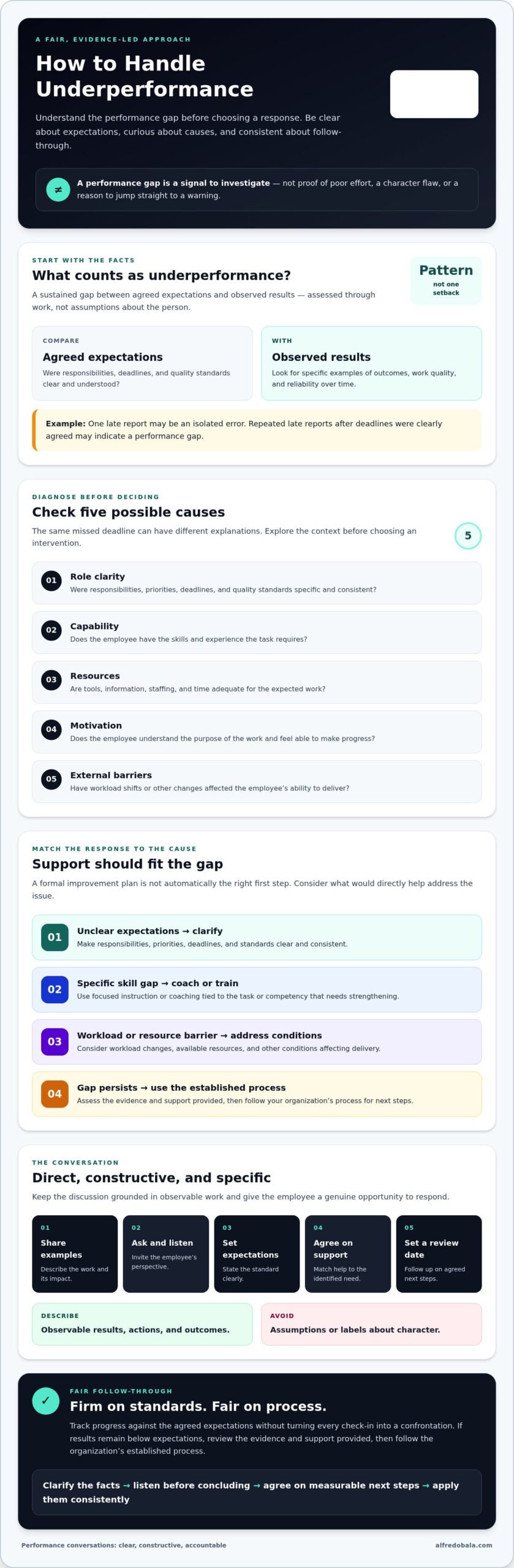
Start with the work, not a judgment about the person. Underperformance means a sustained gap between agreed expectations and observed results. That distinction matters when deciding how to handle underperforming employees: a missed deadline may deserve a conversation, but one delay alone doesn’t establish a pattern. Check what was expected, whether the employee understood it, and whether similar gaps have continued. A fair assessment begins with evidence, not frustration.
What counts as employee underperformance?
Look at role-specific expectations, such as measurable outcomes, the quality of completed work, and reliability in meeting commitments. Compare actual results with clear standards and consider them over enough time to see whether a pattern exists. For example, one late report may be an isolated error; repeated late reports after deadlines were clearly agreed may signal a performance gap. Before drawing a conclusion, verify that the expectations were communicated and understood.
Keep performance management distinct from discipline. The first focuses on clarifying the gap and addressing what may help close it; disciplinary steps follow an organization’s own policies and processes. Those procedures vary, so don’t assume a single approach fits every workplace. Performance improvement is commonly treated as a systematic process, rather than a reaction to one disappointing result. That perspective helps managers assess the situation before choosing a response.
Why a fair response starts with context
Results don’t happen in isolation. Priorities may have shifted, resources may be limited, or a heavier workload may have changed what the employee could reasonably complete. Ask open questions and listen carefully. Respectful curiosity isn’t an excuse for unmet expectations; it helps establish the facts before you decide what support or accountability is appropriate.
Then make the standard clear and invite a response. Share specific examples, explain the impact on the work or team, and ask what may be contributing to the gap. The employee may identify a barrier you hadn’t considered, or confirm that expectations were understood but not met. Either way, accountability means setting clear standards while giving the employee a genuine opportunity to respond. Keep the conversation focused on actions and outcomes, not assumptions about character.
Observable results describe the work; assumptions about character judge the person. That principle keeps feedback precise and gives both manager and employee a more productive starting point for the next conversation.
Diagnose Why an Employee Is Underperforming Before Choosing a Response
Before deciding how to handle underperforming employees, identify what may be driving the gap. The same result can have different causes: missed deadlines might point to competing priorities, an unfamiliar task, insufficient tools, or disengagement. Compare agreed expectations with examples of the work, the conditions in which it was done, and the employee’s perspective. Don’t treat low motivation as the default explanation; consider it alongside other possibilities.
A performance gap is a signal to investigate, not a diagnosis that tells you which intervention to choose. Use five lenses to guide that investigation:
- Role clarity: Were responsibilities, priorities, deadlines, and quality standards specific and consistent?
- Capability: Does the employee have the skills and experience the task requires?
- Resources: Are tools, information, staffing, and time adequate for the expected work?
- Motivation: Does the employee understand the purpose of the work and feel able to make progress?
- External barriers: Have workload shifts or other changes affected their ability to deliver?
Is the gap caused by unclear expectations or limited capability?
Check the assignment itself before judging the result. If two managers gave conflicting priorities, or the quality standard was never explained, the employee may not have had a fair target. If the standard was clear, look for a specific skill or training gap. For instance, repeated errors in a new reporting process may call for focused instruction, not a general warning. Match support to the competency or task that needs strengthening.
Could motivation, feedback, or working conditions be affecting results?
Ask open questions: “What’s making this work difficult?” “Which priorities are competing for your time?” “What would help you feel more confident about the next step?” Listen for obstacles, changes at work, and concerns about the goal. Consider whether your feedback has been timely, actionable, and tied to agreed expectations. This conversation can surface a solvable barrier while keeping clear what needs to improve.
The Fair Work Ombudsman’s best practice guide for managing underperformance offers further guidance on feedback, training, and review processes. For a leadership perspective on motivation, Alfredo Bala’s The Motivation Equation explores practical frameworks for motivation and leadership. His leadership and team development insights also address how individual performance connects to wider team outcomes.
Choose the Right Response: Coaching, Training, or a Formal Improvement Plan
Once you have a clearer view of the cause, choose a response that addresses it directly. A skill gap calls for a different intervention than an overloaded schedule or a need for clearer problem-solving. Knowing how to handle underperforming employees means pairing appropriate support with clear accountability: define what needs to change, agree on how progress will be assessed, and set a review date.
| Response | Likely use | Manager action and follow-up |
|---|---|---|
| Coaching | The employee needs clearer thinking, feedback, or a structured way to solve a work problem. | Explore options together; review progress against an agreed work outcome. |
| Targeted training | Evidence points to a specific knowledge or skill gap. | Arrange relevant instruction or practice; assess the quality of the next comparable task. |
| Workload changes | Competing priorities or capacity constraints are affecting delivery. | Clarify priorities or adjust assignments; check whether agreed deadlines are met. |
| Formal improvement plan | A documented process is appropriate under company policy and HR guidance. | Record the gap, expectations, support, and review points; assess progress against stated measures. |
When should a manager use coaching or training?
Use coaching when an employee understands the task but needs help working through priorities, decisions, or obstacles. Ask focused questions, offer specific feedback, and agree on an action the employee can apply to their work. Training fits when there’s a defined capability gap, such as difficulty using a required process. Make the measure observable: for example, assess whether the next set of reports follows the agreed quality standard.
Don’t overlook workload changes. If a new assignment has displaced existing priorities, clarify what takes precedence before judging missed deadlines. Support and accountability can work together: the manager provides the agreed help, while the employee remains responsible for meeting clear expectations.
When should a performance improvement plan be considered?
A performance improvement plan (PIP) is a formal, documented process for setting out the gap, required expectations, available support, and review points. It isn’t a universal template or a guaranteed route to a particular outcome. Before starting one, consult HR and follow your organization’s policies. Keep measures specific to the role, and make review dates clear so both parties understand how progress will be assessed.
If the employee’s view of their performance differs sharply from yours, prepare concrete examples and keep the discussion focused on observable work. Harvard Business Review’s Managing an Underperformer Who Thinks They’re Doing Great offers perspective on that challenging conversation. Alfredo Bala’s leadership and team development insights offer another resource for leaders thinking about performance and team development.
How to Discuss Poor Performance and Agree on Measurable Next Steps
A constructive performance conversation is direct, specific, and designed to move the work forward. Keep the focus on observable results rather than labels such as “careless” or “uncommitted.” For example, describe which report was submitted late, the agreed deadline, and the effect on the next step of the project. Then invite the employee to explain what happened. This approach makes the gap clear without turning the discussion into a judgment of character.
How do you prepare for a performance conversation?
Prepare before you meet. Gather relevant examples, the standards or goals previously agreed, and any prior feedback. Stick to information you can verify rather than hearsay. Choose a private setting and allow enough time for both people to speak. Plan open questions that invite context while keeping the performance concern explicit.
You might open with: “I’d like to talk about the last two project updates. They were submitted after the agreed deadlines, which affected the team’s planning. I want to understand what got in the way and agree on how we can get future updates in on time.”
How should expectations and follow-up be documented?
Use a clear sequence to turn the discussion into an agreed plan:
- Prepare evidence. Bring specific examples and the relevant expectation.
- Invite the employee’s perspective. Ask what contributed to the gap and listen for useful context.
- Clarify the expected result. Define what successful work looks like in observable terms.
- Agree on support and ownership. Record what the manager will provide and what the employee will do.
- Set a review date. Decide when you’ll check progress and how you’ll assess it.
After the meeting, document the agreed actions, owners, support, measures, and review date in line with company policy. Be practical: an expectation such as “improve communication” is hard to assess, while “send the project update by the agreed time on each scheduled reporting day” is observable. Make sure timelines are realistic and confirm that both parties understand the record. A written summary supports consistency; it shouldn’t replace regular, two-way follow-up.
For a broader leadership perspective on motivating people and developing teams, explore Alfredo Bala’s leadership insights.
What to Do When Underperformance Continues After Support
When agreed support hasn’t closed the performance gap, pause before choosing the next step. Review the evidence against the measures and timeframe you agreed, what support was actually provided, and what the employee has shared about progress or remaining obstacles. This helps you make a decision based on the full record, not disappointment or assumptions. It also gives the employee a clear opportunity to understand how the review reached its conclusions.
How can a manager tell whether performance is improving?
Compare current work with the specific expectations you set. Look for meaningful progress as well as remaining gaps. If the goal was to submit complete reports by the agreed deadline, for example, assess both timeliness and completeness rather than relying on a general impression that things are “better.” Recognize genuine improvement, then identify precisely what still falls short.
Make the review a two-way conversation. Ask which support has helped, what still feels difficult, and whether any new barriers have emerged. A stronger result in one area may show that an intervention is working, even if another measure still needs attention. Use that information to decide whether a focused development conversation could address the remaining gap or whether the matter needs to move into a more formal process.
When should a leader involve HR or consider further action?
Involve HR if performance remains below expectations or you’re considering formal action. Review the organization’s process together and confirm that expectations, support, feedback, and follow-up have been handled consistently. Don’t treat escalation as automatic, but don’t let uncertainty prolong a situation without a clear decision. If the next step raises legal questions, employment requirements vary by location, so seek qualified local advice rather than relying on a general guide.
A renewed development conversation is appropriate when there’s a reasonable path forward, such as refining priorities or continuing targeted support, and the employee is engaging with the agreed steps. Escalation may be appropriate when the gap persists despite support, or when organizational policy calls for formal review. In either case, explain the basis for the decision, document it according to company policy, and communicate what happens next. Consistency supports trust across the team as well as clarity for the individual.
Learning how to handle underperforming employees is an ongoing leadership discipline. A fair process combines clear standards with careful listening, reliable follow-through, and timely decisions. For further perspective on leading people and teams, explore Alfredo Bala’s leadership insights.
Lead the Next Performance Conversation with Clarity
Strong leadership starts with a disciplined response: define the performance gap using observable evidence, investigate its likely causes, and match support to what the employee needs. Then make expectations, responsibilities, and review points clear. If progress remains below the agreed standard, assess the record fairly and follow your organization’s process, involving HR when appropriate.
That’s the practical foundation for how to handle underperforming employees without defaulting to blame or avoiding accountability. A thoughtful conversation can support the individual while protecting the team’s ability to deliver. The aim isn’t to promise a particular outcome; it’s to make the next step clear, consistent, and fair.
Alfredo Bala brings leadership experience shaped by his time as CEO of Mannatech Inc. and COO of Britt World Wide, and his work in the networking profession since 1980. He is also the author of The Motivation Equation, a book focused on motivation and leadership. Explore Alfredo Bala’s leadership insights for further perspective as you strengthen your approach. Lead with clarity, listen with purpose, and give people a fair opportunity to move forward.
Frequently Asked Questions
How do you handle an underperforming employee for the first time?
Start with a private, fact-based conversation about the specific work gap. Prepare examples, compare them with the agreed expectations, and ask the employee what may be affecting their results. Listen before settling on a cause, then clarify what needs to change and what support may help. Agree on an observable measure and a follow-up date, and document the discussion according to your organization’s process. Keep the tone respectful, but don’t leave expectations ambiguous.
What should you say to an employee who is not meeting expectations?
Describe what happened, the standard that was agreed, and the impact, without using labels about the employee’s character. For example: “The last two weekly reports arrived after the agreed deadline, which delayed the team’s review. What’s getting in the way, and what would help you meet the next deadline?” This keeps the concern explicit while inviting useful context. Close by confirming the expected result, any support, and when you’ll review progress.
How can you tell whether poor performance is caused by lack of skill or motivation?
Look for evidence and ask questions rather than assuming motivation is the issue. A skill gap may show up as repeated errors on a specific task, uncertainty about a process, or difficulty applying training. Explore whether the employee has clear priorities, enough time and tools, and timely feedback. Ask what feels difficult and what support would help. Their responses, alongside work examples, can guide whether to try targeted training, coaching, or another change.
Should you put an underperforming employee on a performance improvement plan?
Not automatically. A performance improvement plan may be appropriate when a documented process is needed to clarify the performance gap, required outcomes, support, and review points. First check your organization’s policy and consult HR about whether a formal plan fits the situation. Coaching, training, or changes to workload may better address some causes. A plan isn’t a one-size-fits-all template or a promise of a particular outcome, so keep its expectations role-specific and follow internal guidance.
How long should you give an employee to improve their performance?
Set a review period that fits the role, the gap, and the opportunity to demonstrate improvement. A task performed daily may provide evidence sooner than work completed only at longer intervals. Define the expected results, support, and review date in advance, and follow company policy and HR guidance. Avoid choosing an arbitrary deadline or extending one without a clear reason. If formal action is being considered, get HR input and check any applicable local requirements.
What happens if an employee does not improve after coaching?
Review the agreed measures and timeframe, the coaching and other support provided, the employee’s input, and the performance gap that remains. If there’s progress, consider whether focused development or a revised support plan is appropriate. If expectations still aren’t met, consult HR and follow the organization’s established process for further action. Document the evidence and decision consistently. Employment requirements vary by location, so seek qualified local advice if legal questions arise.
How do you address underperformance without damaging trust?
Build trust through clarity, consistency, and respect, not by avoiding a difficult conversation. Raise concerns privately, use specific examples, explain the impact, and give the employee a genuine chance to share their perspective. Be clear about what needs to change and what support you’ll provide, then follow through on agreed check-ins. Avoid personal judgments and surprises. Fair, steady communication shows that accountability is about the work and that the employee is being treated thoughtfully.
 EN
EN  ES
ES
Recent Comments