
What if the most important learning in your organization happened between training sessions? Leaders often invest in courses, yet employees return to the same routines because learning has little room in the daily work. Creating a culture of continuous learning means making practice, reflection, and asking questions part of how the team gets results.
You already know that skills matter. The challenge is giving people the time, confidence, and permission to build them while meeting business priorities. Learning takes root when leaders model curiosity, treat mistakes as opportunities to improve, and make feedback useful rather than threatening.
This guide offers a practical sequence for weaving learning into everyday work, from identifying the capabilities your priorities demand to supporting peer coaching, reflection, and on-the-job practice. You’ll also see how managers can make development safer and more consistent, and how to spot progress through changes in behavior and performance rather than course-completion figures alone. The goal isn’t more training for its own sake. It’s a team that keeps learning, adapting, and applying what it learns.
Key Takeaways
- Recognize the everyday habits that distinguish a learning culture from a calendar of training sessions.
- Make it safer for employees to ask questions, share feedback, and learn from mistakes.
- Focus creating a culture of continuous learning on a real capability gap or business priority.
- Use a four-step roadmap to diagnose needs, set priorities, build learning routines, and review application.
- Look beyond participation and course completion to see whether people are applying skills and changing how they work.
What Creating a Culture of Continuous Learning Means at Work
Continuous learning at work is the shared practice of developing, testing, and applying knowledge as part of ordinary work. It isn’t a course library employees are expected to explore in their spare time or a workshop that ends when people return to their desks. It’s a pattern: teams ask questions, exchange feedback, reflect on results, and use what they learn in the next task.
Formal training still has a place. Courses can introduce concepts, provide structure, and support required instruction. But access to learning materials alone doesn’t make development a workplace habit. The difference is what happens afterward: whether managers invite people to try a new approach, make time to discuss what worked, and help turn insight into practice.
This distinction matters because work rarely stays still. Teams face changing priorities, new tools, and unfamiliar problems. A learning culture can help employees build the adaptability to respond thoughtfully, though it can’t guarantee a particular business outcome. The idea connects with the broader concept of a learning organization, where learning is treated as an ongoing capability rather than a one-off event.
How Is a Learning Culture Different from Employee Training?
Training is usually scheduled instruction; a learning culture extends into the work that follows. Imagine a team reviewing a completed project and finding that handoffs caused confusion. A workshop might teach clearer documentation. Learning becomes part of the culture when the team tests that skill on its next project, checks whether the handoff improved, and adjusts its approach together. Practice, reflection, and application make the lesson useful.
Why Does Continuous Learning Depend on Leadership?
Employees pay close attention to leadership behavior. If a manager welcomes questions, responds constructively to mistakes, and makes time to build skills, learning feels legitimate. If every deadline crowds out reflection, people receive a different message, regardless of what a training portal promises. Leaders set the conditions through their priorities and example. For a wider view of how leadership habits shape organizational capability, explore these executive leadership development strategies.
Creating a culture of continuous learning therefore takes more than offering instruction. Leaders need to connect development to meaningful work and reinforce that connection in everyday decisions. What gets discussed, practiced, and supported signals what the organization truly values. That’s the foundation for learning that can adapt as the work changes.
The Conditions That Help Continuous Learning Become a Habit
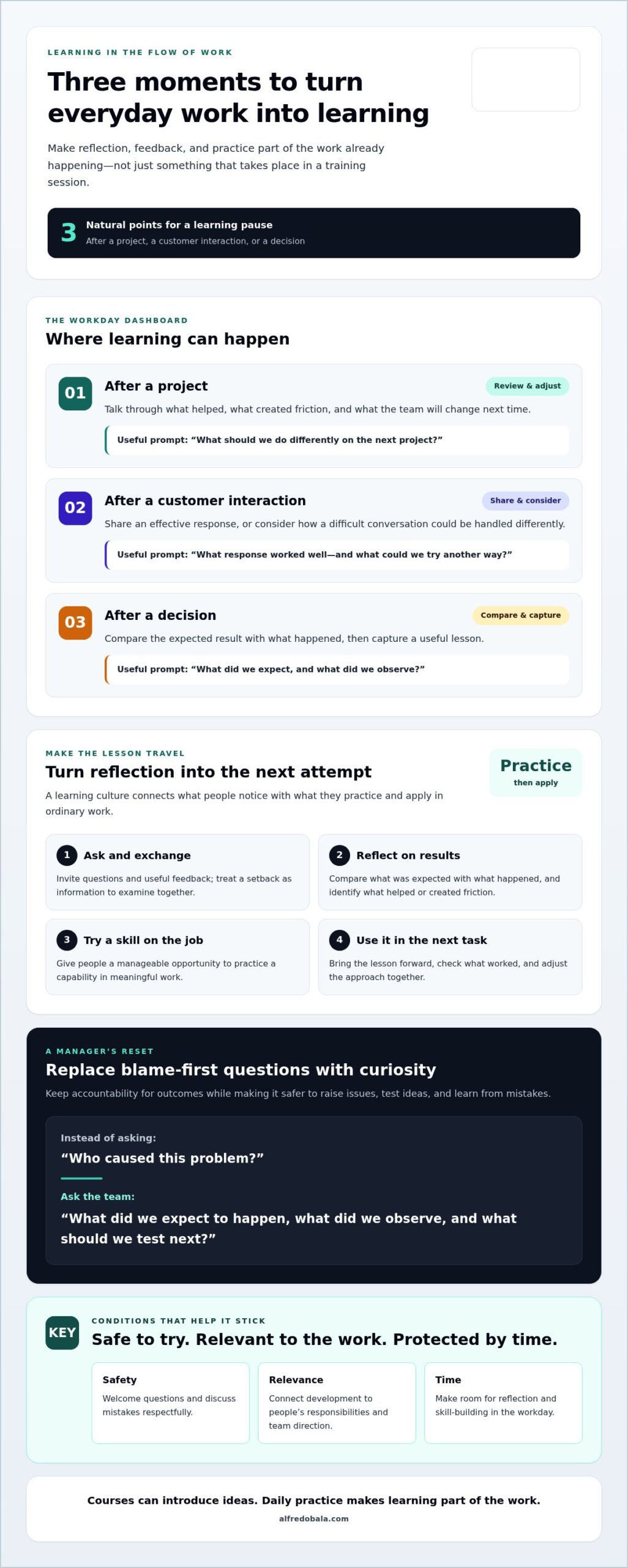
People are more willing to learn when they can speak up without being mocked, dismissed, or punished for not already knowing the answer. Psychological safety doesn’t mean lowering standards or ignoring mistakes. It means making it possible to raise a concern, test an idea, and discuss what went wrong respectfully. Pair that trust with clear priorities and protected time, and learning becomes something employees can act on, not another expectation squeezed into an already full day.
Make learning safe to try, relevant to the work, and protected by time.
How Can Managers Make Learning Safe and Relevant?
Lead with curiosity. Instead of asking, “Who caused this problem?” ask, “What did we expect to happen, what did we observe, and what should we test next?” The team remains accountable for outcomes, but a setback becomes information to examine rather than a reason to assign blame. That distinction can help employees raise issues earlier and learn from them together.
Make development specific to each person’s responsibilities and the team’s direction. A manager might connect a current project to a capability the employee will need for a future role, then agree on a manageable opportunity to practise it. Follow up with timely, direct feedback: name what worked, identify what could improve, and invite the employee’s perspective. Managers also set the tone by sharing what they’re learning and acknowledging when they need to revise an assumption.
Where Can Learning Fit into the Flow of Work?
Learning doesn’t always require a separate program. Build brief reflection into moments the team already has:
- After a project: Discuss what helped, what created friction, and what the team will change next time.
- After a customer interaction: Share an effective response or consider how a difficult conversation could be handled differently.
- After a decision: Compare the expected result with what happened and capture a useful lesson.
Peer demonstrations can make practical knowledge easier to share. Invite a team member to walk colleagues through a process, explain a useful technique, or show how they approached a challenge. Keep the exchange focused on skills others can adapt, not on delivering a polished presentation.
Digital tools can make resources easier to find, but access alone won’t create the conditions for learning. Managers reinforce the habit by making time, recognizing thoughtful questions, and revisiting lessons in later work. For more perspectives on motivation and team growth, explore leadership and team development insights. When leaders coach, model curiosity, and connect development to real responsibilities, creating a culture of continuous learning becomes a shared practice rather than an individual burden.
Why Courses Alone Do Not Create a Continuous Learning Culture
Training can give people useful knowledge, but learning doesn’t have to compete with work. The stronger approach is to connect instruction to a real task, then make space to practise, receive feedback, and apply the skill where it matters. A course is a starting point. The workplace is where people find out whether they can use what they’ve learned and what support they still need.
Picture an employee completing a course on delegating effectively. If their manager never discusses how to assign work, gives no opportunity to practise, and offers no feedback, the learning may stay theoretical. If the manager helps them plan an upcoming delegation and checks in afterward, the new knowledge has a route into daily behavior. That’s the difference between providing content and supporting skill transfer.
Is More Training Enough to Build a Learning Culture?
No. Attendance and completion show that someone took part, not that they can apply a skill consistently. Learning technology can make resources easier to access and organize, but it’s one tool among several. Managers still need to coach, teams need opportunities to practise, and people need useful feedback on how their approach is working. Without those connections, adding courses can increase activity without changing how work gets done.
For leaders creating a culture of continuous learning, the key question isn’t only, “What training should we offer?” Ask, “Where will people use this, and who will help them improve?” Make application visible: agree on a behavior to try, identify a relevant work situation, and schedule a follow-up conversation. This turns learning from a separate obligation into support for the work already underway.
What Common Barriers Cause Learning Efforts to Stall?
Three barriers often interrupt the path from insight to action:
- Time pressure: When urgent tasks always take priority, development is postponed. Protecting space to practise signals that learning is part of the job.
- Fear of mistakes: If people expect blame for every misstep, they may avoid asking questions or testing a new approach. Hold employees accountable for their responsibilities while examining setbacks for useful lessons.
- Generic goals: Broad development themes can feel distant from a team’s real challenges. Tie learning to a specific responsibility, skill gap, or upcoming demand so employees can see its relevance.
Address the barrier, not just the training plan. A platform can host a course, but it can’t create protected time or make a manager’s response feel safe. Sustainable learning depends on relevant goals, practice opportunities, coaching, and leadership follow-through. No single course, tool, or initiative can transform the culture by itself.
How to Create a Culture of Continuous Learning: A Practical Roadmap
Start with a real work challenge, not a broad campaign. Creating a culture of continuous learning is easier when employees can see which capability matters, where they’ll use it, and how the team will learn from the effort. Use this four-step sequence to move from intention to observable practice.
- Diagnose needs. Ask employees what is slowing work down, review recurring challenges, and identify the skills needed to address them. Look for a specific gap, such as unclear project handoffs or difficult customer conversations.
- Set priorities. Choose one capability that connects directly to a current business need. Define what using that skill should look like in a real task, so progress means more than attending a session.
- Build routines. Pair learning with opportunities to practise. Plan manager check-ins, peer discussion, and feedback around the work where the skill will be used.
- Review application. Look at examples of changed practice, invite participant feedback, and adjust the approach before expanding it.
How Should Leaders Start a Learning Culture Initiative?
Keep the first effort focused and manageable. Executives can clarify the business priority and protect time; managers can identify relevant tasks and coach practice; employees can describe challenges and test new approaches; learning teams can shape useful materials and gather feedback. Agree on what behavior should change, where people will practise it, and how managers will support them. A small pilot gives the group room to learn before extending the effort more widely.
For example, if a team identifies inconsistent handoffs as a recurring challenge, define the desired behavior in practical terms: the outgoing colleague records key decisions, open issues, and next steps. Give the team a chance to practise on upcoming work, then ask what made the process easier or harder. Use what you observe and hear to refine the routine rather than assuming the original plan is right.
How Can Teams Turn New Knowledge into Daily Practice?
Connect each learning session to an upcoming work task. After practice, make space for a peer to share what they tried, a manager to offer specific feedback, or the team to discuss what they would change next time. These follow-through moments reveal whether the knowledge fits the work and what support may still be needed. For a related perspective on leadership and human performance, explore The Motivation Equation, Alfredo Bala’s book on motivation and leadership.
Build on what the pilot teaches you. To explore more perspectives on developing leaders and teams, read leadership and team development insights.
How Leaders Sustain and Measure a Culture of Continuous Learning
Measure learning to understand what is helping people grow, not to monitor every move. Course access and participation can show whether employees are engaging with an opportunity. They can’t, by themselves, show whether someone can use a skill in their work. Creating a culture of continuous learning calls for a fuller picture: activity, application, reflection, and the capabilities the team still needs to develop.
What Should Leaders Measure Beyond Course Completion?
Use a mix of indicators. Participation and access are useful signals of engagement, while observed practice and thoughtful reflection offer evidence of learning transfer. Review examples of how employees applied a skill, how peers shared knowledge, and whether recurring capability gaps are changing. Pair these observations with relevant measures such as learner feedback, retention, or internal progression where appropriate, without assuming learning alone caused a particular result.
Look at patterns over time and consider context. A new process, shifting responsibilities, or changes in workload may affect what the measures show. Ask managers and employees what helped or blocked application, then use that insight to adjust support. Metrics should guide better decisions, not become a scorecard that makes people fear being watched or penalized for honest answers.
How Can Executives Keep Learning Visible and Sustainable?
Executives shape the message through what they share and recognize. Talk openly about lessons from a decision or project, including what you would change with the benefit of experience. Recognize employees who ask useful questions, pass on practical knowledge, or test an approach thoughtfully. That visibility shows learning is valued in leadership practice, not just in a training plan.
Keep the review focused on improvement. In team discussions, invite people to share one example of a skill they applied, one insight they gained from a colleague, and one capability that still needs attention. These conversations make learning tangible while giving leaders a clearer view of where to invest time and support.
Take one step this week: ask your team where a current challenge would benefit from a new skill, then agree how you’ll notice that skill being used. For further perspective on leadership and organizational growth, explore Alfredo Bala’s leadership insights.
Make Learning Part of How Your Team Works
A learning culture isn’t built by adding more courses to the calendar. It takes shape when leaders connect development to real priorities, protect time to practise, and make questions and feedback part of everyday work. Creating a culture of continuous learning also means looking beyond participation: notice whether people apply new skills, share useful insights, and adapt their approach.
Start with one capability your team needs now. Define what applying it would look like, support employees as they practise, and review what changed. Use what you learn to refine the approach and decide what to build on next. Small, consistent leadership choices can make development a trusted part of how work gets done.
Alfredo Bala’s executive perspective draws on experience as a former Mannatech Inc. CEO and Britt World Wide COO. His book, The Motivation Equation, focuses on motivation and leadership. Explore Alfredo Bala’s leadership insights for perspectives on motivating people and developing teams.
Choose one useful learning opportunity and create room for your team to put it into practice. For leadership insights and executive perspectives on developing teams, explore Alfredo Bala’s work.
Frequently Asked Questions
What is a culture of continuous learning?
A culture of continuous learning is a shared way of working where people regularly build skills, ask questions, exchange knowledge, and apply lessons to real tasks. It goes beyond offering courses. Leaders support it by making development relevant, creating time to practise, and responding constructively to feedback and mistakes. Learning becomes part of how work improves, rather than a separate event employees attend occasionally.
How do you create a culture of continuous learning?
Start with a capability or work challenge that matters, then ask employees and managers what skills could help address it. Set a clear learning goal and create opportunities to practise during real work. Give managers a role in coaching and feedback, then review what people applied and what barriers remain. Begin with a manageable effort, learn from it, and refine the approach before expanding it.
Can a small organization build a continuous learning culture?
Yes. A smaller organization can begin with simple routines instead of a large training program. Try peer knowledge-sharing, project reviews, coaching conversations, or protected time to practise a relevant skill. Leaders make a difference by participating and treating questions as useful. Choose one capability to develop, observe how employees use it at work, and adjust the routine based on what the team finds practical.
Is an LMS necessary to create a learning culture?
No. A learning management system can organize content and make learning easier to access, but it can’t create trust, manager support, or opportunities to apply skills. Teams can establish learning routines through conversations, peer practice, and project reflection. Consider technology when it solves a real access, coordination, or measurement need. Treat it as support for the culture, not a substitute for leadership and everyday learning habits.
How can managers encourage employees to keep learning?
Managers can connect development to real responsibilities, ask employees what they want to strengthen, and make room for practice. Offer specific feedback and respond to questions without embarrassment or blame. After a project or unfamiliar task, invite the team to discuss what worked and what they would change. Consistent actions matter more than occasional messages about the importance of learning. Make follow-up part of the work.
How do you measure continuous learning at work?
Combine participation measures with evidence that people are applying what they learn. Attendance or course completion can show activity; examples of changed practice, peer teaching, and useful reflection can help show transfer. Ask employees and managers what has become easier or different in their work. Interpret measures in context, review them over time, and use the findings to improve learning opportunities rather than treating one metric as proof of culture change.
What is the difference between continuous learning and continuous improvement?
Continuous learning focuses on how people build and apply knowledge and skills. Continuous improvement focuses on making processes, products, or outcomes better over time. The two can reinforce each other: a team learns from its work, applies an insight, and reviews what happens. Neither requires constant formal training. Leaders can connect them through reflection, experimentation, feedback, and clear opportunities to put new knowledge into practice.
 EN
EN  ES
ES
Recent Comments