
What if the best boardroom advice isn’t another framework, but a sharper connection between strategy and the decisions leaders make every day? That’s the promise of effective corporate board advisory services. When guidance feels abstract or lacks relevant operating experience, even a strong strategy can stall before it becomes accountable action.
The right support depends on the challenge. A board adviser offers strategic perspective, a consultant is typically engaged for a defined project, and a director holds a formal governance role. Understanding those distinctions helps you identify what kind of guidance your company needs, assess whether an adviser’s experience fits the situation, and prepare for a focused engagement.
This guide explores what board-level advice can contribute to consequential decisions, from strategy and growth to board composition and emerging issues such as AI oversight. It also outlines practical ways to clarify priorities and connect recommendations to ownership and follow-through. Alfredo Bala’s perspective draws on executive leadership, including his experience as former CEO of Mannatech Inc. and former COO of Britt World Wide, as well as his work in the networking profession since 1980. The goal is a clearer view of how boardroom perspective can help move strategy into execution.
Key Takeaways
- See how corporate board advisory services can help leaders examine high-stakes decisions across governance, strategy, and execution.
- Learn how governance sets decision rights and how an operator’s perspective can test whether strategic priorities are practical.
- Compare a board adviser, consultant, and director by their purpose, relationship to the board, focus, and decision authority.
- Prepare for an advisory engagement by defining the decision, gathering context, identifying stakeholders, and agreeing on follow-through.
- Explore how Alfredo Bala’s executive experience as a former CEO and COO informs his boardroom perspective.
What Are Corporate Board Advisory Services, and What Do They Help Boards Decide?
Boards must make sound strategic decisions while markets shift, priorities compete, and the consequences of delay or misjudgment grow. The challenge is not simply to gather more information. It is to identify which assumptions need scrutiny, which trade-offs matter most, and what decision the board must make.
Corporate board advisory services provide experienced guidance to help boards examine governance, strategy, and consequential decisions. An adviser can bring a structured perspective to questions such as whether a growth plan matches the company’s capabilities, whether board discussions focus on the right risks, or whether decision-making responsibilities are clear. For a foundation in how governance shapes oversight and accountability, see Corporate Governance.
Advice and challenge have limits. An adviser can help directors test assumptions, surface alternatives, and frame the questions that belong in the boardroom. Management remains responsible for developing and executing business plans. An adviser does not take over that work or replace the board’s judgment. The value is a better-informed discussion, not a promised outcome or a substitute for leadership accountability.
What problems can a board adviser help clarify?
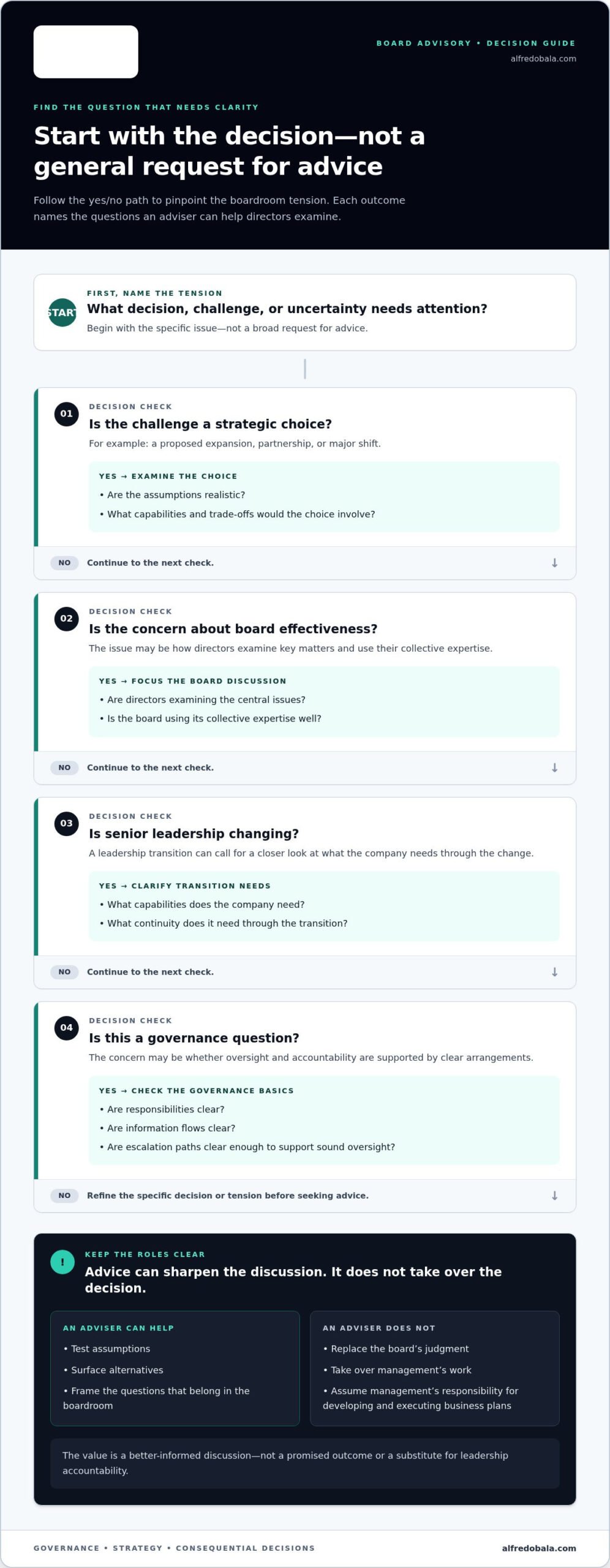
Start with the decision or tension, not a general request for advice. The need may concern a strategic choice, board effectiveness, a leadership transition, or a governance question. Each calls for a different line of inquiry:
- Strategic choices: Are the assumptions behind a proposed expansion, partnership, or major shift realistic? What capabilities and trade-offs would the choice involve?
- Board effectiveness: Are directors examining the central issues and using their collective expertise well?
- Leadership transitions: What capabilities and continuity does the company need through a change in senior leadership?
- Governance questions: Are responsibilities, information flows, and escalation paths clear enough to support sound oversight?
A structured outside perspective can expose assumptions that have gone unchallenged and help directors distinguish evidence from expectation. That clarity sharpens the questions they consider and gives discussion a more disciplined focus. It does not guarantee agreement or eliminate uncertainty. It helps the board deliberate with a clearer view of the choices, their implications, and what further information may be useful.
Who typically uses corporate board advisory services?
CEOs may seek perspective before presenting a consequential decision to the board. Founders may need to consider how governance and leadership should evolve as the business grows. Board chairs and directors may want to strengthen discussion around a difficult strategic choice or clarify how the board can contribute without stepping into management’s role.
The context changes with scale. A growing business may be weighing how to expand while building leadership capacity and decision processes. An established global organization may be balancing priorities across markets, operations, and a complex governance structure. In either case, relevant operating experience can help test whether strategic ambition connects with execution realities. For a broader look at the role, see the strategic corporate board advisor.
How Board Advisory Connects Governance, Strategy, and Executive Experience
Governance and strategy answer different questions, but board decisions need both. Governance establishes how authority, oversight, and accountability are arranged. Strategy sets the company’s priorities and direction. Governance defines how a board makes and oversees decisions; strategy defines the choices that move the company toward its priorities.
That connection matters when a strategic ambition depends on decisions across the organization. Consider a company weighing expansion into new markets. Directors may need to examine the strategic rationale, the risks leadership has identified, and whether the organization has the capacity to carry out the plan. Advisory perspective can help connect those questions without blurring who owns the decision.
Corporate board advisory services can help directors and executives test assumptions and focus on the questions that matter. They do not replace the board’s judgment or management’s responsibility to make and execute business decisions. Advice is most useful when it helps leaders see the strategic choice more clearly and consider what execution will require.
How does operating experience strengthen strategic advice?
Operating experience brings the realities of leadership into strategic discussion. A plan that looks compelling on paper may depend on capabilities the organization has not built, leaders already stretched across competing priorities, or coordination across teams and markets. An experienced operator can probe those dependencies and surface trade-offs directors may want to understand before evaluating a proposal.
Alfredo Bala’s experience as former CEO of Mannatech Inc. and former COO of Britt World Wide grounds his board-level perspective in executive responsibility. Those roles inform practical questions an operator may bring to discussion: What must change for this priority to advance? Which teams will carry the work? What competing demands could slow progress? These questions do not predict a particular result. They help connect strategic intent to the conditions required for execution.
Why does board advice need to fit the company’s context?
Advice is relevant when it reflects the organization’s actual circumstances. Company stage shapes its immediate choices: a growing business may be building leadership capacity and operating structure, while an established organization may be coordinating priorities across a wider geographic reach. Leadership structure also matters. A founder-led company and a business with an established executive team may need to examine decision authority from different starting points.
Begin with the decision, then consider the context around it:
- Company stage: What capabilities or structures are still developing?
- Leadership structure: Who will assess, approve, and execute the decision?
- Strategic priorities: What goals or constraints shape the available options?
- Geographic reach: Where might operating conditions affect implementation?
A generic framework can organize a conversation, but it cannot replace understanding the company’s priorities and constraints. Leadership context is also central to executive leadership development strategies, where decision-making and the ability to lead execution meet.
For a perspective grounded in executive leadership and board experience, explore Alfredo Bala’s boardroom perspective.
Board Adviser, Consultant, or Director: Which Advisory Model Fits?
Choose the role that matches the work the organization needs done. A board-level perspective may help directors weigh an ongoing strategic question. A consultant may be engaged to address a defined issue. A director takes part in the board’s work. These roles can overlap in subject matter, but differ in relationship, focus, and decision authority.
The comparison below is a starting point. Actual scope depends on the engagement and the organization’s context. A title alone does not settle responsibilities.
| Role | Purpose | Relationship to the board | Typical focus | Decision authority |
|---|---|---|---|---|
| Board adviser | Bring experienced perspective to board-level questions | Provides counsel to directors or leadership | Strategy, governance, board effectiveness, or leadership considerations | Advises; doesn’t make board decisions by virtue of the advisory role |
| Consultant | Address a defined organizational need | Works with the organization on an agreed scope | A project, analysis, or area of specialist expertise | Provides findings or recommendations; decision authority remains with the organization |
| Director | Participate in the board’s governance and deliberations | Serves as a member of the board | Board matters, oversight, and decisions within the director’s role | Participates in board decisions as a serving director |
When is a board adviser different from a consultant?
A board adviser is generally engaged for perspective on questions that sit at board level and may continue as priorities evolve. A consultant is more commonly brought in for a bounded need, such as assessing a particular market opportunity or examining a specific operating challenge. Either can be useful. The choice turns on whether the organization needs continuing strategic counsel or focused expertise for a defined question.
For example, a company considering several strategic paths may value an adviser who can help directors examine the broader decision. If leaders need a focused analysis of one issue, a consultant’s defined scope may better match the task. In either case, clarify the question, the expected contribution, and who retains responsibility for decisions.
What changes when the adviser also holds a board seat?
An adviser offers counsel; a serving director participates in board responsibilities and decisions. When one person holds a board seat, role clarity matters. Distinguish when they are contributing as a director from any separate advisory capacity, and make sure others understand where counsel ends and board participation begins. The specifics depend on the organization and the engagement, not simply the title.
That distinction helps directors and executives set expectations about input, accountability, and decision-making. For a wider discussion of the board-adviser role, explore the corporate board advisor guide. Alfredo Bala’s board-level perspective is grounded in executive leadership and board-seat experience; learn more about Alfredo Bala’s leadership perspective.
Use corporate board advisory services when the need is board-level counsel, not a substitute for a director or a project specialist. State the decision to be supported, the adviser’s role, and who will make and act on the final decision. That clarity helps the chosen model serve the organization rather than blur accountability.
How to Prepare for Corporate Board Advisory Services
Make the discussion useful before it begins. Corporate board advisory services are more focused when leaders can state the decision at hand, explain why it matters now, and identify what kind of perspective would help. Preparation does not require a polished presentation. It requires a clear brief that gives the adviser enough context to challenge assumptions and keep the conversation tied to the company’s priorities.
Use this sequence to prepare:
- Define the decision. Frame the question the board or executive team needs to address, including the decision deadline and what makes it consequential now.
- Assemble the context. Summarize company priorities, relevant history, constraints, available evidence, and options under consideration.
- Identify stakeholders. Note who will make the decision, who will execute it, and whose perspective may materially shape the discussion.
- Agree on follow-through. Clarify what a useful engagement should produce, who will own next steps, and when the issue will be reviewed again.
What should executives bring into the first advisory discussion?
Bring a concise account of the strategic question and why it matters now. Add relevant board materials or other available evidence, the options leadership is considering, and the assumptions that remain unresolved. Include constraints that could affect the choice, such as leadership capacity, timing, or competing company priorities.
Be clear about the decision path, too. Identify the directors and executives involved, the people accountable for implementation, and stakeholders whose interests or expertise are relevant. This helps distinguish what the adviser is being asked to illuminate from what the board or management must decide. A short, candid brief is more useful than a large collection of documents without a clear question.
Define success in terms of the engagement’s usefulness, not a promised business result. For example, leaders might want to leave with a clearer view of the available options, a sharper set of questions for board discussion, or agreed next steps. These measures focus the work while recognizing that final decisions and outcomes remain with the organization.
How can leaders turn advice into accountable action?
Close the discussion by recording what has been decided, what remains open, and who owns each next step. Separate board oversight from management execution: directors may request further analysis or set a review point, while executives and their teams carry out the approved work. Clear ownership prevents useful advice from becoming an unassigned item in a meeting record.
Set a practical review point and revisit the original question. Has new evidence emerged? Have company priorities, constraints, or stakeholder needs shifted? If the context has changed, the next discussion may need to address a different decision. This discipline keeps follow-through connected to the business rather than treating the initial recommendation as fixed.
For an executive perspective on preparing for consequential leadership discussions, explore Alfredo Bala’s executive advisory perspective.
Alfredo Bala’s Corporate Board Advisory Perspective: From Executive Leadership to Boardroom Decisions
Boardroom advice is strongest when it understands the realities behind a decision. Alfredo Bala, known as The Motivation Guy, is a leadership expert, author, speaker, and board-seat holder. His perspective draws on executive roles as former CEO of Mannatech Inc. and former COO of Britt World Wide, alongside experience in the networking profession dating to 1980.
That operating background matters because strategy is not only about choosing a direction. Leaders must also consider the people, capabilities, priorities, and organizational conditions needed to act on it. Alfredo’s executive and board experience informs discussion of those connections, helping directors and executives frame sharper questions without promising a particular business result.
What does an executive perspective bring to board-level counsel?
Leading an organization gives an executive firsthand context for how major choices meet the work of implementation. A board-level conversation about growth, for instance, can examine not only the intended direction but also leadership alignment, competing priorities, and what the organization may need to carry it forward. These are questions to investigate, not assumptions about any company’s circumstances.
Alfredo’s former CEO and COO roles provide a practical operator’s lens for considering how strategy and execution intersect. That experience can help ground advisory discussion in questions such as: What assumptions sit behind the proposal? Which capabilities will matter? What trade-offs should directors understand? The purpose is to improve the quality of questions and clarify the decision before the board, not to take the place of directors’ governance responsibilities or management’s role in execution.
Corporate board advisory services are most useful when counsel is relevant to the decision and grounded in the realities leaders face. Experience can broaden the discussion, but the board and executives remain accountable for their own judgments and actions.
How can board-level advice support global growth?
Growth across markets calls for more than ambition. Leaders need to consider whether priorities are aligned, whether the organization’s leadership structure can support its direction, and how local operating context may affect execution. Board-level advice can bring these considerations into view and test whether a proposed strategy is clear enough for leaders to act on.
The right questions depend on the company’s goals and circumstances. Directors might examine how leadership responsibilities connect to expansion priorities, where coordination across markets needs attention, or which assumptions require more evidence. These discussions do not guarantee results or rely on a universal formula. They help align oversight and strategic intent with the organization’s actual context.
Alfredo’s perspective brings executive leadership and board-seat experience to those conversations. For leaders considering how experienced counsel could inform their company’s strategic decisions, explore Alfredo Bala’s corporate board advisory services.
Put the Next Strategic Question to Work
Treat advice as an investment in judgment, not a shortcut around it. Before opening a board-level conversation, consider what decision could shape the company’s direction and what perspective might help leaders see it more clearly. A well-framed question gives experience somewhere useful to land.
That is the standard to bring to corporate board advisory services: insight should deepen deliberation and help leaders move forward with greater intention. The aim is not to remove uncertainty. It is to meet uncertainty with clearer thinking, disciplined discussion, and confidence in the responsibilities that remain yours.
Alfredo Bala brings an executive and board-level perspective to consequential business questions. Explore Alfredo Bala’s corporate board advisory services and consider how experienced counsel could support your next strategic decision. The strongest progress begins with a clear question and the resolve to act thoughtfully.
Frequently Asked Questions
Can a privately held company benefit from corporate board advisory services?
Yes. A privately held company can benefit when leaders face a decision that would benefit from experienced challenge. For example, a founder weighing whether to bring in a new executive team may want to examine how that change affects decision-making and company priorities. Match the advice to the company’s actual question. Private ownership does not remove the value of outside perspective, and it does not transfer decision responsibility away from company leaders.
Are corporate board advisory services the same as legal or financial advice?
No. Board-level advisory can help clarify strategic questions, governance considerations, and the implications of different choices, but it is not a substitute for legal, tax, accounting, or financial advice. For example, an adviser might help directors identify the strategic questions raised by a proposed transaction. Technical analysis, professional opinions, and advice within a specialist’s scope should come from appropriately qualified professionals. Keep those roles clear so strategic discussion and specialist counsel each serve their purpose.
How long does a corporate board advisory engagement last?
There is no standard duration. A company might seek input around a defined decision, such as reviewing strategic options before a board discussion, or maintain an advisory relationship as priorities evolve. The timeframe should reflect the purpose, complexity, and scope agreed by the parties. Before work begins, clarify when the engagement starts and ends, what would prompt a review of its scope, and how open questions or next steps will be handled.
Is a board adviser responsible for making the company’s decisions?
No. An adviser can offer perspective, but authorized company leaders retain responsibility for deciding whether and how to act on it. For example, if an adviser identifies a risk in a proposed plan, management can assess the concern and directors can consider it through the appropriate board process. A person serving as a director holds a different role from an adviser. State the role clearly so recommendations are not mistaken for decisions or delegated authority.
Can a board adviser help with international growth decisions?
Yes. An adviser can help leaders examine the assumptions behind an international growth plan, including whether leadership capacity, operating priorities, and market-specific considerations align. A useful discussion might compare what the company expects to remain consistent across markets with what may need local adaptation. The adviser’s contribution is to sharpen the questions and trade-offs, not to treat different markets as interchangeable or promise that expansion will succeed.
What should a company define before seeking board advisory services?
Define the issue in a sentence that names the choice leaders face, then identify what makes it important now. For example: “Should we prioritize entering a new market or strengthening our current operations this year?” Note what has already been considered, what evidence is missing, and who will use the discussion. This framing helps distinguish a strategic question from a request for general advice and gives the engagement a clear point of reference.
 EN
EN  ES
ES
Recent Comments