
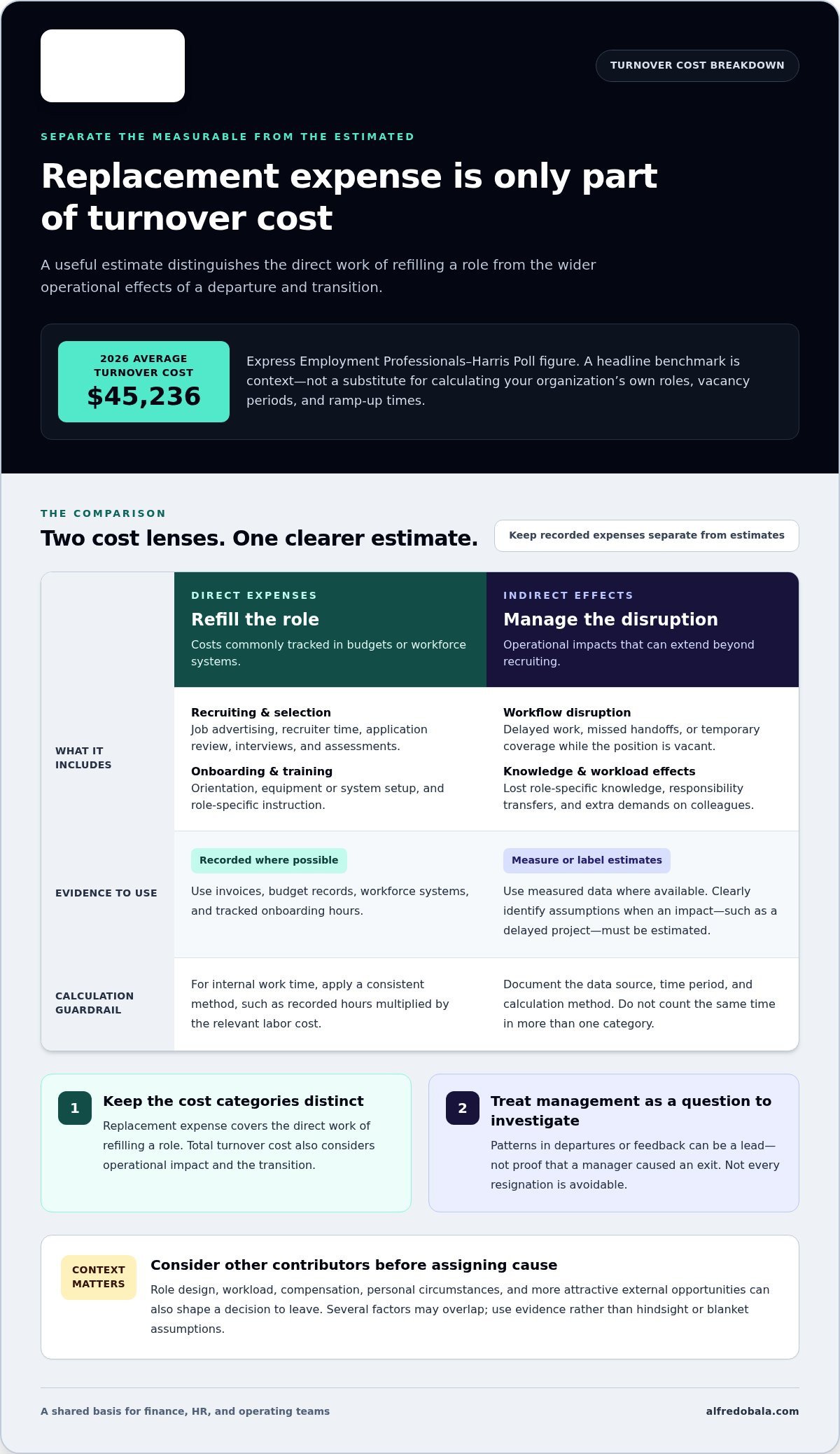
In 2026, the average cost of employee turnover reached $45,236, according to Express Employment Professionals-Harris Poll. But a headline figure can’t tell you what a departure costs your organization or how much of the cost of employee turnover due to poor management is avoidable. Recruiting is only part of the picture: lost productivity, knowledge gaps, and onboarding demands can affect multiple teams and budgets, making the full impact hard to see.
Not every resignation reflects a manager’s behavior. To understand where leadership may contribute, connect credible cost data with evidence about why people leave. Generic replacement estimates can provide a starting point, but your own roles, salaries, vacancy periods, and ramp-up times make the calculation meaningful.
This article explains how to build a transparent, organization-specific estimate, identify management practices that may contribute to avoidable departures, and choose measurable leadership responses. It also explores how motivation and leadership frameworks, including The Motivation Equation, can inform that work without treating training as a guaranteed fix.
Key Takeaways
- Assess the cost of employee turnover due to poor management without assuming every departure has the same cause.
- Build a cost estimate from your organization’s records, separating direct expenses from less visible impacts such as lost productivity and knowledge.
- Look for patterns in communication, recognition, fairness, and development that may contribute to resignations.
- Match leadership responses, such as coaching, training, or clearer routines, to the causes your evidence reveals.
- Review results through shared accountability among executives, HR, and managers instead of relying on a single turnover metric.
What Is the Cost of Employee Turnover Due to Poor Management?
The cost of employee turnover due to poor management is the combined resources an organization uses when an employee leaves and their role must be filled, where management practices may have contributed to the departure. It includes more than recruiting a replacement. A vacancy can interrupt work, shift responsibilities to colleagues, and take valuable knowledge out of the organization.
Replacement expense covers the direct work of refilling a role; total turnover cost also includes the operational impact of the departure and transition. Keeping these components distinct helps leaders build a useful estimate without treating every consequence as a cash expense or every resignation as proof of poor leadership.
Which costs belong in an employee-turnover estimate?
Start with direct expenses that can usually be tracked in budgets or workforce systems. Then account for indirect effects, using measured data where available and clearly labeled estimates where it isn’t.
- Recruiting and selection: Job advertising, recruiter time, application review, interviews, and related assessments.
- Onboarding and training: Orientation, equipment or system setup, and role-specific instruction for the new hire.
- Workflow disruption: Delayed work, missed handoffs, or temporary coverage while the position is vacant.
- Knowledge and workload effects: Lost role-specific knowledge, time spent transferring responsibilities, and extra demands on colleagues.
For example, an organization may track recruiter invoices and onboarding hours precisely, but estimate the impact of a delayed project using its own assumptions. Keep recorded expenses separate from estimates. For each figure, note the data source, time period, and calculation method. If you value internal work time, use a consistent approach, such as recorded hours multiplied by the relevant labor cost, and avoid counting the same time in more than one category. This gives finance, HR, and operating teams a shared basis for discussion. The employee retention overview also describes recruitment, training, and lost organizational knowledge as aspects of turnover’s impact.
When can poor management be a contributing factor?
Look for repeated patterns, not a single complaint or a manager’s reputation. Employees may experience unclear expectations, infrequent or unhelpful feedback, limited support when obstacles arise, or inconsistent treatment across a team. If departures, exit feedback, or engagement trends cluster around those conditions, they may signal a management issue worth investigating. A pattern is a lead, not proof of cause.
Other factors can shape a decision to leave, including role design, workload, compensation, personal circumstances, or more attractive external opportunities. Several may overlap. A useful analysis distinguishes all turnover from avoidable departures, meaning exits the organization believes it could reasonably have prevented by addressing relevant conditions. That judgment should rest on evidence, not hindsight or a blanket assumption that every resignation reflects leadership failure.
Use the estimate to ask sharper questions: Which costs can we verify? Which impacts are estimates? What do departing employees describe, and do current team members report similar experiences? These distinctions make the cost of employee turnover due to poor management more actionable. They also create a fair basis for examining management practices alongside other contributors, rather than assigning blame before the evidence is understood.
How Poor Management Can Lead to Employee Turnover
Management rarely influences retention through one dramatic event. More often, everyday interactions shape whether employees can do their work, trust decisions, and see a future on the team. Unclear priorities can lead to rework. Feedback that arrives only when something goes wrong can leave people unsure how to improve. Limited support can make routine obstacles feel like personal burdens. Repeated friction may gradually weaken motivation and make another role more appealing.
These are possible pathways to investigate, not proof that a manager caused a resignation. A team-level pattern can show that turnover and a management experience occur together, but correlation alone doesn’t demonstrate that one caused the other. Leaders need enough evidence to act wisely without turning a signal into a verdict.
Which management behaviors should leaders examine?
Look at the conditions employees encounter week after week. Review whether goals are clear, feedback is timely and useful, expectations are applied consistently, and people can access help when they need it. Then consider whether employees have appropriate autonomy, receive meaningful recognition, discuss development with their manager, and see conflicts handled fairly. One weak interaction may be temporary; repeated experiences across several areas can point to a deeper team issue.
Compare reported experiences across teams, but protect confidentiality. Small groups can make individual comments identifiable, so combine themes carefully and avoid simplistic manager rankings. The aim is to understand working conditions and identify where support may be needed, not to shame a leader or expose an employee.
How can leaders test whether management is a factor?
Bring multiple sources of evidence together. Exit feedback can reveal why someone says they left; stay conversations can surface what current employees find difficult or motivating. Engagement signals and relevant workforce data add context. None provides a complete explanation on its own. Employees may be reluctant to speak candidly, and survey responses capture perceptions that need to be interpreted alongside events and other evidence.
Compare patterns over time and account for differences that can shape both experience and departures, such as role, tenure, location, team size, or a recent organizational change. For example, a rise in exits on one team may coincide with a new manager, but also with a workload shift or changed role expectations. Ask what else changed, whether feedback describes related concerns, and whether the pattern persists. That gives leaders a testable hypothesis rather than a convenient assumption.
When evidence points to recurring issues, clarify the next question: does the manager need stronger feedback practices, clearer team routines, or better support in addressing conflict? Leadership education, including leadership and motivation insights, can help leaders reflect on the behaviors shaping employee experience. The cost of employee turnover due to poor management becomes more actionable when an organization investigates those behaviors carefully, then evaluates its response against the evidence.
How to Calculate the Cost of Employee Turnover
Build the estimate from your own records, not a benchmark that may not reflect your roles or operating model. First, set a consistent period, such as a financial year, and define which departures count. Then estimate replacement and operational costs for those departures by category. The result is a decision tool, not a precise price tag for every resignation.
Turnover cost for a period = the sum of each relevant departure’s documented direct costs and defensible indirect costs. Calculate costs role by role where possible. A specialist position with a long handover may affect operations differently from a role with short, standardized onboarding.
- Set the scope. Choose the period, locations or business units, and departure types you’ll include. Apply the same definitions throughout.
- Count departures. Use HR records to confirm how many employees left and which roles they held. Don’t combine voluntary and involuntary exits without labeling them.
- Estimate by category. Add relevant expenses and supported operational impacts for each role, then total them for the period.
- Document uncertainty. Record missing inputs, assumptions, and exclusions so others can understand and update the estimate.
Which data should HR and finance gather?
Start with recruiting, screening, hiring, onboarding, and role-specific training costs. Use invoices, internal time records, and consistent finance definitions where available. Estimate vacancy coverage, manager time, or productivity disruption only when you have a defensible way to value them, such as recorded temporary coverage hours or documented delays.
Coordinate across HR, finance, and operating teams before adding figures. If recruiter time is already included in a hiring-cost total, don’t count it again as a separate expense. For every input, note its source, calculation method, and whether it’s a recorded expense or an estimate. This makes the calculation easier to review and refine.
How should leaders interpret the estimate?
When information is uncertain, show a range rather than implying false precision. Explain which assumptions create the low and high estimates, and identify the inputs that most affect the result. Compare teams or periods cautiously: differences in role mix, tenure, hiring conditions, or organizational changes can affect costs independently of management.
Keep total turnover cost separate from the question of attribution. If evidence suggests management may have contributed to some departures, report that as a distinct, qualified analysis, not as a fixed share of all turnover expenses. The cost of employee turnover due to poor management can guide where to investigate, but the estimate alone can’t establish why employees left. Use it to prioritize questions and follow-up, not to claim that every departure carries an identical cost or has the same cause.
Which Management Responses Can Address Avoidable Turnover?
Choose a response after identifying the management experience that may be contributing to departures. A general training program won’t resolve unclear decision rights, and a new feedback template won’t help if managers lack the time or skill to use it well. Match the intervention to the signal, the work context, and the support leaders need to put a change into practice.
How should an organization match interventions to evidence?
Translate employee feedback into a practical question. If people report unclear expectations, review how goals are set, communicated, and updated. If feedback feels rare or unhelpful, examine regular one-to-ones and coaching skills. If employees describe inconsistent treatment or low trust, inspect decision processes, responses to conflict, and whether people have a meaningful way to raise concerns. These signals call for investigation, not an automatic verdict about a manager.
Use the pattern to select a proportionate response. Coaching may suit a manager who understands the issue but needs focused support applying a skill. Manager training can build broader capability when several leaders share a development need. Clearer operating practices can address confusion over priorities, handoffs, or decision ownership. Improved feedback routines can make expectations and concerns easier to discuss consistently.
| Target issue | Possible response | Observable follow-up measure |
|---|---|---|
| Goals or responsibilities feel unclear | Clarify team priorities, role expectations, and how changes are communicated | Employee feedback on role clarity; recurring questions or rework |
| Feedback is limited or unhelpful | Strengthen regular conversations and manager coaching practices | Feedback on conversation usefulness; completion of planned check-ins |
| Employees raise fairness or trust concerns | Review decision processes, consistency, and routes for employee voice | Recurring feedback themes; confidence that concerns are heard |
| Managers lack a shared leadership skill | Provide relevant manager development, with follow-up support | Observed changes in the targeted practice; employee experience signals |
The table is a starting point, not a prescription. Consider team demands, organizational constraints, and each manager’s readiness. An executive learning discussion or speaking engagement can help leaders examine shared expectations and the management behaviors shaping motivation. Alfredo Bala provides professional speaking and executive advisory, bringing leadership and team development insights to this work. Explore The Motivation Equation as a leadership resource for a framework to inform reflection, not as a promise of a particular retention result.
What should leaders measure after taking action?
Set a baseline before introducing a change, then review the same indicators at consistent intervals. Track turnover patterns alongside engagement signals, exit themes, and measures related to the diagnosed issue, such as role clarity or feedback quality. Interpret shifts carefully: staffing changes, workload, or external conditions may also influence results. A change that follows an intervention doesn’t, by itself, prove the intervention caused it.
Share what the organization is testing, who is responsible, and when leaders will review progress. This keeps the cost of employee turnover due to poor management connected to decisions and learning, rather than reducing retention work to a training event or a single metric.
Turn Turnover-Cost Analysis Into Better Leadership Decisions
A turnover estimate becomes valuable when it improves the next decision. Use a disciplined sequence: validate cost and workforce signals, investigate the reasons behind them, choose a focused response, then review what changes. The goal isn’t to assign blame or reduce retention to one number. It’s to understand where the employee experience may be breaking down and take shared responsibility for improving it.
What should executives do with the findings?
Bring HR, finance, operational leaders, and relevant managers together to review the estimate’s assumptions alongside employee evidence. Check whether cost inputs are comparable and whether feedback points to a recurring issue, a local challenge, or a wider organizational condition. Then agree on a small number of observable management practices to improve, such as communicating priority changes clearly or holding more useful development conversations.
Make accountability specific. Name an owner for each action, clarify what support they need, and decide when the group will review progress. Executives can set priorities and remove organizational barriers; HR can coordinate workforce evidence and development; managers can put agreed practices into daily team interactions. Shared ownership makes it less likely that retention becomes an HR initiative disconnected from the work itself.
Review employee experience and business indicators together. For example, if leaders are working to improve role clarity, revisit employee feedback on expectations alongside relevant indicators such as recurring rework or turnover patterns. Use a consistent review cadence and interpret movement with care. Other business changes may affect results, so don’t claim that one leadership action caused a shift without supporting evidence.
How can leadership development support follow-through?
Leadership development is most useful when it connects reflection to practical behavior. Managers can examine how they communicate expectations, respond to concerns, recognize contributions, and support growth, then apply those insights to real team challenges. Follow-up matters: leaders need opportunities to reflect on what they tried, what employees experienced, and where their approach needs adjustment. A learning session alone doesn’t establish that turnover will fall.
Alfredo Bala’s book The Motivation Equation offers a motivation and leadership framework that can inform this work. Use it to consider how management behavior shapes a team’s day-to-day experience, while grounding any organizational response in local evidence. That keeps the cost of employee turnover due to poor management connected to leadership decisions without treating a framework as a guaranteed financial solution.
Validate the signal. Investigate the causes. Choose an action, assign ownership, and review the evidence. That cycle helps executives, HR, and managers turn turnover analysis into more deliberate leadership practice. Explore Alfredo Bala’s leadership insights for further perspective on motivation and leadership.
Make the Next Leadership Decision Count
Use your turnover analysis as a starting point for a more deliberate leadership conversation. Choose one management practice to examine, invite candid input from the people affected, and agree on what a better day-to-day experience would look like. Then make space to learn from the results. This steady discipline helps your organization respond to evidence rather than assumptions.
The cost of employee turnover due to poor management isn’t just a figure to report. It can prompt leaders to ask where expectations, support, or communication need attention, while recognizing that responsibility for a healthy workplace is shared. Progress begins when leaders stay curious, act with care, and follow through consistently.
For a fresh perspective on motivation and leadership, explore Alfredo Bala’s leadership insights. Take the next step with openness and purpose, and build a workplace where people and teams can do their best work.
Frequently Asked Questions
Is employee turnover always a sign of poor management?
No. Employees leave for varied reasons, including personal changes, a better-fit opportunity, role changes, or compensation considerations. Management may be one factor, but a resignation alone can’t establish why someone left. Look for corroborating signals, such as similar feedback from several employees or a pattern that remains after accounting for changes in workload or team structure. Use that evidence to guide inquiry, not to label a manager.
Can you calculate the cost of turnover without a universal industry benchmark?
Yes. You can estimate the cost of employee turnover due to poor management using organization-specific records, even without an industry benchmark. For example, use recruiting invoices, recorded interview hours, and onboarding time to build a local estimate, then mark less certain inputs separately. Review the method with finance and HR so everyone understands what’s counted. A consistent internal estimate can support decisions even if it isn’t directly comparable with another organization’s figure.
What is the difference between turnover rate and turnover cost?
Turnover rate measures how frequently employees leave relative to the workforce over a defined period; turnover cost estimates the resources used to manage those departures and refill roles. A common rate calculation divides separations during the period by average headcount, then multiplies by 100. A rate can help spot a rising trend, while cost analysis helps leaders understand its operational and financial implications. Neither measure explains the cause on its own.
How can leaders identify regrettable employee turnover?
Define “regrettable” using role-relevant criteria before reviewing individual exits. An organization might consider whether a departing employee had specialized knowledge, consistently strong performance, or skills that are difficult to replace. Apply the same criteria across teams and document exceptions. Don’t use “regrettable” simply to mean that a manager wanted the employee to stay. Reviewing exit reasons alongside these criteria can help distinguish a difficult-to-replace loss from turnover with a different organizational impact.
Can stay interviews reveal management problems before employees resign?
They can surface concerns while employees are still on the team, though they can’t guarantee someone will stay or prove that management caused a problem. Ask open questions such as, “What makes your work here worthwhile?” and “What would make your day-to-day work better?” Listen for recurring themes, and explain how feedback will be handled. If employees see no follow-through, the conversation may feel performative rather than useful.
How often should a company review employee turnover data?
Choose a cadence that fits workforce size, hiring patterns, and how quickly leaders can respond. A regular operational review can flag emerging changes, while a deeper periodic review can compare exit themes, roles, and business context. Avoid treating a small number of departures as proof of a trend. Record the review date and definitions used, then compare like with like so leaders can see whether a signal persists or was temporary.
 EN
EN  ES
ES
Recent Comments