
What if the most motivating thing a leader can offer during economic uncertainty isn’t a promise, but a clear and credible next step? Employees may be worried about job security, heavier workloads, or shifting priorities, while leaders themselves may not have every answer. Motivating employees during economic uncertainty starts with recognizing that tension, not trying to talk it away.
Conventional rewards can’t resolve every concern, especially when budgets are tight. But honest communication, meaningful focus, and consistent follow-through can help employees feel more grounded and able to contribute, even when the wider outlook remains unsettled. You don’t need certainty about every outcome to lead with clarity.
In this guide, you’ll learn practical ways to communicate what’s known and unknown without fueling unnecessary alarm, help teams focus on priorities they can influence, and recognize contributions in sustainable ways. We’ll also explore how leaders can respond to concerns about changing roles and technology by supporting learning and growth. The aim is simple: build trust, agency, and motivation through habits your team can rely on.
Key Takeaways
- Start by understanding which uncertainties are affecting your employees instead of assuming every team shares the same concerns.
- For motivating employees during economic uncertainty, communicate what you know, what remains unknown, and when people can expect an update.
- Choose motivation strategies that fit your constraints, from recognition and autonomy to development and workload conversations.
- Build a weekly leadership rhythm around listening, clarifying priorities, removing an obstacle, and recognizing progress.
- Use a consistent leadership framework, including ideas in Alfredo Bala’s The Motivation Equation, to turn good intentions into steady practice.
Why motivating employees during economic uncertainty starts with understanding their concerns
Economic uncertainty doesn’t look the same in every organization. One business may be responding to shifts in demand; another may be managing a tight budget, changing customer needs, new technology, or uncertainty about future plans. Even when an organization is performing steadily, employees may feel unsettled because priorities are changing or decisions haven’t been explained. Start with the situation your people are experiencing, not assumptions drawn from headlines or another company’s circumstances.
Unanswered questions can consume attention. An employee who doesn’t know whether responsibilities will change may hesitate to commit to a new project. Someone balancing a full workload may interpret another priority shift as a sign that leaders don’t see the strain. These reactions aren’t evidence of a poor attitude. They’re cues to understand what’s getting in the way of confidence, focus, or a sense of control.
In uncertain conditions, motivation is the willingness and capacity to direct effort toward meaningful work despite unresolved questions. It differs from short-term morale, which reflects how people feel at a particular moment. A cheerful meeting may lift spirits briefly, but lasting motivation depends more on whether employees understand what matters, feel their contribution counts, and have a workable path forward. A broad overview of understanding employee motivation can help frame the topic, but leaders need to learn what it means for their own teams.
What employees may be worried about when the outlook is unclear
Possible concerns include job stability, changing priorities, compensation, workload, and whether the team has enough capacity to deliver. Which concern feels most urgent can vary by role, location, personal circumstances, and what leaders have already communicated. Don’t treat a quiet team as a team without concerns. Invite people to describe their experience with open questions, such as:
- What feels least clear about your work right now?
- Which recent change is affecting your priorities or workload?
- What would help you feel more able to focus this week?
Listen for the specific friction before prescribing a solution. A workload concern might call for reprioritizing; uncertainty about a role may call for clearer information about what is known and what remains undecided.
How leaders can recognize motivation signals without jumping to conclusions
Notice changes in participation, collaboration, initiative, or the questions people ask. Treat them as prompts for curiosity, not proof that someone is disengaged. A missed contribution could reflect competing demands, unclear direction, or a personal challenge rather than a lack of commitment.
Use private conversations when an employee may need room to speak candidly, and team listening sessions to identify shared obstacles. Ask what has changed, what’s working, and where priorities conflict. Then reflect back what you heard and clarify what you can address or explain. This discipline turns observation into understanding and gives you a sounder basis for motivating employees during economic uncertainty.
How to communicate honestly and motivate employees during economic uncertainty
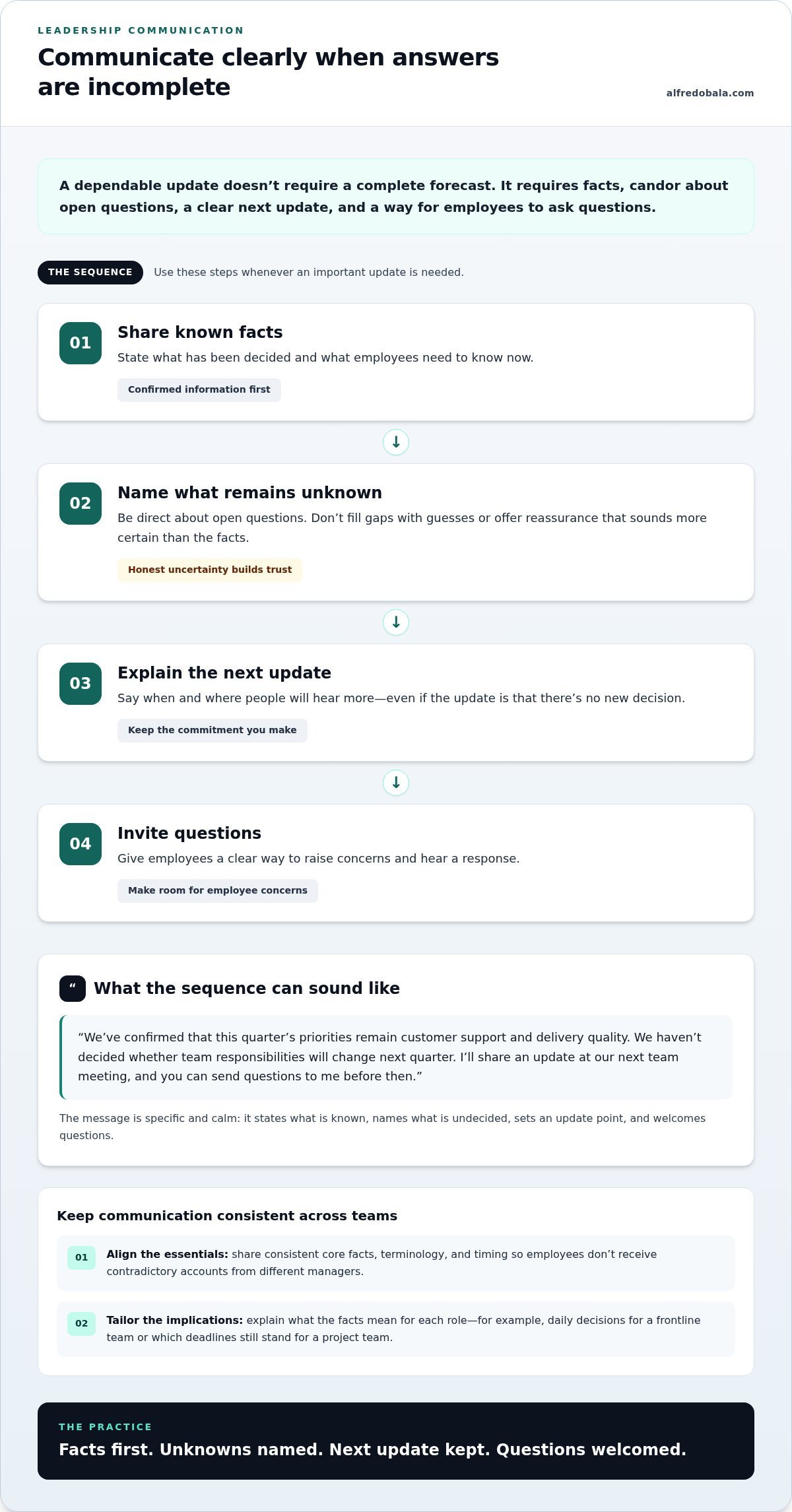
Clear communication doesn’t require a complete forecast. It requires discipline: separate confirmed information from unanswered questions, explain what happens next, and keep your commitments. This approach helps leaders avoid two trust-breakers: speculation that spreads unnecessary alarm and reassurance that sounds certain but isn’t supported by facts. It also gives employees a dependable way to understand changing decisions.
Use the same communication sequence whenever an important update is needed:
- Share known facts. State what has been decided and what employees need to know now.
- Name what remains unknown. Be direct about open questions instead of filling gaps with guesses.
- Explain the next update. Say when and where people will hear more, even if the update is that there’s no new decision.
- Invite questions. Give employees a clear way to raise concerns and hear a response.
For example: “We’ve confirmed that this quarter’s priorities remain customer support and delivery quality. We haven’t decided whether team responsibilities will change next quarter. I’ll share an update at our next team meeting, and you can send questions to me before then.” The wording is calm and specific. It neither predicts an outcome nor leaves people wondering when they’ll hear from you.
Consistency matters across teams. Align on core facts, terminology, and timing so employees don’t receive contradictory accounts from different managers. Then add context for each role. A frontline team may need to know how priorities affect daily decisions; a project team may need clarity on which deadlines still stand. Keep the facts consistent and tailor the implications.
What to say when you do not yet have an answer
Acknowledge the question plainly. For instance: “I understand why you’re asking about team capacity. What I can confirm is that the current project list is unchanged. I don’t yet know whether we’ll add resources, and I won’t guess. I’ll update you at Friday’s team meeting, even if that answer is still pending.” Choose a realistic update point, then follow through. Don’t promise a decision or timeline you can’t substantiate.
How to make uncertainty conversations two-way
Make questions part of the communication rhythm, not an afterthought. Use team meetings for shared concerns, one-to-ones for individual context, and an anonymous channel when people may hesitate to speak openly. Reflect back what you heard: “I’m hearing that shifting deadlines are making it difficult to plan the work. Have I understood that correctly?” Accurate reflection helps distinguish the problem employees raised from the solution a leader assumes they need.
Close the loop. Explain which concerns led to an action, what that action is, and which questions remain unresolved. If you can’t act on a concern yet, say why and identify what would change that. Employees may not get the answer they hoped for, but a reliable process gives them a reason to keep asking, contributing, and planning their work. For leaders who want to bring these principles into wider team conversations, Alfredo Bala’s leadership insights offer a relevant place to explore practical leadership ideas.
Which motivation strategies work when economic uncertainty limits rewards?
When budgets are constrained, leaders still have choices, but no single tactic fits every team. Start with the need behind the concern: employees may need clearer direction, appreciation, more say in how work gets done, a chance to build skills, or a realistic workload. The right response depends on employee needs and organizational context, not on a standard menu of perks.
Use this comparison to decide where to focus. These approaches can support motivation, but they don’t replace fair compensation or candid conversations about pay. Nonfinancial support should complement fair compensation, never serve as a substitute for it.
| Approach | When it may help | What it requires | Caution |
|---|---|---|---|
| Transparent direction | People are unsure which work matters most. | Consistent priorities and clear explanations. | Don’t present temporary plans as permanent certainty. |
| Meaningful recognition | Effort, collaboration, or progress risks going unnoticed. | Specific, timely acknowledgment tied to real contributions. | Generic praise can feel performative. |
| Autonomy | Employees feel they have little control over how they deliver. | Clear decision boundaries and accountability. | Don’t delegate responsibility without authority. |
| Development | People want to strengthen skills relevant to current work. | Useful learning opportunities and manager follow-up. | Avoid implying promotion or advancement is guaranteed. |
| Workload conversations | Capacity, competing demands, or pace is undermining focus. | Honest review of priorities, deadlines, and available capacity. | Recognition isn’t a remedy for unsustainable demands. |
Recognition, autonomy, and development: match the action to the need
Make recognition precise. Name the action and why it mattered: a colleague shared expertise, helped unblock a task, or made meaningful progress on a priority. This gives employees a credible account of their contribution, rather than praise detached from their actual work.
Autonomy can restore agency when leaders define the outcome, boundaries, and check-in points, then let employees choose the route. Development can be just as practical: discuss a skill someone can practice in a current assignment, or a learning goal that supports the team’s present priorities. Don’t imply that training guarantees a promotion or that a future role is available if that hasn’t been established.
How to avoid motivation tactics that damage trust
Be alert to the gap between what leaders celebrate and what employees experience. Praising resilience while ignoring excessive workload can sound like an invitation to endure more, not genuine appreciation. Likewise, incentives that seem arbitrary or inconsistently awarded may weaken trust. Explain what contribution is being recognized and apply your approach fairly.
Skip slogans and forced positivity. “We’re all in this together” won’t resolve conflicting priorities or unanswered concerns. When motivating employees during economic uncertainty, credibility comes from matching encouragement with practical support: clarify what matters, recognize contributions honestly, and address barriers leaders can influence. If available support is limited, say so plainly and focus on steps the team can sustain.
A practical weekly plan for sustaining employee motivation during uncertainty
Consistency gives employees a practical point of reference when longer-term conditions remain unsettled. Set a weekly rhythm that turns leadership intent into visible action, without pretending every question can be resolved at once. Keep it simple enough to sustain:
- Listen. Ask what feels unclear or difficult, and what support would help the team do its work.
- Clarify priorities. Identify the outcomes that matter most now, and name what can wait.
- Remove one obstacle. Address a bottleneck, conflicting demand, or decision that is slowing progress.
- Recognize progress. Acknowledge a useful contribution or milestone with specific, sincere feedback.
This isn’t a promise that circumstances won’t change. It’s a reliable way to respond as they do. For broader context on building leadership capability, explore executive leadership development strategies to connect team-level habits with wider organizational direction.
Turn business priorities into clear, manageable team commitments
Translate organizational direction into a practical agreement: what the team will prioritize this week, what can wait, who owns each commitment, and which decisions employees can make themselves. For example, if a new request competes with an existing deadline, clarify who can reset the order and how the team should raise capacity concerns.
Keep commitments near-term, not because long-term plans don’t matter, but because they may need revision. When conditions or priorities shift, revisit the plan openly. Retire outdated tasks rather than letting them quietly compete with current work.
Measure trust and motivation through listening and follow-through
Use a brief check-in to ask: “What’s clear this week? What’s proving difficult? What support would make the work more manageable?” Look for themes across conversations, rather than treating a single response as a complete diagnosis. You can also observe whether ownership, collaboration, and questions change as priorities become clearer.
Close the loop by sharing what you heard, what action you took, and what constraints remain. If an obstacle can’t be removed, explain why and what you’ll keep monitoring. This follow-through helps employees see that speaking up has a purpose, even when the answer isn’t an immediate fix.
Use the cycle as a learning loop. If a change doesn’t help, ask what needs adjusting rather than repeating it by default. That steady attention is central to motivating employees during economic uncertainty: leaders create a manageable focus, listen for friction, and respond in ways the team can see. Explore Alfredo Bala’s leadership insights to bring these habits into your wider leadership practice.
How leadership frameworks and expert support can help teams move forward
Listening, setting clear priorities, recognizing contribution, and following through are most effective when they form a consistent leadership practice. A framework can help leaders connect these habits instead of treating each concern as an isolated problem. It won’t remove economic uncertainty or produce instant motivation. It gives leaders a way to reflect on how their choices affect employees and respond with greater intention.
That consistency matters because motivating employees during economic uncertainty is not a one-time announcement or morale event. It is the ongoing work of aligning what leaders say with what teams experience. Use a framework to ask better questions, check whether actions fit the situation, and adjust when the team’s needs or business priorities change.
Apply The Motivation Equation as a leadership lens
Alfredo Bala’s book, The Motivation Equation, offers practical frameworks for exploring motivation and leadership. Leaders can use it to think through how they lead, communicate expectations, and support people in practice. Treat it as a lens for reflection, not a checklist that promises the same response will work for every employee or organization.
As you apply ideas from the book, consider how they relate to the habits your team is building: Are priorities understandable? Do employees have appropriate ownership? Does follow-through reinforce the message leaders intend to send? These questions connect a leadership framework to the real decisions managers make day to day.
When a shared leadership conversation can help a team
Sometimes individual managers are working hard, but their teams hear different messages or lack a shared way to discuss motivation and uncertainty. A focused leadership conversation can bring people together around common language, clarify what leaders can influence, and create space to consider how communication and decisions land across roles. A keynote from Alfredo Bala can give organizations a structured opportunity to discuss leadership and team development together.
Expert perspective can also help leaders step back from immediate pressures and examine their assumptions. The aim isn’t to hand over responsibility for motivation. Leaders still need to listen, make decisions, and follow through. A speaker or shared session can prompt useful discussion, while managers translate that discussion into actions suited to their people and organizational context.
Choose a next step based on what you’ve heard from your team. If employees need greater clarity, begin with a leadership discussion about consistent communication. If priorities or capacity are the concern, focus the conversation there. To continue exploring practical leadership perspectives, explore Alfredo Bala’s leadership insights and consider what ideas may be useful for your team’s next conversation.
Make your next leadership move count
You can’t control every economic pressure your team faces, but you can choose how you lead through it. The next step is to turn intention into practice: make one commitment to your team, follow through, and use what you learn to shape the next conversation. That steady discipline is at the heart of motivating employees during economic uncertainty.
Alfredo Bala brings a seasoned perspective to leadership and motivation. He is the author of The Motivation Equation, has served as a CEO and COO, and has been active in the networking profession since 1980. His experience offers a grounded foundation for leaders looking to reflect on how they guide people through change.
Use the ideas that fit your team, keep listening, and adjust as circumstances evolve. To deepen your leadership perspective, explore Alfredo Bala’s leadership insights. A thoughtful next step can help your team move forward with greater clarity and confidence.
Frequently Asked Questions
How can managers motivate employees when they cannot promise job security?
Managers should avoid guarantees they don’t have the authority to make. Instead, explain what has been confirmed, acknowledge what remains uncertain, and describe what leaders are doing to understand the situation. Set a clear rhythm for updates, even if there’s no new decision to report. If an employee asks about their specific role, listen respectfully, explain how the question will be addressed, and follow up as promised.
What should a leader say when employees ask about uncertain business conditions?
Answer with verified information first, then clearly identify what hasn’t been decided. For example, if a team asks whether a project will continue, distinguish its current status from any future decision. Don’t fill gaps with predictions or repeat rumors. If you need more information, say so plainly, explain the next step, and give a realistic time for an update. Keep that commitment, even if the answer is still pending.
Can nonfinancial recognition help motivate employees during economic uncertainty?
Yes, specific recognition can help employees understand how their effort contributes, particularly when a new financial reward isn’t possible. Acknowledge concrete actions, such as helping a colleague solve a problem or improving a handoff between teams. Make recognition fair and grounded in real contribution, rather than relying on generic praise. It doesn’t replace fair compensation, eliminate concerns about job stability, or make excessive workloads acceptable. Pair appreciation with practical action on problems leaders can address.
How often should managers communicate with employees during economic uncertainty?
There’s no universal schedule; choose a cadence that reflects how quickly information changes and what employees need to know to work effectively. For example, a team facing shifting deadlines may need a brief weekly planning update, while a stable project may need less frequent check-ins. Communicate sooner if material information changes. Avoid sending messages simply to appear active, especially if they contain speculation. A useful update is timely, relevant, and consistent with what leaders can verify.
How can leaders find out what employees need without making them more anxious?
Ask calm, open-ended questions in a one-to-one or team discussion, such as, “What’s making it harder to plan your work?” Explain that the purpose is to understand concerns and improve what leaders can, not to promise every request will be met. Respect privacy and let employees choose what they share. Afterward, report back on themes, actions, and constraints. Closing that loop helps prevent the listening process from feeling like a survey with no follow-up.
Do motivation strategies need to change when business priorities shift?
Yes. Review team commitments when conditions change, and make clear which goals remain active, which should pause, and what new work takes precedence. If a customer deadline moves ahead of an internal project, explain the trade-off and reset ownership rather than expecting employees to deliver everything on the original plan. Revisit workload and support as responsibilities change. Clear adjustments help employees focus without treating every earlier commitment as equally urgent.
When should an organization bring in an external leadership speaker to address motivation?
A speaker may help when an organization wants leaders or teams to share a focused conversation about motivation, leadership, or development. Before choosing a session, define who will participate, what they should learn, and which current challenge the discussion should address. Alfredo Bala’s professional speaking can create a common starting point, but it can’t replace managers’ ongoing communication or follow-through. Connect the discussion to real workplace decisions so participants can carry the ideas into their leadership practice.
 EN
EN  ES
ES
Recent Comments