
The best leadership book for aspiring managers depends on the challenge you’re preparing to meet. For a foundation in leadership practices, start with The Leadership Challenge, which presents five practices of exemplary leadership. Other books in this guide address the move into senior leadership, the first steps as a manager, and giving and receiving feedback.
Choosing a book can feel like a small decision with big consequences: you want ideas that lead to better conversations, clearer decisions, and stronger teams. This guide matches titles to the skills and transitions they can help you explore, so you can choose a practical starting point instead of working through an undirected reading list. You’ll find books for developing core leadership skills, shifting from technical expertise to senior leadership, building confidence as a new manager, and making feedback more candid and constructive. Each recommendation focuses on the challenge it addresses, helping you direct your reading toward the leadership capability you want to develop next.
Key Takeaways
- Choose a leadership book by the skill you want to strengthen, from self-awareness and influence to building trust across a team.
- Prepare for senior leadership by shifting your focus from completing technical work to guiding people and setting direction.
- As a new manager, use transition-focused reading to build confidence, communicate clearly, and establish trust with your team.
- Make feedback more useful by pairing care with candor, and treat it as a way to surface blind spots rather than a license to be harsh.
- Use the final recommendations to create a focused reading path that fits your next leadership challenge.
1. Books for developing leadership skills
A strong starting point is The Leadership Challenge, which presents five practices of exemplary leadership. Its emphasis on influence rather than coercion offers aspiring managers a practical test: can you earn commitment, not just issue instructions? Use that distinction to review your decisions, especially when a colleague disagrees or a project stalls. A leadership book for aspiring managers should help turn these moments into opportunities to practise judgment, communication, and accountability.
Popular books differ in their central task. John Adair’s Develop Your Leadership Skills, published in 2013, focuses on leadership development; Being the Boss by Linda Hill and Kent Lineback, published in 2011, addresses the manager’s role. HBR’s 10 Must Reads on Leadership, published in 2011, brings together leadership ideas, while Extreme Ownership by Jocko Willink and Leif Babin centers on responsibility for team outcomes. Choose based on the skill you need to practise, not the title that sounds most impressive.
For a strengths-based perspective, Gallup’s 2008 book Strengths Based Leadership reports findings from 10,000 randomly selected followers about what they need from influential leaders, according to the National Institute of Standards and Technology (NIST). Apply that focus by asking what your colleagues need from you, then compare their answers with your current habits. The question can reveal whether your leadership is responsive or built only around your own preferences.
For practical management skills, compare Adair’s leadership guidance with Extreme Ownership and Being the Boss. Turn each chapter into a workplace experiment: take responsibility for a team outcome, clarify expectations, or identify a conversation you’ve been avoiding. The No Asshole Rule also challenges the excuse that high performers can behave badly, a pattern its author says leaders have excused for nearly 20 years. Pair that lesson with self-awareness: notice how your conduct affects colleagues before judging theirs.
Among the titles in this guide, HBR’s 10 Must Reads: The Definitive Management Ideas of the Year from Harvard Business Review, published in 2020, is a newer option than the leadership collections published in 2011. The books focus on leadership ideas and management practice, rather than specifically on women or underrepresented managers. Readers seeking that perspective can prioritize works centered on those experiences and assess how their examples apply to their own workplace.
Book prices vary by format, edition, and seller, so compare these factors to find an option that suits your reading preferences. For practical tools, begin with The Leadership Challenge’s five-practice framework or Extreme Ownership’s focus on team responsibility. Use each idea to plan a specific action and review what happens. This simple cycle turns reading into practice instead of leaving useful concepts on the page.
2. Transitioning from technical skills to senior leadership
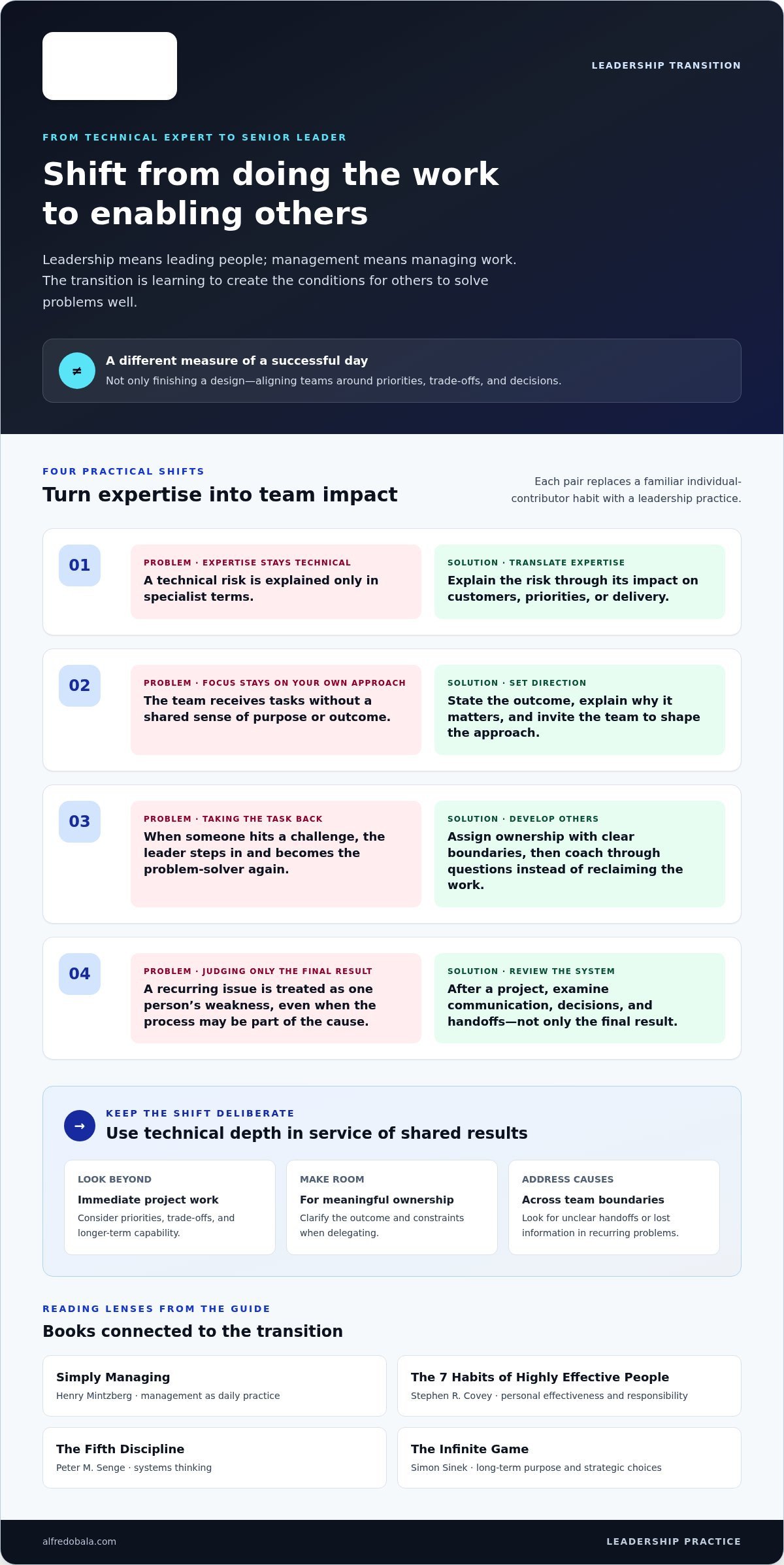
Make the shift deliberately: leadership means leading people, while management means managing work. A technical specialist may earn trust by solving a difficult problem personally. A senior leader must also create the conditions for others to solve problems well. Henry Mintzberg’s Simply Managing, published in 2013, can help readers examine management as daily practice rather than distant theory. As you read, notice where your impact comes from expertise and where it depends on enabling colleagues.
That change affects how you measure a successful day. An engineer might finish a design; a senior leader aligns teams around priorities, trade-offs, and decisions. Stephen R. Covey’s The 7 Habits of Highly Effective People, published in 2004, offers a lens for examining personal effectiveness and responsibility. Apply it by identifying a decision you can delegate, then clarify the outcome and constraints. Delegation isn’t withdrawal; it’s making room for others to own meaningful work.
Broaden your view beyond the immediate project. Peter M. Senge’s The Fifth Discipline, published in 2006, focuses on systems thinking. That perspective is useful when a recurring issue crosses team boundaries. For example, repeated delivery delays might reflect unclear handoffs, not an individual’s technical weakness. Map the process, identify where information gets lost, and bring the relevant teams together to address the cause.
Use a simple practice sequence to build leadership range:
- Translate expertise. Explain a technical risk in terms of its impact on customers, priorities, or delivery.
- Set direction. State the outcome, explain why it matters, and invite the team to shape the approach.
- Develop others. Assign ownership with clear boundaries, then coach through questions instead of taking the task back.
- Review the system. After a project, examine communication, decisions, and handoffs, not only the final result.
Senior leadership also asks you to think beyond immediate wins. Simon Sinek’s The Infinite Game, published in 2019, can prompt reflection on long-term purpose and strategic choices. Ask whether a short-term decision strengthens capability or merely protects this quarter’s output. For support turning these ideas into team practice, explore leadership and team development insights as a practical next step. The goal is not to abandon technical depth, but to use it in service of direction, capability, and shared results.
The transition from employee to manager is one of the hardest career transitions. The books listed here can help new managers build confidence, communication, and trust. Use their ideas to examine how you give direction, share responsibility, and respond when colleagues need support. Confidence can grow through clear decisions and follow-through; communication can improve when expectations and trade-offs are explicit. Trust grows when people understand what they own and have room to deliver.
Choose a recurring leadership moment, such as setting priorities or handing off work, and consider how to handle it more deliberately. Explain the purpose, invite questions, and agree on what success looks like. Then reflect on whether your approach helped others contribute, rather than measuring only what you completed. Repeating this kind of reflection can make the shift from individual contribution to shared results more manageable.
3. Getting started as a new manager
Becoming a manager means changing how you contribute. Instead of relying mainly on your own expertise, you’re responsible for helping others do their best work. This shift from employee to manager is one of the hardest career transitions. Books can help you build confidence, communication, and trust, but apply their ideas to real team situations. Start by identifying an immediate challenge, such as setting expectations, delegating work, or handling a difficult conversation.
For a transition-focused guide, read Michael D. Watkins’s The First 90 Days. It covers strategies for getting up to speed during leadership transitions. Use its central premise to plan your start: learn the team’s priorities, understand existing relationships, and identify which decisions need attention first. A new manager inheriting a delayed project, for example, should listen to contributors before changing the process. That creates a clearer picture of the obstacles and the team’s capacity.
Another useful selection is HBR’s 10 Must Reads for New Managers, published in 2017. It’s aimed directly at the shift into management, making it a relevant choice for readers seeking guidance on core responsibilities. Pair its ideas with a weekly routine: clarify goals with each direct report, note decisions that need follow-up, and reflect on whether your communication was specific. These small practices help convert broad advice into observable management habits.
For practical application, work through a simple sequence:
- Listen first. Ask each team member what helps them do focused work and where coordination breaks down.
- Make expectations explicit. Define the outcome, ownership, and constraints before assigning a task.
- Delegate with support. Agree on when to review progress, while leaving the employee room to choose an approach.
- Close the loop. Summarize decisions after meetings and follow up on commitments you made.
These steps help prevent a common trap: continuing to act as the strongest individual contributor instead of building the team’s capacity. If you’re comparing highly recommended books for new managers, start with The First 90 Days for transition strategy and HBR’s 10 Must Reads for New Managers for management-focused ideas. Choose based on your immediate need, then test one lesson in a real conversation or project. Keep a brief record of what you tried, how colleagues responded, and what you’ll adjust. That turns reading into a working management practice, not simply another item on your shelf.
4. Giving and receiving feedback
Feedback is a leadership tool, not a verdict on someone’s character. In Radical Candor, Kim Scott recommends caring deeply while giving direct feedback. Scott describes useful feedback as a way to reveal blind spots or gaps in self-awareness, not as permission to be mean. That distinction matters when a colleague misses a handoff: address the missed commitment and its impact rather than labeling the person careless.
Make your message specific enough to act on. Describe what happened, explain its effect, and invite a response. For example, say, “The project update arrived after the client meeting, so we couldn’t answer their timeline question. What got in the way?” This gives the other person a clear example and room to explain. Avoid vague judgments such as “You need to be more professional,” which leave the expected change unclear.
Timing and setting shape the conversation, too. Raise a sensitive concern privately and soon after the event, while the details are clear. If a presentation missed key information, identify the missing data and agree on how to prepare the next one. When recognizing strong work, name the action and its effect, such as a clear handoff that helped another team make a timely decision. Specific praise is useful, too.
Receiving feedback takes discipline. Listen without preparing a rebuttal, then check that you understand the example. If your manager says your updates feel unclear, ask which information was missing and when the confusion occurred. You can disagree with an interpretation while still examining the evidence. Separate intent from impact: you may have meant to be concise, yet your team may have lacked the context needed to act.
- Request an example. Ask what you said or did, and what effect it had on the work.
- Reflect before responding. Summarize the point in your own words before explaining your perspective.
- Choose one adjustment. For unclear updates, state the decision, owner, and next action explicitly.
- Close the loop. Tell the person what you changed and invite them to note whether it helped.
HBR’s 10 Must Reads on Emotional Intelligence, published in 2015, offers another lens for understanding how emotions affect workplace interactions. Use it alongside Radical Candor to examine both the message and your response. Before a difficult conversation, write down the observable behavior, its impact, and the change you’re requesting. Afterward, consider whether you listened, stayed direct, and agreed on a next step. That practice makes feedback a continuing exchange, not a one-way correction.
5. What are the best leadership books for aspiring managers?
The strongest choice depends on the leadership challenge you want to address first. A leadership book for aspiring managers should offer a useful perspective and a clear way to apply it. Choose for relevance, not prestige: influencing without authority calls for different reading than preparing for your first management role. Use the recommendations below as a focused starting point, then test an idea at work.
For a broad leadership foundation, consider The Leadership Challenge. Its five practices give readers a framework for examining how they influence and support a team. For a collection of management-focused ideas, HBR’s 10 Must Reads for New Managers, published in 2017, is directly aimed at the transition into managing. Choose the framework when you want to examine leadership practice; choose the manager-focused collection when you want guidance for your new responsibilities.
- To explore influence: Read The Leadership Challenge and identify a situation where you need commitment rather than compliance.
- To prepare for a management role: Use HBR’s 10 Must Reads for New Managers to focus your reading on the manager’s responsibilities.
- To examine feedback: Read Kim Scott’s Radical Candor for an approach built around caring deeply and giving feedback.
- To build emotional awareness: Consider HBR’s 10 Must Reads on Emotional Intelligence, published in 2015.
- To think about team dynamics: Patrick M. Lencioni’s The Five Dysfunctions of a Team, published in 2007, focuses on challenges within teams.
Use your current responsibilities to narrow the options further. If you lead project meetings, choose a book that helps you improve how you listen and communicate. Nancy Kline’s Time to Think, published in 2015, offers a prompt to examine how attention shapes conversations. If your work involves motivating colleagues, Daniel H. Pink’s Drive, published in 2011, provides a reading path centered on motivation.
Build a sequence instead of collecting titles. Start with the book that addresses an immediate need, capture one principle, and apply it in a real conversation or decision. Then choose another title that develops a different capability. For example, pair a book on team dynamics with one focused on feedback, so you can consider both the team environment and your individual conversations. This approach turns a reading list into a deliberate development plan, with each title serving a specific leadership objective.
More than 1,000 new business books are published each month in the United States, making a focused reading plan more useful than trying to keep up with every release. The article’s author says they read 100 leadership books, yet the practical next step remains choosing a title that meets a current need. The transition from employee to manager is one of the hardest career transitions, and the listed books help new managers build confidence, communication, and trust.
Alfredo Bala (The Motivation Guy): The Motivation Equation
The Motivation Equation gives aspiring managers practical frameworks for understanding motivation and strengthening leadership. Turn to it when you’re ready to move beyond reading about leadership and consider how motivation shapes the way people contribute, collaborate, and pursue shared goals. Its ideas can complement books on feedback, team dynamics, and the shift into management by helping you reflect on what encourages people to do meaningful work.
For challenges that call for a broader team perspective, Alfredo Bala’s Leadership and Team Development Insights offer another way to explore motivation and leadership in practice. Use these resources to connect your reading with the questions your team faces, such as how to build engagement or align effort around a shared objective. To explore The Motivation Equation and leadership insights, visit alfredobala.com.
Turn Your Next Leadership Lesson Into Action
Choose a leadership book for aspiring managers that addresses the challenge in front of you, then put one idea to work. The real measure of leadership development isn’t how many titles you finish; it’s whether what you’ve learned shapes your next decision, conversation, or team interaction. Keep asking what your colleagues need from you, and let their response guide your next step.
When you want to explore motivation as part of your growth, Alfredo Bala’s The Motivation Equation offers practical frameworks to consider. His Leadership and Team Development Insights can also help you think about how individual motivation connects with team development, while Speaking offers another way to engage with leadership ideas. Choose the format that best fits how you want to keep learning.
Take the next step at your own pace. Explore Alfredo Bala’s leadership resources and decide which ideas you’re ready to put into practice. Your leadership grows through deliberate choices, and your next one can start today.
Frequently Asked Questions
Which leadership books are best for first-time managers?
The First 90 Days and HBR’s 10 Must Reads for New Managers are strong starting points for first-time managers. To make the reading useful, keep a short list of questions for your first one-to-ones: what’s working, where decisions get stuck, and what support would help. Use the answers to identify which ideas to apply first, rather than trying to change every team habit at once.
What is the best leadership book for managing a team for the first time?
Best Team Ever is a useful choice for a new manager focused on team effectiveness. It identifies three habits associated with high-performing teams: common understanding, psychological safety, and prosocial purpose. Use these ideas to diagnose a specific challenge: unclear priorities may call for shared understanding, while reluctance to raise concerns may point to a need for greater psychological safety. Start with the issue your team faces now.
Which leadership books include exercises, templates, or practical tools?
The Leadership Challenge offers a five-practice framework, while Extreme Ownership focuses on team responsibility. The article recommends using these ideas to plan a specific action and review the results.
 EN
 ES
Recent Comments