
Pressure may spark a short burst of effort, but trust provides a stronger foundation for lasting progress. To understand how to inspire a team to achieve goals, set a clear shared outcome, connect each person’s work to a meaningful purpose, and give people the autonomy, support, feedback, and development opportunities to contribute. Motivation grows when people know what they’re working toward and believe they have a genuine role in achieving it.
Setting a target isn’t enough. People also need the confidence to speak honestly, take ownership, and work through setbacks together. The challenge is creating the conditions for that commitment without relying on constant pressure or oversight.
This article shares practical ways to build those conditions and move a team toward shared goals. You’ll learn how transparent communication strengthens trust, delegation encourages ownership, and collaboration and ongoing development sustain momentum. Together, these practices turn goals from instructions handed down into meaningful work the team can pursue with purpose.
Key Takeaways
- Build trust through clear communication: share the purpose behind decisions, invite honest input, and take responsibility when things go wrong.
- Delegate meaningful ownership by giving people room to make decisions and take initiative, with guidance that fits their needs.
- Connect daily responsibilities to the organization’s wider purpose so each person can see how their contribution moves shared goals forward.
- Strengthen collaboration with attentive listening, useful feedback, and recognition that reflects what matters to each team member.
- Make development part of the work: use learning opportunities and stretch assignments to help people grow their capabilities while contributing to team goals.
1. Building trust through transparent communication
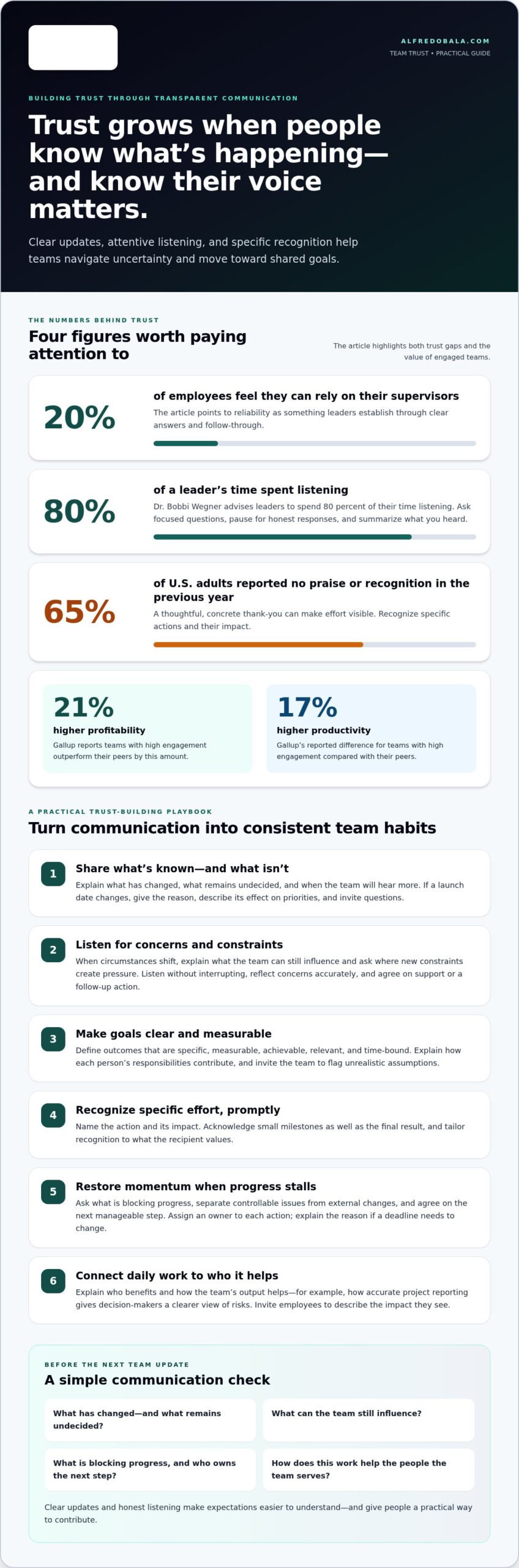
Trust grows when leaders make communication a consistent practice, not a crisis response. Share what’s known, what remains undecided, and when the team will hear more. If a launch date changes, explain the reason, describe the effect on priorities, and invite questions. This transparent approach helps employees distinguish a real challenge from silence or speculation. About 20% of employees feel they can rely on their supervisors, so leaders should establish reliability through clear answers and follow-through.
During uncertainty, communicate what has changed and what the team can still influence. For example, if a client revises a project’s scope, explain which deliverables remain essential and ask team members where the new constraints create pressure. Dr. Bobbi Wegner advises leaders to spend 80 percent of their time listening. Apply that guidance by asking focused questions, pausing for honest responses, and summarizing what you heard before deciding next steps.
To set clear, achievable team goals, define outcomes that are specific, measurable, achievable, relevant, and time-bound. For example, a support team might aim to reduce unresolved customer issues by a target date, then agree on how to measure progress. Explain how each person’s responsibilities contribute to the result, and invite the team to flag unrealistic assumptions. This creates shared expectations and a clear way to assess progress.
Recognize progress by giving specific, timely feedback tied to a person’s contribution. Name the action and its impact, such as how one team member’s careful review prevented a handoff delay. Acknowledge small milestones as well as the final result, and tailor recognition to what the recipient values. In the United States, 65% of adults reported receiving no praise or recognition in the previous year. A thoughtful, concrete thank-you makes effort visible.
When goals feel difficult or progress stalls, keep the team motivated by listening for obstacles, revisiting priorities, and agreeing on the next manageable step. Ask what is blocking progress, distinguish controllable issues from external changes, and assign an owner to each action. If a deadline no longer fits the work, explain the reason for adjusting it. Honest updates preserve trust while giving employees a practical route back to momentum.
Emotional intelligence makes these conversations more effective. If a team member becomes quiet during a review, ask privately what concerns them rather than assuming they lack commitment. Listen without interrupting, reflect their concern accurately, and agree on support or a follow-up action. This shows respect while maintaining accountability. Leaders who admit their own mistakes also show that candor is safe and responsibility applies at every level.
Connect the vision to daily work with a plain explanation of who benefits and how the team’s output helps. For example, explain how accurate project reporting gives decision-makers a clearer view of risks. Repeat the connection in team updates, then invite employees to describe the impact they see. Gallup reports that teams with high engagement outperform their peers by 21% in profitability and 17% in productivity. Clear purpose helps people understand why their contribution matters.
2. Empowering employees through delegation and autonomy
Delegate an outcome, not just a checklist of tasks. A project lead might own a client presentation, choose the workflow, and coordinate input from colleagues. Agree on the desired result, decision boundaries, and when to raise a risk. Then let the lead make day-to-day choices. This gives employees genuine ownership while keeping accountability clear. Leadership shifts from controlling each task to setting direction and removing barriers.
Make autonomy practical by matching decisions to experience and impact. A new team member could choose how to organize research, while a senior analyst owns the recommendation and presentation. Clarify which decisions they can make independently and which require coordination. When an employee proposes a different approach, discuss the reasoning and possible risks rather than dismissing it. This builds rapport and makes ownership more than a delegated label.
Motivation differs from person to person, so learn what makes each team member invest effort. One employee may value recognition; another may be energized by greater autonomy or a meaningful project. Intrinsic motivation can come from the sense of accomplishment in completing work. Offer opportunities to contribute visibly, then let people shape how they deliver. The goal is to connect responsibility with the kind of progress each person finds meaningful.
Connect ownership to growth through stretch assignments, mentorship, and learning opportunities. For example, ask an aspiring manager to lead a project review, then pair the assignment with a mentor who can help them prepare. Set a clear learning objective alongside the project outcome. Afterward, discuss what the employee learned and which capability to develop next. Resources that help people build their knowledge and abilities support a growth mindset.
Flexible work can support employee well-being when leaders focus on outcomes and communicate expectations. Remote work can give employees back the hour or two they would otherwise spend commuting each day. Teams can use that time to organize work around focused tasks, personal responsibilities, or needed rest. Agree on shared deadlines and handoffs rather than treating visibility as a measure of commitment. This makes flexibility compatible with team accountability.
Put the practice into action: assign one meaningful responsibility, define the result, and agree on support. At the next check-in, ask what decisions the employee made, what they learned, and what would help them take greater ownership. If delegation feels difficult across your team, Leadership and Team Development Insights can help leaders examine how responsibility and development fit together.
3. Connecting team tasks to organizational purpose and vision
Purpose gives people a reason to act. Make the connection visible: explain the organization’s mission, name the outcome the team supports, and show how each role contributes. For example, a data analyst may not meet customers directly, but accurate reporting helps leaders identify service gaps. This helps employees understand why precision matters, even when a task feels routine. A shared purpose also gives teams a reference point when priorities compete.
Use a goal-setting framework to turn vision into practical commitments. SMART goals are specific, measurable, achievable, relevant, and time-bound. For example, a product team could define a customer-support improvement, select a measure, confirm it’s achievable, connect it to customer experience, and set a deadline. Intel uses Objectives and Key Results (OKRs) to set and communicate company-wide and individual goals. Both approaches help teams clarify how their work supports organizational direction.
Measure achievement through agreed outcomes, not activity alone. A team might track completed deliverables alongside the results they were meant to influence. To understand motivation, ask employees whether priorities are clear, whether their work feels valuable, and what is blocking progress. Compare their answers with goal milestones during regular check-ins. When results stall, examine workload, dependencies, and changing assumptions before deciding whether to adjust the goal or the execution plan.
Culture makes purpose credible. If a company says collaboration matters but rewards only individual output, employees receive conflicting signals. Leaders can align their actions by recognizing work that advances shared goals, such as helping another team resolve a handoff problem. Explain why the contribution matters to the wider mission. Recognition then reinforces both the behavior and the purpose behind it, rather than becoming a generic gesture disconnected from success.
Bring the vision into everyday decisions. Before launching a task, explain which organizational priority it advances and what should take precedence if demands conflict. For instance, a service team balancing speed and accuracy might agree that resolving complex cases correctly supports its purpose better than rushing every response. Ask team members how their responsibilities connect to the outcome. Their answers reveal whether the vision is understood or remains abstract.
Use a simple alignment exercise at the next planning meeting. Write the organizational objective at the top of a shared document, then ask each team to map its key deliverables to that objective. Discuss tasks with no clear connection rather than removing them automatically; they may support essential operations or another priority. Finish by agreeing on how progress will be reviewed. This makes alignment visible and helps employees see how they contribute in the workplace.
An engaged team can pursue demanding goals with greater clarity when purpose informs decisions, measures, and daily work. Make the connection specific, revisit it as priorities change, and help employees see how their contributions support the organization’s direction.
4. Building a supportive, collaborative environment
Make collaboration part of the work, not an extra meeting. Pixar holds regular dailies where employees present work and receive feedback from peers and supervisors. This lets colleagues spot gaps early, share skills, and improve ideas before they become final deliverables. Adapt the approach with brief team reviews: show current work, invite useful questions, and agree on the next action. These practices foster shared ownership and make innovation a team effort.
A supportive environment also affects organizational performance. Highly cohesive organizations can be 21 percent more profitable and have up to 59 percent better employee retention. Those figures point to the value of strong working relationships, not a reason to force artificial harmony. Leaders invest in cohesion by making cooperation visible, distributing credit fairly, and addressing behavior that blocks others from contributing. A team can disagree about an idea while still treating its people with respect.
Address conflict or low morale directly while keeping the shared goal in view. Speak with the people involved, hear each account, and identify the specific behavior or process creating friction. Then agree on a practical next step, such as clarifying who owns a handoff or how feedback should be delivered. If morale has dipped, ask employees what is draining their energy and act on a concrete concern where possible.
Feedback works best when it is timely, specific, and balanced. Instead of saying, “Good work,” name the action: “Your clear handoff helped the design team resolve the issue without redoing the report.” Pair recognition with constructive guidance, so employees know what to repeat and what to strengthen. Peer recognition can also build cohesion. Invite colleagues to identify contributions that helped the group reach a milestone, not just individual wins.
Listening helps leaders find friction before it becomes a bigger obstacle. Ask team members which process slows their work, then follow up with a visible response. For example, if repeated approval delays hold up project decisions, map the handoff and remove an unnecessary step. Active listening and empathy support emotional well-being, while practical changes give the team more room to focus on its priorities.
Build connection into existing routines. Begin a weekly meeting with a five-minute catch-up, giving people space to share context before moving into decisions. Managers can also schedule quarterly team outings to help colleagues connect beyond task assignments. Keep these activities purposeful and inclusive, especially for remote employees. A short check-in, fair recognition, and a resolved workflow issue all signal that cooperation matters in everyday work.
After each major milestone, ask what helped the team collaborate, where communication failed, and which skill would improve the next phase. Turn the answers into one or two clear actions, assign ownership, and revisit them at the next review. This cycle makes support tangible. Employees see their feedback shaping the workplace, while leaders learn which conditions help the team contribute, adapt, and reach shared goals.
5. Supporting continuous learning and professional development
Make learning part of the work, not a reward reserved for quiet periods. Choose a capability the team needs, then connect it to an active organizational priority. For example, a team preparing a new service can build presentation skills while developing its launch plan. Employees see how practice supports the mission, and the organization benefits from useful work alongside new expertise. Meaningful development links personal growth with shared progress.
Start with a skill gap, not a generic training calendar. Ask each employee which responsibility they want to master and what currently makes it difficult. A project coordinator might want to improve stakeholder communication before leading a complex handoff. Agree on a practical learning goal, then choose an assignment that lets them practise. This keeps development relevant to both the employee’s ambitions and the team’s needs.
Stretch assignments build capability through real decisions. Give an employee responsibility for presenting a project update, improving a process, or coordinating a cross-functional task. Define the intended outcome and available support, then let them shape their approach. A mentor can help them prepare, reflect on setbacks, and identify lessons afterward. The leader’s role is to create room to practise, not remove every challenge.
Use a simple development cycle: identify a skill, apply it, review the result, and choose the next step. For instance, after a team member facilitates a planning session, discuss what helped participants contribute and where the conversation lost focus. Agree on one improvement to practise at the next meeting. Regular reflection turns experience into learning and gives employees a visible path toward greater responsibility.
Connect growth to organizational values through the work leaders recognize. If the team values customer care, invite an employee to study recurring customer concerns and recommend a response process. Discuss which skills the assignment develops and how its outcome serves the mission. Recognition should name both the contribution and the capability demonstrated. This makes development visible, reinforces valued behaviors, and shows how individual progress strengthens team performance.
Protect development time by linking it to current responsibilities. A manager might pair a learning task with an existing project, so practice contributes to a deliverable rather than competing with it. Review progress in one-to-one conversations, ask what support would help, and adjust the assignment as priorities shift. Consistent opportunities matter more than a one-off course because employees can apply, refine, and extend their skills over time.
Build a team development plan around one shared capability and individual learning goals. Match each goal with a real assignment, a source of guidance, and a chance to reflect on results. For further practical guidance on developing people and teams, explore leadership development insights.
Alfredo Bala (The Motivation Guy): The Motivation Equation
The Motivation Equation offers practical frameworks for understanding motivation and strengthening leadership. After applying the practices in this article, use the book to explore how trust, purpose, autonomy, and development can shape how people contribute. It’s a useful next step if you want to reflect on your team’s motivation and bring greater intention to your leadership approach.
For leaders looking to develop their teams, Alfredo Bala’s Leadership and Team Development Insights offer a relevant starting point. The central task remains yours: turn insight into consistent actions that help people do meaningful work and pursue shared goals. To learn more, contact Alfredo Bala (The Motivation Guy) or visit alfredobala.com.
Make your next leadership decision count
Choose one leadership behavior to put into practice this week, then make it visible in how you guide your team. A focused change, followed by honest reflection, can create a stronger foundation for the next challenge. If you’re considering how to inspire a team to achieve goals over the long term, keep developing your approach as your people and priorities evolve.
Alfredo Bala (The Motivation Guy) offers The Motivation Equation and Leadership and Team Development Insights for leaders seeking practical perspectives on motivation and team growth. His Speaking offering can also bring these ideas into a broader leadership conversation. Consider which format best fits your next step, whether you’re refining your own practice or seeking fresh direction for your organization.
Contact Alfredo Bala (The Motivation Guy) to continue the conversation. Strong leadership is built through deliberate choices, and your next one can begin today.
Frequently Asked Questions
What motivates teams to achieve shared goals?
Teams are motivated when a goal feels worthwhile, progress seems possible, and their contributions matter. For example, a product team improving onboarding may feel more committed when members see how their work helps new customers succeed. Understanding how to inspire a team to achieve goals means noticing what gives each person a reason to contribute, then shaping the work so individual effort supports an outcome the group values.
How can managers connect team goals to individual strengths and purpose?
Start by asking each person which tasks draw on their strongest skills and which capabilities they want to develop. Then map those strengths to specific responsibilities. For example, a detail-oriented employee might review a launch plan, while a colleague skilled at facilitation gathers input from partner teams. Discuss how both contributions serve the same objective, and revisit assignments if the work changes or someone’s strengths are underused.
What are effective ways to communicate team goals and track progress?
Choose one shared place to record the goal, its owner, key dependencies, and latest status. Keep updates focused on decisions: what has moved forward, what is blocked, and what needs attention next. For example, a project dashboard can show a delayed approval alongside its impact on the next deliverable. Review it during existing team meetings, so tracking supports decisions instead of creating a separate reporting burden.
What are practical steps to build team ownership and accountability?
Agree on responsibilities together, then ask each owner to explain their next action and what they need from others. Record handoffs so dependencies don’t disappear between roles. If a deadline slips, discuss the cause and reset the plan with clear ownership rather than assigning blame. For example, a delayed review may require a different approver or sequence. Follow up on the revised commitment and recognize people who reliably fulfil their responsibilities.
 EN
 ES
Recent Comments