
A speaker’s fee depends on more than reputation. Experience, demand, event format, customization, and travel all shape corporate speaker booking fees. The scope may be negotiable, but longer presentations and extensive customization can increase the fee.
It’s reasonable to want a clear figure before committing to a speaker. Start by matching the speaker’s expertise to the event’s purpose, then clarify what the quoted fee covers and whether adjusting the scope could make the engagement a better fit.
This guide explains how fees vary by experience, what costs may extend beyond the keynote, how to approach negotiations, and why virtual engagements can be priced differently from in-person appearances. Use these factors to shape a realistic brief and assess value against your budget.
Key Takeaways
- Match a speaker’s experience and expertise to your event’s goals, then shape your budget around the level of impact you need.
- Look beyond the keynote: format, preparation, customization, travel, and time on-site can all affect the total booking cost.
- Approach negotiations with flexibility on timing, scope, or event format; these factors can create more room to align the booking with your budget.
- Compare virtual and in-person engagements by considering audience needs and preparation, not just the fee difference.
Do keynote speakers charge less for virtual events?
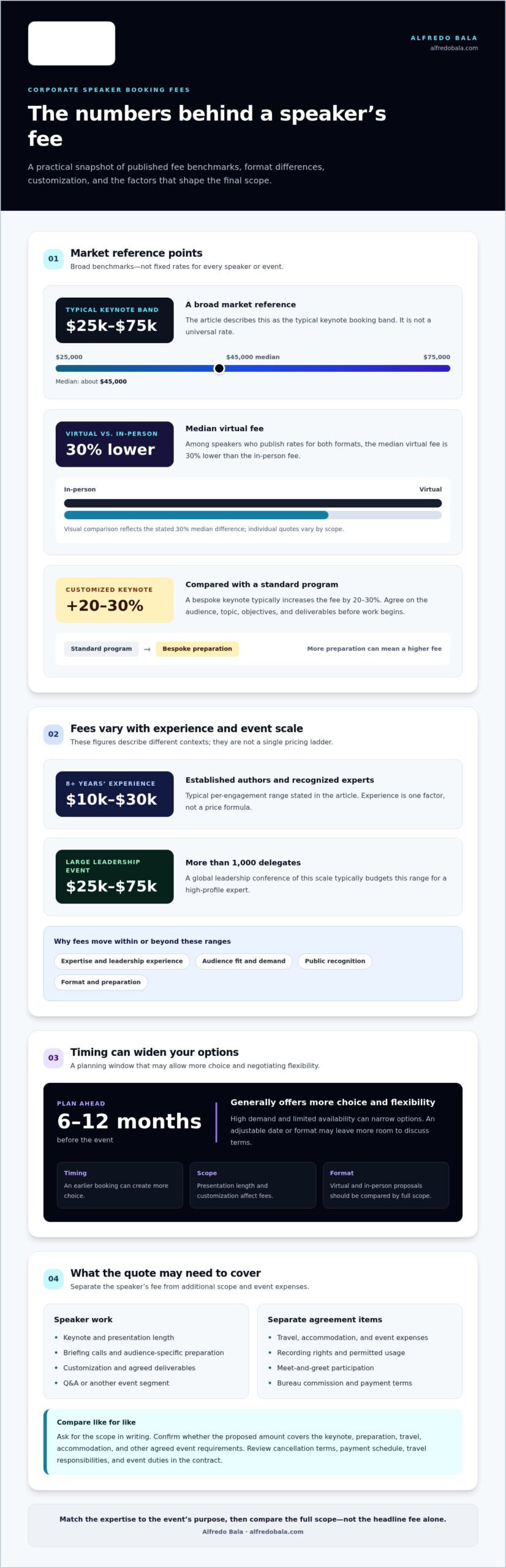
Often, yes, but the format alone doesn’t determine keynote speaker fees. Among speakers publishing rates for both formats, the median virtual fee is 30% lower than the in-person fee.
Audience size, preparation, and format can all affect pricing. For a conference or leadership event, compare the full scope of virtual and in-person engagements before setting your budget.
Travel and Event Expenses
Separate the speaker’s fee from travel and event expenses.
For an international engagement, account for the destination and format in your budget. A virtual event may avoid travel, but preparation and audience needs still shape the work. List expected expenses separately so you can compare in-person and virtual proposals on equal terms.
Ask for the scope in writing. Confirm whether the proposed amount covers the keynote, preparation, travel, accommodation, and other agreed event requirements.
Corporate and Institutional Budgets
Build a practical budget around the event’s purpose and audience.
For larger gatherings, a global leadership conference with more than 1,000 delegates typically budgets $25,000-$75,000 for a high-profile expert.
Academic institutions and nonprofits may have limited budgets, and some speakers may offer flexible or discounted rates. If booking through a speakers bureau, provide the event goal, audience, date, format, and budget so the bureau can identify suitable speakers and coordinate the engagement.
Before signing, review the contract’s scope, cancellation terms, payment schedule, travel responsibilities, and any agreed preparation or event duties. These details clarify what happens if plans change and when payments are due.
What’s included in a speaker’s fee beyond the keynote?
A keynote fee can cover more than the time a speaker spends onstage. The market’s typical keynote booking band is $25,000 to $75,000, with a median about $45,000. Treat that as a broad market reference, not a fixed rate for every speaker or engagement.
There is no single average fee that applies equally to celebrity, motivational, business, and technical speakers. Their fees reflect different factors: public recognition and demand for celebrities, performance goals for motivational speakers, leadership experience for business speakers, and specialist expertise for technical speakers.
As a practical step, ask the speakers bureau to itemize what the proposed fee covers. Clarify whether it includes briefing calls, keynote customization, audience-specific preparation, a question-and-answer session, or participation in another event segment. An established author may deliver a standard keynote, while a tailored presentation can involve additional preparation.
Customization is a material pricing factor: a bespoke keynote typically increases the fee by 20-30% compared with a standard program. Agree on the audience, topic, objectives, and deliverables before work begins. This helps distinguish a standard presentation from a customized engagement and makes proposals easier to compare.
Recording rights, meet-and-greets, and agency commissions can affect the overall agreement. Treat each as a separate contract item: specify whether recording is permitted and how it may be used, whether a meet-and-greet is included, and how any bureau commission is handled. Don’t assume these extras come with the keynote.
Format matters, too. Compare what each engagement includes, such as preparation, access, and usage rights, rather than judging value by delivery format alone.
Are speaker fees negotiable?
Yes, corporate speaker booking fees can be negotiable through changes to scope, timing, and format, not just the fee itself. A celebrity speaker in high demand may have different negotiating flexibility from a specialist whose expertise closely fits the event.
Start with the event’s purpose, audience, date, and desired outcomes. Then define the deliverables, such as a keynote, a workshop, or both. Longer presentations and extensive customization can increase fees, so a focused brief may make the scope more efficient while preserving the event’s goals.
Timing can shape your options. Booking six to twelve months before an event generally offers more choice and negotiating flexibility. High demand and limited availability can narrow your options, while an adjustable date or format may leave more room to discuss terms.
Consider value, not just name recognition. For a leadership event, match the speaker’s subject knowledge to the audience’s challenge before deciding whether a fee adjustment would improve the fit.
Organizations can also discuss their mission, scale, and potential for repeat engagements. Some speakers may offer flexible pricing to nonprofits or smaller organizations when they connect with the mission. Others may count bulk book purchases toward an honorarium or offer discounts for multiple bookings. These are possibilities to discuss, not automatic reductions.
Make a focused proposal that states your budget, audience, event format, and essential deliverables. Scope, timing, and format all inform corporate speaker booking fees. Ask whether adjusting the workshop scope, presentation length, or booking structure could bring the engagement within budget. A bureau can help communicate your priorities and explore suitable terms, while keeping value, not just a lower fee, in view.
Speaker fee ranges by experience level
Experience is a useful starting point for estimating keynote speaker costs, but it is not a price formula. Fees generally rise from emerging talent to established experts, while audience fit, demand, and profile can shift a speaker’s fee within or beyond those ranges.
These ranges don’t form a simple ladder. Experienced authors and recognized experts, including those with 8 or more years of experience, typically charge $10,000-$30,000 per engagement. That overlaps with professional-speaker ranges because years alone don’t determine a fee.
Subject expertise matters, too. A technical specialist may command more when their insight addresses a high-stakes conference need, while a celebrity’s public recognition and entertainment value can also shape demand.
Use the speaker’s profile as a guide, then assess the fit. For a leadership conference, a practitioner with directly relevant insight may offer more value than a famous name whose expertise does not match the audience. Compare proposals based on the event’s purpose, the speaker’s availability, customization needs, and travel.
Build your budget around the outcome you need, not the highest available tier. To connect leadership expertise with your event goals, explore leadership and team development insights.
Alfredo Bala (The Motivation Guy): The Motivation Equation
The Motivation Equation offers event planners a practical framework for bringing leadership and motivation into a corporate event. Consider it when your goal extends beyond a keynote to giving teams useful ideas they can apply at work.
Alfredo Bala (The Motivation Guy) offers speaking and leadership and team development insights for planners shaping events around leadership, team development, or organizational growth. The Motivation Equation provides a foundation for exploring motivation and leadership; the audience and event objectives can guide the focus.
For your speaker brief, outline the challenge facing the audience, the message you want them to take away, and how the presentation fits into the wider program. This makes it easier to connect the event’s purpose with a relevant leadership discussion.
Visit alfredobala.com to explore Alfredo Bala’s work and decide whether it fits your event’s goals.
Make the Next Booking a Strategic Choice
Before choosing a speaker, define what you want the audience to think, feel, or do differently after the event. That outcome gives your team a stronger basis for assessing corporate speaker booking fees than name recognition alone. It also sharpens the brief and connects the speaker’s perspective to your organization’s priorities.
For events focused on motivation and leadership, Alfredo Bala (The Motivation Guy) offers speaking, leadership and team development insights, and The Motivation Equation. These offerings can help planners shape a program around leadership and team development rather than treating the keynote as a standalone moment.
Build the next step around your event’s purpose: share the challenge, audience, and message you want to carry through the program. Contact Alfredo Bala (The Motivation Guy) to explore whether his work fits your event. A clear purpose is the beginning of a more meaningful experience for your audience.
Frequently Asked Questions
Does It Cost More to Book Through a Speakers Bureau?
Not necessarily. A bureau’s fee arrangement depends on the booking agreement. Before comparing proposals, request an itemized summary showing the speaker fee, any bureau charges, travel, and agreed extras. This helps you compare quotes covering the same services. A bureau can also coordinate the booking and suggest alternatives if your preferred speaker is unavailable.
Why do some sources quote a much higher average speaker fee?
“Average” can refer to different speaker groups and booking types. A list of celebrity speakers may produce a different figure from one focused on emerging specialists. Virtual and in-person bookings, event length, and customization can also affect fees. Before using a published figure to set expectations, check which speakers and formats it includes and whether it reports a median or an average.
What If My Speaker Budget Is Under $20,000?
A budget under $20,000 can still provide access to professional keynote speakers. Start by ranking your priorities: relevant expertise, audience fit, or broad name recognition. For example, a focused industry meeting may benefit more from a specialist with direct knowledge than from a nationally recognized personality. A clear topic and a well-defined brief help direct attention toward speakers suited to your event’s purpose.
Are Workshops, Meet-and-Greets or Additional Appearances Included?
Don’t assume these activities are included in a keynote booking. A workshop, reception appearance, or audience question session may require separate preparation and time. List each activity in the event schedule, then compare the requested scope with the written agreement. For example, specify whether the speaker should join a post-keynote discussion or attend a separate reception.
Is Presentation Customization Included?
Customization depends on the agreed presentation scope. A standard keynote differs from one tailored to an organization’s strategy, terminology, or current challenges. Share the audience profile, event objective, and essential themes early. Then agree on what tailoring involves, such as adapting examples or focusing on a particular leadership challenge, so expectations are clear before preparation begins.
Is a Keynote Speaker Worth the Cost?
A keynote is worth considering when its purpose is clear and the speaker’s expertise supports it. Define what the audience should take away, then assess whether the speaker can offer relevant insight that serves the wider program. For example, an event about team leadership calls for a speaker whose perspective fits that theme, not simply someone booked for visibility.
 EN
 ES
Recent Comments