
An important commitment slips. No one follows up, and soon another does too. Before long, accountability feels less like a shared standard and more like a source of anxiety. Building a culture of accountability starts with changing that pattern: make expectations clear, then follow through with fairness and respect.
Most leaders know missed commitments need attention. The harder question is how to address them without making people hide mistakes, shift blame, or stay silent when they see a problem. The answer isn’t softer standards. It’s pairing clear ownership with trust, so people can raise issues early and learn from what went wrong.
Drawing on leadership experience that includes serving as CEO of Mannatech Inc. and COO of Britt World Wide, Alfredo Bala explores how leaders can make accountability part of everyday team practice. You’ll learn to clarify outcomes and ownership, respond consistently when commitments are missed, and build an environment where people take responsibility and speak up. The result is a practical foundation for stronger motivation, trust, and team development.
Key Takeaways
- Make each commitment clear by defining the intended outcome, the owner, and what follow-through looks like.
- Give people the authority, resources, and information they need to take ownership and raise risks early.
- Build a culture of accountability without blame or micromanagement by pairing fair standards with trust and open communication.
- Use check-ins to surface obstacles, make decisions, and adjust course, not to track every task.
- Start small: choose one recurring team commitment, clarify expectations, and review how consistently it’s met.
What Building a Culture of Accountability Really Means
Important commitments can slip even when people are capable, motivated, and well-intentioned. A deadline passes because ownership was unclear. A risk goes unmentioned because no one knows who should raise it. The problem may not be effort. The team may not have agreed on what success looks like, who owns the outcome, or how people will follow through.
Building a culture of accountability means creating shared clarity around those agreements and treating them as part of everyday work. People understand what they’ve committed to, how their contributions connect to a result, and what to do when circumstances change. A useful understanding of accountability starts with the idea that people answer for actions and outcomes. In a team, that principle becomes a practical working agreement, not a search for someone to blame.
Accountability versus responsibility: what leaders need to clarify
Responsibility usually describes an assigned role or duty: the work someone is expected to perform. Accountability means owning an agreed outcome, including coordinating the work, communicating progress, and addressing obstacles. The concepts overlap, but they aren’t interchangeable. A person can complete a task responsibly while the broader outcome still lacks clear ownership.
Consider a project with a firm delivery date. Several contributors may be responsible for research, design, and review, while one project lead remains accountable for coordinating those pieces and communicating whether the deadline is at risk. That doesn’t make the lead responsible for doing everyone’s work. It makes ownership visible, so contributors know how their work fits and where to raise decisions or delays.
Why accountability is more than consequences
Consequences matter, but they aren’t limited to punishment. A response to a commitment can include recognizing excellent follow-through, providing support when someone lacks resources, correcting a missed standard, or resetting an agreement when priorities have changed. The right response depends on what happened and what the team needs next. Leaders build trust by applying expectations consistently, not by reacting harshly to every setback.
Accountability is owning an agreed outcome and addressing what happens next; blame assigns fault without creating a path forward. That distinction affects whether people speak up when a deadline is in danger or conceal the problem until it’s too late. When leaders respond fairly, team members can trust that commitments matter and that raising a concern won’t automatically invite punishment. That confidence supports motivation and makes shared agreements more dependable.
Over time, clear ownership and steady follow-through help teams execute with fewer avoidable surprises. People can resolve problems earlier because they know who needs to be involved, while leaders gain a clearer view of where support or decisions are needed. Accountability becomes a shared operating habit: commitments are taken seriously, obstacles are surfaced, and the team learns how to deliver together.
The Conditions That Make Accountability Work
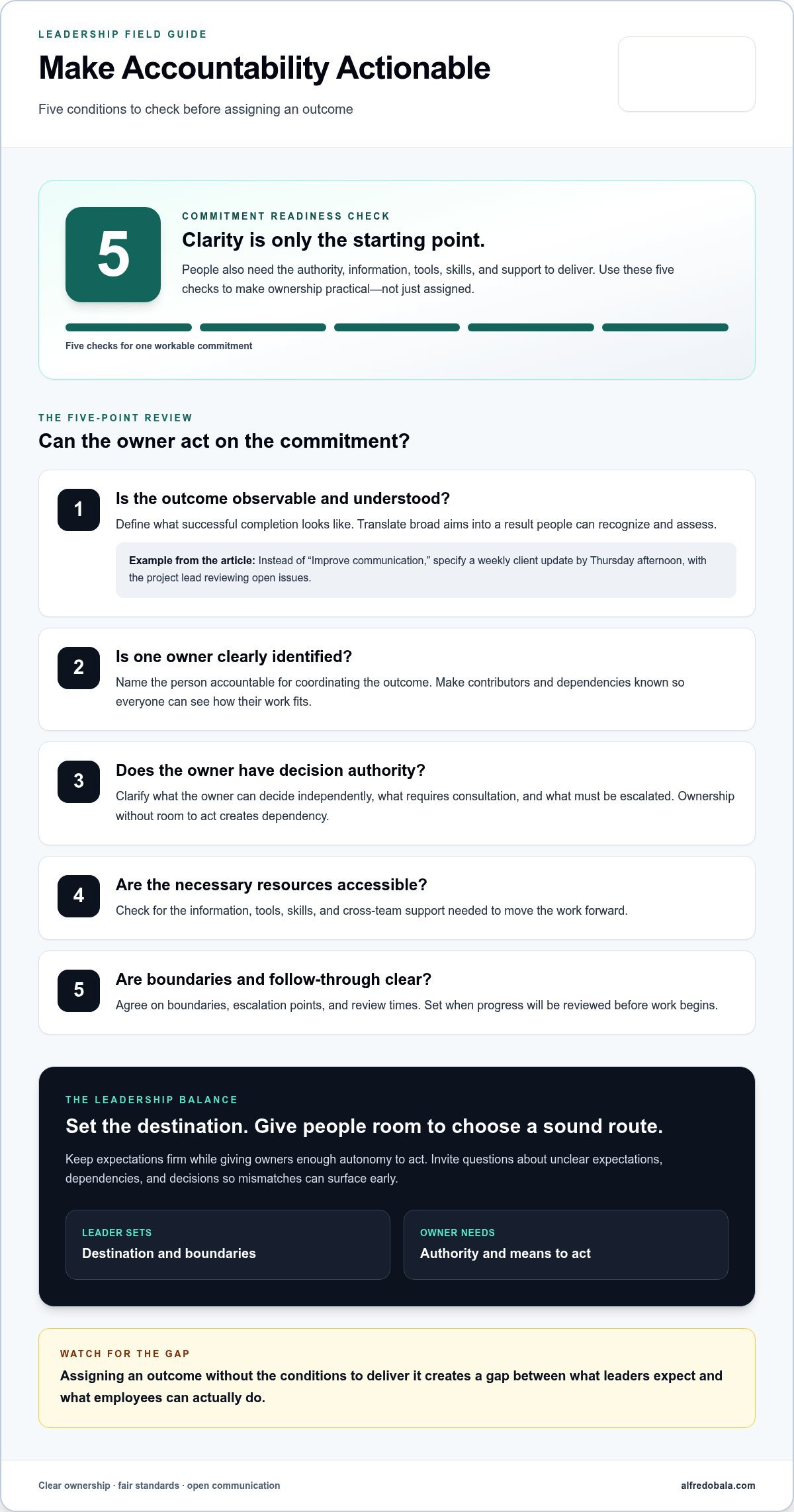
Clear standards are a starting point, not a complete system. A person can understand the target and still be unable to meet it without decision-making authority, timely information, practical tools, or support from other teams. Assigning ownership without addressing those conditions creates a gap between what leaders expect and what employees can actually deliver.
Building a culture of accountability means matching each commitment with the conditions to act on it. Leaders set the destination and boundaries; team members need enough autonomy to choose a sound route. That balance keeps expectations firm without turning every decision into an approval request.
Set expectations people can act on
Translate broad aims into observable results, named owners, and realistic timeframes. “Improve communication” is difficult to assess. “Send the weekly client update by Thursday afternoon, with the project lead reviewing open issues” gives people something concrete to deliver. Explain what successful completion looks like and when progress will be reviewed, so the standard is understood before work begins.
Then invite questions. Ask what might be unclear, what dependencies could affect delivery, and what decisions the owner expects to make independently. These conversations surface mismatched assumptions early, while there’s still room to adjust scope, timing, or support.
Pair ownership with trust, support, and resources
Before assigning an outcome, clarify decision authority: what can the owner decide, what requires consultation, and what must be escalated? Share the information, tools, skills, and cross-team support needed to move forward. If an employee is accountable for delivery but must wait for approval at every turn, the arrangement creates dependency rather than ownership.
Trust doesn’t mean leaving people to struggle alone. Make it safe to report a risk early by responding with curiosity and practical problem-solving, while keeping the commitment visible. A flagged obstacle is useful information and an opportunity to decide whether to remove a barrier, change the plan, or renegotiate the outcome.
Use this checklist in a team discussion or leadership review:
- Is the intended outcome observable and understood?
- Is one owner clearly identified, with contributors and dependencies known?
- Does the owner have authority to make the necessary decisions?
- Are the required information, tools, skills, and support accessible?
- Are boundaries, escalation points, and review times clear?
- Can people raise risks early without losing ownership of the next step?
Consider a team responsible for publishing a monthly performance summary. The owner needs access to current figures, input from relevant colleagues, and authority to resolve routine content questions. Leaders can define the quality standard and publication date, then let the owner organize the work within those limits. If a data delay threatens the date, a clear escalation path enables an early decision instead of a last-minute surprise.
Review these conditions whenever expectations are missed. The cause may be an unclear target, a decision bottleneck, or a resource gap, rather than a lack of commitment. For more perspective on how motivation and leadership shape team ownership, explore Alfredo Bala’s leadership insights.
Accountability Without Blame, Fear, or Micromanagement
Accountability doesn’t mean leaders must control every action. Micromanagement can make people wait for permission instead of using judgment, while blame can make them conceal problems. Building a culture of accountability requires a different response: keep the agreed standard visible, give people room to act, and address missed commitments with fairness and curiosity.
Start with facts, not a verdict about someone’s character. A missed deadline tells you the outcome wasn’t delivered; by itself, it doesn’t explain why. The expectation may have been misunderstood, priorities may have changed, or an obstacle may have gone unraised. Find out what happened before deciding what response fits.
| Approach | Leader’s response | Likely effect |
|---|---|---|
| Blame | Assigns fault or uses labels before understanding the facts. | People may become defensive or hide problems. |
| Avoidance | Lets a missed commitment pass without discussion. | Expectations lose meaning, and the same gap can recur. |
| Micromanagement | Controls each step instead of focusing on the agreed result. | Initiative weakens as people wait for direction. |
| Constructive accountability | Clarifies what was agreed, examines what changed, and establishes a next step. | Standards stay clear while learning and ownership remain possible. |
How to respond when a commitment is missed
Keep the conversation direct and specific. Restate the agreed expectation and describe the observable gap without speculating about effort or intent. Then ask: What changed? What obstacle emerged? What support or decision would help now? Listen for facts and dependencies, not just explanations.
End with a recovery agreement. Name the next action, who owns it, and when you’ll review progress. If the original deadline or scope no longer makes sense, agree on a realistic reset rather than leaving the commitment unresolved. A clear next step turns a difficult conversation into forward movement.
Make consequences fair, proportionate, and consistent
Context matters. An isolated mistake may call for reflection and a practical adjustment. A changed constraint may require support or a revised agreement. A repeated pattern of unaddressed behavior calls for a firmer conversation about expectations and impact. Apply shared standards consistently, while tailoring the response to the circumstances and consequences of the miss.
Follow-through can also recognize strong ownership: someone flags a risk early, helps repair a problem, or delivers reliably. Recognition, coaching, correction, and a reset all have a place. The goal isn’t to make every missed commitment feel identical. It’s to ensure people know that commitments matter, concerns can be raised honestly, and the next action will be addressed.
Leaders set that tone through their own behavior. Acknowledge when your decision contributed to a delay, keep your commitments visible, and follow through on agreed actions. Consistency protects trust without lowering the standard. People can take responsibility more confidently when they see that accountability applies across the team, including to those who lead it.
A Practical Leadership Cycle for Building Accountability
Accountability becomes part of daily work when leaders turn it into a repeatable cycle, not an occasional conversation after something goes wrong. The cycle connects a clear target to ownership, support, progress reviews, and learning. Each step gives the team a chance to act, spot trouble early, and adjust with purpose.
Accountability is a leadership practice: define the promise, support the work, review the facts, and use what you learn to improve the next commitment.
- Define the outcome. Describe the result in terms people can observe, including its purpose, quality standard, and timing. For a broad priority such as improving customer onboarding, specify what a completed deliverable should contain and how the team will know it’s ready. A precise outcome gives progress reviews a shared reference point.
- Agree ownership. Name one person to coordinate the result, then identify contributors, dependencies, and decision points. Ownership shouldn’t obscure shared effort; it should make coordination clear. Confirm who needs to provide input, who can approve changes, and which decisions the owner can make independently.
- Enable action. Provide access to the information, tools, skills, and support required to move forward. Agree on milestones and what evidence will show progress at each stage. Set a simple expectation for raising risks or requesting help, such as flagging a blocked dependency as soon as it threatens a milestone.
- Check progress. Hold proportionate check-ins around meaningful milestones or changes in risk. Ask what has moved forward, what is blocked, and what decision or support would help. These conversations are for surfacing issues and coordinating action, not inspecting every task or measuring commitment by constant availability.
- Learn and reset. At completion, compare the result with the agreed outcome. Recognize what worked, identify where the plan or process created friction, and decide what to change. If priorities shift before completion, renegotiate scope or timing explicitly. Don’t allow a changed expectation to become an unspoken new standard.
Make the cycle visible. Record each commitment, owner, milestone, dependency, and decision in one shared place the team already uses. A concise record reduces reliance on memory, helps colleagues see how their work connects, and makes it easier to identify when an assumption or dependency has changed. Keep it useful rather than elaborate; the purpose is shared understanding, not administration for its own sake.
For example, if a milestone depends on another team’s approval, record who will provide it and when it’s needed. In a check-in, the owner can report whether that dependency is on track and raise a risk before it affects delivery. The team can then make a decision, adjust sequencing, or revise the commitment together.
Start with one important team priority and run the full cycle. Over time, building a culture of accountability becomes less about chasing updates and more about keeping agreements clear, decisions timely, and learning continuous. Explore Alfredo Bala’s leadership insights to deepen your approach to leading teams and strengthening ownership.
Make Accountability a Leadership Habit That Strengthens Teams
A culture takes shape through repeated leadership choices. Teams notice whether leaders honor commitments, acknowledge changing circumstances, invite candid updates, and apply expectations consistently. If a leader asks people to take ownership but avoids their own follow-through, the standard quickly loses credibility. Model the conduct you expect, especially when a conversation is uncomfortable.
Building a culture of accountability doesn’t require a sweeping rollout. Begin with one recurring commitment that causes friction because ownership or follow-through is unclear. A regular project handoff, status report, or cross-team approval can be a useful starting point. Choose something meaningful enough to matter, but focused enough for the team to review and improve.
Start with one team commitment and build from there
Bring the people involved together and agree on the result, the owner, the support required, and how progress will be reviewed. Clarify what should happen if priorities shift or a dependency threatens delivery. Then use the agreed process consistently, rather than introducing new rules each time a problem appears.
After the next review, ask what became clearer, where coordination still stalled, and what the team should adjust. Refine the commitment before extending the practice to other priorities. A small, deliberate improvement gives people a concrete example of accountability in action and helps leaders learn which expectations need more definition.
Connect accountability with motivation and leadership growth
Accountability is part of the broader work of developing motivated, capable teams. People are more prepared to own their contribution when they understand its purpose, have room to use their judgment, and see leaders uphold shared agreements. These conditions don’t guarantee a particular result, but they give teams a stronger basis for consistent effort, honest communication, and learning.
Leaders looking to deepen this perspective can explore The Motivation Equation, Alfredo Bala’s book on motivation and leadership. His professional speaking and executive advisory work also brings leadership insights to team development and organizational growth.
For your next team meeting, select one recurring commitment and ask three direct questions: What outcome are we agreeing to? Who will own coordination? How will we review progress and respond if circumstances change? Capture the answers, put the agreement into practice, and return to it at the next review. That is a clear first step toward making accountability a leadership habit rather than a one-time initiative.
For further perspectives on motivation, team development, and organizational growth, explore Alfredo Bala’s leadership insights and consider how they can inform your team’s next commitment.
Turn One Commitment Into a Team Standard
Choose one recurring promise your team makes and use it as a practical test of its working culture. Make the agreement visible, invite people to say what could get in the way, and revisit it after the next review. The aim isn’t to create another process to maintain. It’s to make reliable follow-through part of how the team works together.
Building a culture of accountability takes consistency, especially from leaders. Your response when plans shift, concerns surface, or commitments are met teaches the team what ownership looks like in practice. Small, repeated choices can shape stronger habits over time.
Alfredo Bala’s perspective draws on a career that includes active involvement in the networking profession since 1980 and leadership across business environments. For more ideas on motivation, leadership, and team development, explore Alfredo Bala’s leadership insights.
Take the next step today: choose one commitment, clarify what the team is agreeing to, and review how the practice serves everyone involved. For leadership perspectives on motivation and team development, explore Alfredo Bala’s leadership insights.
Frequently Asked Questions
What is a culture of accountability?
A culture of accountability is a shared way of working in which people understand what they’ve agreed to deliver, how progress will be discussed, and where to turn for support. It’s more than a written policy or a punishment system. For example, a team might agree to raise a delivery risk as soon as it appears, rather than waiting for a scheduled report. Leaders shape the culture by responding fairly and keeping their own commitments.
How do you build accountability in the workplace?
Build accountability through repeated practice, not a single announcement or meeting. Choose a real team priority, define what completion means, name an owner, and make sure that person has appropriate authority and resources. Agree on a useful progress review, then follow through on decisions. After the work is complete, ask whether expectations were clear and what created delays. Building a culture of accountability starts with one workable commitment, then improves as the team learns together.
What is the difference between accountability and responsibility?
Responsibility commonly refers to a person’s role or contribution; accountability focuses on owning an agreed result and communicating how it’s progressing. Teams may use the words differently, so clarify their meaning in your workplace. For example, several colleagues might prepare sections of a client proposal, while one project lead coordinates the full draft and reports whether it’s ready for review. Shared contributions remain clear, and ownership of the overall result doesn’t disappear.
How can leaders hold employees accountable without micromanaging?
Set the result, decision boundaries, and review points, then let employees choose how to complete the work within those limits. A manager overseeing a presentation might agree on its audience, purpose, and review date without approving each slide as it’s created. Use check-ins to discuss progress or obstacles, not to request a running account of every action. If delivery falls short, return to the original agreement and establish the next step together.
What should a manager do when an employee misses a commitment?
Speak privately and address the gap promptly. Identify the agreed deliverable and the observable difference between the plan and what happened, then ask what changed. If a supplier delay disrupted a report, for instance, clarify what can still be delivered and what decision is needed. Agree on a realistic recovery action and follow-up point. If the same issue recurs, discuss the pattern and apply expectations consistently rather than letting it pass without resolution.
Can accountability improve trust and team performance?
Accountability can support trust and team performance when people can rely on fair treatment, clear agreements, and honest updates. It can also expose problems sooner, giving a team more time to respond. But accountability alone won’t guarantee trust or strong results. If someone lacks access to essential information or faces inconsistent expectations, the process may feel unfair. Leaders can strengthen the conditions for ownership by listening to concerns and acting on barriers the team identifies.
How do you measure accountability in a team?
Measure practices that reflect how your team works, rather than assigning people a universal accountability score. For example, review whether each priority has a clear owner, whether agreed milestones are discussed, and whether at-risk commitments are raised before deadlines pass. Also track whether plans are completed or explicitly renegotiated when circumstances change. Discuss patterns as a team and use them to improve coordination or clarity, not to rank people or assign blame.
 EN
 ES
Recent Comments