
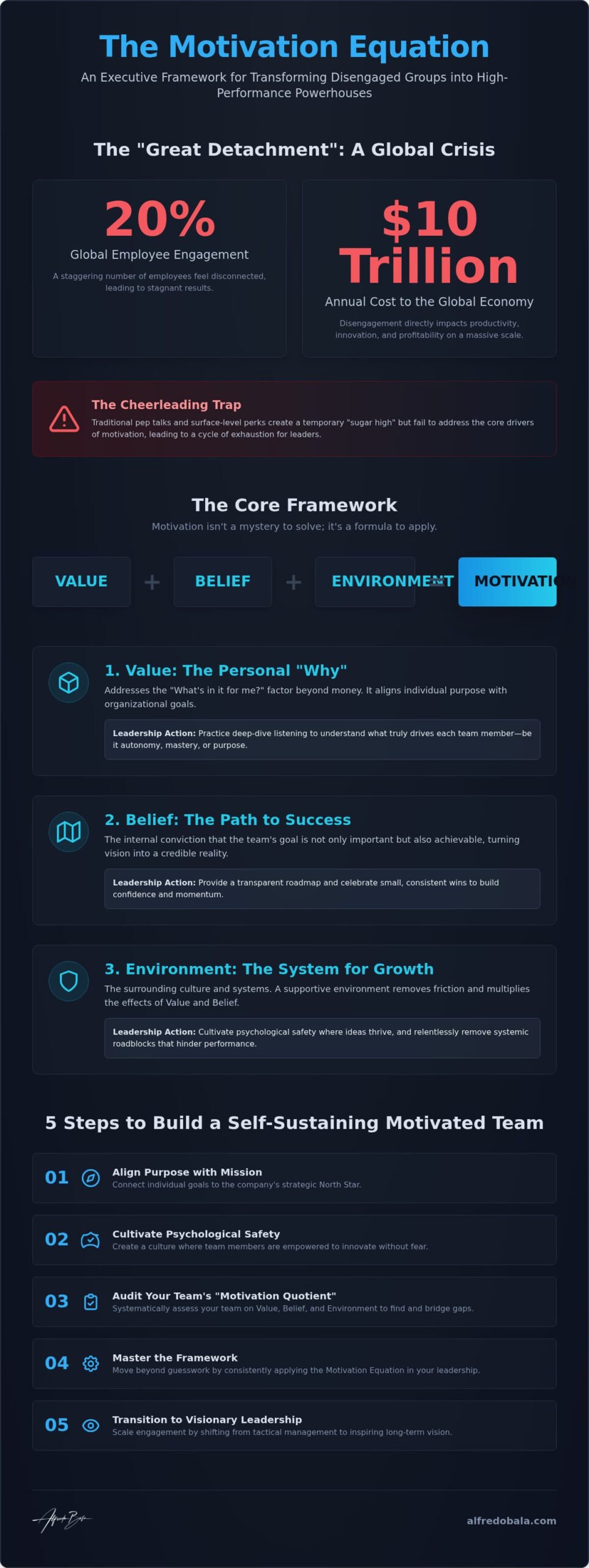
If you feel like you are constantly cheerleading a team that just won’t cheer back, you aren’t alone. Global employee engagement plummeted to just 20% in 2025, leaving executives exhausted and results stagnant while the “Great Detachment” costs the global economy an estimated $10 trillion. You know that traditional pep talks and surface-level perks aren’t the answer to how to build motivated teams in a complex, hybrid world. It is draining to carry the weight of an entire department’s productivity on your shoulders while watching high-potential talent walk out the door. You deserve a team that operates with the same level of ownership and urgency that you do.
I’ve spent 40 years at the helm of global organizations, and I have learned that high performance isn’t a stroke of luck or a personality trait. It’s the predictable result of a specific leadership formula. This article introduces the Motivation Equation, a battle-tested executive framework designed to transform disengaged groups into high-performance powerhouses. We’ll explore how to move beyond the exhaustion of constant oversight to create a self-sustaining culture that delivers predictable results under pressure. By mastering these mechanics, you’ll build a leadership legacy that develops top talent and drives sustainable global growth.
Key Takeaways
- Move beyond the “cheerleading trap” by aligning individual purpose with your organization’s core mission for sustainable results.
- Master a battle-tested executive framework on how to build motivated teams that maintain high performance even in complex, hybrid environments.
- Create a culture of psychological safety where collective intelligence thrives and team members feel empowered to innovate without fear.
- Audit your team’s current Motivation Quotient to bridge the gap between individual goals and your company’s strategic North Star.
- Transition from tactical management to visionary leadership to scale engagement and performance across global operations.
Beyond the Carrot and the Stick: Why Traditional Motivation Fails in 2026
Stop trying to buy loyalty with gift cards and quarterly bonuses. It doesn’t work. In the 40 years I’ve spent leading global organizations, I’ve seen countless executives fall into the trap of thinking motivation is something you do to people. It isn’t. Motivation is an internal engine that only ignites when an individual’s personal purpose aligns perfectly with the organizational mission. If those two forces aren’t in sync, you’re just pushing a car with no fuel.
I call this the “Cheerleading Trap.” You stand in front of the room, deliver a rousing speech, and see a temporary spike in activity. But by Tuesday afternoon, the energy has evaporated. External pep talks are a sugar high. They’re short-lived because they don’t address the underlying mechanics of human performance. When you’re looking for how to build motivated teams, you have to look deeper than the next “all-hands” meeting. You need a framework that creates a self-sustaining fire rather than a series of small, expensive sparks.
We need to reframe our entire approach to leadership. Team motivation is a high-yield strategic asset that powers global growth, rather than a mere human resources metric to be tracked on a spreadsheet.
The Limits of Extrinsic Rewards
Money is a hygiene factor. It’s essential to keep people from being unhappy, but it’s rarely what makes them exceptional. Think about the last time you gave a significant bonus. By the following quarter, that new level of income has become the baseline. This is the psychological hedonic treadmill at work. Once the initial excitement wears off, the “spark” vanishes. To master how to build motivated teams, you must pivot from transactional leadership, where you trade dollars for hours, to transformational leadership. You need to offer a vision that people want to own, not just a paycheck they want to collect.
The Complexity of Modern Team Dynamics
The rules of engagement have shifted. Remote and hybrid work models have stripped away the incidental social cues that used to sustain office culture. You can’t rely on “water cooler talk” to build rapport anymore. Today’s workforce is increasingly purpose-driven; they aren’t just looking for a job, they’re looking for a mission that justifies their talent. If you use a one-size-fits-all management style, you’ll alienate your top performers. Understanding the core psychological drivers behind The Motivation Equation is the only way to navigate these complexities. You must treat motivation as a science, balancing the discipline of strategy with the art of human connection.
The Motivation Equation: A Strategic Framework for Human Performance
Motivation is not a mystery to be solved; it’s a formula to be applied. In my four decades of global leadership, I’ve found that the difference between a stagnant group and a high-velocity team lies in three specific variables: Value, Belief, and Environment. This is the core of the Motivation Equation. It moves leadership away from the realm of guesswork and into the domain of strategic precision. If you want to master how to build motivated teams, you must stop looking at your staff as a monolith and start looking at the individual variables driving their daily performance.
Value is the first pillar. It represents the “What’s in it for me?” factor that goes far Beyond the Carrot and the Stick approach of traditional management. Belief is the second pillar. It’s the internal conviction that the goal is attainable and the path is visible. Finally, Environment is the system that surrounds them. If the environment is filled with friction, even the most valued and believing employee will eventually burn out. When these three variables are aligned, engagement becomes the natural byproduct of the system rather than a forced effort.
Defining the Variables of Influence
To maximize Value, you must practice deep-dive listening. You can’t assume you know what drives your people. For some, it’s autonomy; for others, it’s the chance to solve complex global problems. Building Belief requires more than just a vision statement. You need to provide a transparent roadmap and celebrate small wins that prove the strategy is working. When you optimize the Environment, your job is to remove the obstacles that prevent flow. A motivated team needs space to focus, not a calendar full of redundant meetings. If you find these concepts resonate, you might want to explore The Motivation Equation: A Masterclass in Leadership and Human Performance for a deeper dive into these mechanics.
Applying the Equation to Daily Leadership
This framework serves as a powerful diagnostic tool. When an individual’s performance dips, don’t just reach for a disciplinary plan. Instead, ask yourself: Is the Value missing? Have they lost Belief in the mission? Or is the Environment toxic? You must also tailor your approach to personality types. An “Achiever” is often driven by the Value of mastery and individual recognition. A “Relator” might find more Value in team cohesion and shared success. By adjusting these variables, you create a customized roadmap for how to build motivated teams that can weather any market shift. For more insights on refining your personal leadership style, visit alfredobala.com to see how we can elevate your executive impact.
Cultivating the Environment: Psychological Safety and Collective Intelligence
Design your environment before you demand performance. If psychological safety is the “operating system” of your organization, then motivation is the software that runs on top of it. When the OS is riddled with bugs, fear, or silence, no amount of talent can prevent a system crash. To understand how to build motivated teams, you must first acknowledge that your role has shifted. You are no longer the “commander” who dictates every move; you are the “architect” who builds a space where collective intelligence can flourish. This environment is the foundation upon which the Motivation Equation operates.
In a “fail-forward” culture, the leader is the first person to admit a mistake. This isn’t a sign of weakness. It’s a strategic move that grants your team the permission to take calculated risks. When employees see that failure is treated as data rather than a disaster, they stop playing it safe and start playing to win. This shift is essential in an era where 82% of workers state that meaningful learning opportunities are the primary driver of their engagement. By moving from a “command and control” model to a “guide and empower” model, you unlock the creative potential that micromanagement inevitably smothers.
Building a Culture of Trust
Trust isn’t built through corporate retreats or annual trust falls. It’s built through the consistent daily practice of vulnerability. High-performance output is directly proportional to the level of trust within a group. You must create a space where dissent is not only allowed but actively encouraged. If everyone in the room agrees with you, most of them are redundant. For global, virtual teams, building trust requires specific intentionality. Use “micro-connections” like brief, non-work video check-ins to replace the social cohesion lost in the hybrid transition. This is a fundamental pillar of how to build motivated teams that can operate across time zones without losing momentum.
Leveraging Diversity for Strategic Impact
The most complex problems of the 2026 economy cannot be solved by a single expert. They require the “wisdom of select crowds.” By integrating global perspectives into a unified team identity, you tap into a reservoir of collective intelligence that a homogenous group simply cannot access. This isn’t about checking a box; it’s about gaining a strategic advantage. When you bring together diverse “Whys” and align them under one North Star, you create a force that is greater than the sum of its parts. Mastering these Executive Leadership Development Strategies for Global Growth in 2026 ensures that your organization remains agile as AI and market shifts continue to redefine the professional landscape.
Five Steps to Building a Self-Sustaining, Motivated Team
Execution is where strategy meets reality. You’ve understood the theory of the Motivation Equation and the necessity of psychological safety, but now you must translate those concepts into a repeatable process. Building a team that performs under pressure without constant supervision isn’t a result of luck. It’s the result of a disciplined, five-step sequence that turns disengaged workers into invested stakeholders. If you’re serious about how to build motivated teams, you must be willing to move beyond occasional check-ins and commit to a structural transformation of your leadership approach.
- Step 1: Audit the Motivation Quotient. You can’t fix what you haven’t measured. Determine where your team stands today against global engagement benchmarks.
- Step 2: Align individual ‘Whys’ with the North Star. Find the intersection between what your people care about and where the company is going.
- Step 3: Implement transparent communication loops. Create systems where feedback flows in both directions, ensuring that no one feels like a cog in a silent machine.
- Step 4: Empower through autonomy. Give your people clear ownership of results rather than a list of tasks to check off.
- Step 5: Celebrate progress. Recognize the milestones that prove the system is working, reinforcing the belief that the goal is achievable.
From Audit to Alignment
Start with “Stay Interviews” instead of waiting for exit interviews to tell you what went wrong. With global employee engagement hovering at just 20% in 2025, you need to understand exactly what keeps your top talent at the table. Ask them what meaningful learning opportunities they crave, as 82% of employees cite development as a primary driver of their commitment. Once you have this data, craft a team charter that reflects these shared values. This process allows you to identify and eliminate “energy vampires” and bureaucratic friction that slow down your high performers. When you align personal ambition with corporate objectives, you solve the riddle of how to build motivated teams at the foundational level.
Empowerment and Accountability
Shift your focus from hours logged to outcomes achieved. This “Outcome-Based Management” approach is the only way to lead effectively in a hybrid world. You must delegate authority, not just tasks. When you give a team member the power to make decisions, you’re telling them that you trust their expertise. This trust is the fuel for the Motivation Equation. To ensure that trust translates into measurable results, it’s essential to track the team performance metrics for leaders that reveal whether your empowerment strategy is actually moving the needle. Finally, design a recognition system that reinforces your core values. Don’t just reward the final destination; celebrate the grit and innovation it took to get there. To see how these principles can be integrated into your specific corporate board or executive strategy, you can master these leadership mechanics through my proprietary framework.
From Manager to Visionary: Scaling Motivation Across Global Organizations
Scaling the Motivation Equation is the ultimate test of executive mastery. It is one thing to drive performance within a small, tight-knit group where you can personally touch every variable. It is quite another to inspire a workforce of thousands across different cultures, languages, and time zones. To succeed at this level, you must transition from a tactical manager to a visionary guide. You have to institutionalize the mechanics of how to build motivated teams so that the culture remains self-sustaining even when you aren’t in the room. This is how you move from individual impact to a global legacy. If you’re looking for a structured approach to this challenge, the 2026 Executive Readiness Checklist for building high performance teams offers a disciplined blueprint for turning individual brilliance into collective execution at scale.
Leading through uncertainty is the hallmark of the visionary. Whether your organization is navigating a merger, an acquisition, or a massive strategic pivot, the variables of Value and Belief are often the first to erode. People fear what they don’t understand. During these high-pressure transitions, your role is to restore clarity. You must over-communicate the “North Star” and ensure that every employee understands how the change enhances their personal Value. Sometimes, a culture reset requires an outside catalyst to break through organizational inertia. Engaging a keynote speaker for organizational growth can provide the external perspective and infectious energy needed to realign a global collective around a new vision.
Strategic Influence at Scale
Communication is your primary tool for influence at scale. You cannot rely on a single memo to shift a global mindset. You need internal branding that makes the mission feel personal to an engineer in Tokyo and a sales lead in New York. The CEO must act as the “Chief Motivation Officer,” consistently reinforcing the “Why” behind every strategic move. When you communicate vision so it resonates across diverse backgrounds, you create a unified team identity. This alignment is the secret to how to build motivated teams that can execute complex global strategies with precision and speed.
Sustainable Leadership for the Long Haul
Legacy is built through the leaders you develop, not just the targets you hit. You must prioritize mentorship and executive advisory to shape the next generation of leadership. These future visionaries need to understand the science of human performance as deeply as they understand the balance sheet. At the same time, you have to protect your own energy. Leader burnout is a silent killer of organizational momentum. By building a robust mentorship pipeline, you distribute the weight of leadership and ensure high team energy for the long haul. Remember that motivation is a discipline, not a destination. It requires constant refinement, a steady hand, and a heart that is personally invested in the elevation of others.
Master the Science of Human Performance
Motivation is not a feeling; it is a discipline. You’ve seen that the “cheerleading trap” is a temporary fix for a structural problem. By applying the strategic variables of Value, Belief, and Environment, you move from the exhaustion of micromanagement to the clarity of strategic alignment. You now have the foundational blueprint for how to build motivated teams that thrive in the hybrid economy. It is about building a culture of psychological safety where collective intelligence solves global problems before they ever reach your desk.
This framework isn’t just theory. It is built on 40 years of global leadership experience and the practical strategies I’ve used to scale multi-billion dollar organizations. You have the potential to transition from a manager of tasks to a visionary of people. Your journey doesn’t end here; it begins with the daily application of these mechanics. The world needs leaders who can turn potential into performance with precision and heart.
Ready to take the next step in your development? Master the mechanics of influence with The Motivation Equation book. Your team is waiting for the visionary leader you are about to become.
Frequently Asked Questions
What is the fastest way to motivate a disengaged team?
The fastest way to re-ignite a disengaged team is to identify the specific friction point where their personal goals have decoupled from the company’s mission. You must stop guessing and start listening to their individual “Whys.” Once you align their daily tasks with what they actually value, you provide an instant sense of purpose. This tactical shift creates immediate momentum that a generic pep talk can never achieve.
Can you build a motivated team without increasing salaries?
You can absolutely build a motivated team without a budget increase because money is primarily a hygiene factor rather than a long-term driver. While fair compensation prevents dissatisfaction, true engagement comes from mastery, autonomy, and a clear sense of purpose. Focus on increasing the “Value” variable in the Motivation Equation by offering meaningful learning opportunities and granting your people greater ownership over their results.
How do you motivate a remote team that never meets in person?
Motivating a remote team requires intentional micro-connections and a radical commitment to transparent communication loops. Without the social cues of a physical office, you must replace incidental talk with structured feedback and clear ownership of outcomes. When you master how to build motivated teams in a virtual setting, you rely on the strength of your “Environment” variable to ensure every member feels seen despite the distance.
What are the most common leadership mistakes that kill motivation?
The most destructive mistakes are micromanagement and falling into the “Cheerleading Trap” of empty slogans without a roadmap. Micromanagement signals a fundamental lack of trust, which instantly erodes psychological safety and belief in the goal. Similarly, if you provide a vision without clear ownership, your team will eventually burn out from the friction. High-performance teams require a “guide and empower” approach rather than “command and control.”
How does the Motivation Equation differ from traditional management theories?
The Motivation Equation is a diagnostic framework rather than a static list of psychological needs. While traditional theories describe what people need in a general sense, this equation provides a specific formula (Value x Belief x Environment) that leaders use to identify exactly where performance is breaking down. It is a results-oriented system designed for the high-pressure realities of global business rather than an abstract academic exercise.
What role does psychological safety play in team performance?
Psychological safety is the operating system that allows your team to function at peak capacity without the drag of fear. Without it, your people will hide mistakes and avoid the calculated risks necessary for innovation. When a leader fosters a “fail-forward” culture, they create an environment where collective intelligence can flourish. This safety is the non-negotiable foundation that makes every other part of the Motivation Equation possible.
How do you handle a high-performer who is negatively impacting team morale?
You must address the behavior immediately because no level of individual output justifies a toxic team environment. A “brilliant jerk” can destroy the psychological safety you’ve worked hard to build, causing your other top talent to disengage. Use the Motivation Equation to diagnose if their behavior stems from a lack of alignment or a toxic personal environment. Be prepared to move them if they refuse to adapt to the team’s core values.
How often should a leader conduct motivation audits?
I recommend conducting a formal motivation audit at least once every quarter to stay ahead of market shifts. The global economy and team dynamics move too quickly for an annual review to be effective anymore. By checking the Motivation Quotient of your organization four times a year, you can spot declining engagement early. This allows you to adjust your how to build motivated teams strategy before it impacts your bottom line.
 EN
EN  ES
ES
Recent Comments