
What if your team’s silence isn’t a lack of ideas, but a reaction to what happens after someone speaks? Building psychological safety in the workplace starts with everyday responses to hard questions, dissenting views, and admitted mistakes. When employees raise concerns only in private, leaders lose the chance to address risks while there’s still time to act.
It’s reasonable to worry that openness could weaken standards or slow decisions. But psychological safety isn’t about avoiding conflict or excusing poor performance. It’s about making candor possible while keeping accountability clear. People need to know they can speak honestly without being humiliated or punished for raising a concern.
This guide covers practical ways to invite questions, respond to disagreement, follow up on concerns, and check whether your efforts are changing real conversations. The goal isn’t a symbolic initiative. It’s a workplace where speaking up helps the team learn, decide, and deliver.
Key Takeaways
- Build psychological safety through the responses people experience repeatedly, not declarations alone.
- Use curiosity, attentive listening, and genuine thanks to make it easier for employees to raise concerns and challenge ideas.
- Pair open discussion with clear expectations and follow-through. Candor and high standards can reinforce each other.
- Put building psychological safety in the workplace into practice with a 30-day cycle: listen, choose one behavior, practice, then review and adjust.
- Protect confidentiality when gathering input, and recognize which barriers require action beyond an individual leader’s control.
What does building psychological safety in the workplace actually mean?
Imagine a team reviewing a project plan when an employee spots a risk: a key handoff may happen before the necessary checks are complete. They start to speak, then pause. The leader is pressed for time, the room seems ready to move on, and the concern goes unspoken. The risk hasn’t disappeared. The team has lost a chance to examine it.
Building psychological safety in the workplace means creating a shared sense that people can take interpersonal risks at work: asking a question, admitting uncertainty, offering an idea, or respectfully challenging a decision. The Psychological safety overview traces the concept and its connection to workplace learning. In practice, the question isn’t whether every conversation feels comfortable. It’s whether people can contribute without expecting humiliation or retaliation.
What psychological safety is, and what it is not
Safety isn’t a promise that every suggestion will be adopted, every disagreement resolved in someone’s favor, or every mistake free from consequences. Performance expectations, deadlines, and accountability still matter. The difference is that people can raise relevant information and have it considered on its merits.
Respectful disagreement addresses an idea, decision, or risk. A personal attack targets the person. Neither automatic consensus nor conflict avoidance is the goal. Teams need room to test assumptions, while leaders remain responsible for making decisions and explaining what happens next.
Why workplace psychological safety starts with everyday interactions
People read the climate through small moments: whether a leader interrupts a question, dismisses a concern as obvious, or makes space for someone to finish. A manager might respond to a raised risk with, “Walk us through what you’re seeing,” instead of immediately defending the plan. That invitation doesn’t settle the issue, but it makes examination possible.
Psychological safety means you can speak honestly at work, even when your view is uncertain or unpopular, and expect a fair hearing. It doesn’t require agreement. It does require room to discuss the substance without punishing the act of speaking.
Candid questions, concerns, and ideas give a team more information to work with. A question may uncover an assumption; a concern may prompt a closer look at a potential problem; a different idea may reveal an option the group hadn’t considered. None guarantees a better outcome on its own. But when people withhold what they notice, decisions are made with less of the team’s knowledge.
Psychological safety is most visible in ordinary interactions, especially when a conversation is inconvenient. Leaders don’t need to agree with every challenge. They do need to make it worthwhile for people to raise one.
How leaders build psychological safety through consistent responses
A leader’s response to candor teaches the team what to expect next time. A statement about openness may set an intention, but repeated actions establish the standard: whether questions are heard, uncertainty is acknowledged, and concerns receive follow-through. Building psychological safety in the workplace is less about saying “speak freely” and more about making that invitation credible in everyday interactions.
These habits also align with the U.S. Surgeon General’s framework for workplace mental health and well-being, which treats protection from harm and worker voice as important parts of a healthy workplace. Leaders can put that principle into practice by inviting input before a decision is final, listening without rushing to defend, and thanking people who surface a difficult issue.
How to invite questions, ideas, and disagreement
Ask questions that make room for a different view: “What might we be missing?” or “What concerns should we resolve before we decide?” Pause long enough for people to think. Offer written input or a follow-up conversation as alternatives to speaking in a group, rather than unexpectedly calling on quieter employees.
People learn whether it’s safe to speak by watching what a leader does with the last person who did.
How to respond when someone raises a concern
Listen without interruption, then reflect back the point: “You’re concerned the handoff could leave the review incomplete. Have I understood?” Thank the person for raising it, clarify what you’ll check, and explain when or how you’ll report back. Even if the concern doesn’t change the decision, closing the loop shows that speaking up led to consideration, not a dead end.
Disagree with the idea, not the person. A leader might say, “I see why that option could help. I’m not convinced it addresses the timing risk, so let’s compare it with the current plan.” This keeps the discussion focused on evidence and trade-offs instead of turning dissent into disloyalty.
| Leader action | Possible employee interpretation | Constructive alternative |
|---|---|---|
| Interrupts or dismisses a question | “It’s safer to stay quiet.” | Pause, invite the person to finish, and ask what prompted the question. |
| Thanks someone, then never follows up | “Speaking up changes nothing.” | Share what was reviewed and explain the decision or next step. |
| Responds to a mistake with blame alone | “Hide errors until they’re unavoidable.” | Clarify responsibility, examine contributing factors, and identify what must change. |
Learning from mistakes doesn’t erase responsibility. It means distinguishing deliberate choices from process gaps, addressing any impact, and agreeing on corrective action. For broader leadership and team development insights, explore Alfredo Bala’s leadership resources.
Psychological safety and accountability: does one weaken the other?
No. Psychological safety doesn’t mean lowering standards, overlooking missed commitments, or agreeing with every objection. It means people can raise relevant information without being shamed for speaking, while the team still acts on its responsibilities. Silence and blame can hide problems; candor, clear expectations, and follow-through bring them into view.
Respectful challenge helps a team examine assumptions before deciding. It doesn’t guarantee a better outcome, but it gives decision-makers a chance to consider information they might otherwise miss. The aim isn’t endless debate. It’s a more informed decision, followed by clarity about who owns the work.
What psychological safety is not: comfort without standards
Permission to raise a concern isn’t permission to ignore a responsibility. Clear roles and expectations make feedback more useful because people can identify the decision, risk, or commitment at stake. Without that clarity, “be honest” can sound like a vague invitation, and concerns may not lead to action.
For example, an employee flags that a proposed launch date leaves too little time for a quality review. The manager assesses the trade-off, decides to move the date, and names who will update the schedule and complete the review. The concern is heard, and the standard remains.
How to combine candor with responsibility
Learning and ownership belong together. If a mistake occurs, examine what contributed to it, address its impact, and assign clear corrective actions. That differs from using blame as a substitute for understanding or treating a learning conversation as a reason to avoid responsibility.
Psychological safety protects the right to raise a concern; it doesn’t remove the responsibility to act on what the team decides.
Make space for challenge before a decision is final: “What risks or alternatives should we consider?” Then explain the decision afterward, including how the input shaped it or why the team chose another path. An employee’s idea may be rejected while their contribution is still treated with respect. That distinction keeps disagreement focused on the work.
Building psychological safety in the workplace means making both sides visible: people can question a plan, and leaders can set expectations, make decisions, and hold owners to agreed next steps. The standard isn’t comfort at any cost. It’s candor in service of responsible work.
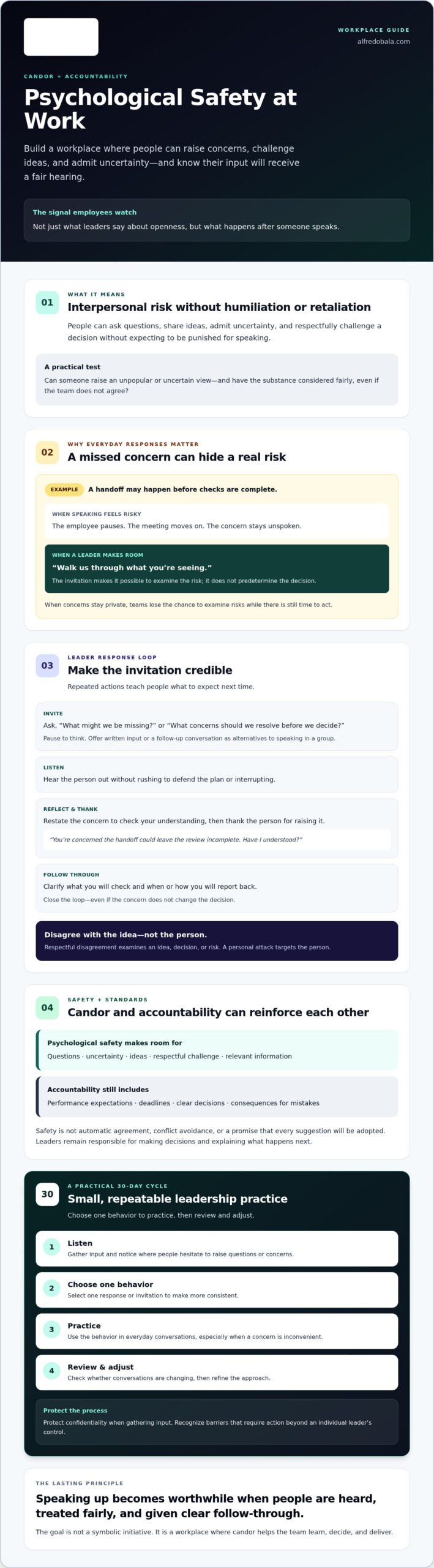
30-Day Plan for Psychological Safety at Work
Turn intention into a leadership practice with a focused month of listening, action, and review. Building psychological safety in the workplace doesn’t require a sweeping program to begin. Start with a specific behavior leaders can practice, observe, and improve.
Weeks one and two: listen and choose one behavior
Ask team members when it feels easier or harder to raise questions, risks, or differing views. Use an appropriate channel, such as a confidential survey, one-to-one conversations, or a facilitated discussion. Make participation voluntary. Don’t ask people to disclose personal experiences in front of colleagues, and explain how input will be handled before gathering it.
Look for a leadership habit you can change. Perhaps you interrupt while people explain a concern, defend a decision too quickly, or move on without clarifying next steps. Choose one behavior to work on and make it observable. For broader context on leadership practice, explore executive leadership development strategies.
Weeks three and four: practice, follow through, and review
Use the chosen behavior in recurring meetings and important decision discussions. If your focus is listening without interruption, practice it consistently. If it’s follow-through, record each concern that needs action, along with an owner, next step, and update point.
At the end of the month, ask what has changed and what still feels difficult. Invite feedback on your response, then adjust the practice based on what you hear. Keep the review specific: asking whether people know how to raise concerns can prompt more useful reflection than a general question about whether the culture feels better.
- Questions raised: Are questions and alternative views appearing in discussions before decisions are final?
- Concerns followed up: Do raised issues receive an owner, a next step, and an update?
- Perspectives included: Are leaders making room for input beyond the quickest or most senior voices?
These are signals to examine, not definitive proof of a cultural shift. Pulse questions capture perceptions at a particular moment; they don’t establish why those perceptions exist or prove that a leadership behavior caused a change. Protect confidentiality when reviewing responses, and consider patterns alongside what you observe in team interactions.
Keep the scope manageable. A disciplined month of listening, practicing, and adjusting gives you a clearer basis for what to continue. For more leadership insights from Alfredo Bala, explore Alfredo Bala’s leadership resources.
Make psychological safety a leadership discipline, not a campaign
Building psychological safety in the workplace isn’t a task leaders complete with a survey, workshop, or statement about openness. Trust develops through a pattern: invite people to contribute, respond constructively when they do, and follow through. The work is ongoing because every difficult conversation gives employees new evidence about whether candor is welcome.
Leaders can own their reactions, meeting practices, clarity about decisions, and follow-up on concerns. But some barriers need support beyond one manager’s control. Persistent workload pressures, unclear organizational processes, or inconsistent expectations across departments may require coordinated decisions, resources, or policy changes. Address what you can directly and raise wider issues with the people who can act on them.
How executives reinforce psychological safety across teams
Senior leaders set a standard through what they model and recognize. If executives invite challenge but punish managers for surfacing problems, the message is contradictory. Consistent expectations help managers understand that respectful questions and honest reporting are valued. Teams can adapt how they invite input to suit their work while keeping the commitment to listening and follow-through intact.
For a broader view of leadership and organizational change, explore keynote speaker insights on organizational growth.
Turn the first action into sustained leadership practice
After a difficult conversation, assess your response. Did you listen through the concern, ask a useful question, and make the next step clear? If you became defensive or moved on too quickly, identify one adjustment to try next time. Reflection turns good intentions into a practice you can refine.
Review progress with the team rather than declaring the culture fixed. Ask what makes it easier to raise concerns now, where people still hesitate, and what would make follow-through more dependable. Use the answers to adjust how meetings are run or decisions are communicated. The aim is steady improvement, not a claim of perfection.
Start with one meeting. Invite a perspective you haven’t heard yet, then listen without rushing to respond. Follow up on any issue that needs attention. Leaders seeking further ideas can explore Alfredo Bala’s leadership insights and speaking as part of their continuing development.
Make your next conversation count
Building psychological safety in the workplace is a leadership discipline, not a one-time initiative. It grows through consistent invitations to speak, fair responses to questions and disagreement, and clear follow-through. Openness doesn’t lower standards; it helps teams surface information while there’s still time to consider it and act responsibly.
Start small. In your next team meeting, invite a perspective you haven’t heard, listen without rushing to defend a decision, and make next steps clear. Then reflect on how your response shaped the conversation. Repeat, review, and adjust. Trust is built through everyday moments, not declarations alone.
Alfredo Bala brings leadership expertise and executive advisory experience, including former roles as CEO of Mannatech Inc. and COO of Britt World Wide. To explore his leadership insights and speaking, visit Alfredo Bala’s leadership insights and speaking.
Every candid conversation gives a leader a chance to build trust. Take that first step, and keep making it easier for your team to contribute.
Frequently Asked Questions
What is psychological safety in the workplace?
Psychological safety is a shared sense that people can take interpersonal risks at work, such as asking questions, admitting uncertainty, raising concerns, or respectfully challenging an idea. It doesn’t mean every suggestion will be accepted or every conversation will feel comfortable. It means employees can contribute without expecting humiliation or punishment simply for speaking. Standards and accountability remain in place, while honest input becomes part of how the team works.
How do you build psychological safety at work?
Build it through consistent leadership behavior, not a single announcement or workshop. Invite questions before decisions are final, listen without interrupting, acknowledge when you’re uncertain, and thank people for surfacing concerns. Then follow through: clarify who will act, what happens next, and when you’ll update the team. Building psychological safety in the workplace also means reviewing your habits and asking employees whether your responses make speaking up easier or harder.
Does psychological safety mean there is no accountability?
No. Psychological safety makes it possible to discuss mistakes, risks, and disagreement without defaulting to humiliation or blame. Accountability still means meeting clear expectations, owning decisions, addressing the impact of errors, and completing agreed corrective actions. For example, a team can examine why a review was missed, identify process factors, assign someone to correct the issue, and clarify how similar work will be checked next time.
How can a manager encourage employees to speak up?
Ask open questions such as, “What are we missing?” or “What concerns should we address before deciding?” Make room for people to respond without putting anyone unexpectedly on the spot. Offer more than one way to contribute, such as a follow-up conversation or written input. When someone does speak, listen fully and respond to the substance. Employees are more likely to contribute when leaders treat dissent as useful information, not disloyalty.
Can psychological safety improve team performance?
Psychological safety can support conditions for learning and better-informed decisions by making it easier to share relevant ideas, questions, and concerns. It doesn’t guarantee stronger performance, and it shouldn’t be treated as the sole cause of business results. Outcomes also depend on clear goals, resources, expertise, and execution. Leaders can assess whether open discussion helps their team identify risks or consider alternatives, then evaluate results alongside those other factors.
How do you measure psychological safety in a team?
Use a combination of confidential feedback and observable team practices. You might ask whether employees feel able to question decisions, raise mistakes, or request help, then look at whether concerns receive owners, next steps, and updates. Pulse questions capture perceptions, not definitive proof of culture or the cause of change. Protect confidentiality, avoid forcing personal disclosure, and discuss patterns carefully with the team before deciding what to adjust.
What should a leader do after an employee raises a concern?
Listen without interruption, then restate the concern to check your understanding. Thank the employee, explain what you’ll do next, and give a realistic point for following up. If you disagree, address the idea or evidence rather than dismissing the person who raised it. After reviewing the issue, report back on the decision and any action required. A clear response shows that speaking up leads to consideration and responsible follow-through.
 EN
EN  ES
ES
Recent Comments