
The promotion that recognizes your results can also take you away from the work that earned it. As a first-time manager, success depends less on what you deliver alone and more on how well your team performs. That shift brings common challenges for first-time managers into sharp focus: leading former peers without losing trust, balancing individual work with people leadership, and giving clear feedback when performance falls short.
If the role feels harder than expected, you’re not alone. Management asks you to build new habits while delivering results, often before you’ve had time to find your footing. Trying to solve every problem yourself may feel efficient, but it can hold back your team and leave you stretched thin.
This guide will help you recognize common challenges before they escalate and respond with practical steps. You’ll learn how to communicate expectations, delegate with confidence, handle feedback conversations, and establish credibility as you grow into the role. The aim isn’t to have every answer on day one. It’s to lead with intention, earn trust through consistent actions, and shift your focus from personal output to team outcomes.
Key Takeaways
- Shift your focus from proving your individual value to creating the conditions for your team to succeed.
- Understand the common challenges for first-time managers, including leading former peers, delegating, giving feedback, and balancing priorities.
- Choose whether to handle, delegate, or coach on a task by weighing urgency, risk, employee readiness, and learning value.
- Build dependable team routines by listening, clarifying expectations, agreeing on priorities, and following up in purposeful one-to-ones.
- Strengthen your leadership confidence through regular reflection on decisions, conversations, and lessons from delegated work.
Common challenges for first-time managers begin with a change in identity
A promotion can bring pride and possibility, along with uncertainty and pressure to prove you deserved it. You may feel tempted to show you’re still the person who can take on the hardest task and deliver it quickly. But management asks you to demonstrate value differently: not by absorbing more work, but by helping a team deliver agreed outcomes.
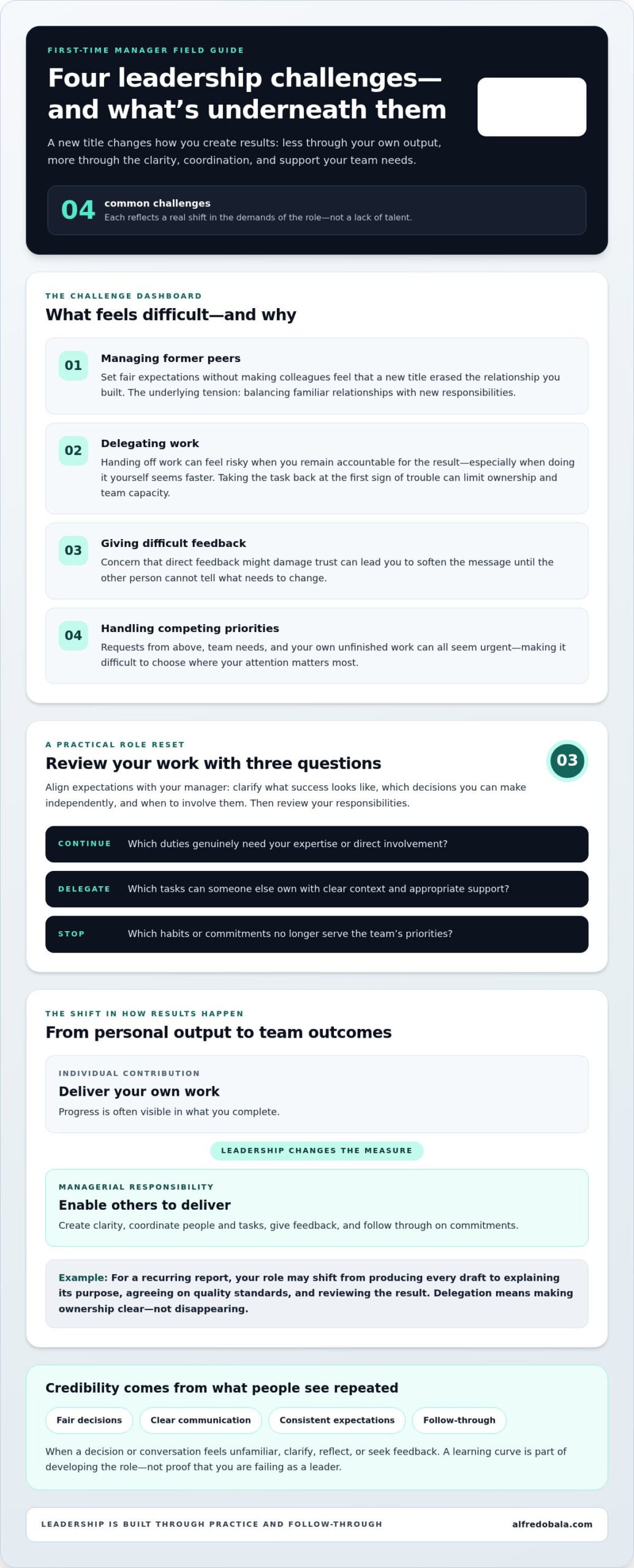
Individual contribution means delivering your own work; managerial responsibility means creating the clarity, coordination, and support that enable others to deliver theirs. Technical expertise can help you understand the work, but it doesn’t automatically prepare you to set expectations, listen well, give feedback, or make space for others to own decisions. Those are distinct capabilities, developed through practice.
Why becoming a manager changes the work
As an individual contributor, progress is often visible in what you complete. As a manager, your impact may come from a well-framed goal, a timely decision, or a conversation that helps someone move forward. The principles of management offer useful context for this wider responsibility: coordinating people and resources toward shared objectives.
Your priorities now include clarifying what matters, coordinating people and tasks, giving feedback that keeps work on track, and following through on commitments. That can make a familiar productivity measure, such as how many tasks you personally finish, a poor measure of your leadership. If you keep doing the work because it feels faster, your own output may look strong while your team has fewer chances to take ownership and build capability.
How to reset expectations during the first months
Replace assumptions with alignment. Ask your manager to clarify what success looks like, which decisions you can make independently, and when you should involve them. Get specific about near-term priorities and how progress will be assessed. Clear expectations give you a reference point when competing requests arrive and help you distinguish urgent work from work that can wait.
Then review your responsibilities with three questions:
- Continue: Which duties genuinely need your expertise or direct involvement?
- Delegate: Which tasks can someone else own with clear context and appropriate support?
- Stop: Which habits or commitments no longer serve the team’s priorities?
Make the review concrete. For example, if you prepare a recurring report, consider whether your role should shift to explaining its purpose, agreeing on quality standards, and reviewing the result rather than producing every draft yourself. Delegation doesn’t mean disappearing; it means making ownership clear and staying available for guidance.
Expect a learning curve. Uncertainty about a decision or conversation is a prompt to clarify, reflect, or seek feedback, not proof that you’re failing as a leader. Notice where the new role feels unfamiliar, then choose one capability to practice deliberately. Credibility grows through consistent decisions and follow-through, not through pretending you already know everything.
The hardest first-time manager challenges, and what is underneath them
The common challenges for first-time managers can feel personal, but they usually reflect the demands of a new role, not a lack of talent. You’re learning to influence outcomes through other people while relationships, expectations, and priorities shift around you. Recognizing the tension beneath each challenge helps you respond with judgment instead of self-criticism.
- Managing former peers: You need to set fair expectations without making colleagues feel that a new title has erased the relationship you built.
- Delegating: Handing off work can feel risky when you’re accountable for the result, especially if doing it yourself seems faster.
- Giving feedback: You may worry that a direct conversation will damage trust, so you soften the message until the other person can’t tell what needs to change.
- Handling competing priorities: Requests from above, team needs, and your own unfinished work can all seem urgent, making it hard to choose where your attention matters most.
None of these situations means you’re unsuited to lead. They signal that the role requires skills you may not have needed as an individual contributor. A good manager doesn’t have every answer immediately. Strong leadership includes asking thoughtful questions, gathering relevant context, and being clear about what you’ll do next.
Managing former peers while building trust
Avoid two extremes: acting as if nothing has changed, or becoming so formal that you create unnecessary distance. Be transparent about your responsibilities and how decisions will be made. If you now assign work or review performance, explain the expectations and apply them consistently across the team. Make room for questions, listen without becoming defensive, and don’t rely on your title to settle every disagreement. People are more likely to trust what they see repeated: fair decisions, clear communication, and follow-through.
Delegating work and giving difficult feedback
Fear of mistakes can lead you to take a task back at the first sign of trouble. Resist the reflex. Delegation builds team capacity while giving managers the focus to guide priorities, remove obstacles, and strengthen performance. Agree on the result, boundaries, and check-in points, then let the person own the approach unless the risk or circumstances require your direct involvement.
Feedback works best when it’s direct and grounded in what happened. Describe a specific observation, explain its impact, and agree on the next action. For example: “The client update went out after the agreed deadline. That left the team without time to respond. What would help you send the next update on schedule?” Coaching invites the person to understand and improve; it doesn’t mean avoiding accountability. Vague criticism, by contrast, leaves them guessing.
When priorities collide, make the trade-off visible. Clarify which outcome matters most, what can move, and who needs to know. Building these habits takes practice, and leadership and team development insights can offer perspective as you learn to lead with both trust and accountability.
How to choose between doing the work, delegating, and coaching
Don’t decide based on which option feels fastest in the moment. Choose based on what the situation needs and what will help the team deliver well. A quick assessment of urgency, risk, employee readiness, and learning value can help you avoid two costly habits: stepping in by default or handing off work without enough direction.
| Approach | Choose it when… |
|---|---|
| Handle | Time is critical, risk is high, or the decision falls within your authority and needs your judgment. |
| Delegate | The outcome and boundaries are clear, and someone is ready to own the work with agreed check-ins. |
| Coach | The employee can take the next step but needs to strengthen their judgment, problem-solving, or confidence. |
Use the four decision cues together. A tight deadline may call for direct action if a delay creates real risk. But if the task is important and the employee has time to learn, coaching may be more valuable than taking over. Consider the cost of an error, too: a reversible first draft offers room to experiment; a decision with serious consequences may need closer oversight. Readiness isn’t fixed. Someone may be prepared to own the analysis while needing your approval before acting on it.
Delegation means assigning ownership, not simply passing along a task. State the desired result, relevant constraints, decision-making boundaries, and when you’ll review progress. Agree on what should trigger an early check-in. This gives the employee room to work while keeping risks visible. Meaningful responsibility can support motivation, but people differ in what they find motivating. Ask what kind of challenge, autonomy, or support helps each person do their best work. The Motivation Equation’s leadership framework can deepen your thinking about motivation and human performance.
When should a new manager step in directly?
Step in when an immediate risk needs action, authority is unclear, or a decision belongs to your role. For example, you might pause a commitment that exceeds your team’s remit or address an urgent client issue that can’t wait for a coaching conversation. Explain why you’re intervening, handle only what the situation requires, and agree when ownership returns to the employee. Temporary support should have a clear handoff, not become a quiet takeover.
When should a manager delegate or coach instead?
Delegate when the person can own a defined outcome and you can agree on constraints and review points. Coach when they need to think through a decision, not just follow another instruction. Ask what they’ve considered, what options they see, and what they recommend. These questions develop judgment while keeping accountability with the employee. As common challenges for first-time managers go, choosing the right level of involvement is central to building reliable results and a capable team.
A practical first-time manager plan for communication and team routines
Good routines make leadership easier to understand and easier to trust. They help people raise concerns early, see how decisions connect to team goals, and know when they’re expected to act independently. For anyone facing the common challenges for first-time managers, a predictable rhythm can replace guesswork with shared expectations.
Predictable communication gives a team the clarity to act, the space to raise concerns, and a reliable way to adjust before small problems grow.
Use this starter plan to establish a practical foundation:
- Listen before changing routines. Meet with each person to understand their work, goals, obstacles, and what support helps them do strong work.
- Clarify expectations. Explain what outcomes matter, how responsibilities connect, and which decisions people can make without your approval.
- Agree on priorities. Make the team’s most important commitments visible, including what may need to wait if capacity or circumstances change.
- Review progress and adapt. Set regular check-ins to discuss progress, surface risks, confirm next steps, and adjust priorities when needed.
What to ask in early one-to-one conversations
Make one-to-ones purposeful, not just another calendar obligation. Ask: “What are you working toward?” “What’s getting in the way?” “What kind of support is useful?” and “What helps you do your best work?” Listen for individual differences rather than assuming everyone wants the same level of guidance or independence.
Share an agenda before or during the meeting, and leave room for the employee’s priorities. Close by summarizing agreed actions, who owns each one, and when you’ll follow up. A brief written recap creates a shared reference point and helps prevent good intentions from disappearing into a busy week.
How to set priorities and boundaries without micromanaging
Translate broad goals into a manageable set of team priorities. For each one, define the intended result, who owns it, and the boundaries that matter, such as budget, timing, quality, or decisions that need approval. Make team norms visible too: explain how people should flag a risk, share a decision, or request help. Invite questions, and apply the norms consistently. If a norm isn’t working, discuss why and revise it openly.
Use check-ins to ask what’s on track, what’s at risk, and where a decision or support is needed. Don’t require updates on every small action; focus on progress and obstacles. This keeps accountability clear while leaving room for people to choose how they do the work. For a broader view of leadership responsibilities, consider how leaders set priorities, clarify decision-making, and support team development.
Build routines that fit your team, then strengthen your leadership practice with Alfredo Bala’s leadership insights.
Build confidence as a first-time manager through deliberate practice
Confidence isn’t a prerequisite for leadership. It’s built as you make decisions, notice their effects, and adjust your approach. The common challenges for first-time managers won’t disappear through confidence alone, but reflection helps you meet them with greater judgment instead of relying on guesswork.
Set aside time each week for a short review. Consider a decision you made, a conversation you had, and a piece of work you delegated. Ask yourself:
- What did I intend to happen, and what actually happened?
- What did my team’s response tell me about the clarity or support I provided?
- What would I repeat, change, or follow up on?
- What lesson will I carry into the next similar situation?
Keep your notes focused on observable actions and outcomes, not judgments about your worth as a leader. If a delegated task stalled, for example, consider whether ownership, decision boundaries, or check-ins were clear before concluding that the employee wasn’t ready. Looking for patterns helps you improve the conditions around the work, not just react to one difficult moment.
How to learn from mistakes without losing credibility
Address the impact directly. Acknowledge what happened, correct what you can, and communicate what you’ll do differently. If a decision created confusion, clarify the expectation and check that everyone understands the next step. This is accountability: taking responsibility and responding constructively. Defensiveness shifts attention away from the problem, while excessive self-criticism can make your team responsible for reassuring you. Be honest, then focus on repair and learning.
Record recurring themes in your weekly review. Perhaps you often make decisions before hearing from the people closest to the work, or you postpone conversations about missed expectations. One instance may be a reminder; a pattern points to a habit you can practice changing. You don’t need to get every interaction right to earn credibility. People can see accountability in how you respond after a misstep.
How leadership frameworks can support continued growth
Use a leadership framework as a set of prompts, not a formula that guarantees a particular team outcome. Questions about motivation can help you understand what gives an employee purpose or momentum. Questions about clarity can reveal whether the expected result and decision boundaries are understood. Questions about responsibility can help you distinguish where to offer support from where to leave ownership with the employee.
Seek feedback when you’re unsure how your choices are landing, when a pattern keeps repeating, or when a conversation has become difficult to interpret. Ask your manager or mentor for a perspective on your approach; invite your team to share what is helping or getting in the way. Listen for useful information, then decide what action you’re accountable for taking. Feedback informs your judgment. It doesn’t replace it.
For your next step, put a weekly reflection on your calendar and use it to choose one leadership habit to practice. Explore Alfredo Bala’s leadership insights for further perspective on developing as a leader.
Make your next leadership move with intention
Your first months as a manager aren’t a test of whether you can lead perfectly. They’re an opportunity to build a leadership approach through thoughtful decisions, honest reflection, and steady action. Choose one conversation or team habit to approach more deliberately this week. Small, consistent adjustments can shape the trust and performance you want to foster.
The common challenges for first-time managers are easier to address when you keep learning instead of expecting instant mastery. Alfredo Bala is a leadership expert, professional speaker, author of The Motivation Equation, and former CEO of Mannatech Inc. and COO of Britt World Wide. His work includes leadership and team development insights, professional speaking, and executive advisory through corporate board service.
Explore Alfredo Bala’s leadership insights and The Motivation Equation for practical perspective on developing as a leader. Lead with curiosity, take responsibility for your choices, and keep moving forward. You don’t need to know everything today to become a leader your team can trust.
Frequently Asked Questions
Is it normal to struggle as a first-time manager?
Yes, struggling with the common challenges for first-time managers can be a normal part of adjusting, though each person’s experience is different. A promotion shifts your focus from completing your own assignments to helping the team deliver. Name the situation that feels hardest, such as deciding what to handle yourself, and clarify expectations with your manager. Then choose one behavior to practice this week, like asking a clarifying question before offering a solution.
What is the biggest challenge for a first-time manager?
There isn’t one biggest challenge for every new manager, but shifting from doing the work to enabling others is often central. That shift can make delegation feel risky: you remain accountable for the result while giving someone else room to own the work. Before taking a task back, pause to clarify the outcome, confirm who owns it, and identify what support or decision-making authority they need to move forward.
How do you manage former coworkers after a promotion?
Address the change openly and let your actions show that the relationship remains respectful. Explain any new responsibilities that affect how you assign or review work, and listen to colleagues’ concerns before assuming how they feel. Apply expectations consistently, including when decisions are uncomfortable. Trust develops through fairness and follow-through, not the title itself. Agree on responsibilities and decision boundaries so former coworkers know what has changed without requiring you to become distant.
How can a first-time manager delegate without micromanaging?
Before work begins, agree on the desired result, who owns it, relevant constraints, and when you’ll check in. For example, ask for a brief progress update at a key decision point rather than requesting a running account of every task. Use check-ins to uncover obstacles or decisions that need your input. Tailor your support to the employee’s experience, then adjust it as their capability grows. Delegation transfers ownership, while you remain accountable for the overall result.
How often should a new manager meet with each team member?
There’s no single meeting schedule that suits every team. The useful cadence depends on the work, the employee’s needs, and your organization’s context. Establish regular one-to-ones, agree with each person on what the time is for, and revisit the frequency when responsibilities, priorities, or support needs change. A meeting is useful when it creates space for meaningful listening and leads to clear follow-up, not simply because it appears on the calendar.
What should a first-time manager do in the first 90 days?
Use the first 90 days as a flexible period to learn, align, and adjust, not as a deadline for sweeping change. Start by understanding the team’s existing strengths and how work gets done. Clarify goals and decision rights with your manager, agree on team priorities, then review progress and refine routines. Adapt the sequence to organizational expectations and the team’s circumstances; thoughtful observation can reveal where change will help and where existing practices are working well.
 EN
EN  ES
ES
Recent Comments