
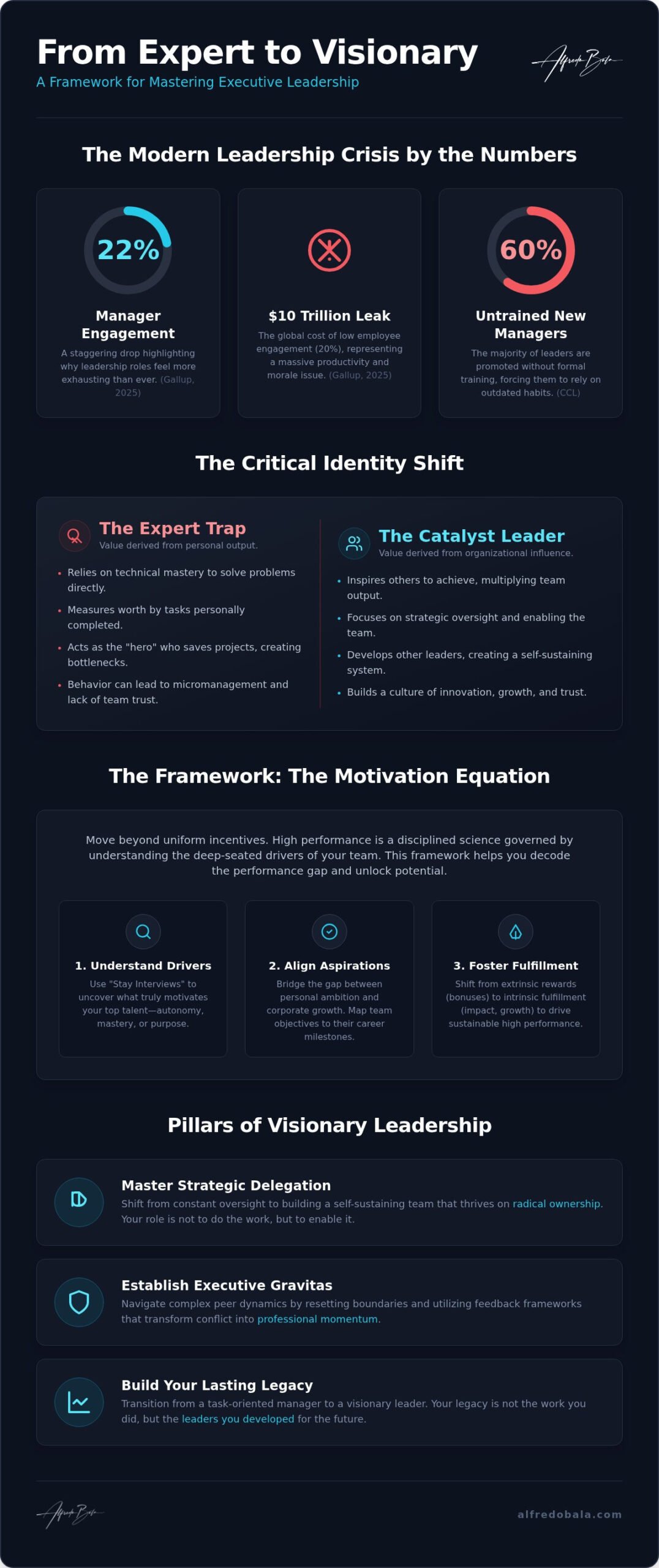
Did you know that manager engagement plummeted to just 22% in 2025? This staggering drop, reported by Gallup, underscores why today’s executive leadership challenges feel more exhausting than ever. You’ve likely spent your career perfecting a specific craft, only to realize that the view from the top is often obscured by administrative friction and the complex psychology of people management. It’s a common struggle to feel like an imposter while making high-stakes decisions or to hesitate when giving tough feedback to former peers who were once your equals.
You deserve to move beyond the daily grind of firefighting and reactive task management. I’ve spent over 40 years navigating these same global waters, and I’ve learned that success at this level is both a disciplined science and a nuanced art. This article promises to help you pivot from a high-performing contributor to a visionary leader by mastering the Motivation Equation. We’ll break down 12 critical hurdles and provide the exact framework you need to regain control of your strategic schedule. You’ll learn how to build a self-sustaining global team and establish the executive gravitas required to lead with absolute authority.
Key Takeaways
- Escape the “Expert Trap” by shifting your personal value proposition from individual output to organizational influence.
- Leverage The Motivation Equation to navigate executive leadership challenges and drive high performance across diverse, global teams.
- Master the art of strategic delegation to build a self-sustaining team that thrives on radical ownership rather than constant oversight.
- Establish executive gravitas by resetting peer boundaries and utilizing feedback frameworks that transform conflict into professional momentum.
- Transition from a task-oriented manager to a visionary leader while securing your legacy and preparing for high-level board advisory roles.
The Identity Crisis: Transitioning from Contributor to Catalyst
The promotion to the C-suite is often the most jarring transition in a professional career. You’ve spent decades becoming the sharpest person in the room, the one with all the answers. Now, that very expertise can become a liability. This is the “Expert Trap,” where your reliance on technical mastery prevents you from stepping into the visionary role your organization requires. One of the most significant executive leadership challenges is realizing that your value is no longer in what you can produce, but in what you can inspire others to achieve.
Research from the Center for Creative Leadership indicates that 60% of new managers receive no formal training before stepping into their roles. Without a roadmap, many fall back on the tactical habits that earned them the promotion. You must recognize that your performance is now a reflection of your team’s output. If you’re still measuring your worth by the number of tasks you personally complete, you aren’t leading; you’re just a high-priced individual contributor. Overcoming the imposter syndrome that accompanies this shift requires a total pivot in your personal value proposition.
Letting Go of the Technical Expert Mindset
Stop trying to be the hero who saves every project at the 11th hour. While it feels satisfying to dive into the weeds and “fix” a problem, this behavior signals a lack of trust. Micromanagement is often just a psychological comfort zone for leaders who haven’t yet mastered the mechanics of influence. True executive presence requires you to step back and allow your team to navigate their own hurdles. You aren’t there to do the work. You’re there to enable it. Shifting from task completion to strategic oversight is the only way to scale your impact across a global organization.
Redefining Your Value as a Catalyst
Success at the executive level requires a new set of metrics. You must invest in executive leadership development strategies that prioritize long-term vision over short-term fire drills. A Catalyst Leader is someone who multiplies the output of others through strategic influence. This transition requires you to model The Five Practices of Exemplary Leadership, ensuring you’re challenging the process and enabling others to act. When you stop being the bottleneck, you create space for innovation and growth. Your legacy won’t be the spreadsheets you built, but the leaders you developed. This is how you establish true executive gravitas. You set the tone for the entire organization by shifting your focus from the “I do” to the “They do.” It’s a disciplined science of behavior and a nuanced art of connection.
Decoding the Performance Gap with The Motivation Equation
Engagement isn’t just a human resources metric. It’s the engine of your entire organization. When global employee engagement sits at a meager 20%, as Gallup reported in 2025, you aren’t just facing a morale issue; you’re facing a $10 trillion productivity leak. One of the most persistent executive leadership challenges is the belief that a uniform incentive structure will drive a diverse, multi-generational workforce. It won’t. High-performance behavior is a disciplined science governed by what I call The Motivation Equation. You must move beyond the surface level of rewards and recognition to understand the deep-seated drivers that move the needle for each individual.
The Mechanics of Influence: Understanding Drivers
Mastering the mechanics of influence begins with curiosity. You can’t motivate someone you don’t truly understand. Conduct “Stay Interviews” to uncover what keeps your best talent in their seats. Are they seeking more autonomy in their global roles? Do they crave the mastery of new AI-driven workflows? Or is it a lack of purpose that’s causing them to drift? By applying motivation strategies for business leaders, you transform from a task-master into a visionary coach who fosters a culture of excellence. This shift from extrinsic rewards to intrinsic fulfillment is what separates a manager from a true executive.
Aligning Team Goals with Personal Aspirations
Alignment is the bridge between personal ambition and corporate growth. If your team members don’t see their own career milestones within your strategic objectives, they’ll eventually check out. Use The Motivation Equation to troubleshoot underperformance early. Don’t wait for the exit interview. Map your team’s objectives to their individual aspirations. When a team member sees that hitting a quarterly target also builds the specific skills they need for their next promotion, buy-in becomes automatic. Addressing these executive leadership challenges through alignment creates a self-sustaining momentum. If you want to dive deeper into these frameworks, you can explore more leadership and team development insights to refine your approach and ensure long-term retention.
Mastering the Art of Strategic Delegation and Scale
Stop trying to do it all. One of the most exhausting executive leadership challenges is the belief that your presence is required for every tactical decision. If you’re still the primary engine for task completion, you haven’t scaled; you’ve simply become a high-level bottleneck. True delegation isn’t about “dumping” unwanted tasks on subordinates to clear your calendar. It’s a precise methodology for transferring authority and building the next generation of leaders. You must overcome the irrational fear that stepping back makes you unnecessary to the C-suite. In reality, your value is proven by how well the organization functions when you aren’t in the room.
Adopt the “70% Rule” as your new standard for hand-offs. If a team member can perform a task at 70% of your current capacity, you must delegate it immediately. While you might do it faster or better today, your time is better spent on visionary strategy and global team dynamics. By holding onto these tasks, you starve your team of the growth opportunities they need to reach 100% proficiency. Scaling requires you to trade the comfort of control for the power of influence.
The 5-Step Framework for Effective Delegation
Successful delegation requires a structured approach to ensure quality remains high without you hovering over shoulders. Follow this roadmap to build capacity:
- Identify the “Why”: Explain the strategic importance of the task so the team member understands its impact on the organization.
- Match the Growth Path: Assign the task to someone whose career aspirations align with the skills required to complete it.
- Define the “Done” State: Be crystal clear about what success looks like using objective, measurable outcomes rather than vague instructions.
- Establish Guardrails: Set specific check-in points to monitor progress and provide support without falling back into micromanagement.
- Review and Refine: Use the completion of the task as a coaching moment to provide constructive feedback and prepare them for even greater responsibility.
Creating a Culture of Radical Accountability
Accountability cannot exist without trust and psychological safety. You must empower your team to take radical ownership of their outcomes, which means giving them the space to fail and learn. When you link individual accountability to the core principles found in The Motivation Equation book, you create a self-sustaining ecosystem of high performance. People don’t just work for a paycheck; they work for the mastery and purpose that comes from owning their results. By mastering this art, you establish the executive gravitas needed to lead at scale while ensuring your team remains motivated and aligned with the company’s global vision.
Navigating Executive Conflict and Gravitas
Authority is never given; it is earned through the fire of conflict and the steady hand of composure. One of the most delicate executive leadership challenges involves the shift from being a peer to becoming a superior. When you transition from the bullpen to the corner office, the social contract with your colleagues changes instantly. You can no longer rely on the casual camaraderie of the past to drive results. Instead, you must cultivate a new form of influence that balances professional distance with genuine advocacy for your team’s success.
The Peer-to-Manager Transition
Don’t ignore the elephant in the room. If you were promoted over colleagues who were also vying for the role, acknowledge the shift early and directly. A single, transparent conversation about the new dynamic can dismantle resentment before it hardens into sabotage. Your goal isn’t to apologize for your success, but to clarify how your new position allows you to better support their professional growth. You must remain accessible as a mentor while establishing the boundaries necessary to make objective decisions about performance and compensation. This balance is the hallmark of a seasoned leader who understands that respect is more valuable than popularity.
Delivering High-Impact Feedback
Performance reviews should never be a surprise. High-performing teams thrive on a continuous feedback loop where “hard truths” are delivered with radical candor and aligned with the individual’s own career aspirations. When you challenge someone directly because you care about their potential, you turn a difficult conversation into a catalyst for mastery. Executive Gravitas is the ability to remain calm, decisive, and influential during team conflict. It’s the silent authority that de-escalates tension and refocuses the energy of the room toward a strategic solution. By mastering this presence, you transform friction into productive momentum rather than allowing it to erode your culture.
Managing up is just as critical as leading down. You must build unwavering credibility with your own supervisor and senior stakeholders by providing solutions, not just reporting problems. When you demonstrate that you can navigate complex global politics with a steady hand, you earn the autonomy to lead your team without interference. If you’re ready to refine these high-level skills, it’s time to start mastering the mechanics of influence through proven motivational frameworks. Conflict isn’t a sign of failure; it’s the environment where your leadership legacy is forged.
Building Your Leadership Legacy: From Manager to Visionary
Management is a destination for many, but for the visionary, it’s merely the foundation. Once you’ve navigated the initial friction of your transition, you must recognize that your executive journey has only just begun. The most daunting executive leadership challenges often surface when you move beyond daily operations and start shaping the long-term culture of a global organization. You aren’t just here to hit quarterly targets. You’re here to build a legacy that outlasts your tenure. This requires a commitment to professional mastery that extends far beyond the boardroom.
Investing in your own growth is non-negotiable. High-level leadership is a lonely endeavor without the right counsel. Find a mentor or an executive coach who has already navigated the complex web of global corporate politics. Their hard-won wisdom will help you avoid the pitfalls that derail less-prepared leaders. As you grow, you should also look to share your insights. Transitioning into the role of a keynote speaker for organizational growth allows you to scale your influence, moving from managing a specific team to inspiring an entire industry.
Assessing Your Leadership Maturity
The first 90 days of an executive transition are about survival, but the months that follow are about maturity. You must take a cold, hard look at your progress. Use this self-assessment to ensure you’re on the right track:
- Identify Your Style: Are you leading as a Visionary, a Coach, or a Pace-setter? Understanding your default mode allows you to adapt to your team’s specific needs.
- Audit Your Schedule: Is your time spent on strategic influence or tactical firefighting?
- Set Personal KPIs: Track your own development goals, such as networking with other C-suite peers or mastering new global market trends, independent of your team’s output.
The Path to Executive Advisory
Every challenge you overcome today is a building block for your future. The skills you’re honing now, from conflict resolution to strategic scaling, are the exact requirements for high-level corporate board advisor roles. Governance and global growth require leaders who have seen it all and can provide a steady hand in times of disruption. This level of success is both a disciplined science and a nuanced art, requiring a lifetime of continuous learning and strategic reading.
Your journey toward global influence starts with a single step toward mastery. Don’t let the weight of your current executive leadership challenges hold you back. Instead, use them as the perfect environment to apply the principles of human performance. Take the first step in refining your approach by exploring the frameworks in The Motivation Equation. You have the potential to be more than just a manager. It’s time to become the visionary leader your organization deserves.
Forge Your Legacy Through Strategic Mastery
You’ve navigated the transition from contributor to catalyst and learned that true leadership isn’t about the tasks you finish, but the potential you unlock in others. By applying The Motivation Equation, you can bridge the engagement gap and transform your team into a self-sustaining engine of global growth. These executive leadership challenges aren’t roadblocks; they’re the refining fire that prepares you for high-level advisory roles and lasting organizational impact. You now have the roadmap to move from reactive management to visionary influence.
To truly excel, you need a proven methodology rooted in over 40 years of global executive experience. This practical, results-oriented approach has been used by top earners to drive performance across every industry and scale. You can master the science of influence with The Motivation Equation and establish the gravitas required to lead at the highest levels. Step into your new role with confidence, knowing you have the framework to lead with authority and inspire with purpose. Your future as a visionary executive starts today.
Frequently Asked Questions
What is the most common challenge for first-time executive leaders?
The most common hurdle is the “Expert Trap,” where new leaders struggle to let go of the technical tasks that earned them the promotion. Instead of doing the work, you must now enable others to do it. This shift from individual contributor to strategic catalyst is one of the primary executive leadership challenges. It requires a fundamental redefinition of your personal value, moving away from tactical execution toward organizational influence and long-term vision.
How do I handle managing people who used to be my friends or peers?
You must address the new dynamic immediately through a transparent and direct conversation. Acknowledge the change in your professional relationship to prevent resentment or confusion. Your goal is to pivot from a social peer to a supportive mentor. While you can maintain a friendly rapport, you must establish clear professional boundaries. This ensures you can make objective decisions about performance and compensation without the cloud of personal bias or past camaraderie.
How can I stop micromanaging and start delegating effectively?
Adopt the “70% Rule” by delegating any task that a team member can perform at 70% of your current capacity. Stop viewing yourself as the primary hero who must save every project. Instead, focus on defining the “done” state with measurable, objective outcomes. When you provide your team with clear guardrails and the autonomy to navigate hurdles, you build their future capacity while freeing your own schedule for high-level strategic oversight and global team development.
What should I do if a team member is older or more experienced than me?
Leverage their deep experience as a strategic asset rather than viewing it as a threat to your authority. You don’t need to be the most experienced person in every technical area to lead effectively. Instead, focus on your role as a visionary guide who removes obstacles and provides strategic direction. Show respect for their tenure by involving them in high-level decision-making processes; this builds trust and secures their buy-in for your broader organizational goals.
How do I find time for my own strategic work while managing a team?
You must regain control of your strategic schedule by strictly prioritizing tasks that only an executive can perform. Most executive leadership challenges stem from being bogged down in administrative or people-centric tasks that should be delegated. Block out non-negotiable time on your calendar for visionary thinking and global strategy. When you build a self-sustaining team through radical accountability, you create the space necessary to focus on the long-term growth and performance of the organization.
What are the most important leadership skills to develop in the first 90 days?
Prioritize active listening and the mechanics of influence during your first 90 days. You need to understand the underlying drivers of your team before you can implement significant changes. Mastering a framework like the Motivation Equation allows you to decode performance gaps quickly. Focus on building credibility with senior stakeholders and establishing your executive gravitas. These foundational skills ensure you can navigate global corporate politics while driving immediate organizational performance and team alignment.
How do I give constructive feedback without discouraging my team?
Deliver feedback using a “Radical Candor” approach that balances direct challenge with personal care. Frame the conversation around the team member’s own career aspirations and growth path. When they see that your “hard truths” are designed to help them achieve mastery, they’ll view the feedback as an investment rather than a criticism. Make performance reviews a continuous conversation rather than a yearly event to ensure your team stays motivated and aligned with strategic targets.
Is it normal to feel like an imposter when you first become an executive?
It’s entirely normal to experience imposter syndrome when you pivot to high-stakes decision-making. This feeling often arises because your old metrics of success no longer apply. You’re no longer measured by personal tasks, but by the collective output of your team. Recognize that your value now lies in your strategic influence and the ability to inspire others. As you establish your executive authority and see the results of your leadership, this initial uncertainty will transform into seasoned confidence.
 ES
ES  EN
EN
Comentarios recientes