
If you believe that a competitive salary and a generous bonus are still your strongest levers for loyalty, you’ve already lost the battle for 2026. In a global market where job-hopping is the default setting, your strategies for retaining top talent 2026 must move beyond the transactional. You’ve likely felt the frustration of watching a high-performer leave for a role that offers nothing more than a fresh title. It’s a costly cycle that drains your resources and stalls your momentum. You know that traditional perks aren’t enough anymore, but finding a sustainable solution feels like chasing a moving target.
This guide will help you master the psychological and strategic frameworks required to keep your highest performers engaged and inspired. We’ll explore a repeatable framework for motivating teams and show you how to build a leadership culture that attracts elite talent through reputation alone. By the end of this article, you’ll have the tools to transform your organization into a destination for the world’s best professionals. It is time to stop reacting to turnover and start building a legacy of excellence.
Key Takeaways
- Understand the rise of the “Sovereign Professional” and why traditional perks no longer prevent your best people from seeking new horizons.
- Discover how to apply the Motivation Equation to quantify psychological safety and effort, providing a scientific basis for your strategies for retaining top talent 2026.
- Transform your mid-level managers into retention engines by prioritizing leadership development that addresses the modern reality of manager-driven turnover.
- Adopt the 1% Rule for culture, using consistent, small actions to maintain a high-performance environment across global teams and diverse time zones.
- Master the art of securing board-level buy-in for human-centric leadership investments by framing retention as a critical driver of organizational scale and precision.
The Great Talent Shift of 2026: Why Traditional Retention Fails
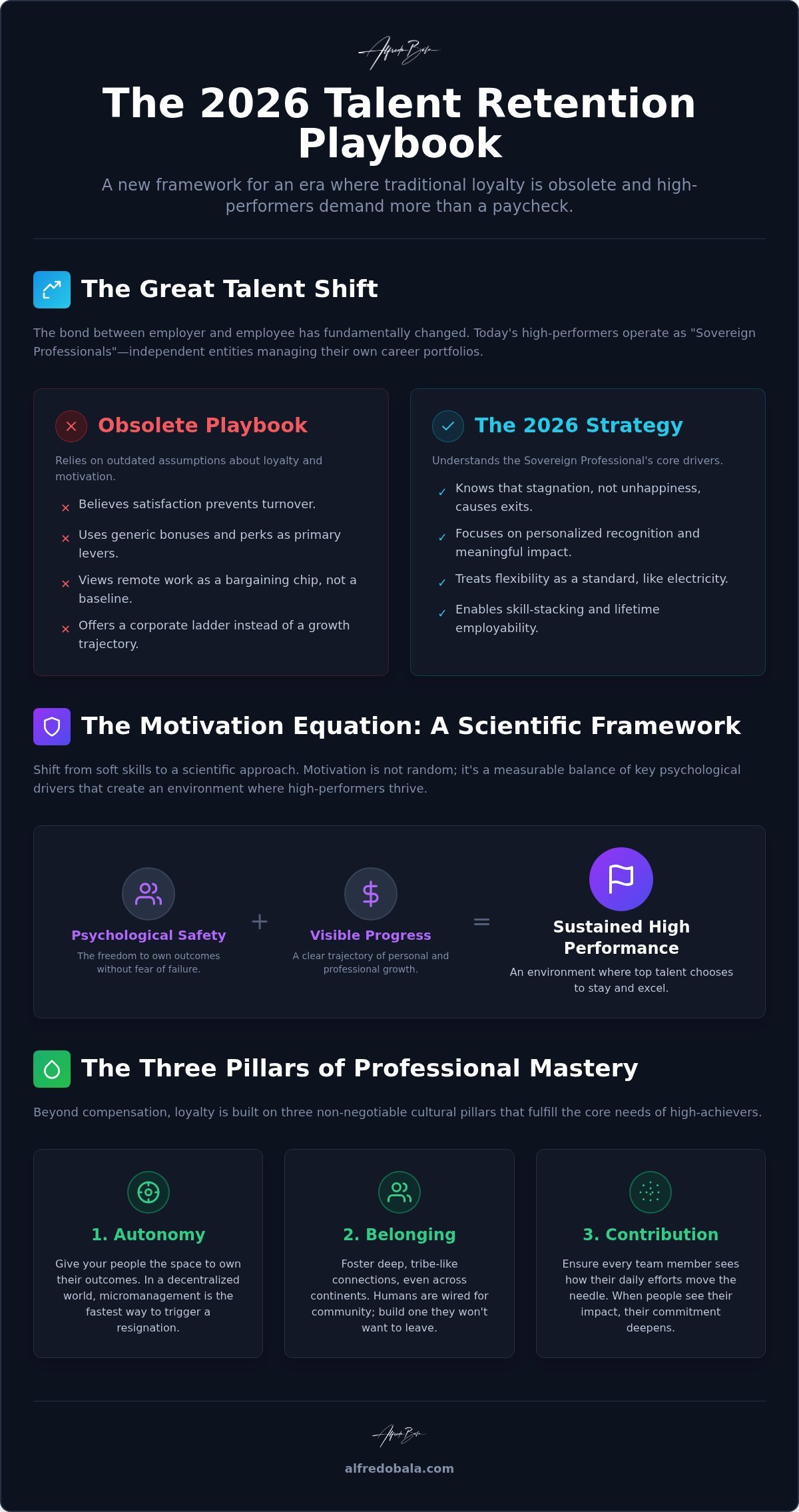
The landscape of global work has fundamentally fractured. By 2026, the traditional bond between employer and employee has dissolved, replaced by a new archetype: the Sovereign Professional. These individuals don’t view themselves as cogs in your machine; they’re independent entities managing their own personal brands and portfolios of skills. If your strategies for retaining top talent 2026 still rely on the hope that “satisfaction” equals “loyalty,” you’re operating on an obsolete map. You aren’t just competing with the company across the street; you’re competing with the allure of autonomy and the global marketplace of opportunity.
High performers aren’t leaving because they’re unhappy. They’re leaving because they’re stagnant. In this hyper-competitive market, “happy enough” is a dangerous plateau. Satisfaction no longer prevents turnover. Flexibility and remote work, once the ultimate bargaining chips, have become mere commodities. They’re the baseline expectations. Offering remote work today is like offering a desk thirty years ago; it’s expected, not appreciated. When a key leader exits, the damage isn’t just the recruitment fee. It’s the catastrophic loss of institutional momentum. It’s the “brain drain” that ripples through your global teams, causing others to question their own tenure and the company’s future.
The Death of Traditional Corporate Loyalty
We’re witnessing the rise of “career-stacking” and fractional roles. Your best people might be holding multiple positions or managing side ventures that prioritize their “lifetime employability” over your “lifetime employment.” Geographical barriers have vanished completely. A specialist in São Paulo can work for a firm in Tokyo as easily as one next door. Loyalty isn’t a default setting anymore. It’s a partnership that must be renegotiated daily through shared vision and mutual respect. To survive this shift, leaders must stop looking at HR policies and start looking at the psychological drivers of human ambition.
Why Perks No Longer Move the Needle
Ping-pong tables and “fun” office cultures have reached a point of diminishing returns. High performers see through the fluff. They don’t want a generic annual bonus; they want personalized recognition that acknowledges their specific contribution to the mission. When a “Purpose Gap” exists, no amount of free snacks will bridge it. These professionals need to see how their work scales and how it feeds into a larger, global impact. If they don’t see it with you, they’ll find it elsewhere. Reframing your strategies for retaining top talent 2026 around meaningful contribution is no longer optional; it’s the only way to maintain your edge.
The Motivation Equation: A Scientific Framework for Employee Loyalty
Stop treating retention as a soft skill or a series of administrative tasks. It’s a disciplined science. To win in the coming years, you need a methodology that quantifies the invisible forces driving your team. Alfredo Bala’s Motivation Equation provides this precision, mapping the critical relationship between effort, reward, and psychological safety. When these variables align, you create an environment where high-performers don’t just stay; they thrive. The Motivation Equation is the balance of individual purpose and organizational goals. By focusing on these intersections, you shift from transactional management to transformational leadership.
Progress is the primary driver for high-achievers. If a top performer feels they’re standing still, they’re already looking for the exit. Your strategies for retaining top talent 2026 must center on the visible trajectory of growth. It’s about moving beyond the “what” of the job and into the “why” of the career. When leadership prioritizes the development of the individual as much as the output of the role, loyalty becomes a natural byproduct of the partnership.
The Three Pillars of Professional Mastery
Mastery requires more than a paycheck. It demands a culture built on three non-negotiable pillars. First, autonomy. Give your people the space to own their outcomes. In a decentralized 2026 labor market, micromanagement is the fastest way to trigger a resignation. Second, belonging. Humans are tribal by nature. You must foster deep connections even when your team is scattered across continents. Finally, contribution. Every high-achiever needs to see how their daily efforts move the needle. When employees see their direct impact, their commitment to the mission deepens. These are the foundational strategies for retaining top talent 2026.
Calculating Your Organization’s Motivation Score
Predicting turnover is far more effective than reacting to it. Use a diagnostic approach to identify exactly where your team members are disengaging. Are they putting in high effort with low psychological safety? That’s a proven recipe for burnout. Is the reward high but the sense of belonging low? That leads to the “Sovereign Professional” mindset where employees feel no tether to the brand. If you want to dive deeper into these leadership and team development insights, you can begin auditing your current landscape today. By quantifying these metrics, you can spot the warning signs of disengagement months before a resignation letter arrives. High-achievers crave progress. If they aren’t moving forward with you, they’ll find a path that offers the momentum they demand.
Beyond Compensation: Leadership Development as a Retention Tool
Invest in your leaders or prepare to lose your best people. While competitors obsess over compensation benchmarks, the reality of 2026 remains unchanged: professionals leave managers, not companies. High-performers don’t just want a paycheck; they want a mentor who understands their trajectory and a coach who sharpens their edge. When you treat leadership development as an optional expense, you’re essentially subsidizing your competitor’s recruitment efforts. Your managers are the individuals who either amplify or diminish the Motivation Equation on the ground every single day. Effective strategies for retaining top talent 2026 recognize that a skilled mid-level manager is the most effective retention tool in your arsenal.
Career pathing in this era isn’t about climbing a rigid, vertical ladder. It’s a partnership. It requires a fundamental shift from telling employees where they fit to asking how the company fits into their personal mission. This transition from transactional oversight to transformational partnership is where the highest ROI resides. Mentorship provides the long-term vision, acting as a compass for the professional’s journey, while coaching delivers the immediate, surgical performance gains required for daily excellence. By integrating both, you create a psychological tether that even the most aggressive headhunters cannot break.
Training Managers to be Talent Magnets
Managers in 2026 must be fluent in empathy, strategic clarity, and digital fluency. They need to navigate decentralized digital environments with the same ease they navigate human emotions. One of the most underutilized strategies for retaining top talent 2026 is the “Stay Interview.” Don’t wait for a resignation to ask what’s wrong. These aren’t casual coffee chats; they’re structured, intentional dialogues designed to identify friction points before they spark a fire. When leaders listen with the intent to act, they build a culture of radical transparency and feedback that traditional bonuses simply can’t buy.
The Role of Executive Advisory in Retention
Retention isn’t just an HR initiative; it’s a board-level imperative. Implementing robust executive leadership development strategies stabilizes the C-suite and sends a clear message that human capital is your most valuable strategic asset. When the board views leadership as a competitive advantage, the entire organization shifts. This top-down focus ensures that retention efforts aren’t siloed but are woven into the very fabric of your global growth plan. Positioning leadership as the ultimate differentiator allows you to build a reputation that attracts elite talent through word-of-mouth alone, turning your organization into a magnet for the world’s best professionals.
Cultivating a High-Performance Culture Across Global Teams
Scaling a high-performance culture across borders is the ultimate test of executive precision. When your team is spread across multiple time zones, the “water cooler” moments that once built culture are gone. You must replace them with a unified psychological framework that translates from London to Singapore. Building unified strategies for retaining top talent 2026 requires more than just shared software; it requires a shared language of motivation. This is where the 1% Rule for culture becomes your most powerful tool. Forget the expensive annual retreats that provide a temporary spark but no lasting heat. Instead, focus on tiny, consistent actions that reinforce your values daily. These micro-engagements build a resilient foundation that outlasts any single event.
Managing high-ego, high-performance talent in global sales or tech requires a nuanced touch. These individuals don’t just want to be part of a team; they want to be recognized for their unique impact. Diversity, in this context, is much more than a compliance checkbox. It is a retention magnet. When elite talent sees a culture that leverages diverse perspectives to solve complex global problems, they feel they’re in the right room. If you’re ready to scale these principles across your entire firm, you can access my leadership and team development insights to start building your roadmap today.
The Mechanics of Global Team Retention
Aligning international offices requires a masterclass in human performance. You can use The Motivation Equation book as a foundational text to ensure every manager, regardless of location, is speaking the same motivational language. This consistency prevents the “us versus them” mentality that often plagues global firms. You must also address the specific burnout factors inherent in 24/7 operations. It’s not just the hours; it’s the feeling of being perpetually “on.” Create localized rituals that celebrate wins in the local context while tying them back to the global mission. This balance keeps teams grounded in their community while inspired by their global reach.
Leading Through Change and Uncertainty
In the volatile economy of 2026, stability has become the ultimate perk. High performers are weary of constant pivots and shifting goalposts. They crave a vision that is robust enough to survive market fluctuations. As a leader, your job is to provide that steady hand on the tiller. Communicating a clear, unwavering vision is one of the most effective strategies for retaining top talent 2026. Utilizing keynote speaker organizational growth services can help align your entire workforce during major strategic pivots, ensuring that everyone understands the “why” behind the shift. When your people feel secure in the direction of the company, they’re far less likely to look for an exit when the market gets noisy.
Executing Your 2026 Retention Strategy: From Vision to Boardroom
Theory alone won’t stabilize your workforce. Execution is the bridge between a visionary idea and a high-performing global team. It’s time to move the principles of the Motivation Equation into the daily operations of your business. Your strategies for retaining top talent 2026 must be backed by rigorous data and championed by your board. Start by auditing your current retention landscape. Look for the friction points where individual purpose and organizational goals have drifted apart. When you present your strategy for approval, frame human capital as a strategic asset that requires the same level of investment as your technology or infrastructure.
A 12-month roadmap for cultural transformation provides the steady cadence required for real change. You can’t flip a switch and expect loyalty to appear. It must be cultivated through discipline and consistency. Measuring success goes far beyond tracking turnover numbers. You should monitor engagement scores, the frequency of internal promotions, and the quality of employee referrals. These metrics tell the true story of your organizational health. When your people are your best recruiters, you know you’ve built a culture that attracts talent through reputation alone.
The Executive Action Plan
Move with purpose. Start by identifying your high-potential talent who are at risk of leaving. Use the diagnostic tools we’ve discussed to spot disengagement before it turns into a resignation letter. Next, implement a customized leadership development framework that addresses the specific needs of your mid-level managers. Finally, align your compensation structures with the pillars of autonomy and contribution. If your rewards don’t reflect the value of the work, the psychological bond will weaken. These are the practical strategies for retaining top talent 2026 that drive measurable growth.
Partnering for Peak Performance
An external perspective is often the only way to see the cultural blind spots that have become invisible to your internal teams. Bringing in a corporate board advisor ensures that your retention strategy is robust, objective, and aligned with global best practices. This level of oversight provides the board with the confidence they need to invest in human-centric leadership. Ready to transform your team and secure your legacy? Book Alfredo Bala for your next leadership summit and start building a culture that elite talent will never want to leave.
Master the Future of Global Leadership
The era of passive retention is over. To thrive in the coming years, you must move beyond the transactional and embrace a methodology that quantifies the human spirit. We’ve explored how the Motivation Equation transforms leadership from a guessing game into a disciplined science. By prioritizing progress, autonomy, and belonging, you create a culture that doesn’t just hold onto people; it inspires them to reach their peak performance. Your strategies for retaining top talent 2026 must be rooted in this deep understanding of psychological safety and shared purpose.
Success at this scale requires a proven roadmap. Authored by Alfredo Bala, a veteran of global team building since 1980, this framework has already helped executives scale multi-million dollar organizations across the globe. It’s time to stop reacting to turnover and start building a destination for excellence. Master the art of motivation with The Motivation Equation book and secure your organization’s competitive edge. You have the tools to lead your team toward a legacy of global success. The journey toward a more resilient, inspired workforce begins with your next move.
Frequently Asked Questions
What are the most effective strategies for retaining top talent 2026?
The most effective strategies center on professional mastery rather than just compensation. Leaders must implement frameworks like the Motivation Equation to align individual purpose with corporate goals. This involves shifting from transactional management to a partnership model. By focusing on autonomy and visible progress, you create a culture where high-performers feel their personal brand grows alongside the company. It’s about becoming a destination for excellence that elite talent won’t want to leave.
How do you retain high-performing employees who are being headhunted?
Retaining headhunted talent requires moving beyond salary matches, which often only delay an inevitable exit. You must address the “Purpose Gap” by ensuring your high-performers see a clear, long-term trajectory for their personal growth within your firm. Engage them in “Stay Interviews” to uncover what your competitors are offering that you aren’t. Often, the deciding factor is the quality of mentorship and the opportunity to lead high-impact global projects that sharpen their professional edge.
Is remote work still a top retention factor in 2026?
Remote work is no longer a differentiator; it’s a baseline commodity in the 2026 labor market. While flexibility remains essential, it won’t stop a Sovereign Professional from leaving for a more inspiring mission. True retention now stems from the “Belonging” pillar of the Motivation Equation. You must foster deep tribal connections and a sense of community that transcends digital screens. High-performers stay where they feel understood, valued, and connected to a unified global vision.
How does The Motivation Equation differ from traditional HR retention tactics?
Traditional HR tactics often rely on generic perks and annual reviews that feel transactional. The Motivation Equation is a scientific framework that quantifies the relationship between effort, reward, and psychological safety. It provides leaders with a diagnostic tool to predict turnover before it happens. By balancing individual ambition with organizational scale, it creates a sustainable system for loyalty. This methodology moves retention from an administrative task to a core component of high-performance leadership strategy.
What is the role of a leadership keynote speaker in employee retention?
A leadership keynote speaker serves as a catalyst for alignment, especially during periods of strategic change. They provide the infectious energy and seasoned wisdom needed to bridge the gap between executive vision and frontline execution. By articulating a clear, empowering narrative, a speaker can reignite a sense of purpose across global teams. This external perspective reinforces your strategies for retaining top talent 2026, helping employees see the value of their contribution to the organization’s long-term success.
How can small companies compete with enterprise benefits for top talent?
Small companies compete by offering high levels of autonomy and direct contribution that large enterprises often lack. You can provide a “pathway to mastery” where every employee’s 1% rule efforts result in visible, measurable impact. While you might not match the scale of enterprise benefits, you can offer a more personalized leadership partnership. High-achievers often choose smaller firms where they can avoid bureaucratic stagnation and see their personal brand flourish through significant, high-stakes responsibility.
What are stay interviews and how do they help with retention?
Stay interviews are proactive, structured dialogues designed to identify why your best people stay and what might make them leave. Unlike exit interviews, which occur when it’s too late, these conversations allow you to fix friction points in real time. They are essential strategies for retaining top talent 2026 because they build trust through radical transparency. When you listen to a high-performer’s needs and act on them, you demonstrate a level of commitment that fosters deep organizational loyalty.
Can board advisory services impact employee turnover rates?
Board advisory services stabilize the organization by positioning human capital as a non-negotiable strategic asset. When a board focuses on leadership development and the Motivation Equation, it ensures that retention isn’t just an HR initiative but a core business priority. This high-level oversight helps identify cultural blind spots and secures the investment needed for human-centric growth. A board-level commitment to culture sends a powerful message to top talent that their development is valued at the highest echelons.
 ES
ES  EN
EN
Comentarios recientes