
In 2016, nearly three-quarters of employees were willing to support organizational shifts. Today, in 2026, that number has plummeted to just 38 percent. This collapse in adaptability means that learning how to lead a team through organizational change is no longer just a management task; it is the defining metric of executive survival. You’ve likely felt the friction firsthand. You see the deep change fatigue in your directors’ eyes and the quiet exit of top talent who no longer believe in the vision. It’s exhausting to push against a tide of skepticism when you’re trying to build the future.
Master the frameworks and emotional intelligence required to transform this resistance into high-performance momentum. By applying the principles of The Motivation Equation, you can move beyond mere survival and enter a state of visionary leadership. This blueprint provides the seasoned strategy you need to align global teams and secure long-term loyalty. We’ll examine the precise metrics of transition success, the psychology of human adaptability, and the roadmap to becoming the leader your organization demands during times of upheaval.
Key Takeaways
- Recognize the shifting landscape of 2026 where employee adaptability is at an all-time low, and learn to diagnose the silent “Change Fatigue” threatening your team’s morale.
- Utilize The Motivation Equation as a strategic framework to ensure the perceived benefits of transformation consistently outweigh the psychological costs for your workforce.
- Adopt a “Keynote Strategy” for internal communications to shift the narrative from simple survival to a collective journey of professional triumph.
- Execute a proven five-step blueprint on how to lead a team through organizational change by anchoring trust and empowering a core group of change champions.
- Leverage organizational transitions as a platform to refine your visionary leadership and prepare for high-impact roles such as corporate board advisory.
The 2026 Change Landscape: Why Traditional Leadership Strategies Stagnate
The world doesn’t pause for your five-year plan. In 2026, AI-driven restructuring and volatile global markets have turned “transition” into a permanent state of being. Relying solely on the foundations of change management from previous decades is no longer sufficient; those legacy models often treated change as a linear event with a clear finish line. Today, that finish line has vanished. Understanding how to lead a team through organizational change now requires a fundamental shift from tactical oversight to strategic influence. You must act as the emotional anchor, providing a steady hand while the technological and structural ground shifts beneath your team’s feet.
Watch for the “Change Fatigue” signal. It isn’t always a loud protest. It’s the heavy silence in strategy sessions, the uptick in “quiet quitting,” and the erosion of discretionary effort. When your high-potential talent stops asking “how” and starts asking “why again,” you’ve reached the limit of human adaptability. Management-led change focuses on spreadsheets and Gantt charts; it’s process-heavy and often soul-crushing. Leadership-led change is vision-heavy. It prioritizes the “why” and builds a narrative that makes the discomfort of growth feel like a worthwhile investment rather than a corporate tax.
The High Cost of Mismanaged Transitions
Poorly executed shifts carry a massive, often invisible price tag. Beyond the missed milestones, the hidden financial drain of “quiet quitting” and top-tier talent attrition can cripple a department for years. When leadership communication is fragmented, it creates strategy silos where departments work at cross-purposes, stalling the very growth the change was meant to ignite. In 2026, Change ROI is the quantified delta between the speed of operational adoption and the preservation of institutional trust.
Leading Remote and Global Teams through Uncertainty
Maintaining a cohesive culture across time zones during a major shift is a unique executive challenge. Without the physical presence of an office, digital transparency becomes your primary currency for building trust. You can’t rely on water-cooler whispers to gauge morale; you must be intentional. Strategic use of virtual town halls allows you to humanize executive decisions, replacing cold directives with a face-to-face narrative of progress. In a decentralized workforce, clarity is the greatest antidote to anxiety. Lead with radical honesty about the challenges ahead, and you’ll find your team is much more willing to follow you into the unknown.
Solving The Motivation Equation: The Core Engine of Change
Stop assuming that a quarterly bonus can bridge the gap created by a structural overhaul. In the high-stakes environment of 2026, traditional extrinsic rewards like perks or one-time payouts fail because they don’t address the psychological friction of uncertainty. To truly master how to lead a team through organizational change, you must look deeper into the mechanics of human drive. This is where The Motivation Equation serves as the definitive framework for the modern executive. It’s a formulaic approach to a human problem, allowing you to move beyond guesswork and into the realm of predictable performance.
The equation is simple yet profound: Value plus Expectation must outweigh the perceived Cost of Change. When a team resists, it’s rarely due to laziness. It’s because the “cost”—the loss of status, the fear of new technology, or the disruption of routine—is higher than the perceived “value” of the new destination. Executives in the boardroom now use this equation to predict team readiness before a single memo is sent. By quantifying these psychological variables, you can identify exactly where a transition is likely to stall. If you want to refine your approach, consider these 3 steps for leading change to ensure your strategy remains grounded in transparency and re-engagement.
Intrinsic vs. Extrinsic Value in Times of Shift
Aligning individual career aspirations with new organizational goals is the only way to secure long-term loyalty during a pivot. Purpose-driven change inspires teams because it connects their daily labor to a legacy that matters. Intrinsic Alignment is the strategic synchronization of personal professional growth with the company’s new direction. When employees see the shift as a vehicle for their own mastery, the friction of the transition dissipates. You’re no longer pushing them; they are pulling the organization forward.
Building Psychological Safety as a Strategic Asset
Psychological safety is not about “niceness” or avoiding difficult conversations. It’s the freedom to take calculated risks and voice concerns without the looming shadow of professional retribution. As a leader, you must model vulnerability by admitting what you don’t know about the future. This transparency encourages your team to provide the honest feedback necessary to course-correct in real time. Integrating these Executive Leadership Development Strategies will help you build a culture where safety and high performance coexist. If you find your organization needs a deeper cultural reset, my work in leadership and team development insights can provide the roadmap for that transformation.
Communicating for Alignment: From Information to Influence
Shift your perspective from broadcasting information to exercising influence. When you consider how to lead a team through organizational change, your primary tool is the “Keynote Strategy.” This approach doesn’t just list technical updates; it frames the transition as a narrative of triumph. You aren’t just surviving a merger or an AI integration; you’re conquering a new frontier. Most leaders fail because they flood their teams with data, hoping transparency will buy trust. It doesn’t. Information flooding creates noise and anxiety. True executive balance involves sharing the “what” and the “why” while leaving space for the “how” to be co-authored by those on the front lines.
Establish “Trust Anchors” early. These are the constants, the values or commitments that won’t change even as the roadmap is being drafted. When the future feels like a moving target, your team needs to know what stays the same. Use these anchors to answer the inevitable objection: “Why are we doing this now?” A compelling business case must be more than a spreadsheet. It must be a declaration of necessity, showing that the cost of standing still is far higher than the risk of moving forward. If you can’t articulate why the status quo is a threat, you won’t convince your team that the change is an opportunity.
The Art of the Strategic Narrative
Craft a “Vision Cast” that paints a vivid picture of the post-change future. Storytelling bridges the gap between cold technical milestones and the actual human impact on your staff. By applying the same principles used by a keynote speaker organizational growth expert, you can turn a standard internal meeting into a catalyst for momentum. Don’t just report progress; celebrate the evolution of your team’s collective potential. When people see themselves in the story of the company’s future, they stop resisting the plot twists.
Feedback Loops and Two-Way Accountability
Transition from top-down orders to inclusive implementation. Establish micro-feedback channels to catch resistance before it turns into toxic resentment. Middle management serves as your vital translation layer, turning high-level executive vision into daily actionable reality. When your managers feel empowered to speak up, they become your strongest allies in maintaining alignment across the entire organization. Accountability isn’t a one-way street; it’s a shared commitment to the new direction.
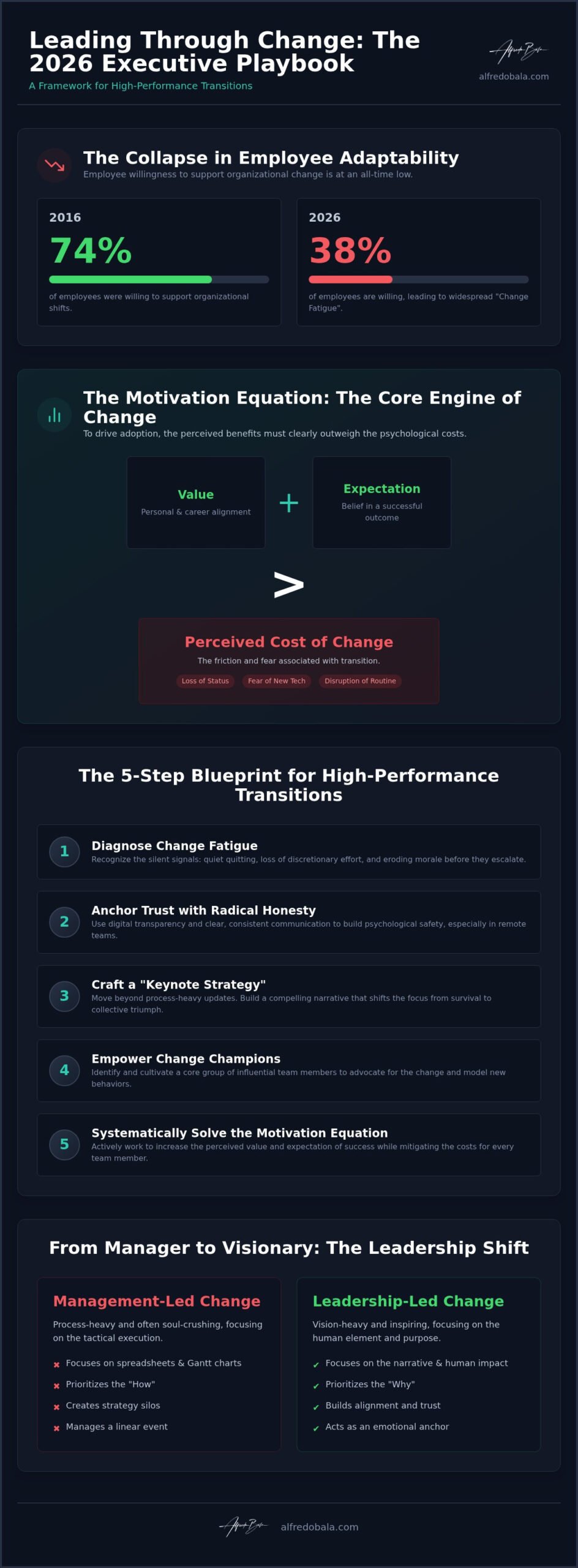
The 5-Step Blueprint for Leading High-Performance Transitions
Mastering how to lead a team through organizational change requires a tactical sequence, not a frantic reaction. It begins with Step 1: Relationship Anchoring. Before you announce a single structural pivot, you must reaffirm the trust that exists between you and your direct reports. Step 2 involves identifying your Change Champions. In any global organization, roughly 10 percent of the workforce drives the sentiment for the other 90 percent. Find those natural influencers early. Step 3 requires solving the Motivation Equation for every department level, ensuring the value of the future state is clear. Step 4 is Executing with Agility, where you pivot the plan without sacrificing trust. Finally, Step 5 is Celebrating Small Wins to build a culture of winning.
Step 1 & 2: Building the Foundation
Audit your current standing before you speak. Are you leading from a place of positional authority or genuine influence? Influence is the only currency that retains its value during a crisis. Before the official rollout, engage in a “Listen First” exercise. Sit with your departmental heads and ask what keeps them awake at night regarding the company’s new direction. This isn’t just a courtesy; it’s a strategic intelligence-gathering mission. By identifying the natural influencers within your ranks, you create a network of catalysts who will champion the vision when you aren’t in the room.
Step 3 & 4: The Execution Phase
Once the foundation is set, you must move into the mechanics of retention and agility. You can effectively apply team retention strategies for network marketing to a corporate environment. The principles of keeping a volunteer workforce engaged are identical to keeping high-salaried talent loyal during a period of high friction. You must define “Agile Leadership” as the discipline to stick to the vision while remaining flexible on the path. Operational Resilience in 2026 is the ability to absorb systemic shocks while maintaining high-velocity output. It’s about listening to the front lines and adjusting the sails without losing sight of the shore.
Don’t wait for the two-year transformation to be complete to acknowledge success. High-performance cultures are built on the momentum of frequent, visible victories. If you’re ready to transform your executive approach and drive lasting impact, explore my leadership and team development insights to elevate your organization’s performance today.
From Manager to Visionary: Elevating Your Leadership Legacy
Elevate your perspective beyond the immediate friction of a transition. While many struggle with the mechanics of how to lead a team through organizational change, the visionary executive recognizes a transition as a crucible for their professional legacy. In 2026, the distinction between a manager and a leader has never been sharper. You aren’t just overseeing a process; you are architecting a culture that thrives on evolution. This requires stepping into the role of “Chief Motivation Officer,” a position that demands as much emotional intelligence as it does strategic acumen. The goal is no longer to return to a state of “normal” but to build an organization that views disruption as its primary competitive advantage.
Building a “Change-Ready” culture is the ultimate executive achievement. It means your team no longer fears the unknown because their identity is rooted in their collective ability to adapt. You achieve this by consistently rewarding curiosity and resilience over mere compliance. When your staff begins to anticipate shifts rather than reacting to them, you have successfully solved the equation of human performance. This cultural shift ensures that the momentum you build today becomes the foundation for every future success your organization achieves.
Executive Advisory and Board-Level Vision
Presenting progress to the board requires a blend of hard data and infectious confidence. When you step into the boardroom, you must demonstrate how the shift aligns with long-term global growth. This is where the role of a corporate board advisor becomes indispensable. An external advisor provides the unbiased perspective needed to identify internal friction points you might be too close to see. When reporting to the board, move beyond adoption rates. Focus on the preservation of talent and the acceleration of innovation. Prove that how to lead a team through organizational change is a science of human capital management that has expanded the company’s capacity for future growth.
Bringing the Keynote Energy Home
Sometimes, an internal reset requires an external spark to break through the weight of change fatigue. A professional leadership speaker for corporate events can provide the psychological shift your team needs to break through stagnation. By bringing a seasoned perspective to your global town halls or executive retreats, you validate the struggle while pointing clearly toward the summit. I invite you to bring this “Keynote Energy” directly to your organization. Together, we can apply the principles of The Motivation Equation to ensure your team doesn’t just endure the pivot but leads it. Master the Equation, master the change, and secure your place as a visionary for the next era of business.
Architecting the Future of Your Organization
The blueprint for 2026 is clear: organizational transformation is no longer a disruption to be managed, but a strategic opportunity to be seized. Success requires you to move beyond tactical execution and embrace the role of a visionary guide. By applying The Motivation Equation, you ensure that the value of the future always outweighs the cost of the transition. You’ve learned that how to lead a team through organizational change involves more than just spreadsheets; it demands a deep commitment to psychological safety, transparent influence, and the empowerment of change champions.
As a veteran CEO with over 40 years of global leadership experience, I’ve navigated these complex professional landscapes across international borders. I’ve seen firsthand how the right framework can turn resistance into high-performance momentum. It’s time to elevate your impact and secure your leadership legacy. Bring Alfredo Bala’s Visionary Leadership to Your Next Event and discover how to scale your team with precision and purpose. The future belongs to those who lead with clarity and heart. You have the tools; now, go lead the evolution.
Frequently Asked Questions
How do I identify the first signs of change fatigue in my team?
Look for “heavy silence” in strategy sessions and a noticeable decline in discretionary effort. In 2026, research indicates that employee willingness to embrace change has plummeted to 38 percent. Watch for a drop in participation during town halls and an increase in “quiet quitting” behaviors. When your top performers stop challenging new ideas and start simply nodding, they’ve likely reached their cognitive and emotional limit for new initiatives.
What is the most common mistake leaders make during organizational change?
Over-communicating the technical “what” while neglecting the psychological “why” is the most frequent executive error. Leaders often assume that providing a dense project roadmap is the same as building genuine buy-in. Without a strategic narrative, employees view the shift as a burden rather than an opportunity. This lack of context creates a vacuum where fear and misinformation thrive, leading to the talent attrition and morale issues discussed earlier.
How can I motivate a team through a change that I didn’t personally initiate?
Own the vision as if it were your own while remaining radically honest about the challenges. You don’t need to have authored the strategy to lead its execution with conviction. Focus on finding the alignment between new corporate goals and your team’s individual growth paths. By applying the principles of how to lead a team through organizational change, you become the bridge that translates high-level mandates into meaningful success stories.
Can The Motivation Equation be applied to remote or hybrid teams?
Yes, the formula is even more critical for decentralized workforces where digital transparency is the primary currency of trust. In remote settings, the “Cost of Change” often includes increased feelings of isolation or technical friction. You must intentionally increase the “Value” and “Expectation” variables through virtual town halls and frequent micro-feedback loops. This ensures every global team member feels anchored to the vision despite the physical distance between offices.
How do I handle “toxic resistors” who actively fight the new strategy?
Distinguish between honest skeptics and those who are actively sabotaging the culture. Honest skeptics often become your best change champions once their concerns are addressed with data. Toxic resistors, however, require swift executive action to prevent their sentiment from infecting the broader team. If a team member remains committed to undermining the strategy after clear coaching, you must prioritize the health of the organization and the success of the transition.
How long does it typically take for a team to fully adapt to a major shift?
Adaptation cycles vary based on scale, but most global organizations require six to eighteen months for full cultural integration. Initial operational adoption might happen quickly, but true psychological alignment takes longer. You’ll know you’ve succeeded when the new behaviors become the “default” state rather than a conscious effort. Patience is a strategic asset; rushing the human element of change often results in long-term structural weakness and recurring friction.
What metrics should an executive use to track the success of a cultural change?
Track the delta between adoption speed and employee retention rates. Key indicators include the percentage of change champions active across departments and the frequency of small wins reported in feedback channels. Executives in 2026 also monitor sentiment analysis data from internal communications. These metrics provide a quantifiable view of how to lead a team through organizational change effectively, moving beyond gut feelings into the realm of data-driven leadership.
How can a keynote speaker help facilitate organizational change?
A keynote speaker acts as a psychological catalyst, breaking through the inertia of change fatigue with an external perspective. By bringing in a veteran voice, you validate your team’s struggles while re-energizing their commitment to the future. This energy serves as a high-impact reset, helping global teams align with a singular vision. It turns a cold corporate directive into an inspiring narrative of collective triumph and personal mastery that resonates across all levels.
 ES
ES  EN
EN
Comentarios recientes