
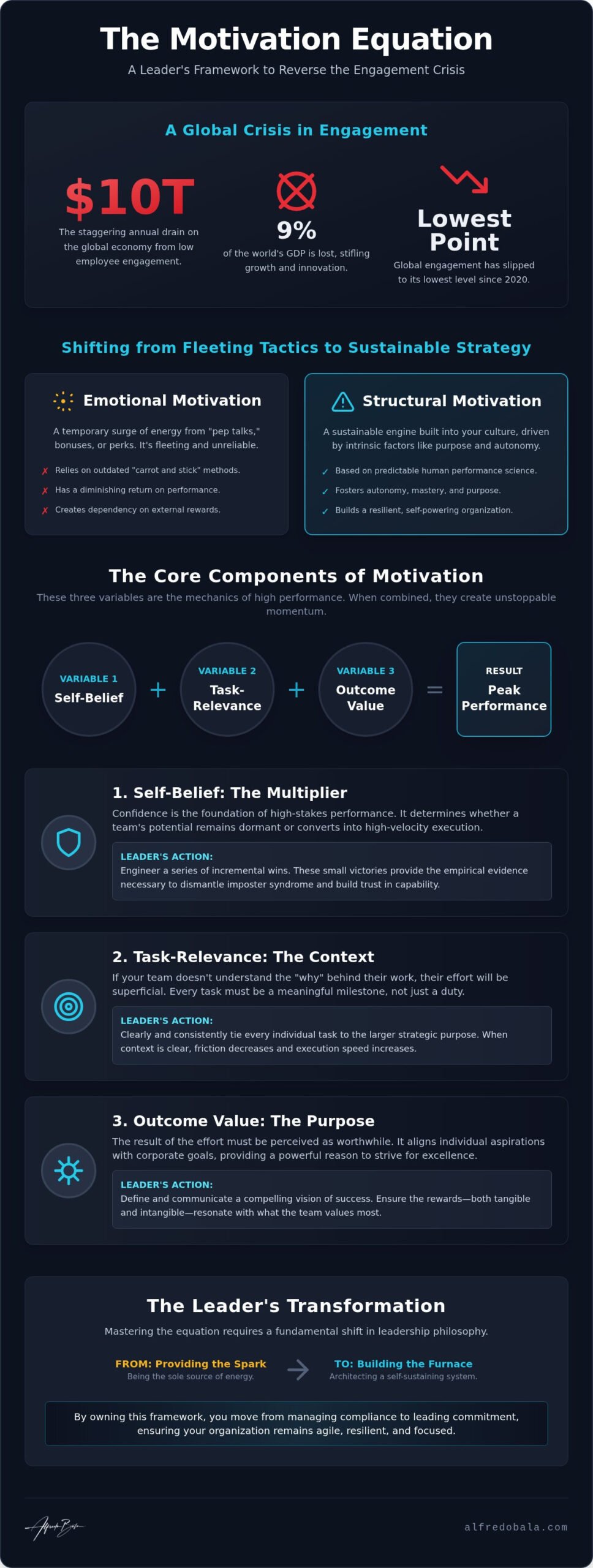
Low employee engagement is currently draining a staggering $10 trillion from the global economy, which represents nearly 9% of the world’s GDP. If you feel exhausted from being the sole “spark” for your team, you aren’t alone. Global engagement has slipped to its lowest level since 2020, making it vital to implement The Motivation Equation for leaders to reverse these trends. It’s a heavy burden to carry when you’re expected to drive results while your team’s energy seems stuck in neutral.
Leadership shouldn’t feel like a constant uphill battle against apathy. This article provides the precise strategic framework used by global executives to drive engagement and peak performance across diverse teams. This isn’t about abstract theory; it’s a grounded science built on decades of hard-won wisdom in the boardroom. We’ll break down the mechanics of this formula to help you reduce execution friction, align your organization across global time zones, and build a culture where motivation is a built-in feature rather than a fleeting feeling.
Key Takeaways
- Learn how to move beyond temporary fixes by mastering The Motivation Equation for leaders, a predictable framework designed for high-stakes human performance.
- Identify the core components of the equation, including the “Self-Belief” factor, to build genuine confidence and precision within your team.
- Shift your leadership style from reactive tactics to a sustainable “Growth Culture” that eliminates the need for constant micromanagement.
- Understand how to adapt these strategic variables for global, remote, and hybrid teams to maintain high performance across different cultural contexts.
- Utilize a step-by-step roadmap to audit your current team’s engagement and implement these methodologies in your next board meeting or leadership summit.
Understanding the Motivation Equation for Leaders: Beyond the Carrot and Stick
Stop relying on the outdated mechanics of the carrot and the stick. In a professional landscape where autonomy is the new currency, traditional incentives are no longer enough to sustain high performance. The Motivation Equation for leaders serves as a strategic tool for predictable human performance, moving beyond the guesswork of “pep talks” and annual bonuses. Alfredo Bala views motivation as both a disciplined science and a nuanced art; it requires the precision of a mathematician and the empathy of a mentor.
There is a vital distinction between emotional motivation and structural motivation. Emotional motivation is fleeting; it’s the temporary surge of energy following a keynote or a successful quarter. Structural motivation is sustainable. It’s the engine built into your organizational culture that keeps teams moving when the initial excitement fades. By mastering this equation, you shift from being the person who provides the spark to the architect who builds the furnace.
The Shift from Extrinsic to Intrinsic Leadership
Financial bonuses and office perks have a diminishing ROI on actual performance. While fair compensation is a baseline requirement, it rarely drives the discretionary effort needed for global scaling. You must understand the foundational Work motivation theories that prioritize autonomy, mastery, and purpose. Modern professionals don’t just want to be managed; they want to be part of a mission that matters. A manager monitors tasks to ensure compliance, but a leader inspires growth by aligning individual aspirations with corporate goals. This shift requires you to stop looking at spreadsheets and start looking at the human drivers behind the data.
Why Leaders Must Own the Equation
Motivation leakage is a silent killer in high-growth organizations. It happens when the vision at the top loses its clarity and intensity as it filters down to the front lines. When you fail to apply a consistent framework, you create a gap between your high-level strategy and your daily execution. Mastering The Motivation Equation for leaders bridges this gap, ensuring that every team member understands their value and the specific path to success. This level of alignment is critical as you refine your Executive Leadership Development Strategies for Global Growth in 2026. By owning the equation, you ensure that your organization remains agile, resilient, and focused, regardless of the external economic climate.
The Core Components: Mastering the Mechanics of Human Performance
Execution is never an accident. It’s the result of a precise calculation where three variables intersect: Self-Belief, Task-Relevance, and Outcome Value. Alfredo Bala’s framework transforms the abstract concept of “team spirit” into a measurable, repeatable strategy. When you apply The Motivation Equation for leaders, you stop guessing why certain teams stall and start diagnosing the specific variable that requires your attention. It’s about moving the needle from compliance to commitment by addressing the psychological needs of your high-performers.
Building Unshakeable Self-Belief
Confidence is the foundation of all high-stakes performance. Many high-potential leaders struggle with imposter syndrome, a silent drag on productivity that prevents bold decision-making. You can dismantle this barrier by engineering a series of incremental wins. These small victories provide the empirical evidence necessary for a team to trust their own capabilities. Self-Belief serves as the critical multiplier in the leadership equation, determining whether a team’s potential remains dormant or converts into high-velocity execution. To deepen your understanding of these dynamics, you can explore Harvard on Team Science, which highlights how collaborative confidence drives innovation.
Task-Relevance acts as the essential context for every action your team takes. If your people don’t understand the “why” behind their work, their effort will be superficial at best. You must ensure that every task is clearly tied to a larger purpose, transforming routine duties into meaningful milestones. When every team member understands their specific role in the broader strategy, friction decreases and execution speed increases.
Establishing Outcome Value
Your team needs to see the horizon, not just the treadmill. Outcome Value is the bridge between the daily grind and the global impact your organization seeks to achieve. If a team member doesn’t see how their specific contribution moves the needle for the board, their engagement will inevitably flag. You must link individual entrepreneurial ambitions directly to the corporate mission. When your vision resonates at every level, from the entry-level associate to the senior VP, you create a self-sustaining loop of high-performance energy. You can see how this fits into The Motivation Equation book, which serves as a masterclass for executives looking to scale their influence. If you’re ready to elevate your team’s output, consider how professional leadership development can sharpen your strategic focus.
Why Traditional Motivation Fails: Shifting from Tactics to Strategy
The most persistent misconception in the boardroom is the belief that motivation is something you “do” to people. Many executives treat engagement like a fuel tank that needs a periodic refill through high-energy pep talks or quarterly bonuses. This approach creates a “Hype Culture,” a cycle of temporary dopamine hits followed by a predictable crash in productivity. True performance doesn’t come from external pressure; it comes from internal alignment. Alfredo Bala’s methodology is built on 40 years of hard-won wisdom, moving from foundational field roles to the highest echelons of global corporate leadership. He recognizes that motivation is not a tactic, it’s a strategic architecture.
Traditional “motivational speakers” often provide a temporary high that vanishes the moment the team returns to their desks. Without a framework to sustain that energy, the investment is wasted. You must transition from reactive “fixes” to a stable “Growth Culture” where performance is a natural byproduct of the system you’ve built. This requires a shift in perspective, viewing human drive as a disciplined science rather than an unpredictable emotion.
The Myth of the ‘Natural’ Self-Starter
Leaders frequently write off underperforming team members by claiming they simply lack the “inner drive” to succeed. This assumption is a strategic failure. Motivation isn’t a fixed personality trait that some possess and others don’t; it’s a state that can be activated through the right environment. When you implement The Motivation Equation for leaders, you gain the ability to “activate” individuals who previously seemed stagnant. By diagnosing which variable is missing, you fulfill your primary responsibility as a leader: creating the conditions for success. As noted in HBR’s Employee Motivation Model, performance is driven by fundamental human needs that must be addressed through structural leadership, not just by hiring “natural” go-getters.
From Reactive to Proactive Engagement
Stop waiting for the results of an annual engagement survey to tell you that your culture is fracturing. Reactive metrics only show you where you’ve already failed. Real-time leadership requires you to use the equation as a diagnostic tool to identify performance bottlenecks before they become organizational crises. If execution is slow, the equation helps you pinpoint whether the issue is a lack of confidence, a lack of relevance, or a lack of perceived value. This proactive stance is essential for any keynote speaker for organizational growth who aims to drive lasting strategic impact. By the time a crisis hits, it’s often too late to pivot; the equation allows you to adjust your trajectory in real-time, ensuring your global team remains aligned and energized.
Scaling Motivation: Applying the Framework to Global and Diverse Teams
Scaling a vision across continents requires more than just a translation of terms; it requires a deep understanding of the human variables at play. The Motivation Equation for leaders remains the constant, but the inputs must be calibrated for cultural nuances. What inspires a team in Dallas might not resonate with a workforce in Tokyo or London. As an executive, your challenge is to maintain the integrity of the framework while allowing for the local flexibility that drives genuine engagement.
Setting this tone starts at the highest levels of governance. A corporate board advisor plays a pivotal role in ensuring that global growth is paired with a culture of sustainable performance. They provide the oversight necessary to keep “Outcome Value” consistent, even when teams are separated by thousands of miles. For the “1%”—those top performers who drive the majority of your results—the equation shifts toward legacy and influence. These individuals don’t just work for a paycheck; they work for the complexity of the challenge and the scale of the impact.
Leading Across Borders and Time Zones
Communication rhythms must be intentional in a hybrid world. In remote environments, “Task-Relevance” is often the first variable to suffer. Without frequent alignment, team members begin to feel like cogs in a machine they don’t understand. Alfredo’s experience scaling international network marketing teams since the 1980s proves that consistency is the antidote to distance. You must establish a cadence that reinforces the “why” across every time zone, ensuring that no one feels isolated from the core mission. This isn’t just about Zoom calls; it’s about creating a shared language of success that transcends borders.
Retention Strategies for High-Performance Teams
High-pressure environments often lead to motivation leakage and eventual burnout. Retention is the ultimate metric of a balanced Motivation Equation. If your top talent is leaving, your variables are out of sync. By applying proven team retention strategies for network marketing and corporate structures alike, you can stabilize your workforce. When people see a clear path to mastery and feel their contributions are valued, they stay. If you’re ready to scale your influence globally, book Alfredo Bala for your next international summit to learn how to build a resilient, high-performance culture.
Implementing the Motivation Equation: Your Roadmap to High-Impact Leadership
Execution is the ultimate test of leadership. You’ve explored the variables; now you must apply them with the precision of an executive strategist. The Motivation Equation for leaders isn’t a passive concept to be filed away; it’s a living diagnostic tool that should be integrated into every high-level briefing and strategic summit. By auditing your team’s current state against these specific variables, you move from hope-based management to results-driven leadership. Your role is to act as the bridge between your organization’s lofty ambitions and the tangible achievements of your workforce.
Leadership is a disciplined science that requires constant calibration. As you scale, the friction within your teams will naturally increase unless you have a framework to neutralize it. This roadmap isn’t just about improving morale; it’s about engineering a culture where peak performance is the standard. It’s time to stop being the spark for everyone else and start building the systems that allow your team to ignite themselves.
The Executive Audit: Assessing Your Variables
Start with a radical audit of your direct reports. Ask questions that cut through corporate jargon: “Can you describe how this specific project impacts our 2026 growth targets?” or “On a scale of one to ten, how confident are you that we’ve provided the tools necessary for this win?” If a team member cannot articulate the relevance of their task, you’ve identified a leak in your performance engine. In the mathematics of human performance, a zero in any single variable, whether it’s belief, relevance, or value, reduces the entire motivational output to nothing. Identifying this “Zero Multiplier” effect allows you to intervene with surgical precision rather than wasting resources on broad, ineffective incentives.
Next Steps for Visionary Leaders
Transformation at scale requires more than a single internal memo; it demands a commitment to continuous strategic mastery. Integrating these principles into your next board meeting or global summit can redefine your organization’s trajectory. If you’re looking for a leadership speaker for corporate events, bringing a veteran perspective to your stage can provide the catalyst your executive team needs. Securing your copy of “The Motivation Equation” will provide the deeper strategic mastery required to navigate complex global markets. Master the equation, and you master the future of your organization.
Step into the Future of High-Performance Leadership
Success in a global market isn’t a matter of chance; it’s a matter of architecture. By shifting from reactive tactics to a sustainable growth culture, you’ve taken the first step toward reclaiming your energy and your team’s potential. Remember that motivation is a disciplined science. When you align self-belief with clear task-relevance and high outcome value, you create an unstoppable engine for execution. Mastering The Motivation Equation for leaders allows you to diagnose friction before it becomes a crisis, ensuring your organization remains agile and focused.
Alfredo Bala draws from over 40 years of global executive experience to provide this roadmap. Having served as the CEO of a multi-million dollar global entity and currently acting as an advisor to corporate boards worldwide, he offers hard-won wisdom that bridges the gap between ambition and achievement. Don’t leave your team’s performance to fate. It’s time to implement a framework that delivers predictable results across every time zone. Order ‘The Motivation Equation’ and start transforming your leadership today. Your team is waiting for the vision only you can provide.
Frequently Asked Questions
What is the basic formula for the Motivation Equation in leadership?
The core formula is built on the intersection of three critical variables: Self-Belief, Task-Relevance, and Outcome Value. These factors work together to determine the total motivational output of an individual or team. If any single variable drops to zero, the entire equation fails, regardless of how high the other numbers are. This mathematical approach allows you to move beyond guesswork and apply a structured framework to human performance.
How does the Motivation Equation differ from traditional employee engagement?
Traditional engagement is often treated as a reactive metric gathered from annual surveys, while The Motivation Equation for leaders is a proactive strategic tool. Instead of simply measuring how happy or satisfied people are, this framework focuses on the mechanics of performance and drive. It allows you to diagnose the specific root causes of stagnation in real-time, moving the focus from HR data points to actionable leadership adjustments that produce predictable results.
Can the Motivation Equation be used to manage underperforming employees?
This framework is an exceptional diagnostic tool for managing underperformance. When a team member isn’t meeting expectations, you can use the equation to identify exactly where the disconnect lies. Is it a lack of confidence in their own abilities, a failure to see the relevance of the task, or a perceived lack of value in the outcome? Pinpointing the specific “zero” allows you to provide targeted mentorship rather than applying broad, ineffective solutions.
How do I apply the Motivation Equation to a remote or global team?
Applying the equation to global teams requires intentional calibration of the Task-Relevance and Outcome Value variables across different cultural contexts. In a hybrid or remote environment, communication rhythms must be prioritized to ensure that the vision doesn’t get lost in translation. You must maintain a steady cadence of alignment to keep every member connected to the mission, ensuring that distance doesn’t lead to isolation or a drop in perceived value.
Why is self-belief considered a ‘multiplier’ in Alfredo Bala’s framework?
Self-belief acts as a multiplier because it dictates the ceiling of a team’s potential. Even if a task is highly relevant and the outcome is incredibly valuable, a lack of confidence will paralyze execution. In Alfredo Bala’s framework, self-belief transforms dormant capability into high-velocity action. Without it, the other variables cannot reach their full power, making it the most critical foundational element for any leader aiming to scale a global organization.
How often should a leader audit their team’s Motivation Equation?
You should treat the Motivation Equation as a continuous diagnostic tool rather than a one-time event. While a deep audit is effective during quarterly reviews or leadership summits, the principles should be applied during every high-level briefing and one-on-one meeting. Real-time leadership requires you to stay attuned to shifts in your team’s energy, allowing you to make surgical adjustments to the variables before performance bottlenecks turn into organizational crises.
Does the Motivation Equation replace financial incentives like bonuses?
The Motivation Equation for leaders doesn’t replace financial incentives; it provides the structural context that makes them effective. Bonuses and perks are baseline extrinsic motivators, but they often have a diminishing ROI in high-autonomy environments. The equation focuses on the intrinsic and relational drivers, such as mastery and purpose, that sustain performance after the initial excitement of a bonus fades. It ensures that your financial investments are supported by a solid foundation of engagement.
What is the first step for a leader who wants to implement this equation?
The first step is to perform a radical audit of your current team’s variables. Start by asking direct reports specific questions to gauge their understanding of task relevance and their confidence in the tools provided. Identifying the “Zero Multiplier” in your current structure is essential for moving forward. Once you’ve diagnosed the primary leak in your motivation engine, you can begin applying targeted strategies from Alfredo Bala’s literature to stabilize and scale your team’s performance.
 ES
ES  EN
EN
Comentarios recientes