
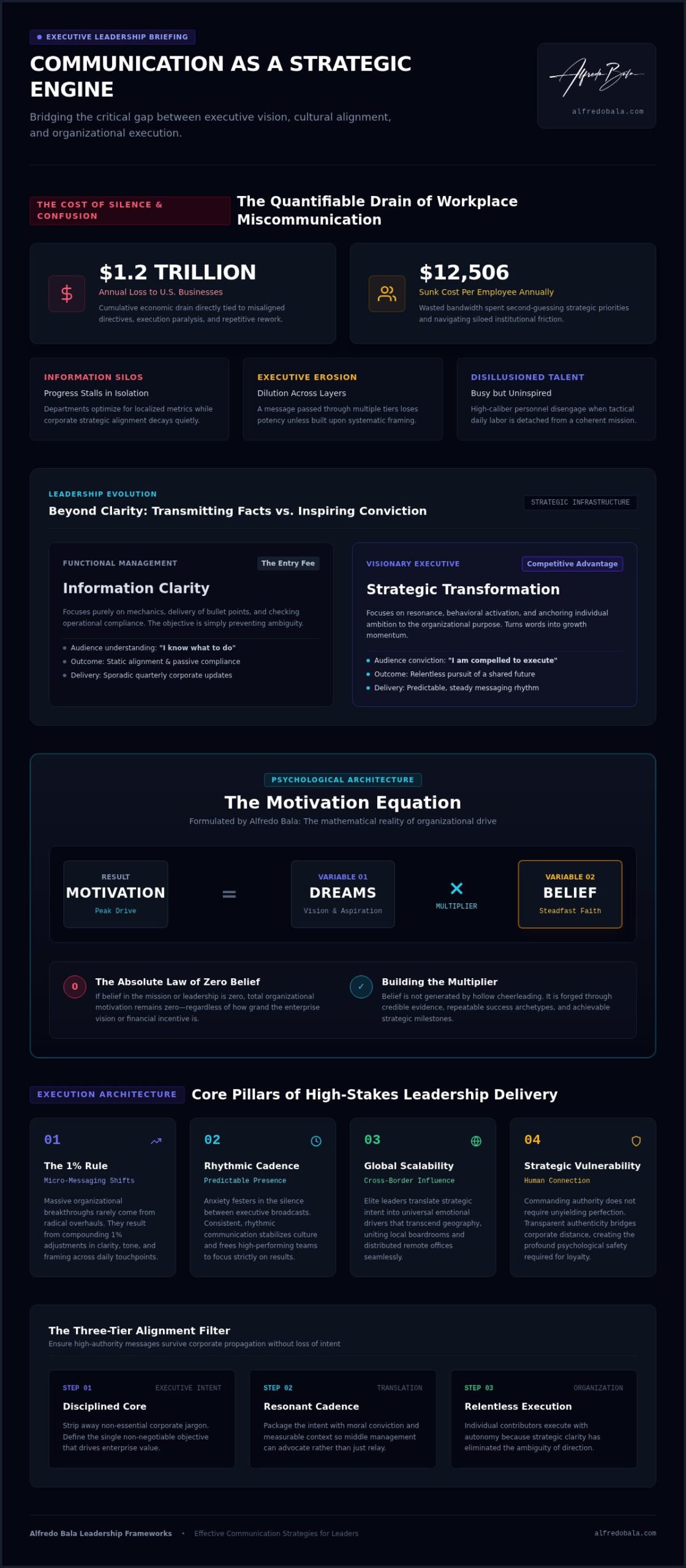
Workplace miscommunication costs U.S. businesses $1.2 trillion every year, which translates to over $12,500 lost per employee. This isn’t just a budget leak; it’s a failure of leadership presence. You’ve likely seen the symptoms: information silos that stall progress and teams that remain busy but uninspired. Mastering effective communication strategies for leaders is the only way to bridge the gap between corporate strategy and individual execution. It’s the difference between a team that follows orders and one that pursues a shared vision with relentless intensity.
You deserve to lead an organization where strategic alignment is crystal clear, even across global borders. This article provides the high-authority frameworks used by elite executives to command respect, build trust, and scale high-performance cultures. We’ll explore how to apply the Motivation Equation to your daily interactions, transforming your words into a precision tool for growth. By the end of this guide, you’ll have the roadmap to increase retention and inspire the kind of action that defines a legacy.
Key Takeaways
- Transform communication from a basic transmission of facts into a strategic engine that aligns your executive vision with organizational execution.
- Leverage the Motivation Equation to catalyze peak performance by multiplying individual dreams by a steadfast belief in the mission.
- Apply effective communication strategies for leaders like the “1% Rule” to identify the subtle messaging shifts that yield high-impact organizational results.
- Learn to scale influence across diverse global markets by utilizing a universal language of motivation that resonates from local boardrooms to international remote offices.
- Embrace strategic vulnerability to bridge the gap between high-level strategy and human connection, fostering the deep trust required to command any room.
Beyond Clarity: Why Communication is the Strategic Engine of Leadership
Stop viewing communication as a soft skill. It’s the hard infrastructure of your business. Leadership communication acts as the vital bridge between executive vision and organizational execution. Without this bridge, your most brilliant strategies are nothing more than static documents. They won’t move people, and they certainly won’t move markets. Your role as a leader is to ensure that your intent doesn’t just reach the team but resonates within them.
Most managers aim for clarity. That’s a mistake because clarity is merely the bare minimum. It’s the entry fee, not the goal. True effective communication strategies for leaders focus on transformation rather than just information. If your team simply understands what you said, you’ve informed them. If they feel compelled to act on it with precision, you’ve led them. This distinction is what separates a functional manager from a visionary executive.
Leadership has a rhythm. It isn’t found in a single, quarterly broadcast but in the steady cadence of consistent messaging. This rhythm builds institutional trust. When your communication is predictable and aligned with your actions, you eliminate the anxiety that breeds in the silence between updates. You create a stable environment where high-performance teams can focus on results instead of second-guessing the direction of the ship.
Think of your communication as a tool for scaling, not just managing. As your organization grows, you can’t be in every room or on every Zoom call. Your communication frameworks must be robust enough to carry your influence into every corner of the company. It’s about creating a ripple effect where your core message remains intact regardless of how many layers it passes through.
The Cost of Communication Breakdowns
Misalignment is a silent profit killer. Research shows that workplace miscommunication costs U.S. businesses an estimated $1.2 trillion annually. This translates to roughly $12,506 lost per employee every year due to wasted time and botched execution. When messages are muddled, your authority erodes. Information silos begin to form, and your best talent becomes frustrated by the lack of direction. Strategic Communication is the disciplined alignment of intent, message, and outcome.
Communication as a Competitive Advantage
Elite leaders use messaging to outpace competitors in rapid markets. When you can pivot an entire global organization through a single, resonant message, you possess a superpower. This requires a sophisticated grasp of cross-cultural communication to ensure your vision remains potent across diverse geographic offices. Building a resilient culture that survives market volatility depends on these executive leadership development strategies. It’s the art of turning your words into a science of growth.
The Motivation Equation in Action: Communicating for Peak Performance
Motivation isn’t a random spark. It’s a predictable psychological outcome. Alfredo Bala (The Motivation Guy)’s “The Motivation Equation” defines it clearly: Motivation equals Dreams multiplied by Belief. If your team’s belief in the mission is zero, your total motivation remains at zero, no matter how grand the dream is. Your words and presence are the primary variables in this equation. They determine whether your vision becomes a reality or remains a distant aspiration.
Mastering this requires understanding that communication is both a disciplined science and a nuanced art. The science lies in the repeatable methodology of your messaging; the art is in the empathetic delivery. When you speak, your verbal and non-verbal cues work together to either fuel or dampen the team’s drive. High-authority effective communication strategies for leaders involve more than just picking the right words. It’s about the tone, the posture, and the moral conviction behind every statement you make.
The Variable of Belief: Inspiring Confidence
Belief is the multiplier of potential. During periods of market volatility, your team looks to you to validate their certainty. You don’t build belief through hollow cheerleading. You build it through narrative and evidence. Use “success story” archetypes to highlight where the organization has triumphed before and explain why those wins are repeatable. Ground your vision in a roadmap that feels achievable. As detailed in The Motivation Equation book, the leader’s primary job is to expand an individual’s dream and then provide the belief required to execute it. Research from the Center for Creative Leadership suggests that communication strategies for leaders must prioritize authenticity to foster this level of psychological safety and commitment.
The Variable of Urgency: Driving Immediate Action
Speed is a competitive advantage. To drive action, your messaging must create productive urgency rather than panic. Panic freezes a team and leads to errors; productive urgency focuses them and builds momentum. By mastering effective communication strategies for leaders, you can use action-oriented imperatives to open your directives. Tell the team exactly what the next move is and why it matters right now. This creates a rhythmic cadence that carries teams through complex projects without causing burnout. It’s the delicate balance of executive gravitas and motivational energy that keeps a global organization moving forward. If you’re ready to refine these skills, exploring proven leadership and team development insights can provide the tactical edge you need to scale.
5 Effective Communication Strategies for High-Stakes Leadership
Command the room before you even speak. High-stakes leadership requires a sophisticated toolkit that goes far beyond generic public speaking tips. To drive a global organization, you must master effective communication strategies for leaders that prioritize precision over volume. These strategies aren’t just about what you say; they’re about the strategic architecture of your delivery in moments where the stakes are highest.
- Strategic Vulnerability: Share a calculated moment of human struggle. When an executive reveals a hard-won lesson from a past failure, it doesn’t diminish authority; it builds a bridge of trust that makes your vision more relatable.
- The 1% Rule in Messaging: Focus on the tiny nuances. A subtle shift in how you frame a challenge can move a team from defensive hesitation to aggressive problem-solving. It’s the art of the “micro-pivot” in your vocabulary.
- Active Facilitation: Move beyond passive listening. Orchestrate the dialogue in the room by drawing out dissenting voices and synthesizing complex arguments into a single, actionable path forward.
- Non-Verbal Authority: Own the physical space. Whether it’s a town hall or a digital broadcast, your “Keynote Presence”-your posture, eye contact, and use of silence-communicates certainty long before you finish your first sentence.
- The Feedback Loop: Implement radical transparency. Create a culture where psychological safety is the norm, allowing for a rapid flow of information that prevents small issues from becoming organizational crises.
Mastering the Boardroom Presence
Influence starts at the top. For corporate board advisors, the challenge is communicating complex global data with absolute simplicity. You must distill massive datasets into clear strategic choices without losing the nuance of the risk involved. This requires a level of executive gravitas that projects confidence even during high-stakes negotiations. Developing these essential leadership communication skills ensures that your voice carries weight when the board is making the most critical decisions for the company’s future.
Leading Through Difficult Conversations
Deliver the truth without losing the heart of the team. When you have to provide tough feedback, use a framework that separates the performance from the person. Start with the “Success Story” archetype by reminding them of their potential, then pivot quickly to the specific solution needed to close the gap. This transition from a problem-focused discussion to a solution-oriented one maintains loyalty and keeps the momentum high, even during organizational setbacks. It’s about preserving the belief variable of the Motivation Equation when it’s under the most pressure.
Scaling Influence: Communicating Across Diverse Global Cultures
Expand your vision beyond your local borders. Scaling influence across diverse global cultures is the ultimate test of an executive’s agility. In markets like China and Southeast Asia, effective communication strategies for leaders must account for high-context nuances where what is left unsaid is often as important as the spoken word. You aren’t just translating a message; you’re transposing a vision into a different cultural frequency. This requires a deep understanding of local values and an ability to listen for the subtle shifts in sentiment that precede organizational change.
The “Universal Language of Motivation” serves as your foundation. While work ethics and social norms fluctuate, the human desire for achievement and purpose remains constant. To scale effectively, you must adapt the variables of the Motivation Equation to fit the local landscape. In some cultures, “Belief” is forged through collective harmony and historical stability; in others, it’s driven by individual disruption and rapid innovation. Your task is to maintain a consistent executive brand voice while granting local leaders the flexibility to frame that voice in a way that resonates with their specific teams. It’s a disciplined science of alignment and a nuanced art of adaptation.
Lessons from the 1% Rule in Global Markets
Focus on the micro-adjustments that yield macro results. In emerging markets, the 1% Rule in messaging involves identifying the specific cultural “belief triggers” that inspire action. Instead of relying on generic corporate directives, use local success stories that mirror the lived experience of your international workforce. This approach is central to team retention strategies for network marketing, where personal connection and shared triumphs are the primary drivers of growth. Small, culturally sensitive shifts in your communication can be the difference between a stalled market entry and a viral expansion.
Communicating with Remote and Hybrid Teams
Maintain your presence across every digital touchpoint. Delivering gravitas through Zoom or Slack requires a deliberate focus on “The Pulse,” which is a consistent rhythm of high-impact communication that keeps remote teams aligned. Don’t let your message get lost in the noise of asynchronous work. Use short, high-energy video messages to bridge the gap between high-level strategy and front-line execution. This direct line of sight from the C-suite to the field builds trust and ensures that everyone, regardless of their time zone, feels the momentum of the mission. If you’re ready to master these cross-border dynamics, explore my leadership and team development insights to start scaling your global impact today.
Mastering Leadership Communication with Alfredo Bala
Alfredo Bala stands as a veteran who has navigated every level of the corporate hierarchy. He doesn’t offer abstract concepts. He shares hard-won wisdom from 45 years in the global field. From factory floor beginnings to serving as a CEO of a NASDAQ-listed organization, he understands the deep mechanics of influence. Mastering effective communication strategies for leaders requires this level of real-world perspective. When you work with a mentor who has successfully scaled teams in over 65 countries, you move beyond basic clarity. You enter a higher level of strategic power.
Executive advisory and board placement can fundamentally transform a company’s strategic voice. It’s about more than just governance. It’s about injecting a seasoned perspective into the very top of the organization. This ensures that the executive vision isn’t just seen; it’s felt throughout the entire corporate structure. Alfredo’s experience as a board advisor allows him to guide leaders through the complexities of global growth, ensuring their message remains potent across diverse markets and cultures. He bridges the gap between high-level corporate strategy and the individual drive needed for execution.
The Path to Executive Mastery
Apply the Motivation Equation to your daily routine. This isn’t just for town halls. It’s for every email, every one-on-one meeting, and every board report you deliver. The transformation begins when you stop being a manager who simply distributes information. You must become a visionary who ignites belief. By focusing on the “Dreams” and “Belief” variables, you shift the organizational culture from compliance to commitment. True leadership communication is the bridge from ‘what is’ to ‘what can be’.
Next Steps: Books, Speaking, and Advisory
Reset your organizational voice. Sometimes, a team needs a professional catalyst to break through communication plateaus. Engaging a leadership speaker for corporate events provides that necessary spark to realign your executive team. Beyond the stage, Alfredo offers strategic advisory services that transform how a company speaks to its stakeholders. You can implement the Motivation Equation framework today to see immediate shifts in team urgency and alignment. To elevate your organization’s presence and drive peak performance, Book Alfredo Bala for your next corporate event.
Command the Future of Your Organization
Your voice is the most potent tool in your executive arsenal. We’ve explored how effective communication strategies for leaders move beyond mere clarity to become the strategic engine of organizational growth. By mastering the Motivation Equation and adapting your message for global resonance, you bridge the gap between abstract vision and high-performance execution. True influence isn’t about talking more; it’s about speaking with the precision that ignites belief and inspires immediate action across every time zone.
Alfredo Bala brings over 40 years of global executive experience to help you navigate these complex landscapes. As the author of the groundbreaking book “The Motivation Equation” and a veteran who has scaled multi-billion dollar organizations, he provides the roadmap for your leadership elevation. It’s time to transition from a manager who directs to a leader who commands the room with authority and heart. Empower your leadership team with Alfredo Bala’s insights and begin your journey toward global impact today. Your legacy is built one resonant message at a time.
Frequently Asked Questions
What are the three most important communication skills for a leader?
The three most critical skills for an executive are radical clarity, contextual framing, and active listening. Clarity ensures that your directives aren’t lost in corporate jargon. Contextual framing answers the “why” before the “what,” which aligns the team’s purpose with the organization’s goals. Active listening creates the psychological safety required for a high-performance culture. Mastering these skills allows you to implement effective communication strategies for leaders that drive measurable results.
How can I improve my communication with a diverse, global team?
Improving global communication requires you to shift from simple information cascading to trust brokering. You must adapt your directness and tone based on whether a culture is high-context or low-context. Successful global leaders use cross-cultural micro-targeting, which means adjusting their delivery to preserve psychological safety across different local markets. This ensures your vision remains potent whether you are speaking to a boardroom in China or a remote office in Southeast Asia.
What is the ‘Motivation Equation’ and how does it relate to communication?
The Motivation Equation is a proprietary framework where Motivation equals Dreams multiplied by Belief. It relates to communication because your words are the primary tools used to expand an individual’s dreams and solidify their belief in the mission. If your communication fails to build belief, motivation stays at zero regardless of the size of the dream. Using this equation transforms your messaging into a disciplined science of human performance and organizational scaling.
How do I communicate effectively during a corporate crisis?
During a crisis, you must prioritize radical transparency and rapid response times. Leaders who wait for perfect information often lose the trust of their stakeholders. You should communicate what you know, what you don’t know, and the specific steps being taken to resolve the issue. This approach projects certainty during volatility, preventing panic from setting in. It’s about maintaining executive gravitas while showing the human side of the leadership team.
Why is non-verbal communication so critical for executive leaders?
Non-verbal communication is critical because it establishes your “Keynote Presence” long before you finish a sentence. Your posture, eye contact, and even your use of silence communicate authority and certainty to your audience. Research suggests that employees place a premium on authentic human empathy and vocal inflection from their leaders. When your non-verbal cues align with your spoken words, you build the deep institutional trust required to lead through complex professional landscapes.
How can a keynote speaker help improve our organization’s communication?
A professional keynote speaker acts as a strategic catalyst to reset your organization’s communication rhythm. They provide a fresh, high-authority perspective that can break through internal information silos and re-energize a stagnant team. By introducing frameworks like the Motivation Equation, a speaker helps your leadership team move from abstract theory to real-world application. This external voice often provides the necessary gravitas to drive a permanent shift in how your company communicates its vision.
What is the difference between a motivational speaker and a leadership consultant?
A motivational speaker provides the infectious energy and emotional spark needed to inspire immediate action. A leadership consultant builds the long-term systems and methodologies required for sustained growth. Alfredo Bala blends these roles by acting as a motivational mentor who also provides deep strategic advisory. He offers the hard-won wisdom of a veteran executive to help you implement effective communication strategies for leaders that scale high-performance teams globally.
How do I balance authority and empathy in my messaging?
Balancing authority and empathy requires a blend of executive gravitas and strategic vulnerability. You must set high, uncompromising expectations for performance while acknowledging the human challenges your team faces. This is achieved by framing directives as a shared journey toward a “Success Story” archetype. When you show that you are personally invested in your team’s elevation, your authority is seen as a supportive guide rather than a rigid command structure.
 ES
ES  EN
EN
Comentarios recientes