
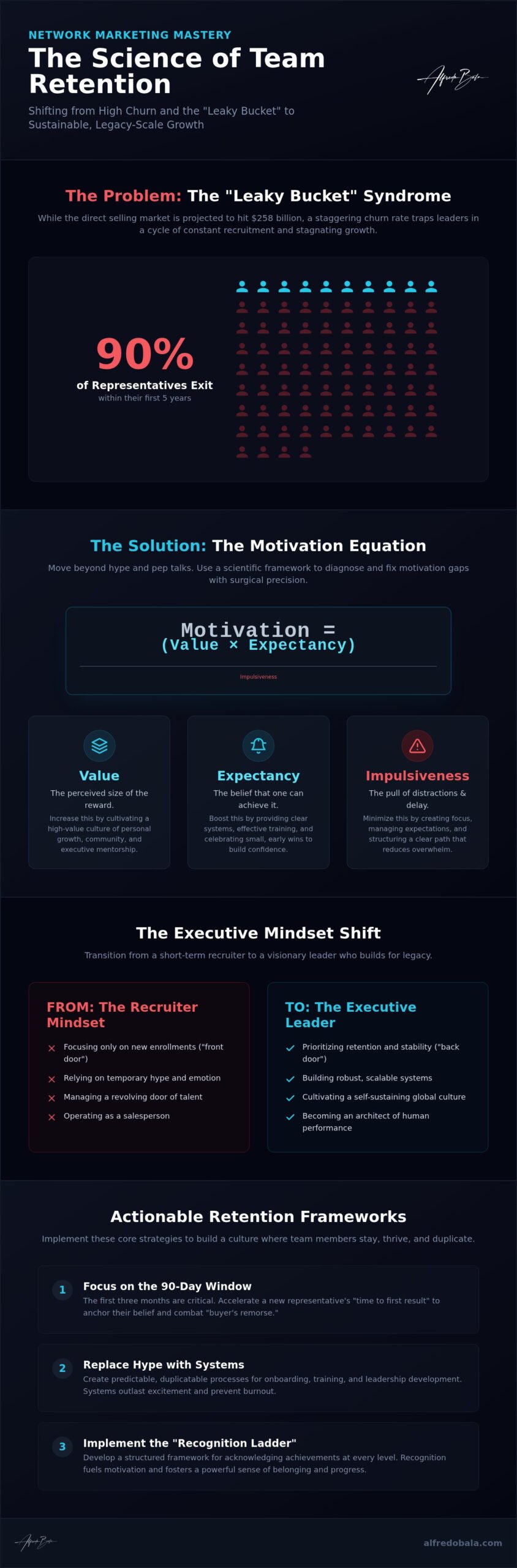
Did you know that while the global direct selling market is climbing toward $258 billion in 2026, roughly 90% of representatives still exit the business within five years? This staggering churn rate isn’t just a statistic; it’s the primary barrier between you and a legacy-scale organization. Most leaders find themselves trapped in a “leaky bucket” cycle, where the adrenaline of new recruitment is quickly drained by the exhaustion of high turnover. If you’re tired of managing plateaus instead of progress, it’s time to shift your focus toward sophisticated team retention strategies for network marketing that prioritize long-term stability over short-term hype.
I understand the frustration of watching promising talent walk out the door. You’ve built the foundation, but the structure won’t hold without a framework rooted in motivation science and executive discipline. This article provides the high-level methodologies required to stop the revolving door and transform your culture into a self-sustaining powerhouse. We’ll examine the Motivation Equation and the strategic shifts needed to transition from a high-volume recruiter to a global executive leader. You’ll discover a predictable system to keep your distributors engaged and your growth trajectory permanent.
Key Takeaways
- Stop the “leaky bucket” syndrome by treating retention as the ultimate metric of leadership health and long-term residual stability.
- Deploy the Motivation Equation to scientifically address the psychological drivers that keep team members focused, productive, and loyal.
- Replace temporary hype with robust, systems-based leadership that maintains high performance without causing emotional exhaustion.
- Leverage advanced team retention strategies for network marketing to cultivate a global culture through the “Recognition Ladder” framework.
- Adopt an executive-level mindset to transition from a recruiter to a visionary leader capable of managing a self-sustaining, global organization.
Why Retention is the True Measure of Leadership in Network Marketing
Retention is the ultimate health check for any organization. While many leaders obsess over the “front door” of recruitment, the most seasoned professionals know that long-term success is decided by the “back door.” A foundational understanding the network marketing model reveals that while recruitment drives initial momentum, it is retention that builds lasting wealth. If your organization suffers from the “leaky bucket” phenomenon, you aren’t building a business; you’re simply managing a revolving door. For every new distributor who joins, another exits, causing your growth to plateau and your residual income to remain stagnant.
Stop measuring your success solely by new enrollments and start evaluating the stability of your downline. Transitioning from a “Recruiting-First” mindset to a “Retention-First” philosophy marks your evolution into an Executive Networker. This type of leader doesn’t just chase the next bonus. They build for legacy. By implementing sophisticated team retention strategies for network marketing, you move beyond the frantic energy of the startup phase and into the disciplined precision of global leadership. You aren’t just a salesperson; you’re an architect of human performance.
The Cost of Churn: Beyond the Financial Loss
High turnover creates a toxic environment that extends far beyond a smaller commission check. When team members witness a constant stream of departures, social proof erodes, replaced by a creeping sense of doubt. This “sinking ship” mentality can paralyze even your most dedicated producers. For the leader, churn is an immense energy drain. Constantly teaching the basics to new recruits prevents you from moving into high-impact coaching and strategic development. Over time, high attrition damages your personal brand reputation, making it harder to attract high-caliber talent who value stability and proven results.
The 90-Day Retention Window
The first three months of a distributor’s journey are the most volatile. This 90-day window is where the battle for loyalty is won or lost. During this period, new representatives are highly susceptible to psychological triggers like “buyer’s remorse” or the social friction of rejection. If they don’t experience a tangible win or a sense of belonging quickly, they will quietly disappear. Effective team retention strategies for network marketing focus on accelerating the “time to first result” to anchor the distributor to the vision. The distributor lifecycle is a strategic roadmap that identifies each phase of a representative’s journey, from the initial spark of interest to the mastery of global leadership.
The Motivation Equation: A Scientific Approach to Team Loyalty
Motivation is not a mystical force that arrives by chance; it is a disciplined science. To master team retention strategies for network marketing, you must move beyond temporary pep talks and adopt a structured framework. Alfredo Bala (The Motivation Guy)’s Motivation Equation serves as the definitive manual for this transition. It allows you to diagnose exactly why a distributor’s engagement is flagging by analyzing three critical variables: Value, Expectancy, and Impulsiveness. When you understand these mechanics, you stop guessing and start leading with surgical precision. You can identify if a “motivation gap” exists because the reward feels too small, the path feels too difficult, or the distractions are simply too loud.
The equation functions as a balance. Value represents the perceived reward of the business, while Expectancy is the distributor’s belief that they can actually achieve that reward. These two factors are divided by Impulsiveness, which measures how easily a person is pulled away by short-term gratification or external noise. By mastering these variables, you create a culture of loyalty that isn’t dependent on the next corporate promotion. You build a foundation where distributors stay because the internal logic of the business makes sense, not just because they’re caught up in a moment of excitement.
Balancing Value and Expectancy
Increasing the perceived value of your organization goes far beyond the physical products you sell. It involves cultivating a high-value culture where personal growth, community, and executive mentorship are the primary draws. Adapting successful retention marketing strategies from the corporate world requires you to manage expectations from day one. If a new recruit expects instant wealth but lacks the skills to achieve it, their Expectancy will plummet, leading to early exit. A seasoned leader balances the big vision with realistic milestones, ensuring that the distributor feels a sense of progress that sustains their commitment for the long haul.
Reducing Impulsiveness and Distraction
The network marketing industry is often plagued by “shiny object syndrome,” where distributors are constantly tempted by the next “ground floor” opportunity. This is a failure of the Impulsiveness variable. To combat this, you must build “blinders” for your team by keeping them anchored to their long-term objectives. Consistency is the antidote to impulsiveness. When you provide a predictable system and a clear roadmap, you reduce the mental friction that leads to distraction. Mastering these variables is the core of Alfredo Bala (The Motivation Guy)’s book, which offers a masterclass in human performance for those ready to lead at an executive level. If you are ready to elevate your organization, exploring the insights at AlfredoBala.com provides the roadmap you need.
Beyond the Hype: Building Systems That Outlast Excitement
Hype is a short-term drug. It provides a momentary spike in adrenaline and activity, but it’s always followed by an inevitable crash. If your leadership style relies on “pumping up” the room, you aren’t leading; you’re just providing temporary entertainment. True team retention strategies for network marketing are built on infrastructure, not just inspiration. While charisma might attract a crowd, it is the strength of your systems that keeps them there when the initial excitement fades. You must transition from a “Charismatic Leader” who is the center of all activity to a “Strategic Advisor” who designs the environment where others can succeed independently. Applying executive strategies for motivating a network marketing team helps you make this critical shift from being the sole energy source to becoming the architect of a self-sustaining culture.
High-retention teams rely on three essential systems: a predictable communication cadence, a scalable training curriculum, and a behavior-based recognition framework. These systems create a sense of safety and professional progress. They also ensure your organization remains compliant and sustainable. When you review the FTC guidance on MLMs, it’s clear that long-term viability requires a focus on actual product movement and ethical business practices. Systems-based leadership ensures that your team stays focused on these core activities rather than getting lost in the “noise” of temporary promotions or emotional peaks.
Transactional vs. Transformational Leadership
There is a massive difference between leading for a check and leading for a change. Transactional leadership is based on a simple exchange: “If you do X, I will give you Y.” While this works in traditional sales environments, it’s insufficient for building a legacy-scale organization. Transformational leadership focuses on the personal evolution of the distributor. When people feel that they are becoming better versions of themselves under your guidance, their loyalty becomes deep-rooted. Transactional relationships fail in direct sales models because the moment the financial reward feels difficult to achieve, the distributor has no emotional anchor to keep them in the business.
Onboarding Systems That Stick
The “Fast Start” approach often prioritizes speed over comprehension, leading to high burnout. An Executive Networker favors a “Sustainable Start.” This involves a structured onboarding process that balances immediate activity with deep skill acquisition. You can automate much of this training process to ensure consistency across a global downline without losing the human touch that builds trust. Implementing executive leadership development strategies allows you to scale these systems across multiple time zones and languages. By focusing on competence rather than just speed, you ensure that new recruits feel capable and confident, which is the ultimate driver of retention.
Strategic Frameworks for Cultivating a Global Retention Culture
Building a culture that thrives across time zones requires more than a shared product line; it demands a shared identity. In a remote, digital-first industry, distributors can easily feel like isolated numbers on a spreadsheet. To counter this, your team retention strategies for network marketing must prioritize a deep sense of belonging that transcends geography and language. You aren’t just managing a sales force. You’re cultivating a global tribe. This starts with creating a unified vision that feels personal to every member, whether they are in a skyscraper in Dubai or a home office in London. When people feel they belong to something significant, they are far less likely to abandon it for the next temporary opportunity.
The “Recognition Ladder” is a critical tool in this cultural architecture. Most leaders only reward results, such as rank advancements or high sales volumes. While important, this ignores the foundational behaviors that lead to those results. An Executive Networker rewards the process. By recognizing consistency, personal development, and mentorship efforts, you anchor distributors to the business before they’ve reached the highest echelons of the pay plan. Leveraging keynote speaker insights for organizational growth helps unify these disparate teams under a single, powerful narrative. High-impact communication ensures that your strategic vision is broadcast with clarity and conviction, cementing the loyalty of your global organization.
The Power of Community and Shared Vision
Tribal loyalty is the ultimate defense against churn. When your organization feels like a community rather than a corporation, retention rates naturally climb. Annual events and regional meetings serve as the “glue” for this community, providing the social proof and emotional connection that digital interactions often lack. Maintaining this culture during rapid international expansion requires intentionality. You must empower local leaders to adapt the culture to their specific customs while remaining anchored to the core values of the global organization. This balance ensures that your team feels connected to a worldwide movement while receiving the localized support they need to succeed.
Leadership Development as a Retention Tool
People stay where they grow. If a distributor feels that their skills have plateaued, they will look elsewhere for their next challenge. By positioning leadership development as a primary benefit of your organization, you create an environment where staying is synonymous with evolving. Create a clear “Leadership Path” that offers ongoing education for top earners, keeping them engaged and challenged long after they’ve reached financial stability. Mentoring the mentors is the highest form of leadership. It ensures that your culture is self-sustaining and that your team retention strategies for network marketing are being duplicated at every level of the downline. Investing in leadership training for network marketing leaders gives your top producers the executive frameworks they need to develop leaders who lead other leaders. If you are ready to implement these high-level frameworks, discover more at AlfredoBala.com.
Elevating Your Organization Through Executive-Level Strategy
Elevate your perspective beyond the daily grind of recruitment. To build a multi-generational organization, you must adopt the mindset of a corporate board advisor. This involves shifting from tactical management to strategic governance. Most leaders fail to scale because they remain stuck in the “hustle” phase, micro-managing individual distributors instead of architecting global systems. High-impact coaching is the lever that breaks through growth plateaus. When you invest in professional development and keynote training, you aren’t just buying information; you’re acquiring the gravitas and precision required to lead thousands. Retention is the silent foundation of every legacy business. Without it, you’re building on sand.
The most successful leaders I’ve mentored understand that team retention strategies for network marketing are a form of risk management. By stabilizing your downline, you protect your most valuable asset: human capital. Transitioning to this executive-level strategy requires a willingness to audit your own leadership flaws and replace emotional reactions with data-driven frameworks. This is how you move from being a top earner to becoming an industry icon whose influence is felt across continents. It’s about building a structure that operates with excellence even when you aren’t in the room.
Implementing the Motivation Equation Today
Start by conducting a rigorous audit of your team’s current retention health. Look past the total enrollment numbers and analyze the activity levels of distributors in their second and third months. Introduce the Motivation Equation to your core leadership group as a diagnostic tool. Teach them to identify whether a lack of production stems from low perceived value, poor expectancy, or high impulsiveness. The long-term ROI of a retention-focused strategy is exponential; a 5% increase in retention can lead to a massive surge in long-term residual profitability. Stop guessing why people leave and start using science to make them stay.
Partnering with a Visionary Guide
Global scale requires global perspective. Alfredo Bala’s advisory services provide top earners with the executive insights needed to navigate complex international markets and cultural nuances. A professional keynote address does more than just motivate; it realigns the entire organization’s belief system and reinforces the strategic vision. When selecting a leadership speaker for corporate events, you need a veteran who delivers battle-tested frameworks rather than temporary inspiration. When you partner with a veteran who has navigated these professional landscapes for over 40 years, you gain a roadmap based on real-world application rather than abstract theory. You’ve built the momentum; now it’s time to build the legacy. Master the science of motivation with Alfredo Bala and secure the future of your organization today.
Secure Your Legacy Through Strategic Retention
You now possess the frameworks to transition from a high-volume recruiter to a visionary architect of human performance. By applying the Motivation Equation and shifting toward systems-based leadership, you’ve moved beyond the “leaky bucket” cycle that stalls so many organizations. Building a global culture requires more than enthusiasm; it requires the disciplined application of team retention strategies for network marketing that prioritize human value and operational excellence. When you focus on development rather than just distribution, your team’s loyalty becomes unbreakable.
With over 40 years of direct sales leadership, including my tenure as the CEO of Mannatech Inc. and my ongoing global board advisory experience, I’ve seen that the difference between a temporary bonus and a lasting legacy is the stability of your downline. It’s time to stop managing plateaus and start engineering growth. Take the next step in your professional evolution and master these variables with a proven roadmap.
Order “The Motivation Equation” and Master the Art of Retention at alfredobala.com today. Your organization is ready for its next chapter, and you have the tools to lead it there.
Frequently Asked Questions
What is the #1 reason people quit network marketing?
The primary reason for turnover is the gap between expectations and reality. Many distributors enter the industry with a “lottery” mindset rather than a business perspective. When they encounter initial rejection or realize success requires disciplined skill acquisition, their motivation collapses. Without a structured framework to manage these early psychological hurdles, they exit before they can experience a tangible win.
How does the Motivation Equation help with team retention?
The Motivation Equation provides a diagnostic lens to see exactly where a distributor’s commitment is failing. By breaking down motivation into Value, Expectancy, and Impulsiveness, you can identify if a team member feels the reward isn’t worth the effort or if they simply don’t believe they can achieve the goal. This scientific approach allows you to apply surgical leadership interventions instead of generic pep talks.
Can you really automate retention in a people-based business?
You can’t automate relationships, but you can automate the systems that foster them. By standardizing your onboarding, communication cadences, and training modules, you ensure every distributor receives a consistent experience. Implementing these automated team retention strategies for network marketing allows you to scale your leadership presence across global time zones without sacrificing the human touch that builds deep-rooted loyalty.
What is the difference between motivation and hype in leadership?
Motivation is an internal, sustainable drive rooted in purpose and competence. Hype is an external, temporary emotional spike that lacks a strategic foundation. While hype might spark a weekend of high activity, it’s always followed by a retention valley. True leaders focus on building systems that empower distributors to succeed through skill, creating a sense of achievement that outlasts any temporary excitement.
How do I identify a “leaky bucket” in my downline early?
The earliest sign of a “leaky bucket” is a decline in engagement during the critical first 90 days. Monitor metrics like meeting attendance, training completion rates, and initial product movement. If a new recruit’s activity drops off after their first two weeks, it’s a clear indicator of a motivation gap. Identifying these patterns early allows you to intervene with targeted coaching before they quietly disappear.
Is it possible to recover a team with high churn rates?
Recovery is possible, but it requires a fundamental shift from a “recruiting-first” to a “retention-first” culture. You must stop the bleeding by auditing your current systems and replacing hype with high-impact training. By re-engaging your core leadership group with the Motivation Equation, you can rebuild the foundation of your organization and transform a high-churn environment into a stable, legacy-scale business.
How often should I recognize my team members for retention?
Recognition should be a consistent, weekly practice that rewards behaviors, not just results. While rank advancements are important, acknowledging small wins like a first presentation or a consistent training streak builds the “Recognition Ladder.” This frequent validation reinforces positive habits that lead to long-term success. It keeps distributors anchored to the community and their own personal growth trajectory.
What role does corporate leadership play in field retention?
Corporate leadership provides the strategic governance and operational stability that allow field leaders to thrive. By ensuring product excellence, ethical compliance, and a reliable commission structure, the corporate office creates a safe environment for growth. When corporate and field leaders align on team retention strategies for network marketing, the result is a self-sustaining ecosystem where distributors feel secure enough to build for the long term.
 ES
ES  EN
EN
Comentarios recientes