
Talent is a commodity; the true currency of the 2026 economy is the psychological architecture of the team itself. You’ve likely felt the frustration of hiring the best in the industry only to watch performance plateau or see your top performers leave for competitors. It’s a common struggle to bridge the gap between individual brilliance and collective execution, especially when fragmented communication and hybrid silos begin to erode your culture. You deserve a system that turns these challenges into a competitive advantage.
Building high performance teams is a disciplined science that requires more than just a recruiter’s eye; it demands a master framework where motivation meets strategic alignment. This article promises to hand you that blueprint. You’ll learn how to transform a group of talented individuals into a world-class engine using a repeatable system for excellence. We’ll dive into the Motivation Equation and provide a definitive executive readiness checklist to ensure your leadership is prepared for the high-stakes demands of the coming year.
Key Takeaways
- Learn why the “talent trap” prevents elite groups from reaching their potential and how to foster synergy instead of ego.
- Apply the Motivation Equation—Value, Expectancy, and Impulse Control—to create a psychological framework for long-term engagement.
- Implement a two-phase readiness checklist focused on foundational trust and the mechanical precision of role clarity for building high performance teams.
- Navigate the complexities of global leadership by establishing a unified organizational DNA that transcends cultural and geographical boundaries.
- Understand the strategic value of external advisory and leadership insights in identifying the blind spots that stall executive progress.
Beyond Talent: Why Most Teams Fail to Reach High Performance
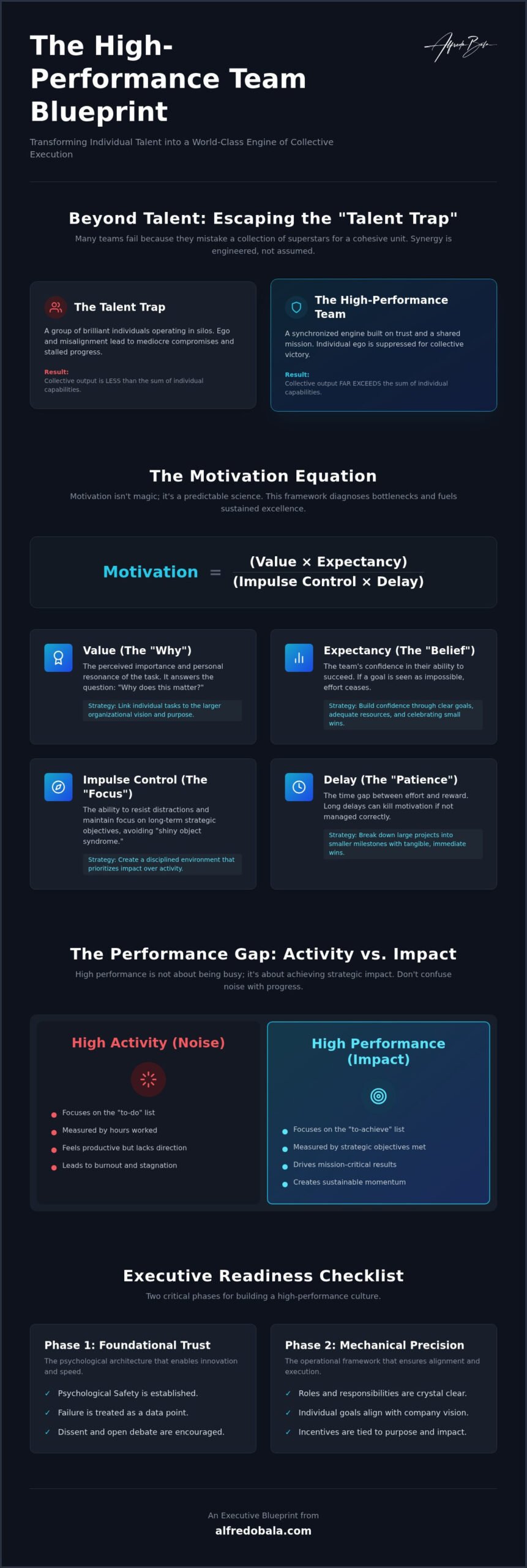
High performance is the rare synergy where collective output far exceeds the sum of individual capabilities. It’s a world-class engine where every piston fires in perfect sequence. Yet, many executives fall into the “Talent Trap.” They recruit superstars, pay top dollar, and then wonder why the group underperforms. The answer is often ego and misalignment. When you have a room full of “the best,” they often spend more energy defending their territory than driving the mission forward.
You’ve likely seen it in your own boardrooms. A group of brilliant minds enters a meeting, yet they leave with a mediocre compromise. This happens because talent without a framework is just potential energy. It lacks direction. Building high performance teams isn’t about collecting the most expensive parts; it’s about the architecture that connects them. You need a system that suppresses individual ego in favor of collective victory.
We must also distinguish between high activity and true performance. In a corporate setting, teams can be busy for 60 hours a week without moving the needle on strategic objectives. High activity is noise; high performance is impact. High activity focuses on the “to-do” list, while high performance focuses on the “to-achieve” list. The High Performance Gap is the distance between your team’s raw potential and its actual execution.
The Psychological Safety Floor
Google’s Project Aristotle remains a cornerstone for leadership in 2026 because it proved that the “who” matters less than how the team interacts. Building high performance teams requires a foundation of psychological safety. If your culture rewards silence or punishes dissent, you’re killing innovation before it starts. A “silence culture” is an expensive tax on speed and agility. You need an environment where failure is treated as a data point for improvement, not a reason for termination. When people feel safe to take risks, they provide the insights that lead to breakthroughs.
The Problem with Traditional Incentives
Financial rewards are a baseline, not a driver of peak performance. Money might get people in the door, but it won’t keep them engaged when the pressure mounts. We’re seeing a massive shift toward purpose-driven work. People want to know their labor matters. To bridge this, you must link individual goals to a larger keynote speaker organizational growth vision. When the vision is clear, motivation becomes intrinsic. It’s the difference between someone working for a paycheck and someone working to build a legacy. True excellence comes when an employee’s personal “why” aligns with the company’s “how.”
The Motivation Equation: The Science of Sustained Excellence
Motivation isn’t a nebulous cloud of “feeling good.” It is a calculated output. Alfredo Bala, known globally as “The Motivation Guy,” has spent decades refining a proprietary framework that treats human drive as a predictable science. This is the Motivation Equation. When you are building high performance teams, you can’t rely on luck or charismatic speeches. You need a formula that accounts for the psychological friction that slows down even the most talented groups.
The equation balances four critical variables: Value, Expectancy, Impulse Control, and Delay. Value is the perceived importance of the task. Expectancy is the team’s belief that they can actually succeed. Impulse Control is the ability to stay focused on the mission despite distractions. Delay is the time between effort and reward. If any of these are out of alignment, motivation craters. By breaking down human behavior into these components, leaders can diagnose performance bottlenecks in real-time rather than waiting for a quarterly review to reveal a problem.
Mastering the Variables of Influence
To drive results, you must first increase the “Value” of the mission for every team member. This isn’t just about the bottom line; it’s about personal resonance. Next, you must build “Expectancy.” If a team believes a goal is impossible, they won’t just work slower; they’ll stop trying. Finally, you must manage “Delay.” In 2026, global projects often span months or years. Keeping motivation high during these long stretches requires breaking down the vision into immediate, tangible wins that satisfy the brain’s need for progress. This methodical approach is essential for building high performance teams that don’t burn out before the finish line.
From Theory to Boardroom
This isn’t just for the front lines. The equation applies directly to C-suite alignment and board advisory. When leadership teams are misaligned, it’s usually because their “Value” or “Expectancy” variables are mismatched. By using this framework, you can move from abstract conflict to concrete solutions. It provides a roadmap for how to build motivated teams that stay the course through market volatility. The Motivation Equation serves as a precise diagnostic tool for executives, allowing them to pinpoint whether a performance drop stems from a lack of perceived value or a breakdown in expectancy.
If you want to master these mechanics and drive strategic impact, exploring the full depth of The Motivation Equation is the next step for any serious leader.
The High Performance Team Checklist: Evaluating Your Organization
Execution is where strategy goes to live or die. While the Motivation Equation provides the psychological blueprint, the Executive Readiness Checklist provides the structural integrity needed to sustain it. Building high performance teams requires a transition from abstract leadership concepts to a rigorous audit of your organizational architecture. This process isn’t a one-time event; it’s a continuous calibration that ensures every gear in your corporate engine is aligned for the 2026 market demands.
We break this audit into four distinct phases. Phase 1 establishes the Foundation through trust and a shared vision. Phase 2 focuses on Mechanics, ensuring role clarity and decision rights are indisputable. Phase 3 addresses Dynamics, managing the friction of conflict and feedback. Finally, Phase 4 targets Growth, securing your legacy through succession planning and skill development. If you skip a phase, the entire structure becomes unstable under pressure.
The Foundation Audit
The foundation is the psychological soil in which your team grows. Without it, even the most expensive talent will eventually wither or depart. Audit your foundation with these three critical questions:
- Does every member know the “Why” behind the 2026 strategy? If your team can’t articulate how their daily labor contributes to the global vision, you have a value leakage that will drain motivation.
- Is there a formal process for “radical candor” and feedback? High performance requires truth at high speeds. You need a system that encourages directness without the fear of political retribution.
- Do team members trust leadership to have their backs during crises? Trust isn’t built in the boardroom; it’s forged in the trenches. If your people don’t feel safe, they won’t take the risks necessary for innovation.
The Mechanics and Dynamics Audit
Once the foundation is set, you must optimize the daily mechanics of how work actually gets done. Building high performance teams often fails at this stage because roles remain blurry or recognition is absent. Use this audit to refine your team’s operational rhythm:
- Are roles defined by outcomes rather than just tasks? In a world-class team, individuals are responsible for results, not just a list of to-do items. This shift in mindset creates a culture of ownership.
- Is there a “Recognition Rhythm” that celebrates small wins? Don’t wait for the annual review to acknowledge excellence. A consistent cadence of recognition keeps the “Expectancy” variable of the Motivation Equation high.
- Does the team have a framework for healthy conflict management? Conflict is inevitable in high-stakes environments. The difference between a stagnant team and an elite one is a repeatable system for resolving disagreements and moving forward.
This checklist serves as your diagnostic mirror. It’s often uncomfortable to look into, but it’s the only way to identify the fractures in your organization before they become catastrophic failures. When you master these phases, you move from managing a group to leading an engine of sustained excellence. Leaders who want to go deeper on measurement should also explore the team performance metrics for leaders that translate this checklist into quantifiable, data-driven results.
Navigating the Global Shift: Managing High Performance Across Borders
The global landscape of 2026 demands a leadership style that is as fluid as the markets it serves. Building high performance teams in a single zip code is a challenge; doing so across continents, time zones, and cultural divides is a masterclass in influence. In industries like global network marketing and direct sales, where teams are decentralized and often voluntary, the traditional “command and control” model collapses. You cannot rely on physical proximity to maintain standards. You must rely on a unified organizational DNA that remains consistent whether a team member is in Dallas, Dubai, or Delhi.
Achieving this level of international scale requires sophisticated executive leadership development strategies. It’s about moving beyond mere management and into the realm of strategic movement-building. Technology provides the infrastructure, but it’s the human touch that provides the fuel. While Zoom and Slack keep us connected, they don’t necessarily keep us aligned. High performance across borders is the result of a deliberate effort to translate your core vision into local contexts without losing the essence of the mission.
Scaling Culture in Decentralized Teams
Performance standards often erode in remote and hybrid environments because the “connective tissue” of the office is gone. To counter this, elite leaders implement the “1% Rule” for global excellence. This involves making small, incremental adjustments to communication and reporting cadences that yield massive cumulative impact across thousands of representatives. One highly effective method for maintaining this alignment is establishing a The Motivation Equation book study group for your global leads. When your top-tier executives speak the same psychological language, the trickle-down effect on the rest of the organization is transformative.
The Executive Guide to Global Influence
Adapting the Motivation Equation for different global markets is not just a suggestion; it’s a requirement for survival. What drives “Value” in a North American market might not resonate in Southeast Asia. You must understand the local nuances of “Expectancy” and “Delay” to keep your international teams engaged. In a “High-Tech” world, global teams are starving for “High-Touch” leadership. They need to feel the presence and conviction of their leaders through the screen. Successful international expansion hinges on the leader’s ability to weave local cultural nuances into the fabric of a universal performance framework without diluting the core mission.
If you’re ready to bridge the gap between global potential and local execution, it’s time to partner with a seasoned global mentor who has lived this journey.
The Visionary Leader’s Path: Partnering for Organizational Transformation
Self-diagnosis is the ultimate executive challenge. It’s nearly impossible to see the cracks in your own foundation while you’re standing on top of it. You might recognize the symptoms, such as high turnover or stagnant growth, but identifying the precise variable in the Motivation Equation that has failed requires a level of objectivity few internal teams possess. This is where the value of an external perspective becomes undeniable. Building high performance teams isn’t just a management task; it’s an architectural feat that often requires a master builder from outside your immediate ecosystem to identify the blind spots you’ve grown accustomed to.
Transitioning from a manager of tasks to a leader of movements is the hallmark of the visionary. While a manager ensures the checklist is completed, a leader ensures the team is emotionally and strategically invested in the “Why.” Partnering with a seasoned veteran like “The Motivation Guy” allows you to break through the organizational plateaus that have historically held your company back. It turns your executive readiness from a theoretical plan into a practical, high-velocity reality. You aren’t just hiring a consultant; you’re engaging a mentor who has transitioned from the foundational levels of industry to its highest echelons.
The Power of a Keynote Intervention
A high-impact presentation can do more than just inspire; it can reset your entire team culture in a single day. A keynote intervention serves as a strategic “hard reset,” aligning every member of the organization around the 2026 vision simultaneously. It moves your people from the “Checklist” phase to a living, breathing performance culture where excellence is the default, not the exception. Engaging Alfredo Bala for keynote speaking or board advisory provides your leadership with the hard-won wisdom of a former global CEO who has navigated these exact waters. It’s the difference between reading about leadership and witnessing its mechanics in action.
Your Next Steps for 2026
Transformation begins with a single, decisive action. Don’t let this checklist become another document gathering digital dust. Building high performance teams requires a commitment to the long game. Follow this timeline to ensure your organization is ready for the challenges ahead:
- Immediate action: Conduct the Foundation Audit with your core team to identify gaps in trust and shared vision.
- Medium-term: Integrate the Motivation Equation into your quarterly reviews to move from subjective feedback to data-driven performance analysis.
- Long-term: Invest in professional development for your high-potential leaders to ensure a robust succession pipeline.
The roadmap for 2026 is clear, but execution requires courage. By implementing these frameworks and seeking expert guidance, you ensure that your organization doesn’t just survive the shifts of the next few years, but leads them. Your team has the potential; now give them the architecture to achieve it.
Leading Your Team Toward a Legacy of Excellence
The road to 2026 demands more than just a collection of elite talent; it requires a commitment to the architectural precision of the Motivation Equation and the structural integrity of a proven readiness checklist. You’ve seen how the gap between potential and execution can stall even the most ambitious global organizations. Building high performance teams is a disciplined science that transforms these plateaus into launchpads for sustained growth and collective victory. Success in this landscape is about more than just managing tasks. It’s about leading a movement that resonates across borders and cultures.
Alfredo Bala brings over four decades of global leadership experience, dating back to 1980, along with the real-world P&L expertise of a former CEO. As the author of The Motivation Equation, he offers the definitive framework for organizational transformation and executive mastery. It’s time to move beyond the checklist and into a living culture of excellence. Bring the Motivation Equation to your organization with Alfredo Bala and secure your place at the forefront of the new economy. Your vision deserves a world-class engine to carry it forward. The future belongs to those who prepare for it today.
Frequently Asked Questions
How do you build a high-performance team from scratch?
Building high performance teams from the ground up requires a blueprint that prioritizes cultural alignment over raw talent. You must define the mission’s Value and the team’s Expectancy before you even hire your first contributor. By establishing clear decision rights and a shared vision at the start, you prevent the ego-driven silos that often plague new ventures. It’s about engineering the environment for success before the work begins.
What is the most important factor in team performance?
Alignment between individual motivation and organizational vision is the ultimate driver of excellence. Talent is abundant, but the synergy required for a team to exceed its individual parts only exists when everyone is moving toward the same objective. Without this strategic harmony, even the most skilled professionals will work at cross-purposes, leading to wasted energy and missed milestones. It’s the connective tissue that turns a group into an engine.
Can a struggling team be turned into a high-performance one?
You can absolutely transform a struggling group by diagnosing the specific variables causing the friction. Most performance plateaus aren’t due to a lack of ability; they’re caused by a breakdown in the Motivation Equation. By conducting a Foundation Audit and resetting the team’s psychological safety, you can reignite engagement. It requires a hard reset of expectations and a commitment to radical candor from the top down.
How does the Motivation Equation differ from traditional goal setting?
Traditional goal setting focuses on the “what,” while the Motivation Equation addresses the “how” and the “why” of human drive. It accounts for the psychological friction points like Impulse Control and Delay that KPIs often ignore. This framework allows you to calculate the probability of success by looking at the internal mechanics of your team rather than just the external targets. It’s a diagnostic tool, not just a destination.
What are the signs of a dysfunctional “star” team?
High turnover of top talent and a “silence culture” are the primary indicators of a dysfunctional team of superstars. When ego takes precedence over collective output, you’ll notice fragmented communication and a lack of innovation. These teams often look productive on paper but fail to adapt to market shifts because they lack the psychological safety to challenge the status quo. It’s the classic “Talent Trap” where brilliance is isolated rather than integrated.
How often should a team revisit their performance checklist?
Revisit your executive readiness checklist at least once a quarter to ensure your organizational architecture remains sound. Markets move fast, and the variables that drove motivation six months ago may no longer be relevant. Monthly pulse checks on the “Mechanics” phase can help you catch alignment issues before they impact your P&L. Consistent calibration is the only way to maintain a world-class engine in a volatile global economy.
Is psychological safety more important than technical skill?
Technical skill is the price of admission, but psychological safety is the multiplier that enables building high performance teams. A group of average technicians who feel safe to innovate will consistently outperform a group of geniuses who are afraid to fail. Without safety, your team’s technical brilliance remains locked in silos. Safety is the floor that allows your team’s skills to reach their ceiling, turning individual expertise into collective impact.
 ES
ES  EN
EN
Comentarios recientes